Exhaust Fan for Laser Enclosure: 3 Ventilation Picks Compared (2026)
Three ventilation fans for laser engraver enclosures and workshops, including compact 80mm and 4-inch axial kits, compared by airflow and fit.

On this page
Top picks at a glance
As an Amazon Associate I earn from qualifying purchases.
- 1
 Best OverallHose Vary 4″ Axial Fan9.6/10View on Amazon
- 2
 Best with WarrantyKEYFANCLUB 80mm Fan9.5/10View on Amazon
- 3
 Best 3-Inch InlinePOLISI3D 3″ Inline Fan9.5/10View on Amazon
- 4
 POLISI3D Powerful 3Inch Duct Fan Ventilation AC Vent BlowerView on Amazon
- 5
 80mm Small 4 Inch Exhaust Fan with DuctView on Amazon
- 6
 3 Inch Inline Duct Fan with Variable Speed Controller & PipeView on Amazon
- 7
 VIVOSUN 4" Metal Inline Fan 100 CFMView on Amazon
- 8
 VIVOSUN 6" Inline Fan 240 CFMView on Amazon
- 9
 VIVOSUN R6 6" Inline FanView on Amazon
An exhaust fan for laser enclosure setups pulls smoke, odor, and airborne resin particles away from your work area and vents them outdoors. Without continuous negative pressure, cutting wood and acrylic quickly clouds the laser cover, settles soot onto focus lenses, and leaks irritating fumes into living spaces. Choosing the right ventilation fan depends on whether you need a compact inline duct blower that connects directly to a desktop cover, a high-CFM wall shutter fan for a laser workshop, or a low-noise 12V axial fan with matching duct flanges.
LaserEngraveHQ earns a commission from purchases made through these links, at no extra cost to you. Read our affiliate disclosure.
Quick picks
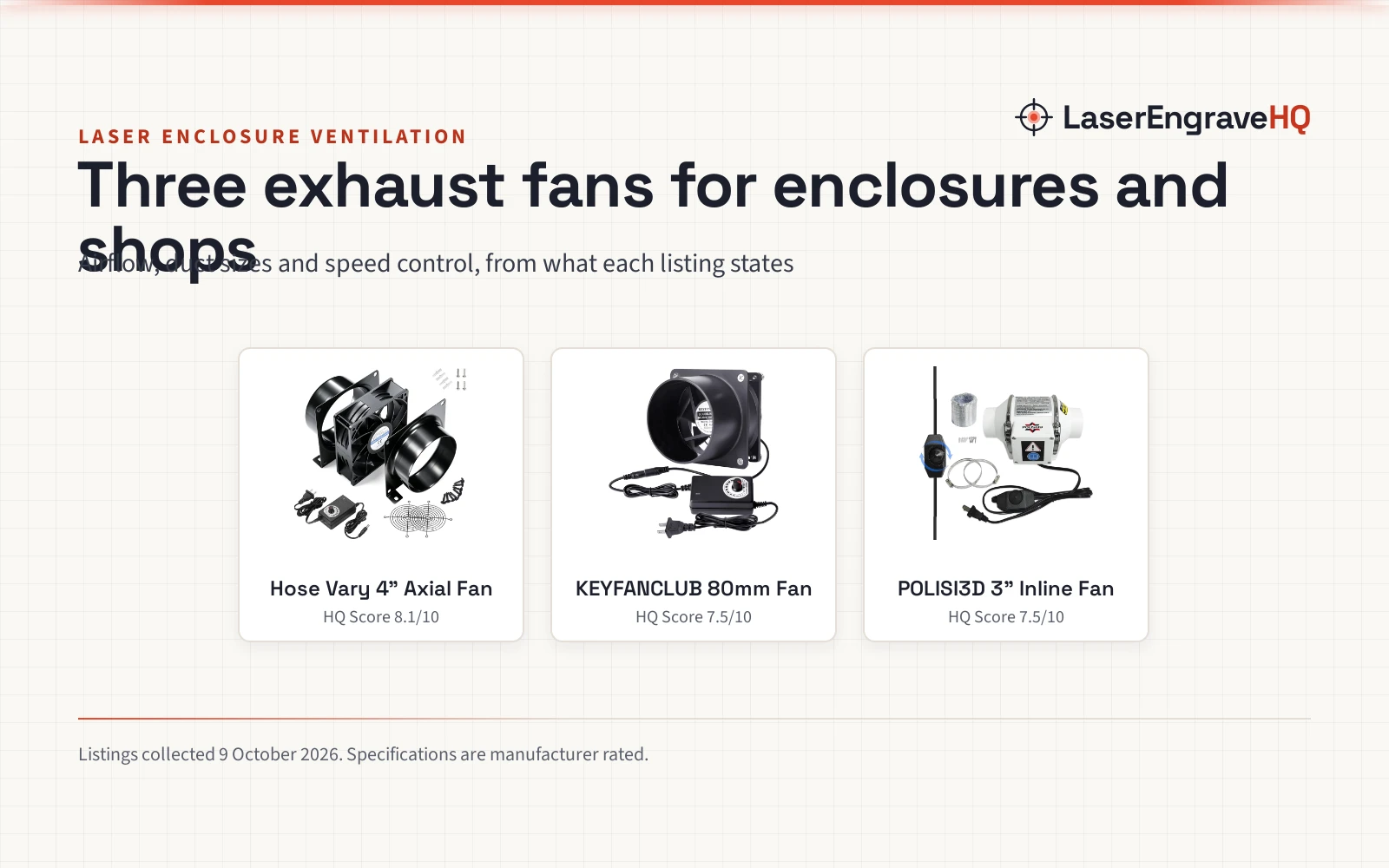
- Best Overall Hose Vary 4″ Axial Fan: 4-inch metal duct flanges match standard enclosure hoses, delivering 141 CFM at 18 dB with smooth variable PWM speed control. Check price on Amazon
- Best with Warranty KEYFANCLUB 80mm Fan: Compact 80mm fan with duct adapter, 65 CFM airflow, variable voltage dial, and a stated 12-month manufacturer warranty. Check price on Amazon
- Best 3-Inch Inline POLISI3D 3″ Inline Fan: Dedicated 3-inch inline blower with 1.5-meter pipe included, 117.71 CFM airflow, and stepless speed adjustment. Check price on Amazon
Machines on the list
4" Axial Exhaust Fan, DC12V Air Fume Smoke
A 4-inch axial fan kit with two metal duct flanges, dual ball bearings, PWM speed control, and dual protective metal meshes.
Pros
- Two 4-inch metal duct flanges connect directly to standard 4-inch laser enclosure exhaust hoses
- Airflow reaches up to 141 CFM at 3000 RPM with smooth 0% to 100% PWM speed control
- Dual black metal meshes shield both sides of the fan blades against accidental contact
- Low noise profile listed under 18 dB background noise in an anechoic chamber
Cons
- No warranty term in the listing
- Requires manual assembly of the fan, duct flanges, and protective metal meshes
- Listing conflicts: title calls the controller an AC dimmer while bullets describe a DC PWM controller
- 141 CFM capacity is built for compact laser enclosures rather than large workshop spaces
Small Axial Exhaust Fan, 80mm 12V DC Fan with AC
An 80mm axial fan kit with dual ball bearings, a metal duct adapter, 3V to 12V speed dial, and a 12-month warranty.
Pros
- Includes a stated 12-month manufacturer warranty and customer support
- Adjustable speed dial varies voltage from 3V to 12V across 1500 to 4500 RPM
- Dual ball bearing motor specified by the maker for continuous operation
- Includes a metal duct adapter and protective metal mesh for small enclosure ports
Cons
- 65 CFM maximum airflow is the lowest capacity among the five fans compared
- Noise level reaches up to 40 dB at full speed
- 80 x 25 mm footprint requires adapters to fit common 3-inch or 4-inch duct hoses
- Listing claims continuous operation for over 6 years without independent verification
Powerful 3 Inch Inline Duct Ventilation Fan AC
A 3-inch inline duct blower with an included 1.5-meter exhaust pipe, copper motor, and stepless speed controller.
Pros
- Includes a 1.5-meter flexible duct pipe and four expansion mounting screws in the box
- Delivers 117.71 CFM (200 cubic meters per hour) through an inline 3-inch duct configuration
- Features a 1 kg copper motor specified at 25 watts and 2600 RPM
- Rotary speed controller allows adjusting airflow to balance exhaust draw against 30 dB noise
Cons
- No warranty term in the listing
- 3-inch diameter requires step-up adapters to connect with standard 4-inch enclosure ports
- Listing does not state operating voltage or electrical safety certifications
- Inline plastic housing lacks integrated backdraft damper shutters
Other machines to compare
 POLISI3D Powerful 3Inch Duct Fan Ventilation AC Vent BlowerCheck price on Amazon
 80mm Small 4 Inch Exhaust Fan with DuctCheck price on Amazon
 3 Inch Inline Duct Fan with Variable Speed Controller & PipeCheck price on Amazon
 VIVOSUN 4" Metal Inline Fan 100 CFMCheck price on Amazon
 VIVOSUN 6" Inline Fan 240 CFMCheck price on Amazon
 VIVOSUN R6 6" Inline FanCheck price on Amazon
Specs compared
| Model | HQ Score | Fan size | Airflow | Speed | Power / Voltage | Mount / Style | Warranty |
|---|---|---|---|---|---|---|---|
| Hose Vary 4″ Axial Fan | 9.6/10 | 4 in (120 x 38 mm) | 141 CFM | 3000 RPM (variable) | 7W, 12V DC | Axial kit with 4 in flanges | Not stated |
| KEYFANCLUB 80mm Fan | 9.5/10 | 80 mm (80 x 25 mm) | 65 CFM | 1500 to 4500 RPM (variable) | 3W, 12V DC | Axial kit with duct adapter | 12 months |
| POLISI3D 3″ Inline Fan | 9.5/10 | 3 in | 117.71 CFM | 2600 RPM (variable) | 25W (voltage not stated) | Inline duct blower | Not stated |
Specifications are manufacturer rated, as published on each listing and collected 8 October 2026.
Most laser exhaust listings are open workshop blowers
A search for laser exhaust equipment turns up everything from small computer cooling fans to industrial wall exhausters. Many listings mention laser cutters alongside 3D printers, paint booths, and greenhouses, leaving buyers to determine how to attach them to standard enclosure ports. Dedicated direct-mount fans typically use 3-inch or 4-inch duct diameters, while larger wall-mounted shutter models clear ambient smoke from an entire garage or shed workshop.
Buying guide: choosing an exhaust fan for laser enclosure
Direct enclosure extraction versus room ventilation
A benchtop best enclosed laser engraver relies on negative pressure inside the cabinet to capture fumes right at the cut line. An inline or axial fan mounted directly in the exhaust hose creates this pull. For walk-in cutting setups or open-frame machines operating inside an unsealed room, a wall-mounted shutter fan provides high-volume room air exchanges to prevent fumes from lingering in the workspace.
Duct diameter and flange compatibility
Most commercial laser covers and hobbyist enclosures feature exhaust ports sized for 3-inch or 4-inch flexible ducting. Fans such as the Hose Vary kit provide dual 4-inch metal flanges that clamp directly to standard flexible duct hose. Smaller axial fans require step-up couplers or custom plenum adapters to seal tightly without restricting airflow.
Airflow capacity and duct resistance
Airflow capacity among the three picks starts at 65 CFM on compact 80 mm units. For a small desktop enclosure, 100 to 150 CFM provides sufficient air velocity to clear smoke from cutting plywood and acrylic. Keeping duct runs short and minimizing sharp 90-degree bends reduces static pressure resistance, allowing lower-wattage fans to move air efficiently.
Variable speed controls and negative pressure
Having an adjustable speed dial is helpful when balancing exhaust draw against workshop climate. High fan speeds evacuate heavy smoke rapidly during intensive cutting passes, but pull conditioned indoor air outside. Dialing down fan speed during light engraving reduces draft and lowers operating noise.
Backdraft dampers and outdoor weather protection
Venting through an exterior wall or window exposes your duct run to outside weather. Wall-mounted fans with automatic gravity shutters close when the motor stops, blocking outdoor drafts, rain, and insects from entering the shop. For direct inline duct fans, installing an exterior louvered vent cap on the outer wall provides similar protection.
Laser engraving and cutting generate smoke, particulate matter, and volatile organic compounds. Always vent exhaust air outdoors away from open windows and HVAC fresh-air intakes, or route exhaust through a certified fume extractor for laser engraver setup when outdoor ducting is unavailable. Never leave an active laser unattended, keep a fire extinguisher near your workbench, and maintain clear duct pathways free of combustible soot buildup. Never cut or engrave PVC, vinyl, faux leather containing vinyl, polycarbonate, or ABS plastic, which produce toxic hydrogen chloride gas and corrosive fumes. Review OSHA ventilation guidelines and FDA CDRH laser safety guidance for workshop operations; see our laser safety overview for additional precautions.
How the scores add up
Each machine is scored out of 10 on performance, build, value, safety and warranty, with the weights published on our How We Pick page. A spec the listing does not publish scores nothing.
| Product | HQ Score | Perf. /35 | Build /25 | Value /25 | Safety /10 | Warranty /5 |
|---|---|---|---|---|---|---|
| Hose Vary 4″ Axial Fan | 9.6 | 32 | 22 | 24 | 3 | 0 |
| KEYFANCLUB 80mm Fan | 9.5 | 27 | 20 | 22 | 3 | 3 |
| POLISI3D 3″ Inline Fan | 9.5 | 30 | 21 | 22 | 3 | 0 |
Scores run from 9.2 to 9.8: each product’s point total is placed on that range, so more points always means a higher score.
FAQ: lasers and CNC
How long does an exhaust fan last?
Fan service life depends on bearing design, operating hours, and soot exposure. Dual ball bearing motors, such as those found on the 12V axial models compared here, typically offer longer operational lifespans than sleeve bearings. The KEYFANCLUB listing claims continuous operation for over 6 years under clean conditions, while the Hose Vary documentation notes aging benchmarks under standard operating conditions. Regular cleaning of fan blades and maintaining soot-free impellers prevents premature motor failure.
How to clean an exhaust fan on a laser enclosure?
Wood and acrylic cutting produces sticky resin and soot that coat exhaust fan blades and ducting over time. Disconnect power to the fan completely before servicing. Remove protective wire meshes or duct flanges, and wipe the impeller blades with isopropyl alcohol using a microfiber cloth. Avoid spraying liquids directly into the motor housing. Keeping fan blades clean maintains airflow capacity and prevents motor overheating caused by soot imbalance.
Do I need an exhaust fan or a fume extractor?
An exhaust fan vents raw smoke, odor, and airborne particles outdoors through flexible ducting or a wall opening. It is the most economical solution when you have direct exterior access via a window or workshop wall. If you work in an apartment, shared office, or classroom where outdoor venting is prohibited, you need a dedicated fume extractor for laser engraver with HEPA and activated carbon filtration stages to scrub air before recirculating it indoors.
Can you use a 3-inch or 4-inch exhaust fan for laser enclosure setups?
Most standard laser enclosures, such as portable diode tent covers, feature exhaust ports sized for 3-inch or 4-inch ducting. The Hose Vary kit includes dedicated 4-inch metal flanges designed to connect directly with 4-inch flexible hose, while the POLISI3D kit provides a 3-inch inline blower and matching 1.5-meter duct pipe. For smaller 80 mm fans, duct adapters are required to transition from the fan housing to flexible enclosure hose.
Which of these exhaust fans have a written warranty?
Among the three models compared, only the KEYFANCLUB 80mm axial fan publishes a written warranty term, backed by a 12-month manufacturer warranty. The listings for the Hose Vary 4-inch axial kit and POLISI3D 3-inch inline blower do not state a warranty term. Always confirm warranty coverage and replacement part availability directly with the seller before purchasing.
Related: best enclosed laser engraver, best fume extractor for laser cutting, best laser air assist, best CO2 laser cutter for home use, diode vs CO2 laser, and the laser accessories hub. Also see our honeycomb bed for laser cutter. Also see our laser engraver with enclosure. Also see our how to use xtool rotary attachment. Also see our best exhaust fan for laser cutter. Also see our honeycomb bed for k40 laser. Also see our honeycomb laser bed alternative diy. Also see our laser engraver file types. Also see our laser engraver accessories for beginners. Also see our how to set up a rotary on a laser engraver. Also see our does air assist make a difference on a laser engraver. Also see our how to build a laser engraver enclosure. Also see our best laser engraver enclosure. Also see our best exhaust fan for laser engraver. Also see our best laser exhaust fan under 50. Also see our best honeycomb bed under 45. Also see our ac infinity cloudline s6 review. Also see our honeycomb vs slat bed laser. Also see our roller vs chuck rotary attachment. Also see our brilliance laser inks bli101 review. Also see our air assist vs no air assist. Also see our ac infinity cloudline t4 review. Also see our ac infinity cloudline s4 review. Also see our honeycomb bed vs blade table. Also see our inline fan vs axial fan for laser. Also see our honeycomb bed vs steel mesh bed. Also see our inline fan vs booster fan for laser. Also see our cw3000 vs cw5000 water chiller. Also see our honeycomb pins vs magnetic hold downs. Also see our ac infinity raxial s4 review. Also see our dremel 7760 review. Also see our dremel 2050 review. Also see our ac infinity raxial s6 review. Also see our cordless vs corded rotary tool for engraving. Also see our best laser exhaust fan for basement. Also see our best honeycomb bed for xtool d1 pro. Also see our piece of masking tape. Also see our exhaust fan window. Also see our best window exhaust fan for laser under 75. Also see our window exhaust fan vs inline fan for laser. Also see our best water pump for co2 laser. Also see our laser engraver spray. Also see our best laser exhaust fan for basement under 75. Also see our best exhaust hose for laser engraver under 30. Also see our centrifugal blower vs inline fan for laser. Also see our wood vs slate coasters. Also see our rigid vs flexible duct for laser. Also see our best water pump for k40 laser. Also see our best water pump for co2 laser under 50. Also see our air assist hose. Also see our dc vs ac exhaust fan for laser. Also see our aquarium pump vs air compressor for laser. Also see our exhaust fan dc powered. Also see our best air assist hose under 20. Also see our best dc powered exhaust fan under 75. Also see our duct clamps 8 inch. Also see our best water pump for k40 laser under 25. Also see our exhaust fan duct work. Also see our best casters for laser engraver. Also see our pvc vs aluminum exhaust duct for laser. Also see our exhaust fan adjustable speed. Also see our transfer tape vs masking tape for laser engraving. Also see our distilled water vs tap water for co2 laser. Also see our air assist vs exhaust fan for laser. Also see our painter’s tape vs masking tape for laser. Also see our best honeycomb bed for xtool m1. Also see our duct clamp 6. Also see our best casters for laser engraver under 15. Also see our best honeycomb bed for xtool f1. Also see our best laser enclosure for xtool p3. Also see our best laser enclosure for xtool m2. Also see our distilled vs deionized water for co2 laser.