Inline Fan vs Axial Fan for Laser: Which One Should You Buy?
Inline fans and axial fans compared on airflow, static pressure, duct runs, noise and power consumption for laser engraver fume extraction.

On this page
Top picks at a glance
As an Amazon Associate I earn from qualifying purchases.
- 1
 VIVOSUN P6 6" Inline Fan &Speed Control 345 CFM Exhaust Fan9.7/10View on Amazon
- 2
 4" Axial Exhaust Fan9.6/10View on Amazon
- 3
 120mm 12V DC Axial Exhaust Duct Fan with 4" Flange Adapter9.4/10View on Amazon
- 4
 VIVOSUN R6 6" Inline FanView on Amazon
- 5
 VIVOSUN G6 6" 388 CFM Inline Fan &Smart ControllerView on Amazon
- 6
 VIVOSUN G4 4" 195 CFM Inline Fan &Smart ControllerView on Amazon
- 7
 VEVOR Inline Duct FanView on Amazon
- 8
 Hon&Guan 4 Inch Inline Duct Fan with Upgrade ControllerView on Amazon
- 9
 3 Inch Inline Duct Fan with Variable Speed Controller & PipeView on Amazon
When you fire up a laser engraver to cut acrylic signs, personalize stainless tumblers, or engrave leather patches, clearing smoke and fumes out of the enclosure is critical for clean cuts and workshop safety. Deciding between an inline fan vs axial fan for laser fume extraction comes down to how your ventilation ducting is routed. This comparison puts inline booster duct fans against axial exhaust fans, examining airflow volume, static pressure, duct resistance, noise levels, and power consumption using what each manufacturer listing publishes.
LaserEngraveHQ earns a commission from purchases made through these links, at no extra cost to you. Read our affiliate disclosure.
Verdict: choose an inline fan for laser enclosures connected to flexible ducting or exhausting through exterior walls, because the Hon&Guan inline examples state concrete static pressure ratings (142 Pa and 171 Pa) to move air through duct resistance. Choose an axial fan like the AMCHIXIN example for compact desktop setups with direct, short exhaust paths where 88 CFM is sufficient, keeping in mind that its listing leaves static pressure unstated.
Machines on the list


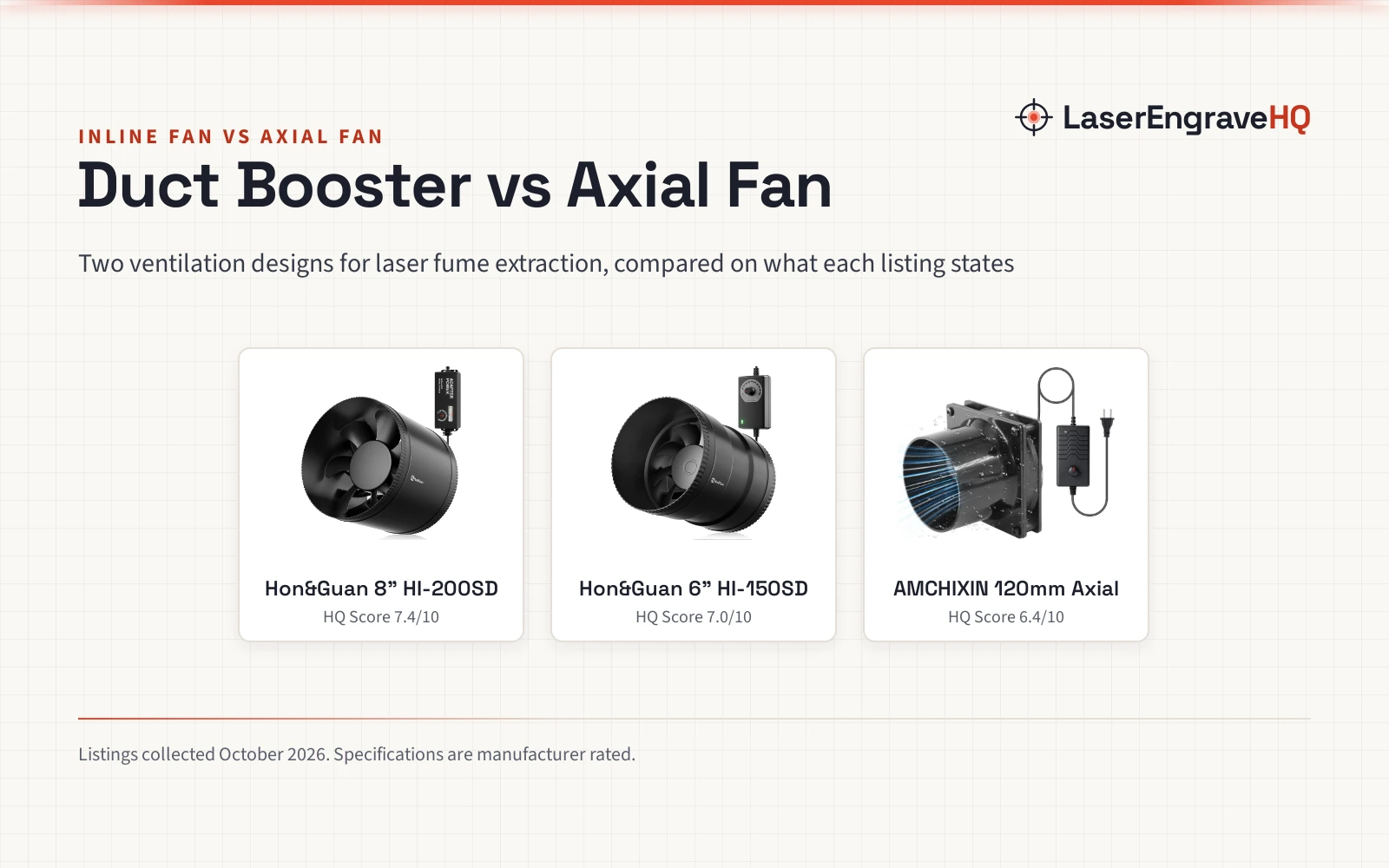
Hon&Guan 8 Inch Inline Booster Duct Fan with Speed
An 8-inch inline duct booster fan delivering 623 CFM of airflow with 171 Pa of static air pressure and a variable speed controller.
Pros
- Rated airflow of 623 CFM moves substantial air volume for large enclosures
- Stated air pressure of 171 Pa helps move fumes through ducting
- Maximum power consumption of 44W with an upgraded DC motor
- Includes a variable speed controller for adjusting airflow and sound
Cons
- No warranty term is stated in the listing
- Spec table lists dimensions as 7.28 x 8 x 8 in while bullets state 7.48 x 9.25 x 9.25 in
- Listing shows contradictory control specs between variable dial, 3 speeds and touch
- Higher sound output rated at 45 dBA compared to smaller 6-inch models

Hon&Guan 6 Inch Inline Booster Duct Fan with Speed
A 6-inch inline booster duct fan providing 345 CFM of airflow and 142 Pa of air pressure with low 19.2W power draw.
Pros
- Rated airflow of 345 CFM at 3300 RPM clears fumes efficiently
- Stated air pressure of 142 Pa overcomes duct resistance
- Low maximum power consumption of only 19.2W
- Quiet operation with a rated noise level of 32 dBA
Cons
- No warranty term is stated in the listing
- Spec table contradicts bullets by listing 2 speeds and app control instead of variable dial
- Spec table lists 240 volts while bullets state 100-240V compatibility
- Plastic housing and blades rather than metal construction

120mm 12V DC Axial Exhaust Duct Fan with 4" Flange
A compact 120mm 12V DC axial exhaust fan with a 4-inch flange adapter, stepless speed control and IP44 moisture resistance.
Pros
- Delivers 88 CFM at 3000 RPM with stepless speed control from 1000 to 3000 RPM
- Dual ball bearing brushless motor with an IP44 moisture-proof rating
- Low power draw of 7.2W powered by an included 12V DC power adapter
- Includes a 4-inch duct flange adapter and protective metal mesh guard
Cons
- No warranty term is stated in the listing
- Airflow is limited to 88 CFM with no static air pressure rating stated
- Listing gives contradictory noise ratings of 20-46 dBA and 46.5 db
- Spec table contradicts bullets by listing outdoor usage and 3 touch power levels
Other machines to compare
 VIVOSUN R6 6" Inline FanCheck price on Amazon
 VIVOSUN G6 6" 388 CFM Inline Fan &Smart ControllerCheck price on Amazon
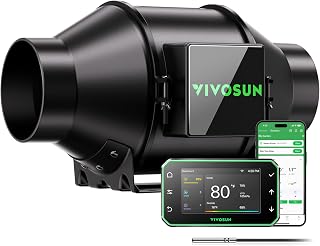 VIVOSUN G4 4" 195 CFM Inline Fan &Smart ControllerCheck price on Amazon
 VEVOR Inline Duct FanCheck price on Amazon
 Hon&Guan 4 Inch Inline Duct Fan with Upgrade ControllerCheck price on Amazon
 3 Inch Inline Duct Fan with Variable Speed Controller & PipeCheck price on Amazon
Side by side
| Spec | Hon&Guan 8″ HI-200SD | Hon&Guan 6″ HI-150SD | AMCHIXIN 120mm Axial |
|---|---|---|---|
| HQ Score | 61 | 58 | 53 |
| Fan type | Inline booster duct fan | Inline booster duct fan | Axial exhaust duct fan |
| Duct size | 8 Inch | 6 Inch | 4 Inch (120mm with flange) |
| Airflow | 623 CFM | 345 CFM | 88 CFM (28-88 CFM in spec table) |
| Air pressure | 171 Pa | 142 Pa | Not stated in the listing |
| Rated speed | 2500 RPM | 3300 RPM | 1000-3000 RPM |
| Power draw | 44W (100-240V) | 19.2W (100-240V) | 7.2W (12V DC) |
| Noise level | 45 dBA | 32 dBA | 20-46 dBA (46.5 db in spec table) |
| Motor type | DC motor | DC motor | Brushless DC, dual ball bearing |
| Speed control | Variable controller included | Variable controller included | Variable speed controller included |
| Moisture rating | Not stated in the listing | Not stated in the listing | IP44 moisture-resistant |
| Warranty | Not stated in the listing | Not stated in the listing | Not stated in the listing |
Specifications are manufacturer rated, as published on each listing and collected 14 October 2026.
Inline fan vs axial fan for laser: Static pressure and duct resistance
In laser engraving, smoke must move through ducting, elbows, and wall vents. Ducting creates static pressure, which is resistance against airflow. The Hon&Guan 8-inch inline fan publishes a static air pressure of 171 Pa, and the 6-inch model states 142 Pa. Those stated figures indicate that these Hon&Guan models are rated to move air through duct runs and past exterior louvers.
In contrast, the AMCHIXIN axial fan listing does not state an air pressure figure. While its blades move air parallel to the shaft at up to 88 CFM, the lack of a published static pressure rating means the listing leaves it unclear how much airflow will be maintained when exhausting through flexible hose or restrictive exterior vents. Where duct resistance is a factor, the Hon&Guan inline models provide verified pressure ratings of 142 Pa and 171 Pa.
Airflow capacity and speed control
Airflow dictates how quickly smoke is evacuated from an enclosure during cutting. The 8-inch Hon&Guan inline example rates airflow at 623 CFM at 2500 RPM, while the 6-inch Hon&Guan listing rates airflow at 345 CFM at 3300 RPM. Both inline models include variable speed controllers, allowing makers to reduce airflow and operating noise during light engraving jobs or increase speed to maximum for heavy cutting.
The AMCHIXIN axial listing states an airflow capacity of 88 CFM (with a range of 28-88 CFM in the spec table) across an adjustable speed range of 1000 to 3000 RPM, controlled by its included stepless speed dial. For a compact diode laser enclosure, 88 CFM provides direct evacuation, but it delivers less volume than the 345 CFM or 623 CFM stated for the Hon&Guan inline examples.
Noise levels and power consumption
Workshop noise and electrical draw are everyday considerations. The 6-inch Hon&Guan inline fan is rated at 32 dBA of noise while drawing a maximum of 19.2W of power. The larger 8-inch Hon&Guan inline fan draws 44W and is rated at 45 dBA. Both operate on 100-240V power supplies.
The AMCHIXIN axial fan draws only 7.2W from a 12V DC power adapter, making it the lowest power consumer of the group. Its noise is rated between 20-46 dBA in bullets and 46.5 db in the spec table. At its lowest 1000 RPM speed setting it is the quietest fan in the comparison at 20 dBA, but at its top 3000 RPM setting it reaches 46.5 db, which is louder than the 6-inch inline fan’s 32 dBA despite delivering 88 CFM compared to 345 CFM.
Enclosure mounting and duct sizing
Duct compatibility determines how easily a fan integrates into your workshop. The Hon&Guan inline fans are designed for inline duct mounting: the 6-inch model fits 6-inch ducting with body dimensions of 7.28 x 5.79 x 5.79 in, while the 8-inch model fits 8-inch ducting with listed dimensions of 7.48 x 9.25 x 9.25 in (and 7.28 x 8 x 8 in in its spec table). They splice directly into the duct line between the laser enclosure and the exhaust port.
The AMCHIXIN axial fan measures 3.7 x 4.72 x 4.72 in with a fan thickness of 0.98 inch and comes with a 4-inch flange adapter. It can be mounted directly to an enclosure wall or exhaust port using its fixed mounting brackets. For enclosures with standard 4-inch ports, see our guide on exhaust fan for laser enclosure options.
Durability and safety features
Both Hon&Guan inline fans use plastic bodies and 10 plastic blades driven by DC motors, meeting general industry standards as stated in the 6-inch spec table. Neither inline listing names an IP ingress rating or electrical certification.
The AMCHIXIN axial fan features a dual ball bearing brushless motor and states an IP44 moisture-resistant rating, along with an included metal mesh guard to protect fingers from spinning blades. For setups venting into humid environments or unheated garages, the IP44 rating provides stated protection against splashing water. None of the listings specify UL or ETL electrical certifications. For guidance on machine safety and venting, see do laser engravers need ventilation.
Warranty and manufacturer support
None of the listings state a concrete manufacturer warranty term. The 6-inch Hon&Guan, 8-inch Hon&Guan, and AMCHIXIN listings all leave warranty coverage unstated. When buying workshop fans without stated warranties, verify retailer return policies before purchase.
Choose an inline fan if
- Your laser setup uses ducting runs where published static pressure ratings, such as the 142 Pa or 171 Pa stated for the Hon&Guan examples, help overcome resistance.
- You cut materials like acrylic or plywood that produce heavy smoke requiring high airflow ratings, such as the 345 CFM or 623 CFM listed for the Hon&Guan models.
- You want a duct-mounted unit that splices directly into 6-inch or 8-inch hose lines.
Choose an axial fan if
- You have a small desktop enclosure with a short, direct exhaust route where high static pressure is not required.
- You prefer a compact unit powered by 12V DC, such as the 7.2W AMCHIXIN example.
- You need a fan that mounts directly to an enclosure wall or exhaust port using a 4-inch flange adapter.
For dedicated workshop exhaust options, explore our best exhaust fan for laser engraver guide, or compare self-contained filtration in our fume extractor vs exhaust fan breakdown.
Laser exhaust systems remove combustible particulate and noxious fumes from your workshop. Always vent exhaust outdoors or through certified filtration, maintain positive exhaust flow, keep an extinguisher within reach, and never cut materials containing chlorine such as PVC or vinyl. Review our complete guide to materials you should never laser cut.
Project Match
- Acrylic and Plywood Sign Cutting: Hon&Guan 8″ HI-200SD. High-smoke cutting jobs require substantial airflow and pressure to clear the cabinet; this 8-inch model delivers 623 CFM and 171 Pa of air pressure to push dense fumes through workshop ducting. Work area: Not stated in the listing.
- Leather Patches and Tumbler Engraving: Hon&Guan 6″ HI-150SD. Regular engraving in a desktop laser enclosure generates steady haze that this 6-inch unit clears using 345 CFM and 142 Pa of pressure while maintaining a quiet 32 dBA noise rating at 19.2W. Work area: Not stated in the listing.
- Compact Desktop Diode and Soldering Work: AMCHIXIN 120mm Axial Fan. For small enclosed hobby diode lasers venting directly through a wall or window without long hose runs, this 88 CFM unit provides compact 12V ventilation with an included 4-inch flange. Work area: Not stated in the listing.
FAQ: lasers and CNC
What is the main difference between an inline fan and an axial fan for laser engraving?
The main differences shown in these listings are mounting style, airflow capacity, and stated pressure ratings. The Hon&Guan inline booster fans are designed to install into 6-inch or 8-inch ducting and publish static pressure ratings of 142 Pa and 171 Pa alongside airflow ratings of 345 CFM and 623 CFM. The AMCHIXIN axial fan mounts with a 4-inch flange and moves 88 CFM parallel to the motor shaft, but does not publish a static pressure figure.
Can an axial fan push laser fumes through long ducting?
The AMCHIXIN axial fan listing rates airflow at 88 CFM but does not state an air pressure rating. Because duct walls and bends create resistance, an unstated pressure rating makes it unclear how much volume an axial fan will deliver over longer hose runs. In contrast, the Hon&Guan inline listings state 142 Pa and 171 Pa of pressure to verify their ability to move air through ducting.
Why is static pressure important for laser exhaust systems?
Static pressure measures the pressure a fan generates to overcome resistance created by ducting, bends, and exterior vents. Without adequate pressure, actual airflow through an exhaust hose can fall well below free-air ratings. The Hon&Guan inline listings provide stated pressure numbers (142 Pa and 171 Pa), while the AMCHIXIN axial listing leaves pressure unstated.
Which fan is quieter for a laser workshop?
It depends on the operating speed. The AMCHIXIN axial fan states a noise range of 20-46 dBA (and 46.5 db in its spec table), making its 20 dBA minimum setting the lowest sound figure among the listings, though at full 3000 RPM it reaches 46.5 db. The 6-inch Hon&Guan inline fan states a quiet 32 dBA rating for its 345 CFM airflow, while the 8-inch Hon&Guan inline fan is rated at 45 dBA.
Do these fans need speed controllers?
Speed control is beneficial because it lets you dial back airflow and noise during light engraving, then increase speed to maximum for heavy cutting. Each compared listing includes a variable speed controller in its package.
Related: how to vent a CO2 laser outside, do laser engravers need ventilation, and our laser accessories category.