Best Laser Exhaust Fan for Basement (2026): 4 Picks Compared
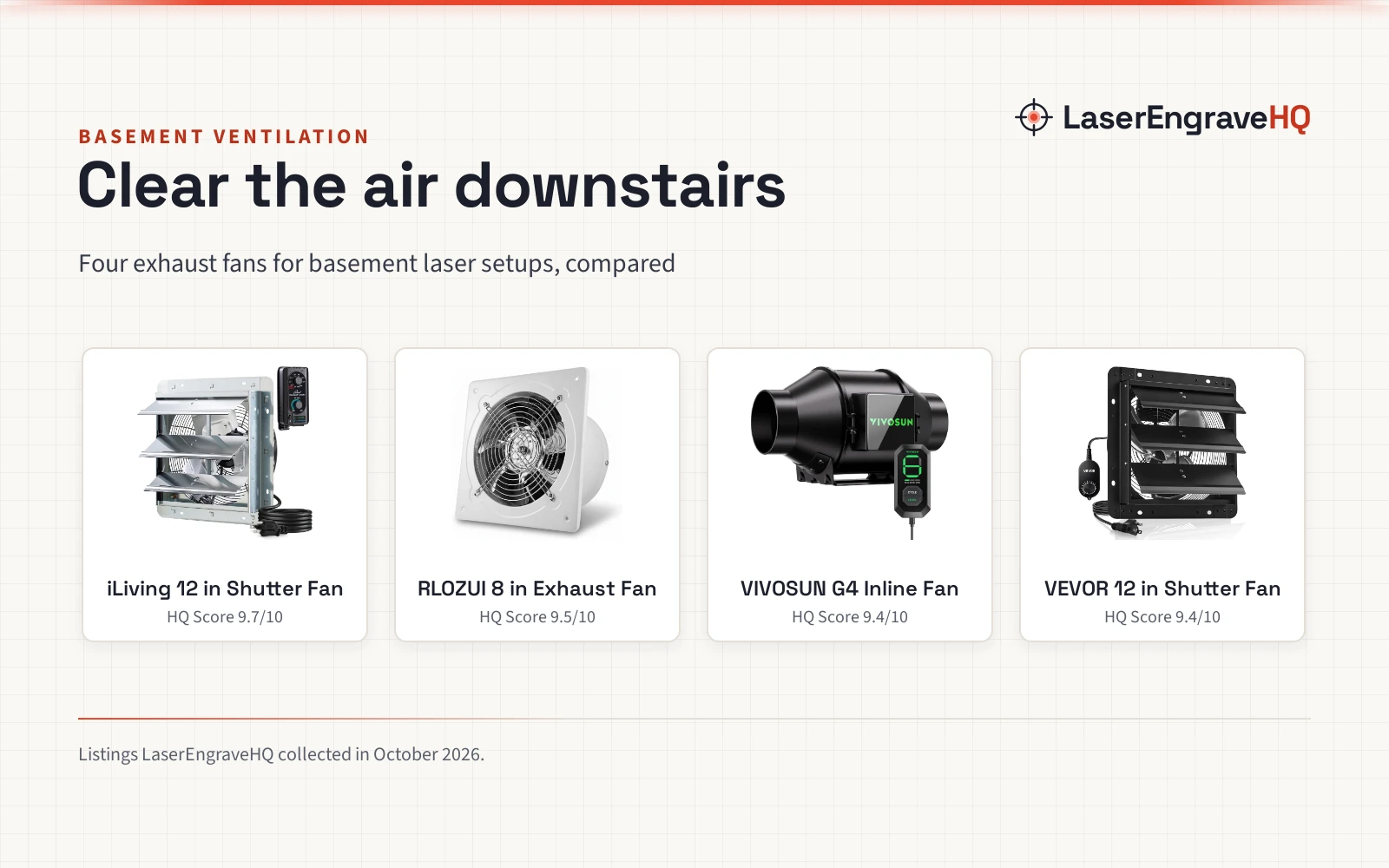
Four exhaust fans for basement laser setups: wall shutter fans and one inline duct fan, compared on stated CFM, noise, controls and certifications.

On this page
Top picks at a glance
As an Amazon Associate I earn from qualifying purchases.
- 1
 Best overalliLiving 12 in Shutter Fan9.7/10View on Amazon
- 2
 Highest stated airflowVEVOR 12 in Shutter Fan9.4/10View on Amazon
- 3
 Best for ducted setupsVIVOSUN G4 Inline Fan9.4/10View on Amazon
- 4
 Compact 8 in pickRLOZUI 8 in Exhaust Fan9.5/10View on Amazon
- 5
 3 Inch Inline Duct Fan with Variable Speed Controller & PipeView on Amazon
- 6
 VIVOSUN 4" Metal Inline Fan 100 CFMView on Amazon
- 7
 VIVOSUN 6" Inline Fan 240 CFMView on Amazon
- 8
 VIVOSUN R6 6" Inline FanView on Amazon
- 9
 VIVOSUN R8 8" Inline FanView on Amazon
- 10
 VIVOSUN P6 6" Inline Fan &Speed Control 345 CFM Exhaust FanView on Amazon
You have the laser running signs, tumblers and leather patches in the basement, and now the whole downstairs smells like a campfire. The best laser exhaust fan for basement setups moves that air outside instead of letting it hang around your workbench. The four listings below do the job four different ways: three wall shutter fans that exchange the room air, and one inline duct fan that ties straight into a duct run. Here is what each one states, ranked by the listings.
LaserEngraveHQ earns a commission from purchases made through these links, at no extra cost to you. Read our affiliate disclosure.
Quick picks
- Best overall iLiving 12 in Shutter Fan: 960 CFM, 32 to 130F thermostat, UL/cUL listed, only stated 1-year warranty. Check price on Amazon
- Highest stated airflow VEVOR 12 in Shutter Fan: 1347 CFM stated, steel housing, variable speed for big shops. Check price on Amazon
- Best for ducted setups VIVOSUN G4 Inline Fan: 4 in inline duct fan, 10 speeds, app control, 28 dB stated. Check price on Amazon
- Compact 8 in pick RLOZUI 8 in Exhaust Fan: 735 CFM brushless motor with stated overheat protection. Check price on Amazon
Machines on the list

iLiving 12" Wall Mounted Shutter Exhaust Fan
A 12 in wall-mount shutter exhaust fan stating 960 CFM, a 32 to 130F thermostat, UL/cUL listing and a 1-year warranty.
Pros
- 960 CFM stated with 1400 sq ft stated coverage
- Thermostat 32 to 130F plus 3 speeds
- UL/cUL listed, the only UL mark here
- 1-year parts and components limited warranty stated
Cons
- 10.2 lb, the heaviest here
- 65W, the highest stated wattage
- Under 65 dB, the loudest stated figure
- Wall mount only, needs a 12 in opening
8 Inch Exhaust Fan, Wall Mounted Ventilation Fan
An 8 in wall, ceiling or window exhaust fan stating 735 CFM from a brushless motor with built-in overheat protection.
Pros
- 735 CFM at 2800 RPM, brushless motor stated
- Built-in overheat protection device stated
- Backdraft damper and anti-corrosion metal build
- Wall, ceiling or window mount stated
Cons
- Requires manual wiring, switch not included
- No warranty term stated
- Dimensions contradict: bullets state cm, spec table states inches
- No thermostat or speed control stated

VIVOSUN G4 4" Inline Fan &Cycle Mode Speed
A 4 in inline duct fan stating 195 CFM, 10 PWM speeds with app control and 28 dB operation for ducted exhaust runs.
Pros
- Inline duct form suits ducted enclosure exhaust
- 10 speeds with PWM EC motor and app control
- 28 dB stated, the quietest stated figure
- 3 on/off cycle modes and backup memory stated
Cons
- 195 CFM, the lowest stated airflow here
- Noise contradicts: bullets state 28 dB, spec table 39 dB
- No warranty term stated
- Grow-tent marketing, not laser specific

VEVOR 12 in Shutter Exhaust Fan Wall-Mount
A 12 in wall-mount shutter exhaust fan stating 1347 CFM and variable speed in a steel housing for shops and garages.
Pros
- 1347 CFM stated, the highest stated airflow
- Steel housing with rain-guard shutters
- Variable speed stated
- Prewired power cord, no wiring needed
Cons
- CFM contradicts: title and bullets state 1347, spec table 1100
- Watts contradict: bullets state 40W, spec table 58W
- No certification or warranty stated
- 7.8 lb with no stated thermostat
Other machines to compare
 3 Inch Inline Duct Fan with Variable Speed Controller & PipeCheck price on Amazon
 VIVOSUN 4" Metal Inline Fan 100 CFMCheck price on Amazon
 VIVOSUN 6" Inline Fan 240 CFMCheck price on Amazon
 VIVOSUN R6 6" Inline FanCheck price on Amazon
 VIVOSUN R8 8" Inline FanCheck price on Amazon
 VIVOSUN P6 6" Inline Fan &Speed Control 345 CFM Exhaust FanCheck price on Amazon
Specs compared
| Model | HQ Score | Airflow | Size and mount | Noise | Power | Warranty |
|---|---|---|---|---|---|---|
| iLiving 12 in Shutter Fan | 9.7/10 | 960 CFM | 12 in, wall mount | Under 65 dB | 115V, 0.6A | 1 year |
| RLOZUI 8 in Exhaust Fan | 9.5/10 | 735 CFM | 8 in, wall, ceiling or window mount | 62 dB | 110V, 80W | Not stated |
| VIVOSUN G4 Inline Fan | 9.4/10 | 195 CFM | 4 in inline duct | 28 dB stated (spec table 39 dB) | 110V, 20W | Not stated |
| VEVOR 12 in Shutter Fan | 9.4/10 | 1347 CFM stated (spec table 1100 CFM) | 12 in, wall mount | 60 dB | 120V, 40W stated (spec table 58W) | Not stated |
20 October 2026
Specifications are manufacturer rated, as published on each listing and collected 20 October 2026.
Buying guide: best laser exhaust fan for basement
CFM: what the listings state
Airflow is the headline number on every listing here, and the spread is wide. The VEVOR states 1347 CFM in its title and bullets, though its spec table states 1100 CFM. The iLiving states 960 CFM. The RLOZUI states 735 CFM. The VIVOSUN states 195 CFM. Bigger stated CFM means more air moved per minute, but none of the listings states how much CFM a given basement or laser needs, so treat these as comparisons between the four, not as sizing advice. Where a listing contradicts itself, the title and bullets win.
Wall shutter vs inline duct
Three of the four are wall-mount shutter fans: the iLiving, the RLOZUI and the VEVOR. Their shutters open when the fan runs and close when it stops, which keeps weather and debris out of the opening. The VIVOSUN is a 4 in inline duct fan that mounts in a duct run instead of a wall, which suits venting an enclosure or a ducted run straight outside. Pick the form that matches the hole or duct you are willing to cut.
Noise: what the listings state
The VIVOSUN states 28 dB in its bullets, the quietest stated figure here, though its spec table states 39 dB. The VEVOR states 60 dB. The RLOZUI states 62 dB. The iLiving states under 65 dB. A basement shop shares walls with the house, so the stated noise figures are worth comparing, but remember the VIVOSUN’s two figures disagree and the title and bullets win.
Controls
The iLiving states a thermostat with a 32 to 130F range plus 3 speeds, so it can run on temperature. The VEVOR states variable speed. The VIVOSUN states 10 speeds on a PWM controller with 3 on/off cycle modes and app control. The RLOZUI states a single speed with push button control. More control means the fan can idle low and ramp up, instead of running full tilt all day.
Wiring and mounting
The iLiving ships with a standard NEMA 5-15 plug and a Thermospeed controller in the box. The VEVOR comes with a prewired power cord, so no wiring is needed per the listing. The VIVOSUN hangs from its mounting with a long power cord. The RLOZUI states that manual wiring is required and the switch is not included, so plan for an electrician or a wired switch before it runs. All four are 110 to 120V.
Certifications and safety features
The iLiving states UL and cUL listing, the only UL mark among the four. The VIVOSUN states a CE mark. The RLOZUI states a built-in overheating protection device that cuts power if the motor overheats, plus a backdraft damper. The VEVOR states no certification or safety feature. A stated listing is the one objective safety fact here; the rest of the safety score comes from the features above.
Stated coverage and room types
Only one listing states a coverage figure: the iLiving states coverage up to 1400 sq ft. The other three state room types instead. The RLOZUI title names attic, greenhouse, basement and shed. The VEVOR names attic, garage, barn, greenhouse and workshop. The VIVOSUN names grow tents, bathrooms, basements and 3D printing workshops. The iLiving spec table names bathroom, bedroom, garage and kitchen. Two of the four name basements directly, the RLOZUI and the VIVOSUN, which is worth noting on an article about basement setups. Where a listing does not state coverage, there is no number to compare, so do not invent one.
Power draw and voltage
All four run on standard household current: 115V on the iLiving, 110V on the RLOZUI and VIVOSUN, 120V on the VEVOR. Stated wattage runs from 20W on the VIVOSUN to 80W on the RLOZUI, with the iLiving at 65W and the VEVOR at 40W in its bullets (58W in its spec table). A fan that runs for hours every day lives on its wattage, so the 20W inline fan is the cheapest to leave running and the 80W wall fan the dearest, on the stated figures. None of the listings states a plug type problem: the iLiving and VIVOSUN use standard plugs, the VEVOR comes prewired, and the RLOZUI needs manual wiring.
Motors: what the listings state
The iLiving states a direct drive motor that is permanently lubricated, which means no oiling is stated as maintenance. The RLOZUI states a double ball bearing brushless outer rotor motor, which the listing says cuts friction and extends service life. The VEVOR states an AC motor at 1600 RPM. The VIVOSUN states a PWM-controlled EC motor with a mixed-flow design. Brushless and EC motors are the modern pair here; the listings do not state service intervals for any of them, so there is no maintenance schedule to compare.
Venting the basement: the practical side
A fan only helps if the air leaves the building. The shutter fans need a wall or window opening to push through; the inline fan needs a duct run to the outside. Do not vent into an attic, a crawlspace or another room: that just moves the fumes somewhere you cannot see them. Check your laser’s manual for how it wants to be vented, and give the fan a straight, short run outside where the listing allows it. If the basement has no good opening, that decides the form factor for you: ducting an inline fan through a small vent is often easier than cutting a 12 in hole for a shutter fan. For the difference between filtering and venting, see our fume extractor vs exhaust fan comparison.
Fume extractor vs exhaust fan
These four are exhaust fans: they move air outside. A fume extractor filters the air and recirculates it, which suits shops where cutting an outside vent is not possible. Extractors need filter changes; exhaust fans need an opening. The listings here state no filters and no filter costs, because there are none: the running cost is the wattage and the install. Pick the approach your basement allows, not the one with the bigger CFM number.
Project Match
Match the fan to the setup, using only what the listings state:
| Setup | Pick | Why, from the listing |
|---|---|---|
| Ducted enclosure exhaust | VIVOSUN G4 Inline Fan | 4 in inline duct fan, stated for basements and 3D printing workshops, 10 speeds with app control |
| Whole-room air exchange on a thermostat | iLiving 12 in Shutter Fan | 960 CFM, 32 to 130F thermostat, stated coverage up to 1400 sq ft, UL/cUL listed |
| Highest stated airflow for a shop | VEVOR 12 in Shutter Fan | 1347 CFM stated in title and bullets, steel housing, variable speed |
| Small wall or window opening | RLOZUI 8 in Exhaust Fan | 8 in size, 735 CFM, title names basements, requires manual wiring |
How the scores add up
| Product | HQ Score | Perf. /35 | Build /25 | Value /25 | Safety /10 | Warranty /5 |
|---|---|---|---|---|---|---|
| iLiving 12 in Shutter Fan | 9.7 | 30 | 21 | 20 | 8 | 3 |
| RLOZUI 8 in Exhaust Fan | 9.5 | 28 | 19 | 20 | 5 | 0 |
| VIVOSUN G4 Inline Fan | 9.4 | 27 | 19 | 20 | 3 | 0 |
| VEVOR 12 in Shutter Fan | 9.4 | 28 | 20 | 19 | 0 | 0 |
Scores run from 9.2 to 9.8: each product’s point total is placed on that range, so more points always means a higher score.
Each fan is scored on performance, build, value, safety and warranty. The iLiving leads on stated certifications and the only stated warranty here; the RLOZUI scores on its brushless motor and stated overheat protection; the VIVOSUN on its quiet inline form and controls; the VEVOR on stated airflow, marked down for contradicting its own spec table.
FAQ: lasers and CNC
Do I need an exhaust fan for a basement laser?
Laser work makes fumes, and a basement has no natural draft to clear them. Venting the work area outside keeps the air breathable and keeps residue off your optics and projects. Check your laser’s manual for its venting requirements, and route the exhaust outside, not into another room.
Inline duct fan or wall shutter fan?
An inline duct fan like the VIVOSUN sits in a duct run, which suits pulling air from an enclosure straight outside. A wall shutter fan like the iLiving, RLOZUI or VEVOR exchanges the room air through a wall opening, which suits general basement ventilation. Some shops run both: ducted exhaust at the laser and a shutter fan for the room.
How much CFM do the listings state?
The four state 195, 735, 960 and 1347 CFM, with the VEVOR’s spec table disagreeing at 1100 CFM. None of the listings states how much CFM a given basement or laser setup needs, so use these figures to compare the four against each other, not as sizing guidance.
Which of these run on a thermostat or an app?
The iLiving states a thermostat with a 32 to 130F range and 3 speeds. The VIVOSUN states app control with 10 speeds and 3 on/off cycle modes. The VEVOR states variable speed without a thermostat, and the RLOZUI states a single speed with push button control.
Do any of these state a warranty?
The iLiving states a 1-year parts and components limited warranty. The RLOZUI, VIVOSUN and VEVOR listings state no warranty term.
Which is the quietest on stated noise?
The VIVOSUN states 28 dB in its bullets, the lowest stated figure, though its spec table states 39 dB. Next are the VEVOR at 60 dB, the RLOZUI at 62 dB and the iLiving at under 65 dB. Stated noise is measured by the maker, so treat it as a comparison, not a promise.
Related: fume extractor vs exhaust fan, integrated laser enclosure vs standalone tent and the laser accessories hub.