Reamer Tool Uses: What Reamers Are Used For
A reamer takes a drilled hole and finishes it round, straight and to exact size, and this guide covers the main reamer tool uses, types, sizes and materials.

On this page
Reamer tool uses center on finishing a hole that already exists. A drilled hole comes out rough and slightly off size, and a reamer brings it round, straight and to the exact diameter the part needs. Machinists, repair shops and hobby builders reach for a reamer when a bolt, pin or shaft needs a close fit. The sections below walk through the main uses, the types of reamer, the sizes on offer and the materials each one handles.
As an Amazon Associate I earn from qualifying purchases. LaserEngraveHQ earns a commission from purchases made through these links, at no extra cost to you. Read our affiliate disclosure.
A reamer follows a hole that is already there. It enlarges, smooths and finishes the bore, and it works best when the drilled hole sits close to the finished size. A reamer does not drill a fresh hole in solid material, and it works in light cuts.
Reamer tool uses in the shop
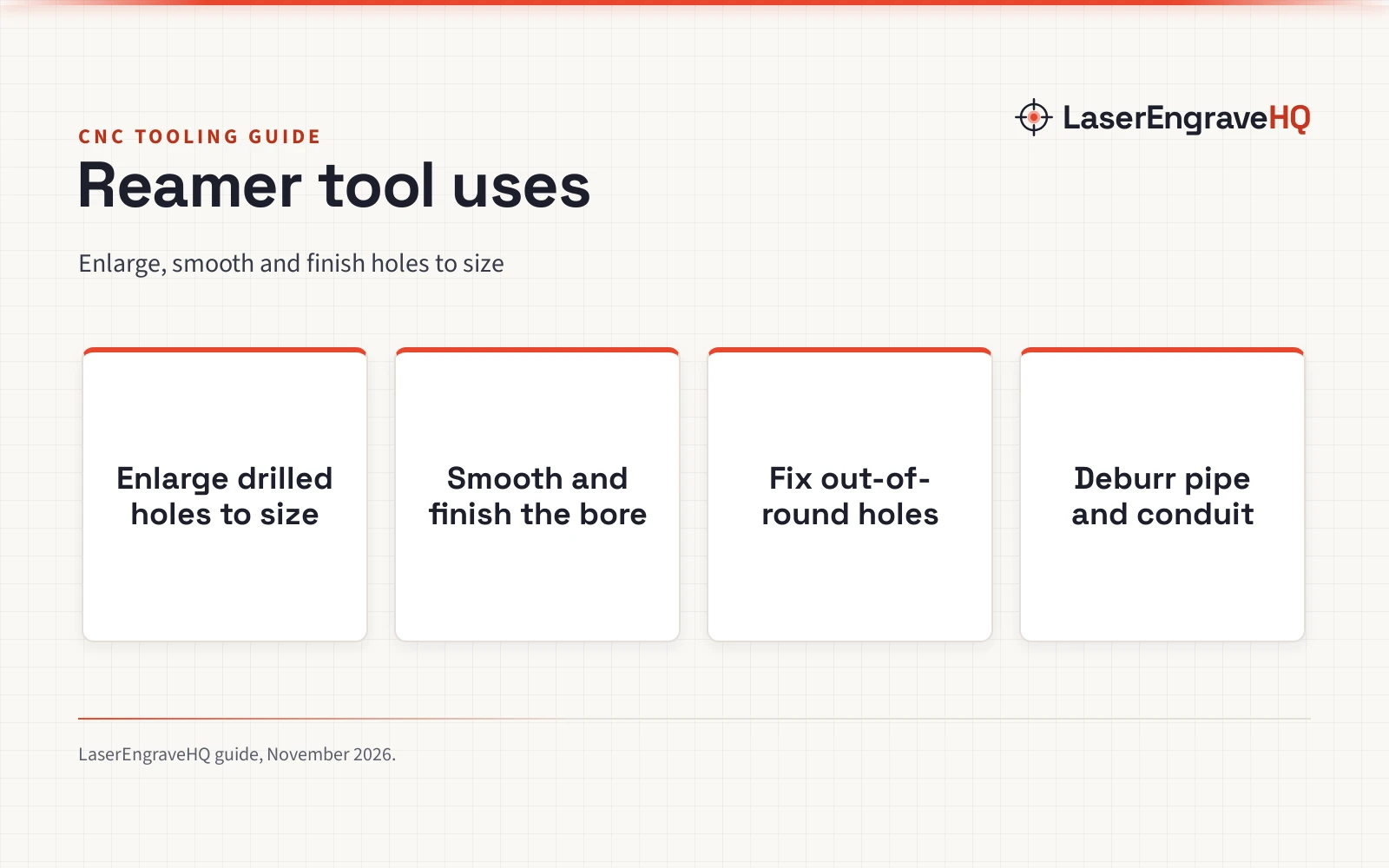
The main reamer tool uses come down to finishing work. A reamer enlarges a drilled hole to a set size, smooths the walls of the bore, and corrects a hole that came out slightly oval. It also deburrs the edge of a pipe or tube. The Klein Tools pipe reamer pen covers the deburring side of the job: it reams copper and PVC pipe, iron, brass and metal conduit, and it ships as a 2-pack with a free-spinning blade and a pocket clip. The adjustable sets cover the sizing side: they enlarge holes in stainless steel, cast iron, aluminum, brass, wood and non-ferrous metals. The uxcell hand reamers cover repair work, pipe, fittings and woodworking, and the deburring tools guide covers the wider set of edge tools. For the basics, see what a reamer is.
Hand, chucking and adjustable: pick the type
Hand reamers are the manual option. They turn with a wrench, a T-handle wrench, an extension rod or a drill chuck. The listings describe them for light cuts, repair work, removing stock and enlarging holes. The uxcell 4-piece set covers 1/8 inch, 3/16 inch, 1/4 inch and 5/16 inch at H8 tolerance, while the ZOCCVI 10-piece set covers 3 to 12 mm at H7 tolerance. The uxcell 1/2 inch hand reamer is an H7 tool in high speed steel, with a flute length of 72 mm (2.83 inches), a shank length of 49 mm (1.93 inches) and an overall length of 136 mm (5.35 inches).
Chucking reamers fit machine tools. The Accusize 29-piece set runs from 1/16 inch to 1/2 inch by 1/64 inch in M2 high speed steel, with a straight flute, right-hand cut and a 45-degree chamfer, and the maker rates it for screw machines, turret lathes, drill presses and machining centers. Its tolerance runs +0.0002 inch to -0.0000 inch through 1/2 inch diameter. For the machine side, see the CNC milling machine setup guide.
Adjustable reamers cover a range of sizes with one tool. The Rahish H12-H16 set expands from 1-1/16 inch to 2-7/32 inches, or 26.98 to 56.35 mm, and each reamer adjusts by loosening a nut and tightening the other. The Bluefox H4-H14 set covers 15/32 inch to 1-1/2 inches, or 12 to 38 mm, and the CME 11-piece set covers the same range with 6 flutes per reamer in M2 high speed steel. The findmall 9-piece metric set runs from 11.75 to 29.5 mm, and the Bluefox 15-piece set runs from 1/4 inch to 1-1/16 inches across H-V to H-11 sizes. The reamer types guide explains hand, machine and adjustable designs in more detail.
How to use a hand reamer
Reaming by hand follows a short sequence. Each move below comes from the way the listings describe the tool.
- Drill the hole. Drill the hole close to the finished size, so the reamer only has a light cut to take. The best drill bit to drill through metal guide covers bit choice for metal work.
- Pick the reamer. Pick the reamer whose cutting diameter matches the finished size of the hole.
- Add fluid. Add tapping fluid or cutting oil to the reamer and the workpiece to reduce friction and extend tool life.
- Turn it by hand. Turn the reamer by hand with a wrench or T-handle wrench, using steady pressure and light cuts.
- Clear the chips. Clear chips from the flutes as they collect, since clogged flutes hurt cutting performance, then check the hole against the part it has to fit.
Materials a reamer handles
The listings name a wide set of materials. Stainless steel, cast iron, aluminum, copper, brass, alloy and plastic appear across the uxcell, ZOCCVI, Rahish and Bluefox listings, along with wood and non-ferrous metals. The Klein pen adds PVC, iron and metal conduit to that list. The tools use high speed steel, carbon steel, 9SiCr alloy steel and alloy steel, with mild steel bodies on the adjustable sets. For stainless steel work, the best end mill for stainless steel guide covers carbide picks for CNC work, and the drill bit material types guide explains HSS, cobalt and carbide. Limits come from the listings: the ZOCCVI set is not recommended for hardened steel, and the Klein pen is a deburring tool for pipe and conduit rather than a hole-finishing reamer. Cutting fluid or tapping fluid helps on metal: the listings say it reduces friction, improves the surface finish and extends tool life.
Common mistakes to avoid
- Using a reamer to drill a fresh hole instead of finishing a hole that already exists.
- Skipping cutting fluid on metal, when the listings call for tapping fluid or cutting oil to reduce friction.
- Forcing the tool or taking a heavy cut, when the listings describe reamers for light cuts.
- Letting chips clog the flutes, which the uxcell listing says affects cutting performance.
- Picking a fixed reamer that does not match the finished size, or an adjustable reamer whose range does not cover the hole.
Reamer tool uses: the short version
- A reamer finishes a drilled hole: round, straight and to exact size.
- Hand reamers turn with a wrench or T-handle; chucking reamers fit drill presses, lathes and machining centers.
- Adjustable reamers expand across a range and suit repair work.
- Fixed sets cover stock sizes in fine steps, and adjustable sets span wide ranges.
- Use cutting fluid on metal, take light cuts and keep the flutes clear.
FAQ: lasers and CNC
What is the difference between a hand reamer and a chucking reamer?
A hand reamer turns by hand with a wrench, a T-handle wrench, an extension rod or a drill chuck. A chucking reamer fits machine tools: the Accusize set is rated for screw machines, turret lathes, drill presses and machining centers. Hand reamers suit light cuts and repair work.
Can a reamer make a hole bigger?
Yes. Enlarging holes is one of the main reamer tool uses: the listings describe reamers that accurately enlarge, smooth or finish holes. A fixed reamer brings a hole to its own cutting diameter, and an adjustable reamer expands across its range, such as 15/32 inch to 1-1/2 inches for the Bluefox H4-H14 set. A reamer still needs a drilled hole to start from.
What size reamer does a drilled hole need?
Match the reamer to the finished size of the hole. A 1/2 inch reamer finishes a hole at 1/2 inch, and the Accusize set steps from 1/16 inch to 1/2 inch by 1/64 inch for fine steps between sizes. For a hole that falls between stock sizes, an adjustable reamer covers the gap within its range.
Can you use a reamer on plastic and wood?
Yes. The listings name plastic and wood alongside metals for the Rahish, Bluefox, uxcell and ZOCCVI reamers, and the Klein pen names PVC among its deburring uses. Match the reamer to the material, and use cutting fluid on metal where the listing calls for it.
Is cutting fluid needed when reaming?
The listings say to use tapping fluid or cutting oil to reduce friction and extend tool life, and the uxcell listing adds that fluid improves the surface finish. Keep the reamer and the workpiece lubricated during the cut.
What do H7 and H8 mean on a reamer?
H7 and H8 are tolerance classes that state how close the finished hole sits to the named size. The ZOCCVI set is made to H7 tolerance, the uxcell 4-piece set is made to H8 tolerance, and the Accusize set states +0.0002 inch to -0.0000 inch through 1/2 inch diameter.
Related: the CNC tooling hub, reamer types and end mill chart. Also see the deburring tools guide.