End Mill Chart: Types, Sizes and Uses
An end mill chart turns cutter diameter, flute count, coating and shank size into a quick read, so the cutter matches the material and the machine.

On this page
Top picks at a glance
As an Amazon Associate I earn from qualifying purchases.
- 1
 SPEED TIGER ISE Carbide End Mill 1/8”9.8/10View on Amazon
- 2
 SPEED TIGER EISE 1/8" Carbide Square End Mill9.8/10View on Amazon
- 3
 5/16 Inch Shank Carbide Square End Mill9.7/10View on Amazon
An end mill chart is a reference that lists cutters by diameter, flute count, coating and shank size, so a maker can match the cutter to the cut, the material and the machine. Read the chart from the cut itself: the width of the slot or pocket sets the diameter, the material points to the coating and flute count, and the collet sets the shank. The sections below walk through each column in order.
LaserEngraveHQ earns a commission from purchases made through these links, at no extra cost to you. Read our affiliate disclosure.
This guide gives no feed or speed figures, because the listings here state sizes, coatings and flute counts, not cutting speeds. Use the chart for cutter choice and follow the feed and speed guidance for the exact machine and material.
How to read an end mill chart
A chart usually lists the cutting diameter first, then the flute count, the coating, the shank diameter and the overall length. Start with the cutting diameter, because it sets the width of the slot the cutter cuts in a single pass and the smallest inside corner radius it can leave. Then read the shank diameter and check it against the collet in the spindle, since a shank that does not fit the collet cannot run at all. The remaining columns narrow the choice: flute count and coating suit the cutter to the material, and the cutting length sets how deep the cutter can reach.
Charts also list the cutter shape. A square end leaves a flat floor, while a ball nose leaves a rounded floor for curved work. Corner rounding cutters shape an edge to a set radius: one corner rounding set in the listings covers radii from 1/16 inch to 3/8 inch, with 3/8 inch and 1/2 inch shanks. Match the shape to the edge or floor the part needs, not to the cutter that looks nearest.
End mill types on the chart
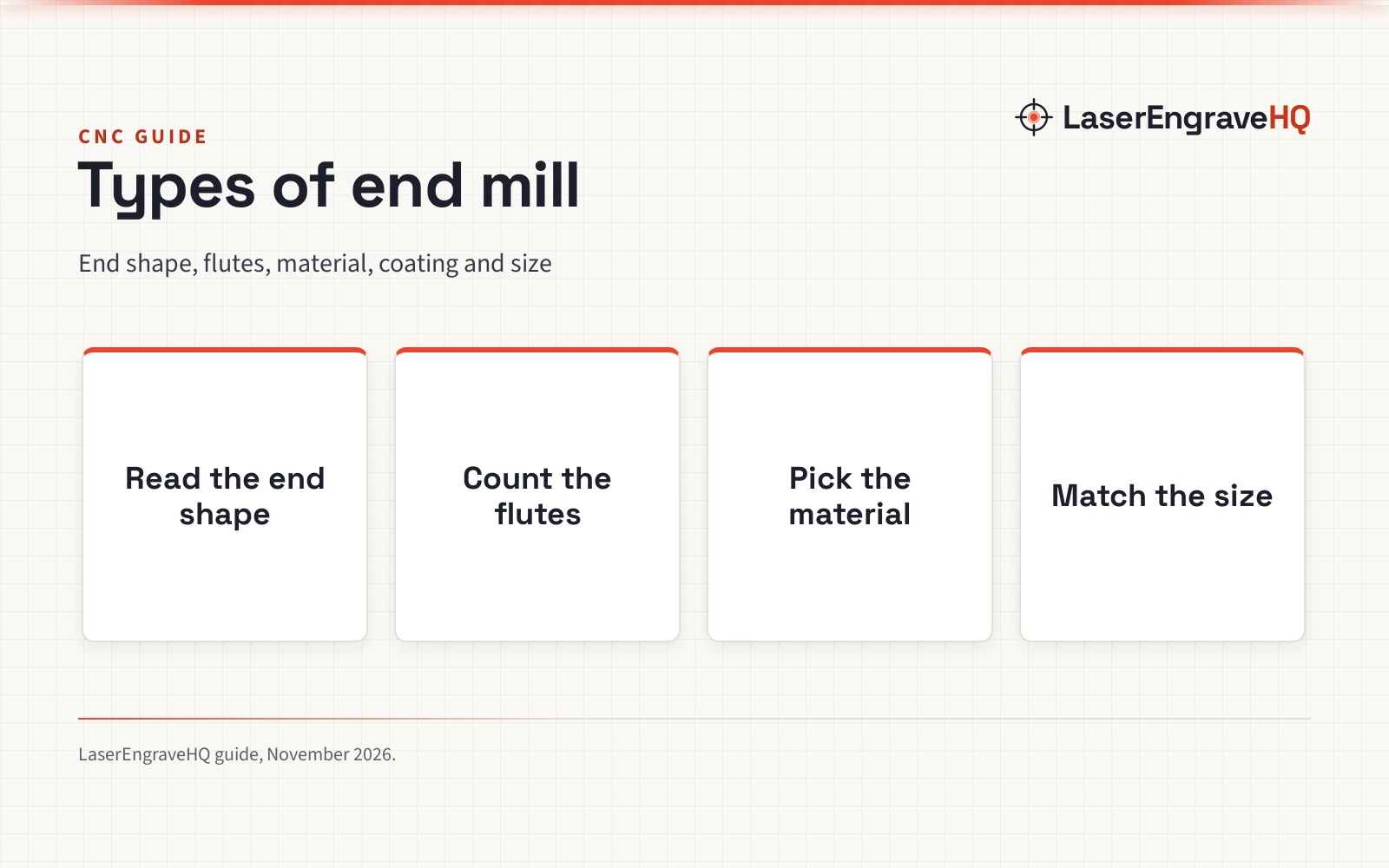
Square end mills are the common general purpose shape, with a flat end for slots, pockets and facing. Ball nose mills suit curved surfaces and rounded floors. Roughing mills clear material fast and leave a ridged finish for a finishing pass. Indexable mills use replaceable carbide inserts instead of a solid cutting edge, so a worn edge means a fresh insert rather than a fresh cutter. One indexable set in the listings holds 4 cutters from 1/2 inch to 1 inch, with a 90 degree square shoulder, APKT11T308 inserts and a 1/2 inch shank. The types of end mills guide covers each shape in more depth.
End mill sizes and shanks
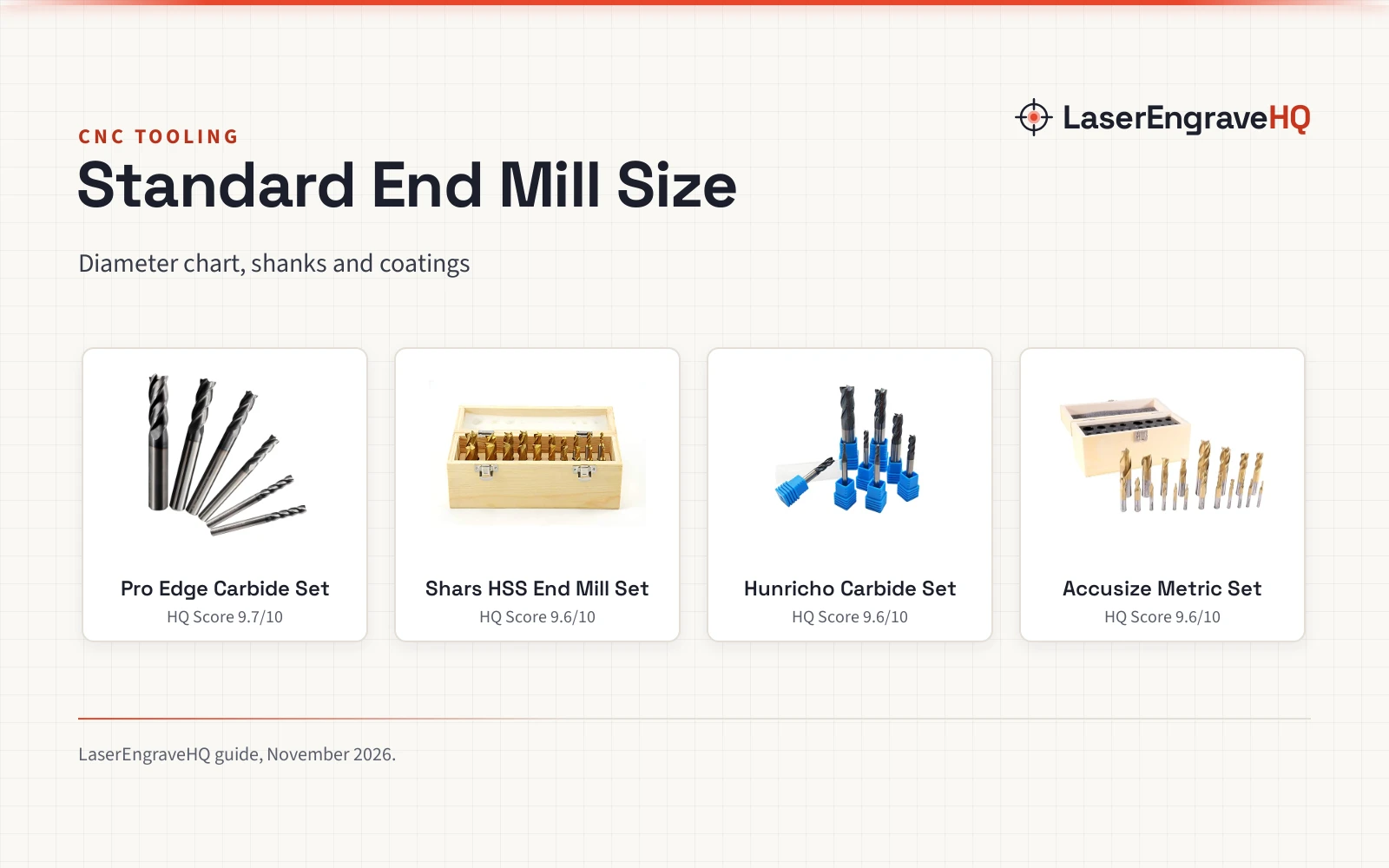
Diameter is the figure that decides the cut. Sets in the listings run from 1/8 inch to 3/4 inch, with common steps at 1/4 inch, 3/8 inch and 1/2 inch. A small diameter suits fine detail and thin walls, while a larger diameter clears a wide pocket in fewer passes. Pick the smallest diameter that still clears the cut, because a cutter that is wider than the slot cannot enter it. The standard end mill size chart lists the common diameters side by side.
Shank size is separate from cutting diameter, and the two do not have to match. One set lists 4 shank sizes across its cutters: 3/8 inch, 1/2 inch, 5/8 inch and 3/4 inch. Another lists a 1/4 inch shank with a 1/4 inch cutting diameter and a 2-1/2 inch overall length. Check the collet size on the machine before ordering, because a shank that is larger than the collet cannot be held. The router bit shank sizes guide explains how shank and collet sizes line up.
Length has two figures: cutting length and overall length. Cutting length sets the deepest cut, while overall length sets how far the cutter reaches from the collet. One 6-piece set lists cutting lengths from 1/2 inch to 1-1/4 inches and overall lengths from 1-1/2 inches to 3 inches. A short cutter is stiffer than a long cutter of the same diameter, so pick a cutter only as long as the cut needs.
Flutes, helix and coatings
Flute count sets how many cutting edges meet the material on each turn. A 2 flute cutter clears chips well and suits softer material, while a 4 flute cutter leaves a finer finish and suits harder material. Sets in the listings come in 2 flute, 4 flute and mixed 2 and 4 flute versions. The 2-flute vs 4-flute end mill comparison covers the trade-off in full.
Helix angle is the twist of the flutes. One set in the listings states a 30 degree helix. Read the helix beside the flute count when comparing cutters, since both columns describe how the edge meets the material.
Coating is the thin layer on the cutting edge. AlTiN and TiAlN coatings appear on the carbide sets in the listings, and TiN appears on the HSS sets and on the carbide inserts in the indexable set. One carbide set lists an HRC 45 rating and another lists HRC 55, which are the hardest workpiece material the maker rates the cutter for. Carbide holds an edge longer than HSS in harder material, while HSS suits general work. The carbide vs HSS end mill comparison covers both materials.
Match the chart to the material and the machine
Start from the material. The listings name stainless steel, alloy steel, carbon steel, cast iron and titanium alloy as materials the carbide cutters suit. Check the listing for the exact material before ordering, because a cutter rated for one metal may not suit another. The best end mill for aluminum guide shows which cutters suit that metal.
Then check the machine. One maker lists its cutters for CNC routers and plunge routers with a 1/4 inch collet, so that shank size fits a wide range of machines. Check the collet on the machine first, then pick the shank from the chart. Once the cutter is chosen, the CNC router feeds and speeds calculator guide shows how to work out the settings for the job.
Common mistakes to avoid
- Ordering a cutter by diameter alone and ignoring the shank size.
- Reading the overall length as the cutting length.
- Using a 4 flute cutter where chips cannot leave the cut.
- Matching a coating to the wrong material.
- Skipping the collet check before ordering a set.
End mill chart: the short version
- Read the cutting diameter first and match it to the slot or pocket.
- Check the shank against the collet.
- Pick the flute count and coating for the material.
- Check the cutting length against the depth of the cut.
- Confirm the cutter shape suits the edge or floor.
FAQ: lasers and CNC
What does the first number on an end mill chart mean?
It is the cutting diameter, the width of the cut the tool makes. Sets in the listings run from 1/8 inch to 3/4 inch, so the diameter column is the first filter when matching a cutter to a slot or pocket.
How do you pick an end mill size for a CNC router?
Match the diameter to the cut, then check the shank against the collet. A 1/4 inch shank fits routers with a 1/4 inch collet, and sets in the listings cover diameters from 1/8 inch to 3/4 inch. Pick the smallest diameter that clears the cut.
What is the difference between a 2 flute and a 4 flute end mill?
A 2 flute cutter has 2 cutting edges and clears chips well, while a 4 flute cutter has 4 cutting edges and leaves a finer finish. Both appear in the listings, and some sets mix 2 and 4 flute cutters in one box.
What does HRC mean on an end mill chart?
HRC is a hardness scale for the material being cut. One carbide set in the listings is rated HRC 45 and another is rated HRC 55. A higher figure means the cutter is rated for harder material, so read it beside the coating and the material the cutter suits.
Is a coated end mill worth it?
Not always. Coatings such as AlTiN, TiAlN and TiN appear on the sets in the listings and suit harder material and longer runs. An uncoated HSS cutter suits general work, so match the coating to the material rather than buying the coated set by default.
What shank size fits a CNC router?
It depends on the collet in the spindle. The listings show 1/4 inch, 3/8 inch, 1/2 inch, 5/8 inch and 3/4 inch shanks, so check the collet size on the machine and pick a shank that matches it. A shank larger than the collet cannot be held.
Related: the CNC tooling hub, types of end mills and standard end mill sizes. Also see the best end mill for aluminum and best end mill for steel guides.