Best Solder Paste (2026): 5 Pastes Compared by Spec
Five solder pastes for boards, phones and small electronics compared on alloy, melting point, particle size and flux, with every figure taken from the listings.

On this page
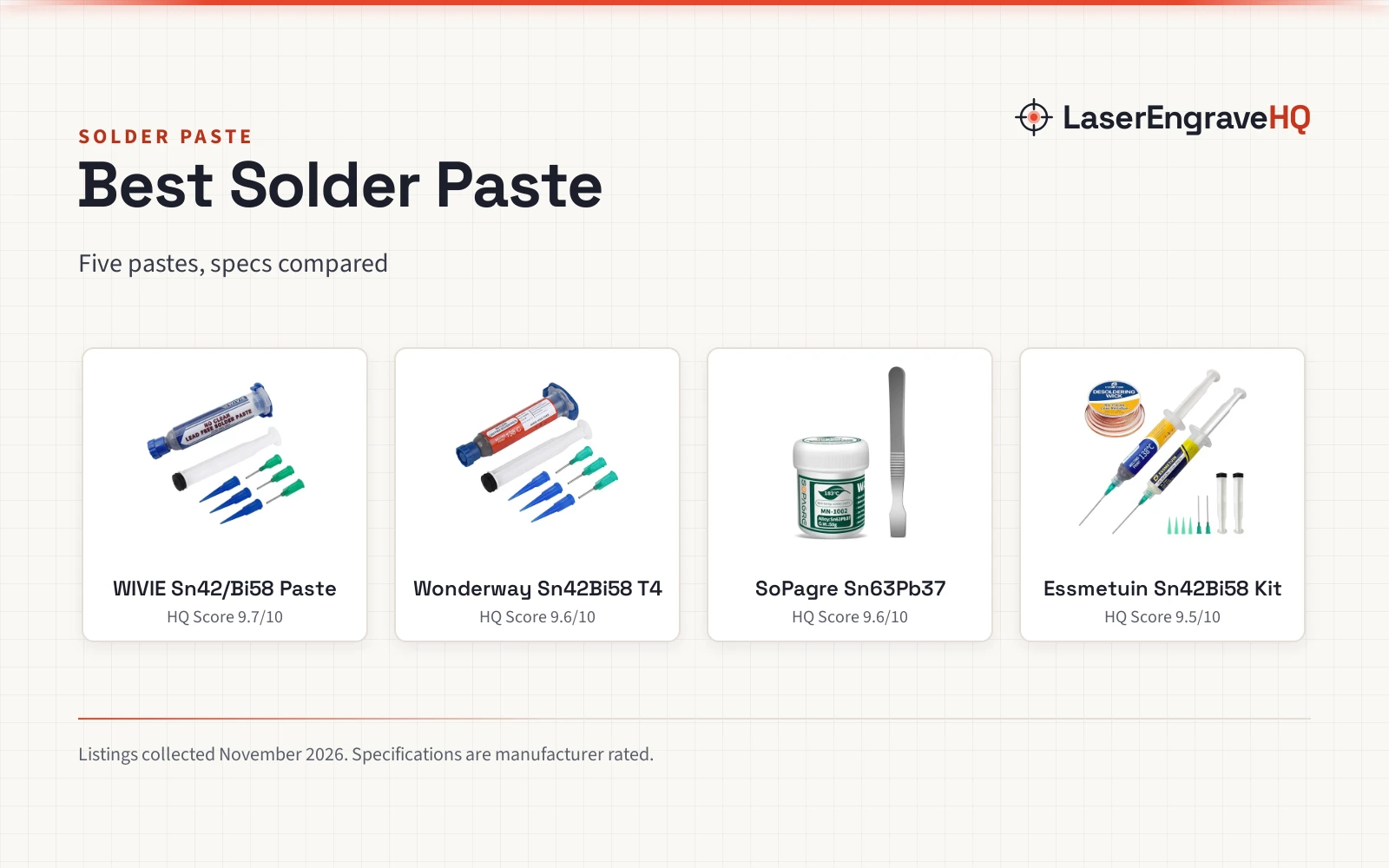
Top picks at a glance
As an Amazon Associate I earn from qualifying purchases.
- 1
 Best OverallWIVIE Sn42/Bi58 Paste9.7/10View on Amazon
- 2
 Best Lead-FreeWonderway Sn42Bi58 T49.6/10View on Amazon
- 3
 Largest AmountSoPagre Sn63Pb379.6/10View on Amazon
- 4
 Best Repair KitEssmetuin Sn42Bi58 Kit9.5/10View on Amazon
- 5
 Best Tin-LeadWonderway Sn63Pb37 T49.5/10View on Amazon
The best solder paste makes small board work go smoothly: paste on the pads, the part set in place, heat applied, and the alloy flows into the joint. Lead-free and tin-lead pastes are compared here on alloy, melting point, particle size and flux, using only what each listing states. The WIVIE paste leads because it states the most about its particles and its residue, while the SoPagre paste suits makers who want more paste per can.
LaserEngraveHQ earns a commission from purchases made through these links, at no extra cost to you. Read our affiliate disclosure.
Quick picks
- Best Overall WIVIE Sn42/Bi58 Paste: T4 particles of 20-38μm and a non-corrosive, non-conductive residue Check price on Amazon
- Best Lead-Free Wonderway Sn42Bi58 T4: Lead-free alloy at 138°C with 10.5% flux stated Check price on Amazon
- Largest Amount SoPagre Sn63Pb37: 50g can with a no-clean formula and tiny residue Check price on Amazon
- Best Repair Kit Essmetuin Sn42Bi58 Kit: Paste, flux and wick in a kit for heat-sensitive boards Check price on Amazon
- Best Tin-Lead Wonderway Sn63Pb37 T4: Tin-lead alloy at 183°C with 10.5% flux stated Check price on Amazon
Machines on the list
Sn42/Bi58 Lead-Free Solder Paste
A 20g lead-free Sn42/Bi58 paste with a 138°C melting point and a T4 particle size of 20-38μm for precision stencil work.
Pros
- T4 particle size of 20-38μm stated for precision stencil printing
- Lead-free Sn42/Bi58 alloy with a low 138°C melting point
- No-clean flux residue stated as non-corrosive and non-conductive
- Stated for BGA, SMT and PCB repairs in consumer electronics
Cons
- 20g of paste suits small jobs more than large runs
- 138°C melting point suits low-heat work only
- No warranty term is stated
- Paste only, with no flux or wick in the box
Wonderway Sn42/Bi58 T4 Lead Free Solder Paste No
A 20g lead-free Sn42/Bi58 paste with a 138°C melting point, 10.5% flux content and a no-clean formula.
Pros
- Lead-free Sn42/Bi58 alloy with a 138°C melting point
- Flux content of 10.5% stated, with a no-clean formula
- Strong viscosity and bright welding point stated
- Pushing design stated for smoother flowing
Cons
- 20g of paste suits small jobs more than large runs
- 138°C melting point suits low-heat work only
- No warranty term is stated
- No particle size is stated, so fine-pitch stencil work needs a check first
SoPagre Sn63/Pb37 Solder Paste 183°C SMD BGA SMT
A 50g tin-lead Sn63/Pb37 paste with a 183°C melting point and a no-clean formula with tiny residue.
Pros
- 50g can, the largest paste amount here
- Sn63/Pb37 alloy with a precise 183°C melting point
- No-clean formula with tiny residue stated
- Stated for BGA, SMD, motors, lighting, sensors, wires, fuses and connectors
Cons
- Tin-lead alloy, so it is not lead-free
- 183°C melting point needs more heat than the 138°C pastes
- No particle size is stated, so fine-pitch stencil work needs a check first
- Paste only, with no flux or wick in the box
Sn42/Bi58 Lead Free Solder Paste (30g)
A 30g lead-free Sn42/Bi58 paste with a 138°C melting point, plus no-clean flux and a solder wick for rework.
Pros
- Kit includes paste, no-clean flux and a solder wick
- Lead-free Sn42/Bi58 paste with a 138°C melting point
- Flux stated as lead-free, halogen free and non-corrosive
- Stated for paper boards and soft boards that cannot withstand high temperatures
Cons
- 138°C melting point suits low-heat work only
- Kit size suits repair work more than large runs
- No particle size is stated, so fine-pitch stencil work needs a check first
- Three items in the kit add setup steps to a simple paste job
Wonderway Sn63/Pb37 T4 Tin Lead Solder Paste No
A 20g tin-lead Sn63/Pb37 paste with a 183°C melting point, 10.5% flux content and a no-clean formula.
Pros
- Sn63/Pb37 alloy with a 183°C melting point
- Flux content of 10.5% stated, with a no-clean formula
- Strong viscosity and bright welding point stated
- Pushing design stated for smoother flowing
Cons
- Tin-lead alloy, so it is not lead-free
- 183°C melting point needs more heat than the 138°C pastes
- 20g of paste suits small jobs more than large runs
- No particle size is stated, so fine-pitch stencil work needs a check first
Other machines to compare
 Wonderway Sn42/Bi58 T4 Lead Free Solder Paste No CleanCheck price on Amazon
 Wonderway Sn63/Pb37 T4 Tin Lead Solder Paste No CleanCheck price on Amazon
 Wonderway Sn63/Pb37 T4 Tin Lead Solder Paste 183℃ MeltingCheck price on Amazon
 BEEYUIHF Lead-Free Solder Paste Sn42/Bi58Check price on Amazon
 Kester EP256 Solder PasteCheck price on Amazon
Specs compared
| Paste | HQ Score | Alloy | Melting point | Paste weight | Flux |
|---|---|---|---|---|---|
| WIVIE Sn42/Bi58 Paste | 9.7/10 | Sn42/Bi58, lead-free | 138°C | 20g | No-clean, non-corrosive |
| Wonderway Sn42Bi58 T4 | 9.6/10 | Sn42/Bi58, lead-free | 138°C | 20g | 10.5%, no-clean |
| SoPagre Sn63Pb37 | 9.6/10 | Sn63/Pb37 | 183°C | 50g | No-clean |
| Essmetuin Sn42Bi58 Kit | 9.5/10 | Sn42/Bi58, lead-free | 138°C | 30g | No-clean, halogen free |
| Wonderway Sn63Pb37 T4 | 9.5/10 | Sn63/Pb37 | 183°C | 20g | 10.5%, no-clean |
Size and performance figures are the brand’s ratings quoted from listings on 19 November 2026.
What the listings tell you, and what they leave out
Five solder paste listings were compared for this guide. None states a warranty term. Two state a flux content, 10.5%, and both are Wonderway pastes. Three state a 138°C melting point and two state 183°C. Only one states a particle size, the WIVIE paste at T4, 20-38μm. Only one listing, the Essmetuin kit, includes flux and a wick alongside the paste.
One listing gives two paste weights, 30g and 20g, so the review notes the figure to trust and the check to make before ordering.
Buying guide: choosing the best solder paste
Lead-free or tin-lead
Three pastes here use Sn42/Bi58, a lead-free alloy, and two use Sn63/Pb37, a tin-lead alloy. Lead-free paste suits makers who want to keep lead out of the work, and the Essmetuin listing states its paste suits paper boards and soft boards that cannot withstand high temperatures. Lead solder is not for food-contact items, so keep it away from anything that touches food or drink.
Melting point
The lead-free pastes melt at 138°C and the tin-lead pastes at 183°C. A lower melting point means less heat on the board and the parts, which matters for heat-sensitive boards and small components. Match the melting point to the board: the Essmetuin paste is stated for boards that cannot withstand high temperatures.
Paste size and particle size
The SoPagre paste comes in a 50g can, the Essmetuin kit holds 30g of paste, and the other three pastes hold 20g each. Only the WIVIE paste states a particle size, T4 at 20-38μm, for precision stencil printing and mini-component soldering. If stencil work is the job, that stated particle size is the figure to look for; the other listings state none.
What comes in the box
Four of the five pastes arrive as paste alone, and only the Essmetuin kit adds a no-clean flux of 10cc and a solder wick. The flux is stated as lead-free, halogen free and non-corrosive, and the wick is stated to leave only a small amount of residue. For board repair, see the best hot air rework station guide and the how to use soldering flux guide.
Soldering melts metal with a hot iron and the flux gives off fumes, so work in a ventilated area, wear eye protection and work on a heat-proof surface. Lead solder is not for food-contact items. See the best fume extractor for soldering for the extraction side.
Project Match
- Phone motherboard precision welding: SoPagre paste, stated for phone motherboard precision welding.
- BGA and SMT board repair: WIVIE paste, stated for BGA, SMT and PCB repairs; SoPagre paste, stated for BGA and SMD work.
- Paper boards and soft boards that cannot withstand high temperatures: Essmetuin kit, stated for that work at 138°C.
- Mini-component soldering and stencil printing: WIVIE paste, with a T4 particle size of 20-38μm stated for precision stencil printing.
- General board, IC and phone work: Wonderway Sn42/Bi58 and Sn63/Pb37 pastes, stated for circuit boards, ICs, phones and TVs.
How the scores add up
Each paste is scored out of 10 on performance, build, value, safety and warranty, with the weights published on our How We Pick page. For solder paste, safety means a lead-free alloy and a no-clean flux residue the listing states as non-corrosive or non-conductive; a paste that states neither scores zero on that line. None of the five pastes states a warranty term.
| Product | HQ Score | Perf. /35 | Build /25 | Value /25 | Safety /10 | Warranty /5 |
|---|---|---|---|---|---|---|
| WIVIE Sn42/Bi58 Paste | 9.7 | 32 | 22 | 21 | 7 | 0 |
| Wonderway Sn42Bi58 T4 | 9.6 | 29 | 21 | 20 | 7 | 0 |
| SoPagre Sn63Pb37 | 9.6 | 30 | 21 | 22 | 4 | 0 |
| Essmetuin Sn42Bi58 Kit | 9.5 | 28 | 20 | 20 | 7 | 0 |
| Wonderway Sn63Pb37 T4 | 9.5 | 29 | 21 | 19 | 4 | 0 |
We translate weighted points into a score with 9.2 as its floor and 9.8 as its cap; the straight-line conversion keeps the ranking exactly.
FAQ: lasers and CNC
How do you use solder paste?
Spread or stencil the paste onto the joint, place the part, then heat the paste to its melting point: 138°C for the lead-free pastes here, 183°C for the tin-lead pastes. The WIVIE listing states its T4 particle size of 20-38μm suits precision stencil printing and mini-component soldering.
How does solder paste work?
Solder paste is a mix of metal alloy powder and flux. Heat melts the alloy at its stated melting point, 138°C for the lead-free pastes here and 183°C for the tin-lead pastes, and the cooled alloy forms the solder joint.
What is solder paste made of?
The pastes here mix a metal alloy with flux. Three use Sn42/Bi58, a lead-free alloy, and two use Sn63/Pb37, a tin-lead alloy. The two Wonderway pastes state a flux content of 10.5%.
Is solder paste conductive?
The WIVIE listing states its no-clean flux residue is non-conductive and non-corrosive. None of the listings calls the paste itself non-conductive, so the residue claim is the only conductivity statement here.
Which solder paste here is lead-free?
Three of the five: the Wonderway Sn42/Bi58 paste, the Essmetuin kit and the WIVIE paste. The other two, the Wonderway Sn63/Pb37 paste and the SoPagre paste, use a tin-lead alloy.
Related: the soldering hub, lead free vs leaded solder, and the soldering flux vs soldering paste guide. Also see our best soldering flux for electronics. Also see our best soldering iron for electronics. Also see our best solder wire. Also see our soldering temperature. Also see our best beginner soldering kit. Also see our how to use a soldering tool. Also see our best hot air rework station.