Best Conductive Filament (2026): 5 Picks for Printed Circuits
Five conductive PLA and TPU filaments for printed circuits, touch sensors and ESD-safe parts, compared by resistivity, spool size and print settings.

On this page
Top picks at a glance
As an Amazon Associate I earn from qualifying purchases.
- 1
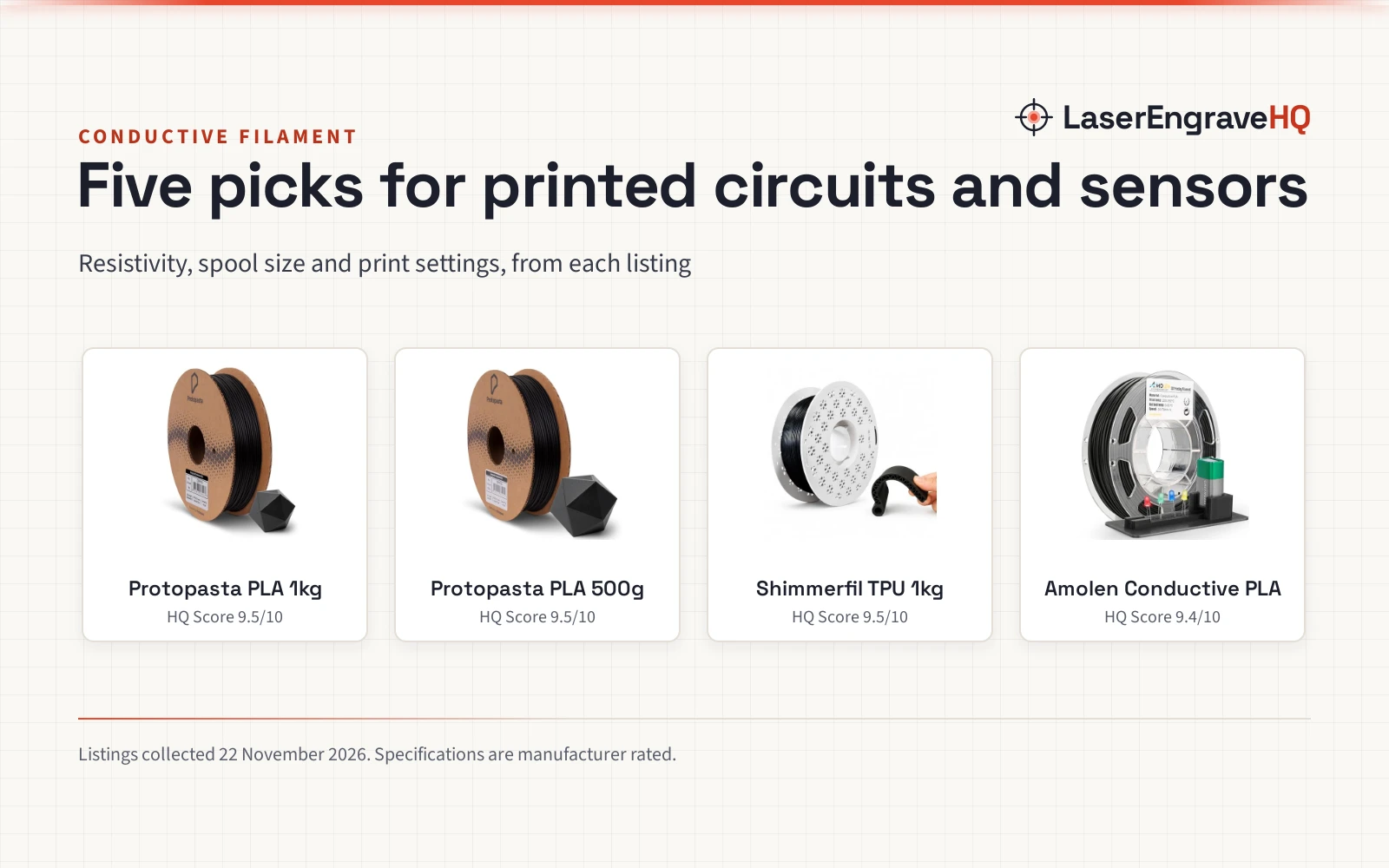
 Best OverallProtopasta PLA 1kg9.5/10View on Amazon
- 2
 Best for Small PrintsProtopasta PLA 500g9.5/10View on Amazon
- 3
 Best Flexible PickShimmerfil TPU 1kg9.5/10View on Amazon
- 4
 Best First TryAmolen Conductive PLA9.4/10View on Amazon
A printed circuit that lives inside the part itself is the appeal of conductive filament: a touch switch in a wall panel, a sensor housing that also carries the signal, a wearable prototype with the wiring printed in. This guide compares the best conductive filament spools for those jobs, conductive PLA and TPU filaments, on the figures that decide what they can do: the resistivity each maker states, the spool size, and the print settings the listing publishes.
LaserEngraveHQ earns a commission from purchases made through these links, at no extra cost to you. Read our affiliate disclosure.
Quick picks
- Best Overall Protopasta PLA 1kg: A 1 kg conductive PLA spool with resistivity under 10 ohm-cm, a 210 to 230°C print range and low warp. Check price on Amazon
- Best for Small Prints Protopasta PLA 500g: The same conductive PLA in a 500 g spool with a recyclable cardboard spool, for smaller print runs. Check price on Amazon
- Best Flexible Pick Shimmerfil TPU 1kg: A flexible conductive TPU with ESD-safe properties, a 1 kg spool and print settings from 20 to 50 mm/s. Check price on Amazon
- Best First Try Amolen Conductive PLA: A 200 g spool for a first try of conductive PLA, with a stated 6 month warranty and sealed vacuum packaging. Check price on Amazon
Machines on the list
Protopasta Electrically Conductive Composite Black
A 1 kg conductive PLA spool with resistivity under 10 ohm-cm, a 210 to 230°C print range and a recyclable cardboard spool.
Pros
- Volume resistivity under 10 ohm-cm for sensors and low-current circuits
- 1 kg spool of 1.75 mm filament for repeated prints
- Prints at 210 to 230°C with low warp, per the listing
- Recyclable cardboard spool
Cons
- No bed temperature is stated
- A 1 kg spool is a large buy for a short print run
- No print speed is stated
- Black is the only color stated
Protopasta Electrically Conductive Composite Black
A 500 g conductive PLA spool with resistivity under 10 ohm-cm, a 210 to 230°C print range and a recyclable cardboard spool.
Pros
- Volume resistivity under 10 ohm-cm for sensors and low-current circuits
- 500 g spool for smaller print runs
- Prints at 210 to 230°C with low warp, per the listing
- Recyclable cardboard spool
Cons
- Warranty is listed as none
- No bed temperature is stated
- No print speed is stated
- Black is the only color stated
SHIMMERFIL Conductive TPU Filament, 1kg, Black
A 1 kg flexible conductive TPU spool with ESD-safe properties, a 20 to 50 mm/s print speed and a 210 to 240°C extruder range.
Pros
- ESD-safe filament for low-voltage circuits, touch sensors and ESD jigs
- Flexible TPU for smart wearables, flexible sensors and gamepad buttons
- Print speed of 20 to 50 mm/s with extruder at 210 to 240°C
- Vacuum sealed with desiccant in a 1 kg spool
Cons
- No warranty term is stated
- Print speed is limited to 20 to 50 mm/s
- Black is the only color stated
- A 1 kg spool is a large buy for a short print run
AMOLEN PLA Filament,1.75mm 3D Printer Filament
A 200 g conductive black PLA spool with a stated 6 month warranty, a 230 to 280°C print range and sealed vacuum packaging.
Pros
- Stated 6 month warranty, the only warranty term in this guide
- 200 g spool for a first try of conductive filament
- Sealed vacuum bags keep the filament dry and out of dust
- Transparent spool shows the filament color
Cons
- No resistivity figure is stated
- The 200 g spool is small for repeated prints
- Needs a printer that reaches 230 to 280°C
- Black is the only color stated

YOUSU 3D Printer Filament Conductive Filament 1.75
A 1 kg flexible conductive TPU spool based on 95A TPU with carbon and graphene, for ESD covers, research and maker projects.
Pros
- Flexible 95A TPU with conductive carbon and graphene
- 1 kg spool of 1.75 mm filament with a 0.02 mm diameter tolerance
- Fits most FDM printers, including Bambu Lab, Creality Ender 3, Anycubic, Qidi and Flashforge
- Made for ESD covers, research and maker projects
Cons
- No warranty term is stated
- Absorbs moisture more easily than PLA and needs drying before printing
- Around 100k ohm per 10 cm, and the listing warns not to expect copper-wire conductivity
- The listing warns against too many overhang models
Specs compared
| Model | HQ Score | Material | Resistivity | Spool | Print temp | Warranty |
|---|---|---|---|---|---|---|
| Protopasta PLA 1kg | 9.5/10 | Conductive PLA | Less than 10 ohm-cm | 1 kg | 210 to 230°C | Not stated |
| Protopasta PLA 500g | 9.5/10 | Conductive PLA | Less than 10 ohm-cm | 500 g | 210 to 230°C | No warranty |
| Shimmerfil TPU 1kg | 9.5/10 | Conductive TPU | 80 cm | 1 kg | 210 to 240°C | Not stated |
| Amolen Conductive PLA | 9.4/10 | Conductive PLA | Not stated | 200 g | 230 to 280°C | 6 months |
| Yousu Conductive TPU | 9.4/10 | Conductive TPU | Around 100k ohm per 10 cm | 1 kg | Not stated | Not stated |
These numbers come straight from each maker’s listing and are rated, not measured by us (22 November 2026). Resistivity is quoted as each maker states it, and the units differ between listings, so the figures do not compare directly.
What the listings tell you, and what they leave out
This guide reads five listings: three conductive PLA spools and two conductive TPU spools. Only one of the five states a warranty term, a 6 month warranty on the AMOLEN spool, and one states no warranty at all. Resistivity is stated for three of the five, and the Yousu listing states resistance per length instead, around 100k ohm for a 10 cm length. Print temperatures are stated for four of the five, and only the SHIMMERFIL listing states a print speed.
The two TPU spools are the flexible picks, sold for wearables and touch sensors as well as circuits. The TPU listings also carry the clearest handling notes: the Yousu listing says the filament absorbs moisture more easily than PLA and needs drying before printing, and the SHIMMERFIL spool arrives vacuum sealed with desiccant.
Buying guide: choosing the best conductive filament
PLA or TPU
Conductive PLA suits rigid parts: circuit housings, sensor mounts and LED holders. Conductive TPU bends, so it suits wearables, flexible sensors and touch buttons that need to flex. The TPU spools here print slower, with the SHIMMERFIL listing rating 20 to 50 mm/s, and the Yousu listing warns against too many overhang models.
Resistivity figures
Resistivity is the figure that decides whether a printed part carries a signal. The Proto-Pasta spools state a volume resistivity of less than 10 ohm-cm. The SHIMMERFIL listing states 80 cm, and the Yousu listing states around 100k ohm for a 10 cm length of 1.75 mm filament. The units differ, so read each figure on its own terms and check it against the circuit you plan to print. The Yousu listing also notes that printed-part conductivity depends on infill rate, sectional area and length, and that an ohmmeter is needed to verify it.
Print settings
Print temperature is stated for four of the five spools. The Proto-Pasta spools print at 210 to 230°C, the SHIMMERFIL TPU at 210 to 240°C with a bed up to 60°C, and the AMOLEN PLA at 230 to 280°C with a bed at 80 to 100°C. The Yousu listing states no print temperature. Dry TPU before printing: the Yousu listing says conductive TPU absorbs moisture more easily than PLA.
Spool size
Spool size decides how many prints a spool covers. The AMOLEN spool holds 200 g, the Proto-Pasta 500 g spool holds 500 g, and the other three spools hold 1 kg each. A 200 g spool suits a first try of conductive filament, while a 1 kg spool suits repeated prints of the same part.
What conductive filament will not do
Conductive filament carries low-current signals for sensors, touch switches and LED circuits. It is not a replacement for copper wire: the Yousu listing says so plainly, and its 100k ohm figure for a 10 cm length shows the gap. The TPU listings note moisture: the Yousu listing says to dry the filament before printing, and the SHIMMERFIL spool arrives vacuum sealed with desiccant.
The listings here describe low-voltage circuits, touch sensors and ESD-safe parts. Dry TPU filament before printing, as the Yousu listing advises, and store spools sealed: the SHIMMERFIL spool arrives vacuum sealed with desiccant, and the AMOLEN spool ships in sealed vacuum bags.
Project Match
- Printed circuits and LED holders: the Proto-Pasta PLA spools, with resistivity under 10 ohm-cm and a 210 to 230°C print range.
- Flexible sensors and wearables: the SHIMMERFIL TPU, with ESD-safe properties and a 20 to 50 mm/s print speed.
- Touch switches and ESD-safe covers: the Yousu TPU, a flexible 95A TPU with carbon and graphene.
- A first try of conductive PLA: the AMOLEN 200 g spool, with a stated 6 month warranty.
How the scores add up
Each filament is scored out of 10 on performance, build, value, safety and warranty, with the weights published on the How We Pick page. A spec the listing does not publish scores nothing.
| Product | HQ Score | Perf. /35 | Build /25 | Value /25 | Safety /10 | Warranty /5 |
|---|---|---|---|---|---|---|
| Protopasta PLA 1kg | 9.5 | 32 | 22 | 21 | 0 | 0 |
| Protopasta PLA 500g | 9.5 | 30 | 22 | 20 | 0 | 0 |
| Shimmerfil TPU 1kg | 9.5 | 30 | 21 | 20 | 0 | 0 |
| Amolen Conductive PLA | 9.4 | 27 | 19 | 18 | 0 | 2 |
| Yousu Conductive TPU | 9.4 | 27 | 20 | 19 | 0 | 0 |
Scores never fall under 9.2 or rise above 9.8. A machine’s spot between those limits is set purely by its point total.
FAQ: lasers and CNC
What is conductive filament?
Conductive filament is 3D printer filament that carries an electric signal, so a printed part can act as a wire, a touch sensor or a circuit trace. The spools in this guide are conductive PLA and conductive TPU, both in 1.75 mm diameter.
Is there a conductive filament?
Yes. The five spools in this guide are all conductive filaments: three conductive PLA spools and two conductive TPU spools, in 1.75 mm diameter.
Is PLA filament conductive?
The conductive PLA spools in this guide are PLA with conductive properties: the AMOLEN and Proto-Pasta spools, and the Proto-Pasta spools state a volume resistivity of less than 10 ohm-cm. A PLA spool only conducts if the listing states conductive properties, so check before buying.
Is CF filament conductive?
The Yousu TPU in this guide gets its conductivity from conductive carbon and graphene, and its listing states around 100k ohm for a 10 cm length of 1.75 mm filament. It also warns not to expect conductivity like copper wire, so check the resistivity figure on the listing for the filament you buy.
Is ASA filament conductive?
None of the five filaments in this guide is ASA: the picks are conductive PLA and conductive TPU only. If you need an ASA part that carries a signal, look for a listing that states conductive properties and a resistivity figure, as the Proto-Pasta listings do.
Related: the 3D printers hub, best PETG filament for Bambu A1, how much 3D print filament costs, best filament dryer for PA6 CF, can you print carbon fiber, is a filament dryer worth it, types of PETG filament, and how thick 3D printer filament is.