Can You Print Carbon Fiber? Filament Needs for 3D Printers
Carbon fiber filament runs through a filament printer and gives prints extra stiffness, if the printer meets the heat and nozzle needs.

On this page
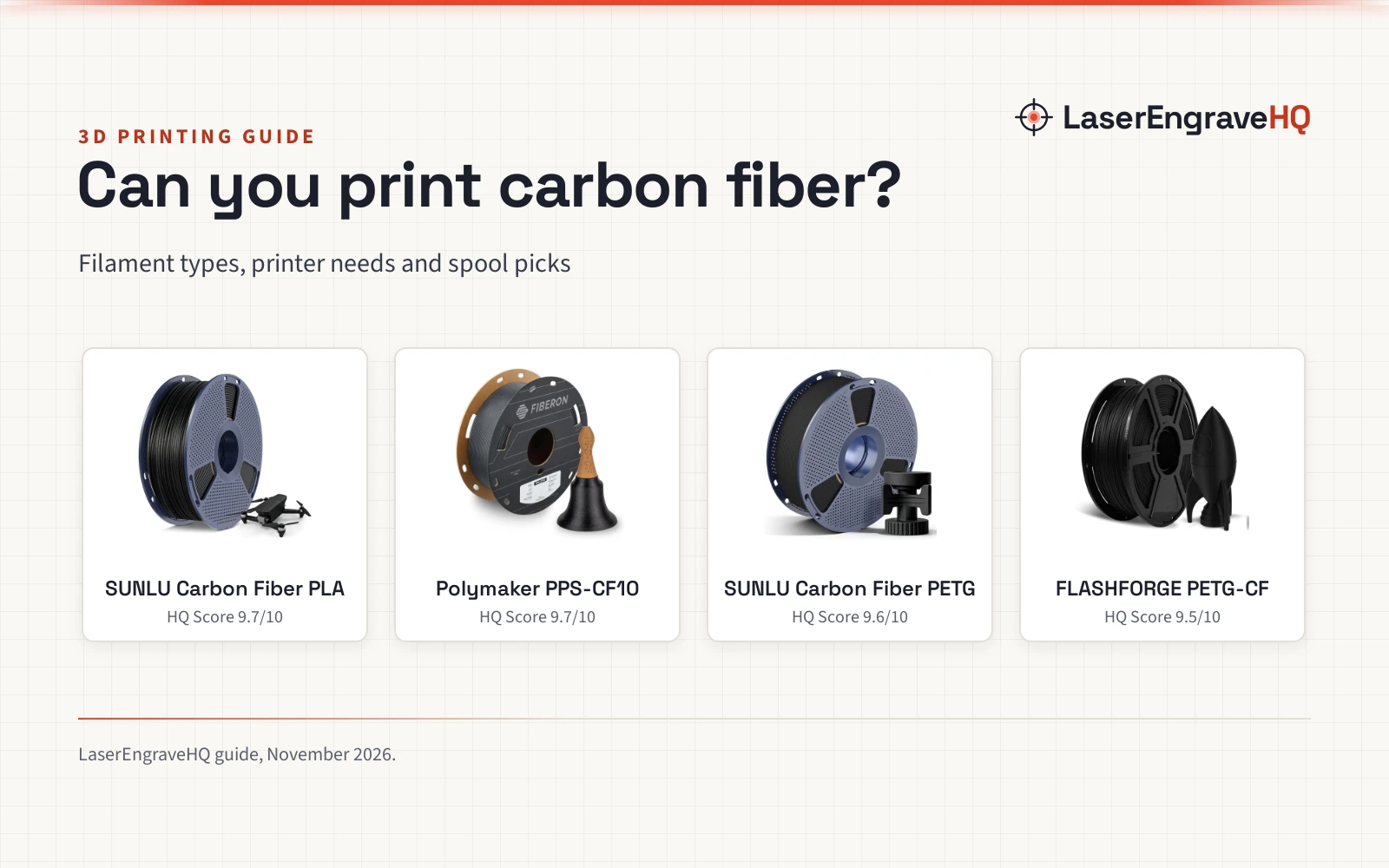
Top picks at a glance
As an Amazon Associate I earn from qualifying purchases.
- 1
 SUNLU Carbon Fiber PLA 3D Printer Filament9.7/10View on Amazon
- 2
 Polymaker Fiberon PPS-CF10 Filament Black 1.75mm9.7/10View on Amazon
- 3
 SUNLU Carbon Fiber PETG Filament 1.75mm9.6/10View on Amazon
- 4
 FLASHFORGE Carbon Fiber PETG Filament 1.75mm9.5/10View on Amazon
Can you print carbon fiber at home? Yes. Carbon fiber filament, chopped fiber mixed into PLA, PETG or PPS plastic, runs through a filament printer that reaches the temperatures the spool needs, and gives prints extra stiffness. The rest of this guide covers what the filament needs from the printer, how to pick a base material, and which spool fits each part.
LaserEngraveHQ earns a commission from purchases made through these links, at no extra cost to you. Read our affiliate disclosure.
SUNLU Carbon Fiber PLA 3D Printer Filament
A 1KG spool of PLA filament reinforced with 15% carbon fiber, printing at 190 to 230°C with a bed at 60 to 80°C and a matte finish.
Pros
- 15% carbon fiber reinforcement for stronger PLA parts
- 1.75mm diameter with accuracy of plus or minus 0.02mm
- Vacuum packed with desiccant to keep moisture out
- 1 year manufacturer warranty
Cons
- Needs a heated bed at 60 to 80°C
- Only a 1KG spool is listed, with no smaller size
- No heat deflection temperature is stated, so heat limits are unclear
- The listing names no wear-resistant nozzle for the carbon fiber
Polymaker Fiberon PPS-CF10 Filament Black 1.75mm
A 0.5KG spool of carbon fiber reinforced PPS filament for high-heat functional parts, printing at 310 to 350°C with a bed at 80 to 90°C.
Pros
- Heat deflection temperature of 252.5°C after annealing at 125°C for 16 hours
- Carbon fiber reinforced PPS for high heat, chemical resistance and rigidity
- Low moisture absorption of about 0.225% at 23°C and 70% relative humidity
- Suited to high-temperature prototypes, tooling and fixtures
Cons
- Needs a printer and all-metal hotend rated for 310 to 350°C
- Annealing at 125°C for 16 hours is needed for the stated properties
- Only a 0.5KG spool is listed
- Must be kept below 20% relative humidity during storage and use
SUNLU Carbon Fiber PETG Filament 1.75mm
A 1KG spool of PETG filament reinforced with 10% carbon fiber, with an impact strength of 19 kJ/m² and a heat deflection temperature of 70°C.
Pros
- 10% carbon fiber for tougher, stiffer parts than standard PETG
- Impact strength of 19 kJ/m² stated by the maker
- Heat deflection temperature of 70°C for warmer surroundings
- Matte surface finish with a subtle grip
Cons
- Filament must be dried at 70°C for 4 to 6 hours before use
- Needs a nozzle temperature of 240 to 250°C
- Only a 1KG spool is listed, with no smaller size
- The listing names no wear-resistant nozzle for the carbon fiber
FLASHFORGE Carbon Fiber PETG Filament 1.75mm
A 1kg spool of carbon fiber PETG filament for stronger, stiffer parts with better wear resistance, for gears, bearings and sliders.
Pros
- Carbon fiber reinforcement for stronger, stiffer parts
- Improved heat resistance over regular PETG
- Better wear resistance for gears, bearings and sliders
- PETG ease of printing with less warping and deformation
Cons
- No nozzle or bed temperature is stated
- No carbon fiber percentage is stated
- No warranty term is stated
- 1kg is the only spool size listed
Can you print carbon fiber with a standard printer?
Yes, if the printer reaches the temperatures the filament needs and the nozzle can handle the fiber. Carbon fiber filament is a plastic base with short carbon fibers mixed in, not woven carbon cloth, so it feeds through a filament printer. The fibers make the plastic stiffer, and the base plastic decides how hot the part can get and how easy the spool is to print.
What carbon fiber filament is
Carbon fiber filament mixes short carbon fibers into PLA, PETG or PPS. The fibers add stiffness and strength to the printed part, and the SUNLU spools here leave a matte surface. The base plastic sets the character: PLA-CF prints at low temperatures and suits display pieces and light-use parts, PETG-CF adds toughness for functional parts, and PPS-CF10 is an engineering filament for high-heat parts such as tooling and fixtures. The spools here are all 1.75mm filament, so check that your printer takes that size before you buy.
What your printer needs
Heat is the main requirement. PLA-CF prints at a nozzle temperature of 190 to 230°C with a bed at 60 to 80°C, PETG-CF needs a nozzle at 240 to 250°C with a bed at 50 to 70°C, and PPS-CF10 needs a nozzle at 310 to 350°C with a bed at 80 to 90°C and an all-metal hotend rated for that heat. Carbon fiber also wears nozzles, and PPS-CF10 calls for a hardened steel, ruby or other wear-resistant nozzle. PPS-CF10 is stiff before printing, and the maker calls for a smooth, low-resistance and direct path from the dry box to the extruder.
Pick the right filament for the part
Start from what the part must survive. For display pieces and light-use parts, PLA-CF gives stiffness and a matte finish. For tougher functional parts, the SUNLU PETG-CF spool adds impact strength of 19 kJ/m² and a heat deflection temperature of 70°C, and the maker names drone frames, automotive components, tools and industrial fixtures as uses. For parts that face high heat, PPS-CF10 lists a heat deflection temperature of 252.5°C after annealing at 125°C for 16 hours, and suits high-temperature prototypes and tooling.
Dry the filament and store it dry
Damp filament gives poor extrusion and surface quality, so check whether the spool calls for drying before use. The SUNLU PETG-CF listing calls for drying at 70°C for 4 to 6 hours before use and storage in a dry environment after. PPS-CF10 calls for drying at 100°C for 10 hours before printing and storage below 20% relative humidity during storage and use. SUNLU spools arrive vacuum packed with desiccant, so keep the spool dry once the pack is open.
Carbon fiber filament for your printer
The spools below cover the base materials in this guide, so match the spool to the temperatures your printer reaches.
FAQ: lasers and CNC
Can you print carbon fiber on any filament printer?
No. The printer must reach the temperatures the spool needs, from 190 to 230°C for PLA-CF up to 310 to 350°C for PPS-CF10, and the nozzle must suit carbon fiber.
Does carbon fiber filament need a special nozzle?
The PPS-CF10 listing calls for a hardened steel, ruby or other wear-resistant nozzle, since short carbon fiber wears a standard nozzle. The PLA-CF and PETG-CF listings here name no nozzle type.
Which carbon fiber filament is easiest to print?
PLA-CF, with a nozzle range of 190 to 230°C and a bed at 60 to 80°C. The SUNLU PETG-CF spool needs 240 to 250°C plus drying, and PPS-CF10 needs 310 to 350°C with annealing.
Do you need to dry carbon fiber filament?
Yes, when the maker calls for it. SUNLU PETG-CF calls for drying at 70°C for 4 to 6 hours before use, and PPS-CF10 calls for drying at 100°C for 10 hours before printing. Keep PPS-CF10 below 20% relative humidity.
Can carbon fiber filament print strong functional parts?
Yes. The SUNLU PETG-CF spool lists an impact strength of 19 kJ/m² and suits drone frames, automotive components, tools and industrial fixtures. PPS-CF10 lists a heat deflection temperature of 252.5°C after annealing and suits high-temperature prototypes, tooling and fixtures.
Related: the 3D printer hub, best PLA filament for 3D printers, best PETG filament for Bambu P1S and do 3D printers come with filament.