Types of PETG Filament Compared: A Maker’s Guide
A guide to standard, clear, carbon-fiber, glass-fiber, matte and high-speed PETG, and the figures to check before buying a spool.

On this page
A maker with a 3D printer and a shelf of parts that never quite worked faces a familiar choice: which plastic holds up when a print has to bend, sit in the sun, or carry a load without cracking. Types of petg filament answer that choice with a short menu: standard PETG, clear PETG, carbon-fiber PETG, glass-fiber PETG, matte PETG and high-speed PETG. Each type starts from the same base plastic and differs in clarity, stiffness, finish or intended print speed, so the right pick depends on the part, the maker figures and the printer, not the spool label alone. This guide explains each type in turn, what it suits, and how to read the figures the makers publish before buying.
As an Amazon Associate I earn from qualifying purchases. LaserEngraveHQ earns a commission from purchases made through these links, at no extra cost to you. Read our affiliate disclosure.
Every figure in this guide comes from a maker listing named in the text. Where a maker states no figure, the guide says so instead of guessing.
What PETG filament is
PETG is a plastic made for FDM 3D printers, and the Creality listing describes it as combining the strengths of PLA and ABS. That means prints with low shrinkage, high impact resistance, solid temperature resistance and high elongation at break, so models can bend repeatedly and stay firm. The same listing notes weather resistance and chemical resistance, with no odor from the filament itself. PETG suits parts that need to flex a little rather than snap, such as brackets, housings and containers, when the design and print settings suit the load and heat the part will see. How it compares with PLA or ABS depends on the load: the maker claims impact resistance and elongation for its filament, not a blanket win on every measure of strength.
Standard PETG
Standard PETG is the baseline every other type is measured against, and it is the plain type on the shelf. It prints with the low shrinkage and high impact resistance the material is known for, and finished parts bend rather than snap. When a maker gives figures, read them the same way every time. Creality lists its PETG filament at 1.75 mm diameter with accuracy of +/- 0.02 mm, sold as a 2 kg black and white pack, with 12-month after-sales service, 24-hour support and a 1-year warranty. Those figures describe the spool, not the finished print: diameter and its tolerance affect how consistently filament feeds and flows, while pack size governs how much plastic is on hand.
Clear PETG
Clear PETG, also sold as natural PETG, is the uncolored variant of the base plastic. Printed walls are translucent rather than transparent like glass, because layer lines and wall structure scatter light, so shapes and detail behind the wall stay blurred. Makers show it for lampshades and display boxes where light passing through matters more than a clear view. Clarity depends on print settings and wall thickness as much as on the spool, so a trial print in the same shape as the finished part shows what the material really looks like. Pick clear PETG when the part should pass light, and colored standard PETG when the part should stay opaque.
Carbon-fiber PETG
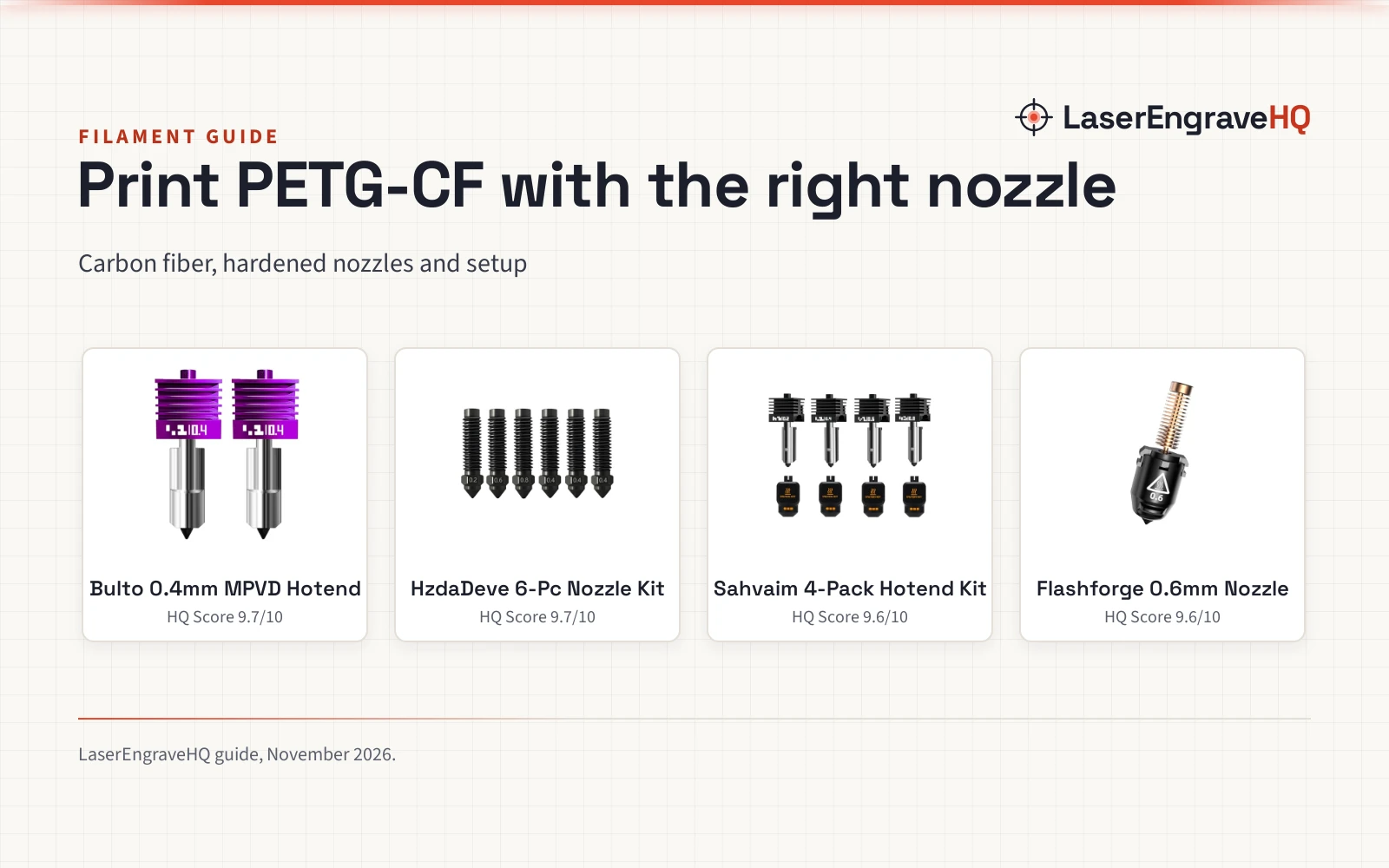
Carbon-fiber PETG, often sold as PETG-CF, adds short carbon fibers to the base plastic and is sold for stiffer printed parts. How much stiffness a print gains depends on fiber content, print orientation and settings, and filled prints can behave differently from plain PETG under impact, so the type suits brackets and mounts only when the maker figures and a trial print support the load. The trade is surface and wear: filled filament can be more abrasive than plain PETG and the finish is often matte rather than glossy, so check maker guidance for the nozzle and feed path. Read the guide on printing carbon fiber before loading a spool, and check the extruder problems guide for what a filled filament asks of the feed path.
Glass-fiber PETG
Glass-fiber PETG, sold as PETG-GF, adds short glass fibers to the same base plastic and is sold for stiffer prints. The gain depends on fiber content, orientation and settings, as with carbon-fiber PETG, and no single figure in this guide covers the category, so housings and jigs still need maker figures and a trial print for the intended load and conditions. Filled plastic can be more abrasive than plain PETG and the finish is often matte. Pick glass-fiber PETG only when its maker figures fit the part, and plain PETG where a smooth glossy surface matters more.
Matte PETG
Matte PETG is sold for a low-gloss, muted surface. The finish can make layer lines less obvious than a glossy surface and suits display parts and pieces meant to look flat rather than shiny. Matte formulations differ by maker and can print and behave differently from standard PETG, so strength and stiffness cannot be assumed to match standard PETG without maker figures. Choose matte PETG for looks after checking the maker print guidance, and standard PETG when a glossy finish is part of the design.
High-speed PETG
High-speed PETG is sold as a variant tuned for faster printing. The label alone does not promise shorter print times or the same toughness and layer adhesion as standard PETG, because results depend on the printer, hotend flow, temperatures and slicer settings. The type suits makers who run long print queues only when maker guidance and a trial print at the intended speed show the part holds together. Pick high-speed PETG for throughput after that check, and standard PETG when print time does not drive the choice.
How to pick a PETG filament
Pick by the figures, then by color. Diameter decides whether the spool feeds at all: Creality lists its PETG at 1.75 mm, and the guide at how thick 3D printer filament is explains which size a printer takes. Accuracy matters next: the same listing gives +/- 0.02 mm, which describes diameter tolerance and affects feed and flow consistency. Pack size follows: the Creality pack holds 2 kg across black and white, so check how much plastic a project needs before ordering. Storage matters too, since the maker asks for a dry and ventilated place, away from high temperature, sun and humidity. For toughness, the comparison at the toughest 3D printer filament puts PETG beside nylon and other plastics. Service terms close the check: the Creality listing gives 12-month after-sales service, 24-hour support and a 1-year warranty.
Common mistakes to avoid
- Buying a filled PETG for a glossy display part.
- Storing an open spool in a damp room.
- Picking a type by color instead of by the figures on the spool page.
- Skipping a trial print before a long run.
- Ignoring the diameter on the spool.
Types of PETG filament: the short version
- Standard PETG is the baseline for tough, bendable parts.
- Clear PETG is for translucent parts that should pass light.
- Carbon-fiber PETG is sold for stiff functional parts, subject to maker figures.
- Glass-fiber PETG is sold for stiff parts, subject to maker figures.
- Matte PETG is for a low-gloss finish.
- High-speed PETG is sold for faster printing, subject to printer and settings.
Match the type to the part, then check diameter, accuracy and pack size on the spool page before ordering.
FAQ: lasers and CNC
Is PETG stronger than PLA?
Strength depends on the load. The Creality listing describes its PETG as combining the strengths of PLA and ABS, with low shrinkage, high impact resistance and high elongation at break, so its printed parts can bend repeatedly and stay firm. That claim covers impact and bending for that filament, not every measure of strength for every PETG, so compare maker figures for the load the part will carry.
Which PETG filament is best for transparent parts?
Clear or natural PETG, sold for translucent parts such as lampshades and display boxes where light should pass through. Printed walls stay translucent rather than transparent like glass, so a trial print in the intended shape shows the real clarity before a long run.
Can PETG filament be used outdoors?
The Creality listing claims weather resistance and chemical resistance for its filament, with no odor. Whether a printed part holds up outside still depends on heat, load, color, design and print settings, so a trial print in the intended shape and conditions is the way to check the result.
What diameter PETG filament do printers take?
Creality lists its PETG at 1.75 mm diameter with accuracy of +/- 0.02 mm. Check the printer manual for the diameter it takes, and read the thickness guide linked above before ordering.
How should PETG filament be stored?
The maker asks for a dry and ventilated place, away from high temperature, sun and humidity. A sealed box or dry cabinet keeps the spool ready for the next print.
Related: the 3D printers hub, how to 3D print for beginners and best 3D printer for smooth finish. Also see how to improve 3D print quality. Also see how long to leave PLA filament out.