UV Laser vs CO2 Laser: Which One Should You Buy?
A complete comparison of UV lasers and CO2 lasers covering beam technology, material compatibility, cutting capability, marking precision, cooling and workshop costs.

On this page
Top picks at a glance
As an Amazon Associate I earn from qualifying purchases.
- 1
 xTool S1 40W Laser Cutter and Laser Engraver for Tumblers9.7/10View on Amazon
- 2
 OMTech 100W CO2 Laser Engraver with 4 Way Pass Through Air9.7/10View on Amazon
- 3
 xTool P2S 55W CO2 Laser Cutter9.7/10View on Amazon
- 4
 Brilliance Laser Inks Black Metal Liquid-Ready Laser MarkingView on Amazon
- 5
 Brilliance Laser Inks Copper-Tone Red Liquid-Ready MarkingView on Amazon
- 6
 CO2 Laser Lens 20mm FL:2.5" or 63.5mm Mirror ZnSe Focus FocalView on Amazon
- 7
 Cloudray CO2 Laser Lens Dia 20mm FL50.8mm Mirror Focal LensView on Amazon
- 8
 TEN-HIGH 40W CO2 Laser Tube 700mm D50mmView on Amazon
- 9
 MCWlaser CO2 PVD ZnSe Laser Lens Focal Focus Lens Dia: 18mmView on Amazon
Makers producing custom signs, glassware, acrylic displays, leather patches, and branded merchandise frequently compare a uv laser vs co2 laser. The choice depends on whether your priority is ultra-fine surface marking on heat-sensitive materials or deep cutting through organic sheet stock. If your workshop demands high-contrast marking on delicate plastics, silicone, micro-electronics, or glassware requiring a silky frosted finish without micro-fracturing, a UV laser is the right machine. If you need to cut structural acrylic, slice through hardwoods and plywood, or engrave leather goods, a CO2 laser is the workhorse you need. The sections below break down beam physics, material compatibility, cutting capability, maintenance, and operating costs.
Other machines to compare
 Brilliance Laser Inks Black Metal Liquid-Ready Laser MarkingCheck price on Amazon
 Brilliance Laser Inks Copper-Tone Red Liquid-Ready MarkingCheck price on Amazon
 CO2 Laser Lens 20mm FL:2.5" or 63.5mm Mirror ZnSe Focus FocalCheck price on Amazon
 Cloudray CO2 Laser Lens Dia 20mm FL50.8mm Mirror Focal LensCheck price on Amazon
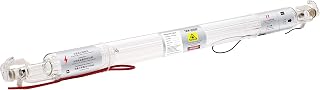 TEN-HIGH 40W CO2 Laser Tube 700mm D50mmCheck price on Amazon
 MCWlaser CO2 PVD ZnSe Laser Lens Focal Focus Lens Dia: 18mmCheck price on Amazon
LaserEngraveHQ earns a commission from purchases made through these links, at no extra cost to you. Read our affiliate disclosure.
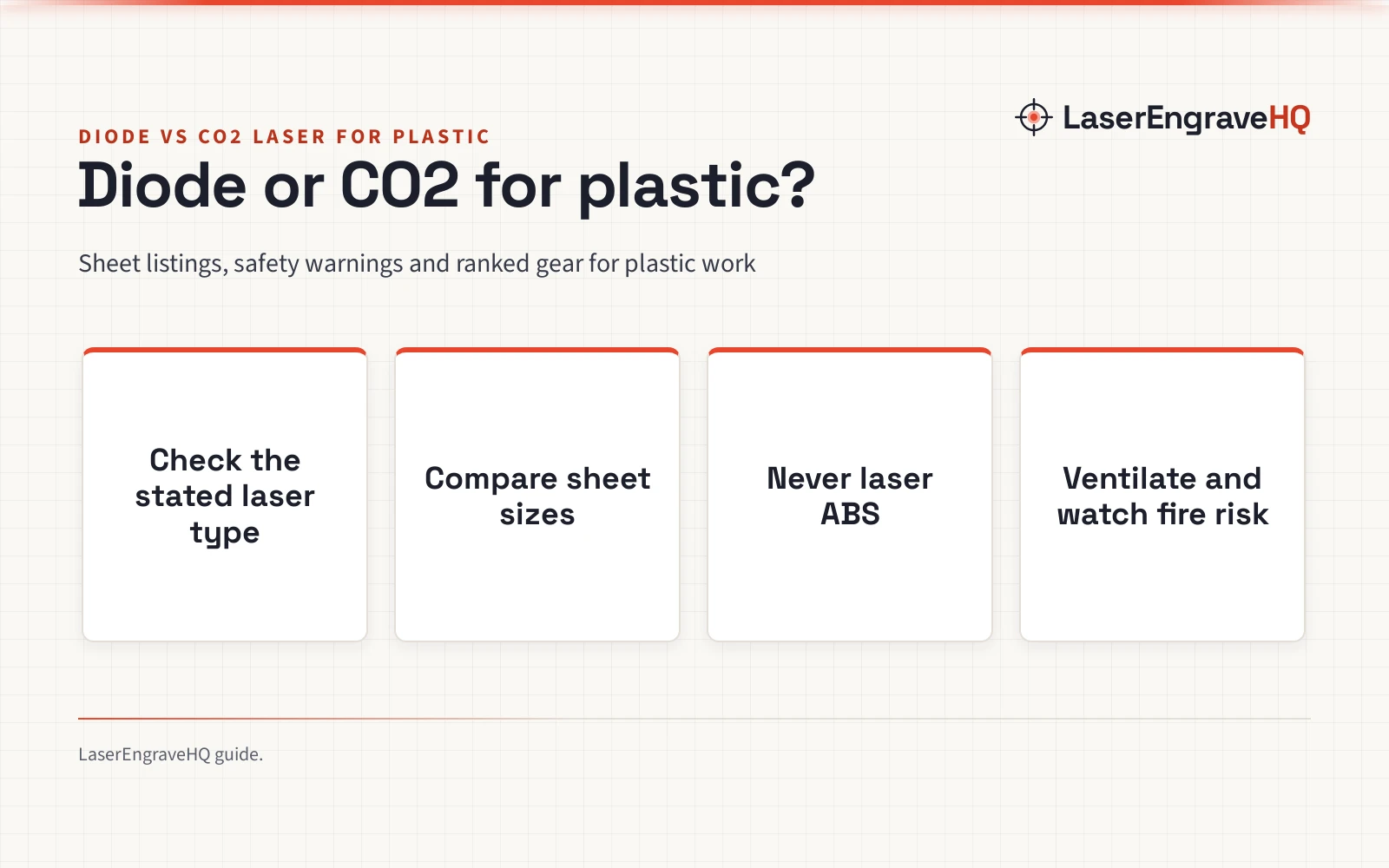
Regardless of whether you choose an ultraviolet machine or a carbon dioxide cutter, never place PVC, vinyl, synthetic leather containing vinyl, polycarbonate, or ABS under the beam. Laser processing of these materials releases corrosive gases that damage optical lenses, ruin guide rails, and create severe workshop hazards.
Step 1: Compare beam wavelengths and marking physics
The defining distinction begins at the optical source. A UV laser operates in the ultraviolet spectrum, carrying higher photon energy than infrared systems. Because ultraviolet photons break chemical bonds directly at the molecular level, the process is called cold marking or photochemical processing. This reaction alters surface color without generating heat, leaving a virtually nonexistent heat-affected zone with no scorch, discoloration, or melt lip.
A CO2 laser excites a carbon dioxide gas mixture inside a resonator tube, producing a far-infrared wavelength. Materials absorb this light thermally: the focused beam heats, vaporizes, and ablates material. While exceptional for cutting sheet stock, this heat can micro-fracture glass, warp thin plastics, and scorch delicate edges. Read our explanation of what is a CO2 laser engraver for more on gas tubes.
Step 2: Map workshop materials to laser absorption
Material compatibility is decisive for an engraving shop. Ultraviolet light is readily absorbed by commercial plastics, including white resins, polyethylene, silicone, and thin films. Photochemical reactions produce high-contrast marks without melting the substrate. While a CO2 laser cuts and engraves cast acrylic cleanly, its thermal beam melts and blurs flexible polymers like polyethylene and silicone.
Glassware presents another clear split. A UV laser produces a smooth, satin-frosted surface on glassware without micro-cracking. A CO2 laser marks glass via thermal shock, fracturing microscopic surface flakes into a slightly rough texture. Review setup techniques in our guide to laser settings for glass.
For organic goods, the advantage flips. Wood, leather, and paper absorb far-infrared energy efficiently. A CO2 laser cuts timber and engraves dark contrast on leather hides. A UV laser leaves only superficial marks on wood, making it impractical for decorative signs. Explore our best CO2 laser cutter for home use guide, or see our UV vs diode laser engraver comparison for other options.
Step 3: Decide between surface marking precision and deep cutting capability
Beam spot size and optical power dictate whether a machine details or cuts. Ultraviolet lasers produce an ultra-tight focal spot, far smaller than an infrared beam. This spot size enables engraving miniature serial numbers, tiny matrix barcodes, and hairline vector art with pin-point precision. However, modest optical power makes ultraviolet units strictly marking machines that cannot slice through structural plywood or thick acrylic.
CO2 laser cutters are built for material separation. Powered by high-output discharge tubes, a CO2 machine delivers the optical power needed to cut thick acrylic displays, wooden puzzles, and sign parts in a smooth continuous pass. Cast acrylic cuts with a flame-polished edge requiring no sanding. If your work requires dimensional cutting, a CO2 unit is required. See our best laser for cutting acrylic guide for details.
For bare metals, a standard CO2 laser cannot mark reflective surfaces without chemical marking sprays. A UV laser marks bare and coated metals with crisp surface contrast and no heat distortion, though deep metal engraving requires a dedicated fiber laser, as detailed in our UV vs fiber laser comparison.
Step 4: Assess cooling, maintenance and operating requirements
Operating needs differ between gantry cutters and compact marking stations. Most workshop CO2 machines use a flatbed gantry layout where the beam reflects off steering mirrors to a moving focus carriage. Mirrors must be cleaned and aligned periodically, as explained in our guide on how to align mirrors on a CO2 laser. Water-cooled glass tubes require continuous circulation via a chiller, covered in our CO2 laser water chiller guide. Tubes also degrade and require eventual replacement.
UV laser machines typically use a galvanometer scan head where internal mirrors steer the beam across a fixed marking field, eliminating flying-optic alignment. However, generating ultraviolet light relies on diode-pumped solid-state crystals and frequency conversion optics. These crystals generate heat and require temperature stabilization via thermoelectric coolers or chillers in a climate-controlled room.
Workshop safety and ventilation are essential. Both beam types vaporize material into airborne soot and chemical fumes. CO2 cutters vaporize dense wood and acrylic, demanding high-flow external ducting as outlined in how to vent a CO2 laser outside.
Eye protection requires strict separation. A CO2 laser demands safety glasses certified for far-infrared wavelengths. A UV laser requires glasses certified for ultraviolet radiation. Swapping eyewear or relying on unmarked plastic provides no protection. Review safety ratings in laser classes explained.
Step 5: Evaluate production workflow and workshop fit
Selecting a machine comes down to your product line. If your business centers on cutting boards, wooden plaques, acrylic cake toppers, ornaments, and leather patches, a CO2 laser provides the cutting power and bed capacity needed to fabricate goods from sheet stock. Cutting and engraving on that same machine delivers rapid payback. Review models in our best laser engraver for small business guide, or consult how to choose a laser engraver.
If your business targets silicone bands, crystal glassware, electronics, or fine plastic merchandise, a UV laser justifies its investment. Cold photochemical processing eliminates scrapped blanks from scorch or melted rims. While the equipment cost is higher, the detail and clean yield on sensitive substrates give specialized shops an edge.
Common mistakes to avoid
- Purchasing a UV laser expecting to cut thick plywood or acrylic sheets.
- Using a CO2 laser on heat-sensitive plastics and expecting uncharred results.
- Wearing infrared safety glasses while running an ultraviolet laser beam.
- Neglecting periodic mirror alignment and chiller maintenance on a CO2 machine.
- Attempting to process prohibited materials like PVC, vinyl, polycarbonate, or ABS.
- Running either machine without dedicated external exhaust or multi-stage filtration.
UV laser vs CO2 laser: the short version
- Identify materials: choose CO2 for wood, thick acrylic, and leather; choose UV for plastics, glass, silicone, and fine parts.
- Define operations: select CO2 for cutting sheet goods; select UV for high-resolution surface marking.
- Compare beam physics: UV provides cold photochemical marking without scorch; CO2 provides thermal ablation for cutting.
- Assess spot size: UV produces an ultra-fine spot for micro-text; CO2 produces a broader beam suited for cutting kerfs.
- Maintain cooling: CO2 gantry units need mirror alignment and water chillers; UV systems need stable ambient temperatures.
- Equip safety gear: use safety glasses matched strictly to each wavelength band, and run dedicated fume exhaust.
FAQ: lasers and CNC
Can a UV laser cut wood or acrylic like a CO2 laser?
No. UV lasers have modest optical output power designed for surface marking and micro-machining rather than bulk ablation. While a UV beam can score thin films, cutting standard wood boards or thick acrylic sheets requires the high thermal power of a CO2 cutter.
Can a CO2 laser mark bare metal?
A standard CO2 laser cannot mark bare reflective metals directly because conductive surfaces reflect the far-infrared beam. Marking metals like stainless steel with a CO2 laser requires chemical marking spray or paste before running the job. A UV laser marks bare and plated metals directly without spray.
Do UV lasers and CO2 lasers share the same safety glasses?
Never. Optical safety eyewear must match the specific wavelength emitted. CO2 glasses block far-infrared light, while UV glasses block ultraviolet radiation. Wearing eyewear rated for one wavelength while running the other offers no eye protection.
Which machine requires more routine maintenance?
Gantry CO2 lasers require more routine upkeep: operators must clean and align steering mirrors, monitor chiller coolant, and eventually replace the discharge tube. UV galvo units lack flying optics, though their harmonic crystals require a clean, climate-stable room.
Why are UV lasers generally more expensive than CO2 lasers?
UV lasers use complex diode-pumped solid-state architectures with specialized nonlinear crystals to convert laser emissions into ultraviolet light. Producing these harmonic crystals and galvo scan heads is far more costly than manufacturing glass CO2 gas discharge tubes.
Can both lasers engrave curved items like drinking glasses?
Yes, both machines engrave curved glassware when paired with a rotary attachment. A CO2 laser marks glass by thermal micro-fracturing, leaving a slightly textured feel. A UV laser interacts photochemically, producing a smooth frosted finish without chipping.
Related: the laser engraver hub, our best UV laser engraver guide, our diode vs CO2 laser comparison, our best fume extractor for laser engraver guide and our analysis on is CO2 laser worth it.