Milling Machine for Beginners: What to Buy
A first benchtop mill, explained step by step: size classes, spindle speeds, materials, travel and the figures to check before you buy.

On this page
Top picks at a glance
As an Amazon Associate I earn from qualifying purchases.
- 1
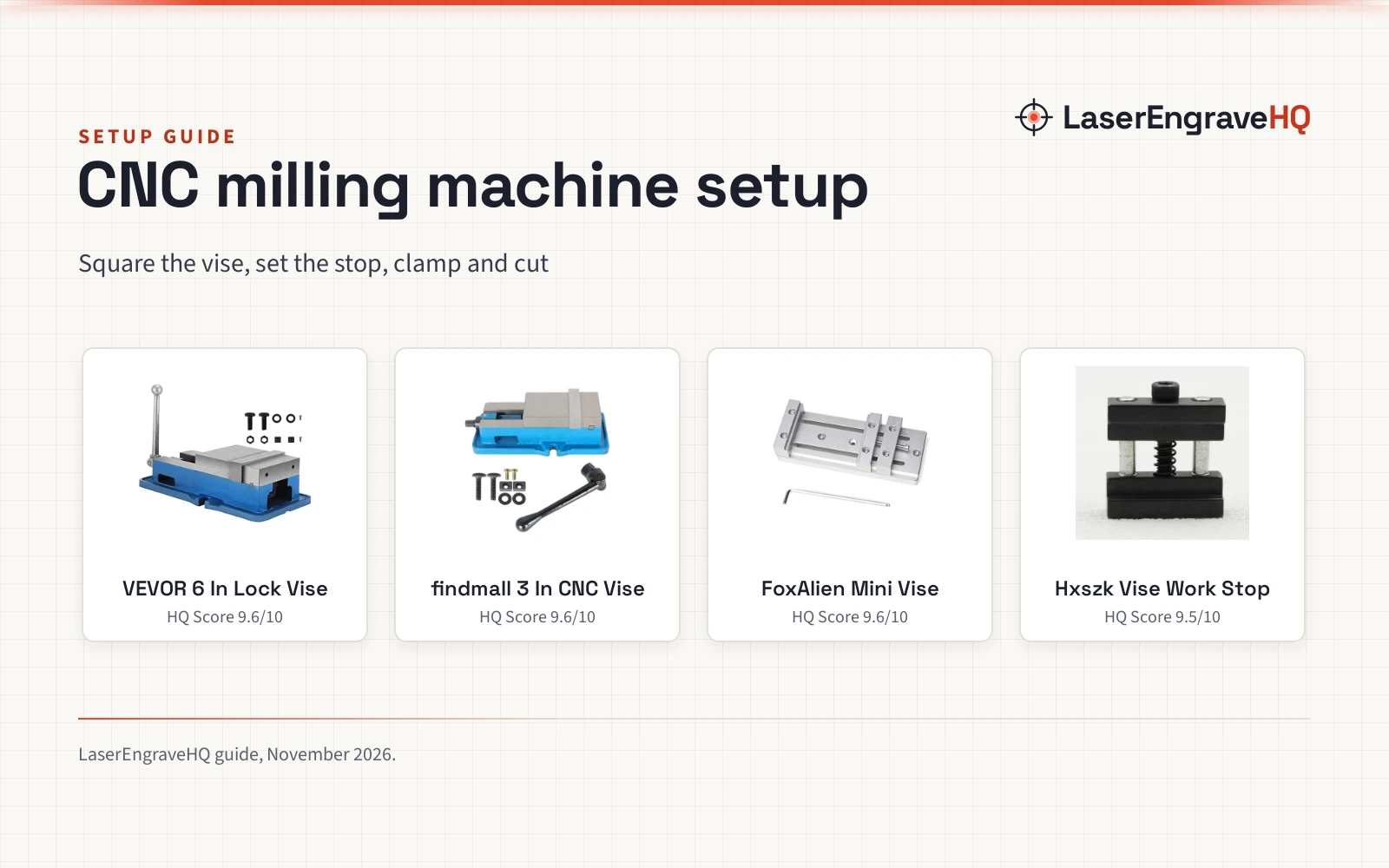
 VEVOR 6 Inch ACCU Lock Down Vise Precision Milling Vice 69.6/10View on Amazon
- 2
 findmall 3 Inch Accuracy CNC Mill Vise Without Base9.6/10View on Amazon
- 3
 Hxszk Milling Vise Quick Clamp Work Stop9.5/10View on Amazon
A milling machine for beginners is a benchtop mill that shapes metal, wood and plastic by moving a workpiece under a spinning cutter, and the best machine to start with is the one that fits your bench, your material and your patience. The reader who wants to make small brackets, model parts or an aluminum plate does not need a full-size shop mill, just a machine with controls they can learn a step at a time. The sections below walk through the types, the figures that matter and the practice cuts, using maker-stated figures for the machines named.
LaserEngraveHQ earns a commission from purchases made through these links, at no extra cost to you. Read our affiliate disclosure.
This guide gives no prices, because prices change often and vary by seller. Every figure in this guide is stated by the maker of the machine it describes.
Step 1: Learn what a mill does
A milling machine cuts with a rotating cutter while the workpiece moves under it on a table. The machine moves along X, Y and Z axes, so the cutter can shape flat surfaces, grooves and curved profiles. A drill press plunges straight down, while a mill also moves sideways, which is what makes slots and grooves possible. The ZHRUI mini mill (on Amazon) lists milling, slotting, surface machining and detailed shaping among its jobs, and the MechMaxx VM18L lists milling, drilling and cutting among its own.
Step 2: Pick a size class: mini mill or benchtop mill drill
Beginner mills come as mini mills or benchtop mill drills. A mini mill such as the ZHRUI, with a 36W motor reaching 20,000 RPM, suits small-scale precision machining, model making and hobby workshops, while the XENDOLL W104MA pairs a 24W motor with a 6.0 lb body for hobby work and model making on a home bench. A benchtop mill drill such as the MechMaxx VM18L, with a 1 HP motor and a 180 lb body, suits light and medium-duty machining in a garage shop, while the JET JMD-15 (on Amazon), a 15-inch mill drill with a 1 HP motor and a 440.0 lb body, suits a fixed shop spot. Read our types of milling machines guide and our manual vertical milling machine guide before choosing a class.
Step 3: Match spindle speed and power to your material
Spindle speed and power decide what a mill can cut. The ZHRUI mini mill runs up to 20,000 RPM, the XENDOLL W104MA lists a 20000 RPM motor with a 3000 RPM spindle speed, the MechMaxx VM18L runs 0 to 2500 RPM, the VEVOR mill drill (on Amazon) runs 150 to 2560 RPM across 12 speed settings, and the INTBUYING mini mill runs 50 to 2250 RPM. Power runs from 24W on the XENDOLL and 36W on the ZHRUI to 600W on the INTBUYING, 1 HP on the VM18L and the JET JMD-15, and 2 HP on the VEVOR. Match the material to the machine: the ZHRUI lists wood, aluminum, copper, plastic and acrylic, the XENDOLL lists wood, soft metal and plastic, and the INTBUYING lists stainless steel, iron, aluminum, copper, wood and nylon. For help with speeds, see our CNC router feeds and speeds calculator.
Step 4: Check travel, tilt and table size
Travel decides how big a workpiece you can mill. The MechMaxx VM18L lists X, Y and Z-axis travels of 8-5/8 in, 6-5/16 in and 10-27/32 in, with a spindle to table distance of 10-7/8 in, while the INTBUYING mini mill lists a table of 5-1/2 in by 20 in. Tilt opens angled work: the VM18L lists a 60-degree head tilt, the INTBUYING lists a head tilt of up to 90 degrees, the VEVOR lists a 45-degree table tilt, and the JET JMD-15 lists a 360-degree head swivel. Capacity matters too: the VM18L lists a 3/4 in drilling capacity and a 2 in face milling capacity, and the JET JMD-15 lists a 1/2 in drill chuck. Measure your bench and your largest workpiece against these figures before ordering.
Step 5: Learn the controls before the first cut
A mill is learned through its controls, not its catalog. The handwheel system positions the workpiece and the cutting tool, and the ZHRUI lists a handwheel-operated adjustment system with a dovetail guide rail. The INTBUYING mini mill lists a micro-feed function with accuracy up to 0.01mm, while the XENDOLL W104MA lists a 0.1mm per frame handle scale. Spindle tooling matters too: the VM18L lists an R8 spindle taper with a quill diameter of 2-3/8 in and a drawbar thread size of 7/16-20, and the INTBUYING lists MT2 with a set of R8-ER32 milling chucks. For cutter types, see our types of end mills guide.
Step 6: Make practice cuts on scrap
Start on scrap material before touching a real part. Take light passes and check the finish after each pass. The XENDOLL kit includes safety glasses, tools and accessories, so wear the glasses for every cut. The ZHRUI lists a milling cutter set in multiple sizes and cutting profiles, and the INTBUYING comes with a set of R8-ER32 milling chucks, so a beginner can try different cutters without a separate order. Keep the work area clear and the workpiece clamped firmly before the cutter spins.
Common mistakes to avoid
- Buying the biggest machine before knowing the material.
- Skipping the weight check: the JET JMD-15 weighs 440.0 lb, while the XENDOLL W104MA weighs 6.0 lb, so the bench must suit the machine.
- Using the 24W XENDOLL on stainless steel, when it names wood, soft metal and plastic among its materials.
- Ignoring spindle speed: the INTBUYING runs 50 to 2250 RPM while the VEVOR runs 150 to 2560 RPM, so the range must match the job.
- Forgetting the work area: the VM18L lists X travel of 8-5/8 in, so measure the part against the travel before ordering.
Milling machine for beginners: the short version
- Learn what a mill does: a spinning cutter shapes the workpiece as the table moves.
- Pick a size class: a mini mill for hobby work or a benchtop mill drill for a garage shop.
- Match speed and power to the material: 24W to 2 HP across the machines named here.
- Check travel, tilt and table size against your bench and your largest workpiece.
- Learn the handwheels, the micro-feed and the spindle tooling before cutting.
- Make practice cuts on scrap, with safety glasses on, before touching a real part.
FAQ: lasers and CNC
What size milling machine should a beginner buy?
A mini mill suits hobby work: the ZHRUI lists a 36W motor reaching 20,000 RPM, and the XENDOLL W104MA weighs 6.0 lb. A benchtop mill drill suits a garage shop: the MechMaxx VM18L weighs 180 lb with a 1 HP motor, and the JET JMD-15 weighs 440.0 lb. Pick the class that fits your bench and your material.
How much power does a beginner mill need?
Power runs from 24W on the XENDOLL and 36W on the ZHRUI to 600W on the INTBUYING, 1 HP on the VM18L and the JET JMD-15, and 2 HP on the VEVOR. Small hobby work suits the lower figures, while the 1 HP VM18L lists light and medium-duty machining and the 2 HP VEVOR lists woodworking and light metalwork.
Can a beginner mill cut steel?
It depends on the machine. The INTBUYING lists stainless steel and iron among its materials, while the ZHRUI lists wood, aluminum, copper, plastic and acrylic, and the XENDOLL lists wood, soft metal and plastic. Match the material to the machine named for it, and do not use a mini mill on a metal it does not name.
What is the difference between a mill drill and a mini mill?
The JET JMD-15 is a 15-inch mill drill with a 1 HP motor and a 440.0 lb body, and the MechMaxx VM18L is a 6 in by 20 in benchtop mill drill. The ZHRUI mini mill lists a 36W motor, and the XENDOLL W104MA weighs 6.0 lb.
Do I need a vise or chucks to start?
The VEVOR mill drill includes a rotating vise, the INTBUYING comes with a set of R8-ER32 milling chucks, and the ZHRUI comes with a milling cutter set. The XENDOLL kit includes safety glasses, tools and accessories. Check what comes with the machine you pick before ordering more tooling.
How heavy is a benchtop milling machine?
Weight runs from 6.0 lb on the XENDOLL W104MA to 440.0 lb on the JET JMD-15, with the MechMaxx VM18L at 180 lb and the INTBUYING at 215.0 lb. Check your bench against the weight before ordering.
Related: the CNC routers hub, types of milling machines and low cost milling machines. Also see our CNC tooling.