Types of End Mills and Which to Use
Types of end mill explained by end shape, flute count, material, coating and size, with the figures the listings state here.

On this page
Top picks at a glance
As an Amazon Associate I earn from qualifying purchases.
- 1
 SPEED TIGER ISE Carbide End Mill 1/8”9.8/10View on Amazon
- 2
 SPEED TIGER EISE 1/8" Carbide Square End Mill9.8/10View on Amazon
- 3
 5/16 Inch Shank Carbide Square End Mill9.7/10View on Amazon
A slot with a flat bottom, a pocket with a rounded corner and a profile cut that leaves a clean edge all start with the same choice, and types of end mill is the choice that names it. An end mill is a rotary cutter for a mill or a CNC router, and its type comes from the shape of the end, the flute count, the material and the coating. The steps below read a listing the way a machinist reads it, from the end shape to the shank, with the sizes the listings state.
LaserEngraveHQ earns a commission from purchases made through these links, at no extra cost to you. Read our affiliate disclosure.
The listings state sizes, flute counts, coatings and hardness figures, not cutting speeds or feeds. Treat any speed figure online as a claim for a specific machine and material, not a rule for yours.
Step 1: Read the end shape
The end shape decides what the bottom of the cut looks like. A square end mill leaves a flat bottom and a sharp corner, and the listings here are mostly square end: Shars lists a square end set from 3/16 to 3/4 inch, and BestParts lists a 4 flute square end set with a 30 degree helix. A corner rounding end mill leaves a rounded edge instead, and Accusize lists a corner rounding set from 1/16 to 3/8 inch for milling rounded corners. Pick the square end for slots, pockets and profiles with flat bottoms, and the corner rounding mill where the edge itself needs a radius.
Step 2: Count the flutes
The flute count is the number of cutting edges, and it decides how the mill clears chips and how smooth the finish runs. A 2 flute mill clears chips fast and suits slotting and softer material, while a 4 flute mill leaves a smoother finish and suits side milling and harder material. The listings here run from 2 flute to 4 flute: Shars lists a set with 2 and 4 flute mills, WEN lists an 8-piece 2-flute set, and most carbide sets list 4 flute mills, while the SpeTool carbide (on Amazon) set lists 2 flutes. More flutes mean less room for chips, so a 2 flute mill is the pick where chips need room to leave, and a 4 flute mill is the pick where the finish matters more.
Step 3: Pick the material
High speed steel and carbide are the materials in these listings. High speed steel, listed as HSS and as M2 high speed steel, is the tougher material for general work, and the Shars, WEN and UI PRO TOOLS sets are HSS. Carbide is harder and holds an edge longer in hard material, and a carbide set lists tungsten steel with a 4 flute cut. Carbide can run at higher speeds than high speed steel, and it resists wear and high cutting temperatures, per the BestParts listing. Pick HSS for general milling and for a starter set, and carbide where the material is hard and the edge must last. See the carbide vs HSS end mill guide for the full comparison.
Step 4: Pick the coating
A coating adds hardness and heat resistance to the edge. The listings here show the range: uncoated HSS, TiN coated HSS in a titanium nitride coat, and AlTiN and TiAlN coated carbide. The AlTiN coating on the carbide sets is listed with high aluminum content for hot hardness and oxidation resistance, and the TiAlN coating is listed with high hardness and low friction. The listings also state the hardness of material the mills suit: the carbide sets list HRC 45, and the SpeTool set lists HRC 55. Pick uncoated HSS for general work, TiN where a longer edge life matters, and AlTiN or TiAlN where the cut runs hot.
Step 5: Match the size and the shank
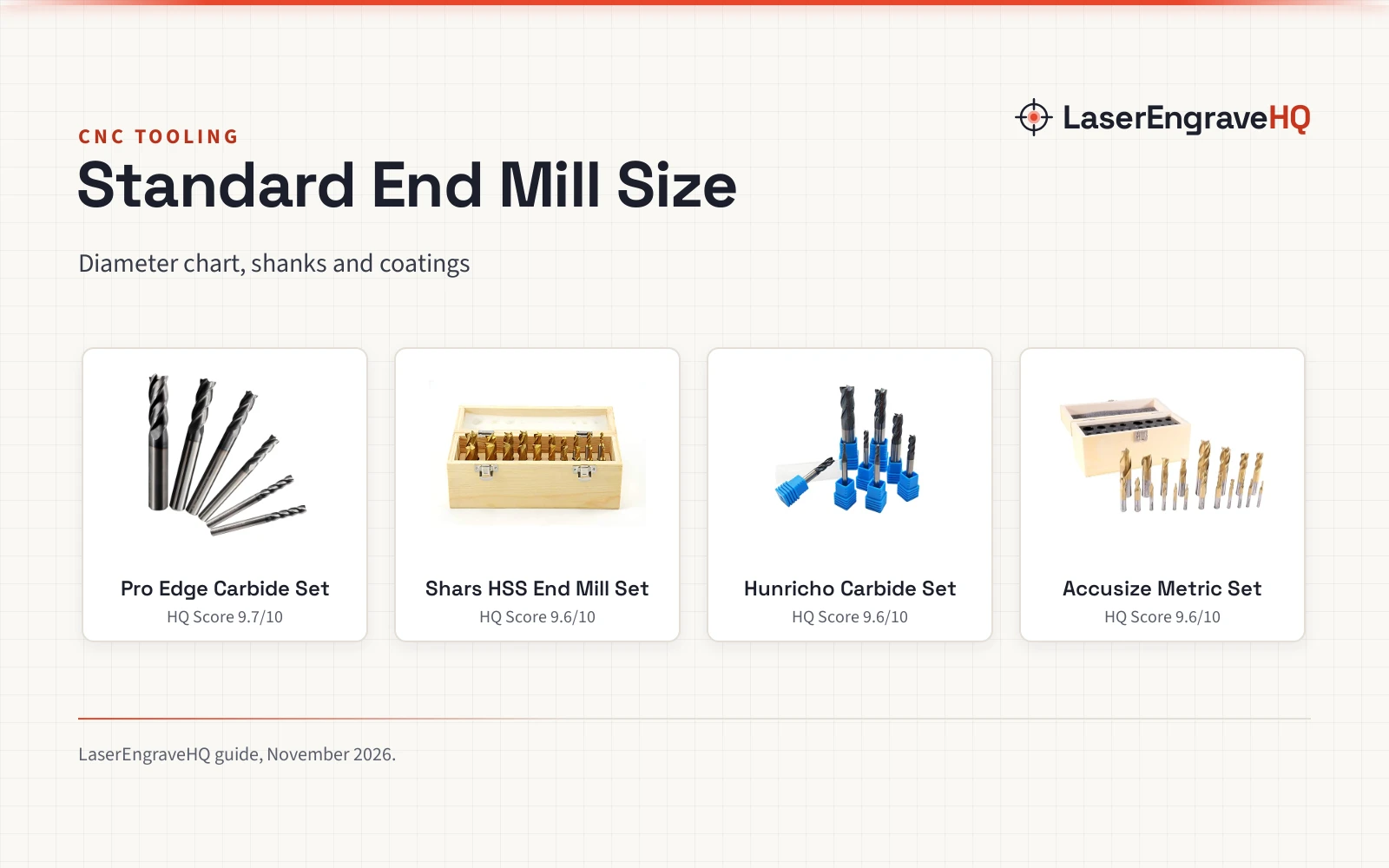
Size is the cutting diameter, and the sets here run from 1/8 inch to 3/4 inch, with the Shars set covering 3/16 to 3/4 inch and the BestParts set covering 1/8 to 1/2 inch. The shank must fit the collet: the Shars set lists 3/8, 1/2, 5/8 and 3/4 inch shanks, and the SpeTool set lists a 1/4 inch shank with a 1/4 inch cutting diameter, a 3/4 inch cutting length and a 2-1/2 inch overall length. Cut length matters where the cut runs deep: the Shars set lists cut lengths from 7/16 to 1-1/8 inches, and the BestParts set lists cutting lengths from 1/2 to 1-1/4 inches. Center cutting mills can plunge straight down, and the Shars set lists center cutting with a Weldon flat shank. Pick the size that matches the slot or pocket, then check the shank against the collet before ordering. See the standard end mill size guide for the diameter chart.
Common mistakes to avoid
- Buying a 4 flute mill for a deep slot where chips need room to leave.
- Picking a size the collet cannot hold.
- Running carbide where HSS would do, for a job that does not need the harder edge.
- Ignoring the coating where the cut runs hot.
- Ordering a set without checking the shank sizes against the collet.
Types of end mill: the short version
- Read the end shape: square end for flat bottoms, corner rounding for rounded edges.
- Count the flutes: 2 flute for chip clearance, 4 flute for finish.
- Pick the material: HSS for general work, carbide for hard material.
- Pick the coating: uncoated, TiN, AlTiN or TiAlN, by heat and the material you cut.
- Match the size and the shank to the slot and the collet.
FAQ: lasers and CNC
What is the difference between a 2 flute and a 4 flute end mill?
A 2 flute mill has fewer cutting edges and more room for chips, so it suits slotting and softer material. A 4 flute mill has more cutting edges and leaves a smoother finish, so it suits side milling and finish work.
Is carbide better than HSS for an end mill?
Carbide is harder and holds an edge longer in hard material, and it can run at higher speeds than high speed steel. HSS is tougher and suits general work and a starter set.
What does center cutting mean?
A center cutting mill can plunge straight down into the material, so it can start a slot or a pocket without a drilled hole. The Shars set lists center cutting.
What size end mill do I need?
Match the cutting diameter to the slot or pocket: the sets here run from 1/8 inch to 3/4 inch, with the Shars set covering 3/16 to 3/4 inch. Then check the shank against the collet.
What is the difference between TiN and AlTiN coating?
TiN is a titanium nitride coat on HSS for a longer edge life. AlTiN is an aluminum titanium nitride coat on carbide, listed with high aluminum content for hot hardness and oxidation resistance.
Can I use an end mill in a CNC router?
Yes, where the shank fits the collet: the SpeTool set lists a 1/4 inch shank for a CNC router and a plunge router with a 1/4 inch collet. Check the shank size against the collet before ordering.
Related: the CNC tooling hub, V bit vs end mill for CNC and roughing vs finishing end mill.