Drill Bit Types Chart and Uses Guide
A drill bit types chart groups fractional, letter, and numbered bits by size, so a maker can match the bit to the hole, the material, and the tool that drives it.

On this page
Top picks at a glance
As an Amazon Associate I earn from qualifying purchases.
- 1
 MACXCOIP 115Pcs Cobalt Drill Bit Set M35 HSS9.6/10View on Amazon
- 2
 Makita B-65399 Impact Gold 14 Pc. Titanium Drill9.6/10View on Amazon
A sign blank, a tumbler jig, a leather patch, or a cut part all start the same way, with a hole in the right place and the right size, and a drill bit types chart is the map that turns a size label into a hole that fits the screw, the dowel, or the hardware that follows. The chart groups bits by fractional sizes, letter sizes, and numbered sizes, and each group labels diameters in its own way, so the reader can match the mark on the bit to the hole the project needs before drilling begins.
LaserEngraveHQ earns a commission from purchases made through these links, at no extra cost to you. Read our affiliate disclosure.
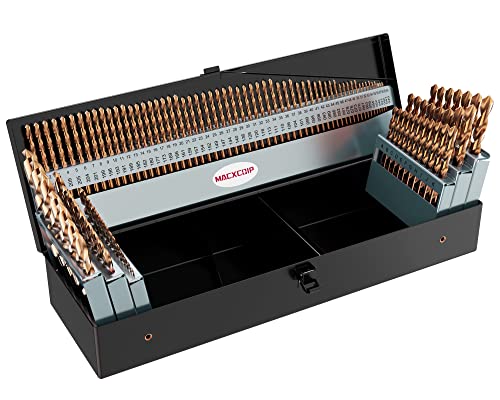
MACXCOIP 115Pcs Cobalt Drill Bit Set M35 HSS
A 115-piece M35 cobalt set with fractional sizes from 1/16 to 1/2, letter sizes from A to Z, and numbered sizes from #1 to #60, in an indexed storage case.
Pros
- 115 pieces cover fractional, letter, and numbered sizes, with an indexed case
- M35 cobalt, listed for hardened metal, stainless steel, cast iron, wood, and plastic
- 135 degree point tip with a twist design for faster cutting and self-centering
- Jobber length HSS set with hardened and polished inserts for precise cutting
Cons
- No warranty term is stated in the listing
- No weight is stated in the listing
- No coating is stated for the cobalt bits
- Fractional sizes end at 1/2, so a larger hole needs a bit outside this range
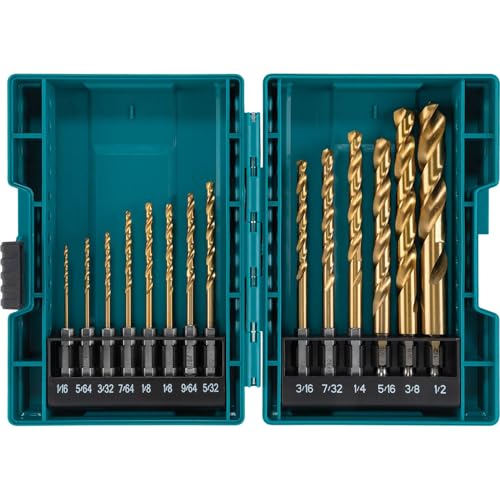
Makita B-65399 Impact Gold 14 Pc. Titanium Drill
A 14-piece titanium drill bit set with a 1/4 in. hex shank, a 135 degree split point, and a titanium nitride coating, for use in hex impact drivers.
Pros
- Titanium nitride coating lasts 2.5x longer than non-coated bits, as the listing states
- 135 degree split point geometry for faster starts and reduced walking
- Impact rated for use in 1/4 inches hex impact drivers
- Listed for ferrous metal, wood, plastic, non-ferrous metal, cast iron, and stainless steel
Cons
- The listing states no manufacturer warranty
- No letter or numbered sizes are stated in the listing
- No storage case is stated in the listing
Drill Bit Types Chart: How to Read the Chart
A drill bit types chart is a lookup table. Find the size system on the bit, find the same system on the chart, and read across to the diameter the label stands for. Fractional sizes are fractions of an inch, letter sizes are letters from A to Z, and numbered sizes carry a hash mark, from #1 to #60. The cobalt set below carries all of the size systems, with fractional sizes from 1/16 to 1/2 in 1/64 increments, letter sizes from A to Z, and numbered sizes from #1 to #60.
| Size system | Sizes in the cobalt set | What to look for |
|---|---|---|
| Fractional | 1/16 to 1/2, in 1/64 increments, 29 pieces | The fraction on the shank |
| Letter | A to Z, 26 pieces | The letter on the shank |
| Numbered | #1 to #60, 60 pieces | The number after the hash mark |
The chart gives the diameter, and the listing gives the material, the point angle, and the shank, so read the chart before choosing a bit. For a closer look, see the drill bit chart, and for the wider CNC context, see CNC router bit types.
What Each Size System Covers
Fractional sizes run from 1/16 to 1/2 in the listings here, with 29 fractional pieces in the cobalt set, 26 letter pieces from A to Z, and 60 numbered pieces from #1 to #60, for 115 pieces in all. The cobalt set is listed for hardened metal, stainless steel, cast iron, wood, and plastic, with copper and aluminum also listed, as M35 cobalt HSS at jobber length. The Makita set is listed for ferrous metal, wood, plastic, non-ferrous metal, cast iron, and stainless steel, with a titanium nitride coating stated to last 2.5x longer than non-coated bits. For stainless steel, see the drill bit for stainless steel guide, and for drilling with a CNC router, see drill bits for CNC.
Point angle is the detail the chart does not show. The cobalt set states a 135 degree point tip with a twist design for faster cutting, self-centering to prevent walk-off, and faster chip and particle removal, and the Makita set states a 135 degree split point geometry for faster starts and reduced walking. A point that centers well keeps the hole where the mark was made, which matters where a hole has to line up with hardware or with a mating part.
How to Pick a Size From the Chart
Picking a size is a short chain of matches, and each match uses the chart or the listing, not a guess.
- Match the hole to the hardware: read the diameter the screw, dowel, or hardware needs from the chart.
- Match the system to the bit: check the mark on the shank, a fraction, a letter, or a number with a hash mark.
- Match the bit to the material: confirm the material is listed for the bit in hand.
- Match the shank to the driver: confirm the shank fits the tool, such as the 1/4 in. hex shank of the Makita set, impact rated for use in 1/4 inches hex impact drivers.
- Match the point to the start: confirm the point angle is stated, with the 135 degree point in the listings here.
If the chart gives a diameter and the listing gives no matching size, change the size system or the set. The cobalt set spans fractional, letter, and numbered sizes, while the Makita set is a 14-piece hex-shank set with no letter or numbered sizes stated. For drilling versus milling tools, see end mill versus drill bit for CNC, and for a beginner overview, see CNC bits explained for beginners.
Gear for the Holes in This Guide
Once the chart gives the size, the drilling itself needs bits that hold the point angle and the size range the chart lists, and the gear below covers that drilling for the materials in this guide.
Common Mistakes to Avoid
- Reading only the fraction and ignoring the letter and numbered systems.
- Choosing a bit for a material the listing does not name.
- Starting a hole without checking the point angle, so the bit walks away from the mark.
- Using a round-shank bit where the driver needs a hex shank.
- Storing the cobalt bits loose instead of in the indexed case, so the size mark is hard to read.
- Trusting a spec table over the title and bullets when they disagree on the count, as the Makita listing does with 14 pieces against a NumberOfItems value of 1.
Drill Bit Types Chart: The Short Version
- Find the size system on the chart and read the diameter from the row.
- Check the listing for the material, the point angle, and the shank.
- Use the cobalt set for the full span, from 1/16 to 1/2, from A to Z, and from #1 to #60.
- Use the Makita set for hex impact drivers, with a 1/4 in. hex shank and a 135 degree split point.
- Keep the cobalt bits in the indexed case, with the size mark readable.
FAQ: lasers and CNC
What does a drill bit types chart show?
A drill bit types chart shows the size systems for drill bits and the diameters each label stands for. Fractional sizes run from 1/16 to 1/2 in 1/64 increments here, letter sizes run from A to Z, and numbered sizes run from #1 to #60.
Which drill bit size system should a CNC maker start with?
Start with the fractional system, from 1/16 to 1/2, with 29 pieces in the cobalt set. Add letter sizes from A to Z and numbered sizes from #1 to #60 when the hole needs a diameter the fractional rows do not hold, and check the CNC tooling hub for more tooling.
Can the same drill bits cut metal and wood?
It depends on the listing for the bit in hand. The cobalt set is listed for hardened metal, stainless steel, cast iron, wood, and plastic, with copper and aluminum also listed, and the Makita set is listed for ferrous metal, wood, plastic, non-ferrous metal, cast iron, and stainless steel.
What does a 135 degree point do?
A 135 degree point centers the bit on the mark and helps prevent walk-off. The cobalt set states a 135 degree point tip with a twist design for faster cutting and self-centering, and the Makita set states a 135 degree split point geometry for faster starts and reduced walking.
How should drill bits be stored?
Store bits in a case with size indexes, so the mark on each bit stays readable. The cobalt set includes drill holders with size indexes in an index storage case, while no storage case is stated for the Makita set.
Related: the CNC tooling hub, drill bit chart and drill bits for CNC. Also see the drill bit for stainless steel guide and how to choose a desktop CNC router.