CNC Router Bit Types: The Complete Guide to Profiles, Spirals, and Flutes
A complete guide to CNC router bit types: understand flute geometry, spiral upcut and downcut designs, V-groove bits, and surfacing cutters for your projects.

On this page
Top picks at a glance
As an Amazon Associate I earn from qualifying purchases.
- 1
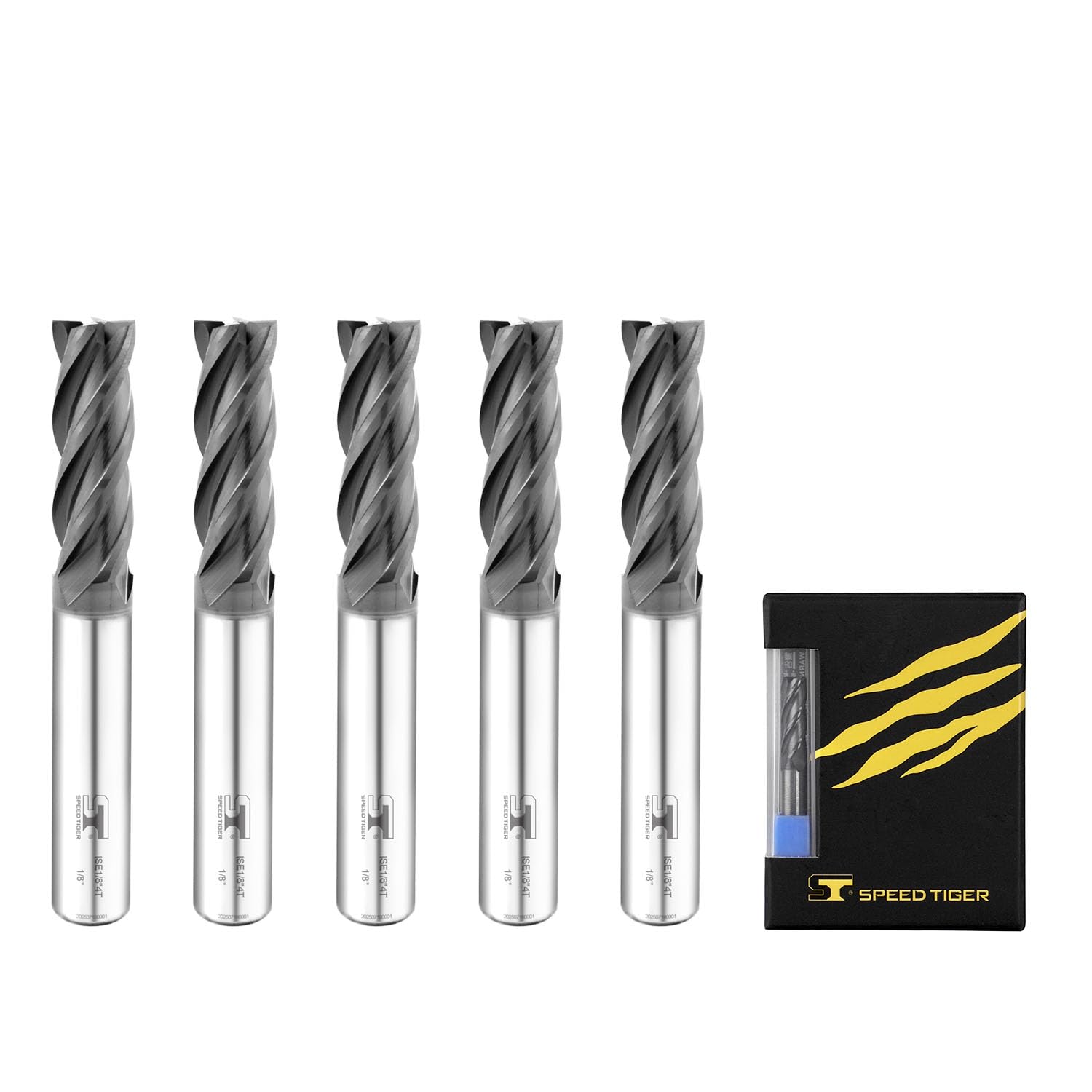 SPEED TIGER ISE Carbide End Mill 1/8”9.8/10View on Amazon
- 2
 Genmitsu 40pcs End Mills CNC Router Bits9.7/10View on Amazon
- 3
 SpeTool 5PCS Spiral Downcut Router Bits 1/4" Shank 1" Cutting9.7/10View on Amazon
Understanding CNC router bit types comes down to matching flute geometry, spiral direction, and cutter profile to your material and toolpath. The primary types include spiral end mills (upcut, downcut, and compression), straight flute bits, V-groove bits, ball nose cutters, and spoilboard surfacing bits. Each profile controls chip evacuation, edge finish, and cutting forces differently across hardwoods, plywood, plastics, and soft metals. The sections below explain each bit category step by step, showing how to select the right profile, avoid common cutting errors, and maintain clean finishes in your shop.
LaserEngraveHQ earns a commission from purchases made through these links, at no extra cost to you. Read our affiliate disclosure.
We do not run destructive shop evaluations on every cutter profile, so this guide provides no invented feed rates or chip load figures. Treat published catalog numbers as baseline specifications from the manufacturer, and tune your spindle speed and feed rates directly on scrap material.
Step 1: Understand spiral flute geometry and chip flow
Spiral bits feature continuous helical cutting edges that wrap around the tool body. The direction of these flutes determines whether chips are pulled upward out of the cut or pushed downward toward the spoilboard, creating distinct cutting dynamics on sheet goods and solid lumber.
Upcut spiral bits pull chips upward, clearing debris quickly from deep mortises, grooves, and pockets. Because upward shear forces lift the workpiece, upcut bits require secure clamping. They leave a clean bottom edge but can cause tearout along the top surface. In the Jiiolioa listing, an upcut spiral end mill specifies a 1/4-inch shank, a 1/16-inch cutting diameter, a 1/2-inch cutting length, and 2 flutes for detail carving. Compare options in our best CNC router bits guide.
Downcut spiral bits push chips downward, holding sheet stock firmly against the table and leaving a crisp top surface without splintering. However, downcut bits pack chips into deep slots, which increases friction if chip clearing is restricted. In the SpeTool listing, a downcut spiral router bit provides a 1/4-inch shank, a 1/4-inch cutting diameter, a 1-inch cutting length, a 2-1/2-inch overall length, and 2 flutes with a coating designed for up to 2.5 times the life of uncoated bits.
Step 2: Choose downcut and compression bits for clean sheet goods
Plywood, melamine, and veneered panels present a common challenge: cutting an edge cleanly on both the top and bottom faces simultaneously. Standard upcut bits splinter the top veneer, while downcut bits splinter the bottom veneer as the flutes exit.
Compression spiral bits resolve this problem by combining both geometries on a single tool. The bottom tip features an upcut flute pulling chips upward, while the upper section features a downcut flute pushing chips downward. When cutting at full depth, both forces compress the core material, leaving smooth edges on both faces. To use a compression bit effectively, your toolpath must plunge past the lower upcut transition zone on the initial pass. For shallow grooves or dados, a dedicated downcut bit is preferable.
For workshops that handle cuts using separate bits rather than a compression tool, the Eyryfui listing provides a 6-piece set with 1/4-inch shanks and 2 flutes spanning down-cut, up-cut, and V-groove cuts. For solid timber, our best CNC router bits for hardwood guide compares dedicated spiral options.
Step 3: Select O-flute and single-flute cutters for plastics and non-ferrous metals
Machining plastics like acrylic or soft metals like aluminum requires specialized chip evacuation. Plastics melt easily under friction, while aluminum chips can weld themselves directly to the flutes if heat accumulates.
Single-flute and O-flute end mills feature an open, rounded gullet that ejects thick chips quickly before heat builds up. Because there is only one cutting edge per revolution, the cutter takes larger bites at reasonable feed rates, preventing friction and melting. In the SPEED TIGER listing, a solid carbide single-flute end mill specifies an O-flute design with a 1/4-inch diameter, a 2-inch overall length, and an error margin of -0.02mm, finished with a zirconium nitride coating. In the Jiiolioa listing, a single-flute spiral end mill features a 1/4-inch shank, a 1/8-inch cutting diameter, and a 1/2-inch cutting length for aluminum, acrylic, PVC, and MDF. For machine setups handling synthetic blanks, browse our best CNC router for plastics guide.
For heavy profiling and slotting in plastics, single-flute O-flute bits are preferred over multi-flute cutters because they eject large chips quickly and reduce frictional heat that causes re-melting.
Step 4: Use V-groove bits for sign making and lettering
V-groove bits taper to a sharp pointed tip, creating angled sidewalls along decorative grooves and engraved text. By varying the depth of cut in software, CNC machines create lines that widen and narrow dynamically, mimicking hand-carved relief work and crisp typography.
The included angle determines the character and depth of the engraving. Steeper angles like 15, 20, or 30 degrees produce deep, narrow lines suitable for fine text, outlining letters, and intricate patterns. Wider angles like 60 and 90 degrees produce broad chamfers, decorative bevels, and shallow v-carved signs that remain readable from a distance. In the SILIVN listing, a 5-piece engraving set provides bits with a 1/4-inch shank across 15, 20, 30, 60, and 90-degree angles with 2 flutes and a blue nano-coating. In the EANOSIC listing, a 5-piece carving set offers 15, 20, 30, 60, and 90-degree V-groove bits with a 1/4-inch shank, a 2-1/2-inch total length, 2 flutes, and a maximum rated speed of 24,000 RPM. For more tooling choices, read our V bit for CNC router guide.
V-groove bits are also practical for chamfering part perimeters, removing sharp edges and reducing manual sanding.
Step 5: Pick ball nose end mills for 3D contours and carvings
Ball nose end mills feature a hemispherical rounded tip that leaves smooth, curved valleys rather than flat floors. This geometry makes them essential for 3D topographical maps, organic carvings, curved molds, and artistic bas-relief projects.
Tapered ball nose bits combine a fine rounded tip with angled sidewalls that widen toward the shank. This tapered profile increases tool rigidity, reducing deflection and chatter during deep 3D carving runs. In the SpeTool listing, a tapered ball nose end mill specifies a 1/4-inch shank, a 3-inch length, a 0.5mm tip diameter, a 0.25mm radius, a 5.2-degree single side angle, 2 flutes, and a 55HRC rating for 2D and 3D carving in woods, aluminum, copper, and acrylic. In the YOKISHUN listing, a 5-piece multipurpose starter set includes a ball nose bit alongside an O-flute bit, an upcut end mill, a 30-degree V-groove bit, and a 1/2-inch by 3-inch end mill on 1/4-inch shanks. For economical starter collections, our cheap end mills guide reviews multi-bit sets.
Finishing 3D carvings requires setting a small stepover in CAM software, which leaves virtually invisible scalloping on curved surfaces.
Step 6: Deploy spoilboard surfacing bits and match collet sizes
A CNC machine cannot maintain consistent cutting depths across large workpieces if the underlying spoilboard or wasteboard is uneven. Spoilboard surfacing bits, also called flycutters or slab flattening bits, feature wide cutting diameters designed to plane large surfaces quickly and true the bed perpendicular to the spindle.
Surfacing cutters remove material across wide swaths with each pass. Running a surfacing routine skims off a minimal depth of MDF, creating a flat reference plane parallel to the machine gantry. For dedicated spoilboard tools, compare options in our best surfacing router bit guide, and check our best CNC spoilboard recommendations for table setup.
Surfacing cutters should be run at conservative depths of cut and moderate stepovers to avoid excessive load on spindle bearings.
Proper bit performance also depends on matching the tool shank to your machine collet. Many desktop CNC routers use 1/4-inch collets. In the LUNYEE listing, a 10-piece router bit set includes bits with 1/4-inch shanks alongside a bonus 1/4-inch ER11 high precision collet. In the SpeTool and Eyryfui listings, bits feature 1/4-inch shanks designed for routers with matching 1/4-inch collets. When routing aluminum, matching your bit shank to rigid tooling is essential; explore recommendations in our best end mill for aluminum guide. Always inspect collets for dust and internal wear before tightening the collet nut to prevent tool slip and runout.
Common mistakes to avoid
- Using an upcut bit on thin sheet goods without adequate hold-downs, causing the board to lift and chatter.
- Running multi-flute bits on aggressive slotting paths in melting plastics instead of a single O-flute cutter with high chip clearance.
- Taking aggressive single-pass cuts with narrow detail bits, resulting in shank deflection or tool snapping.
- Plunging compression bits at shallow depths where only the lower upcut section engages the top veneer.
- Neglecting chip evacuation inside deep slots, which recuts waste chips and causes friction burning.
CNC router bit types: the short version
- Spiral upcut: lifts chips out of deep mortises and grooves, leaving a clean bottom surface.
- Spiral downcut: pushes chips down, holding sheets flat and keeping the top veneer splinter-free.
- Compression spiral: combines upcut and downcut flutes to produce smooth top and bottom edges on plywood.
- O-flute single flute: provides wide chip clearance to prevent melting in acrylic, plastics, and aluminum.
- V-groove bits: carves decorative lettering, sign bevels, and edge chamfers with angled flutes.
- Ball nose and surfacing cutters: sculpts smooth 3D bas-reliefs and planes spoilboard tables flat.
Matching the bit geometry to your material and toolpath is the key to clean CNC routing. Start with a solid downcut or compression bit for sheet goods, keep single-flute cutters ready for plastics, and reserve V-groove and ball nose cutters for decorative detailing.
FAQ: lasers and CNC
What is the difference between upcut and downcut CNC router bits?
The primary difference is the direction of chip evacuation. Upcut bits pull chips upward toward the spindle, leaving a clean bottom edge while risking tearout along the top surface. Downcut bits push chips downward toward the spoilboard, keeping the top surface crisp while packing chips into deep grooves.
When should I use a compression bit?
Compression bits are best for double-sided sheet goods like plywood, melamine, and laminated composites. Because they combine an upcut tip with a downcut upper section, they pull chips toward the center of the board, leaving both faces clean when cut at full pass depth.
Why do plastics require single-flute O-flute bits?
Plastics soften and melt easily under cutting friction. Single-flute O-flute bits feature an open, rounded channel that clears large chips quickly before heat builds up. The single cutting edge prevents the rubbing and re-melting common with multi-flute cutters.
What V-bit angle is best for CNC lettering?
Narrower angles such as 15, 20, or 30 degrees work best for fine text, intricate outlines, and small decorative details. Wider angles like 60 or 90 degrees work best for bold lettering and wide chamfers that need visibility from across a room.
Can I use standard handheld router bits in a CNC machine?
Bits designed for 1/4-inch router collets can physically fit compatible CNC spindles, but standard handheld woodworking bits often lack the optimized chip evacuation geometry required for automated continuous CNC toolpaths. CNC-specific spiral end mills and solid carbide cutters provide superior chip ejection and tool rigidity.
How do I choose between solid carbide and coated router bits?
Solid carbide provides excellent rigidity and wear resistance for precise CNC machining. Coated carbide bits, such as zirconium nitride or blue nano-coatings cited in manufacturer listings, add lubricity and heat resistance, helping the cutting edge maintain sharpness during prolonged machining runs.
Related: the CNC tooling hub, best CNC router bits and best CNC router bits for hardwood. Also see our V bit for CNC router guide. Also see our best surfacing router bit guide.