CNC Bits Explained for Beginners: A Practical Workshop Guide
A practical guide to CNC bits for beginners: learn shank diameters, upcut and downcut spirals, end mill shapes, flute counts, and carbide tooling basics.

On this page
Top picks at a glance
As an Amazon Associate I earn from qualifying purchases.
- 1
 SPEED TIGER EISE 1/8" Carbide Square End Mill9.8/10View on Amazon
- 2
 Genmitsu 40pcs End Mills CNC Router Bits9.7/10View on Amazon
- 3
 SpeTool 5PCS Spiral Downcut Router Bits 1/4" Shank 1" Cutting9.7/10View on Amazon
- 4
 SpeTool 8Pcs Carbide CNC Router Bits Set 1/4 Inch Shank forView on Amazon
- 5
 10Pcs CNC Router Bits SetView on Amazon
- 6
 6Pcs CNC Router Bits SetView on Amazon
- 7
 CNC Spoilboard Surfacing Router BitsView on Amazon
- 8
 Router Bits Sets of 24A Pieces 1/4 Inch Shank Router Bit SetView on Amazon
- 9
 Genmitsu 30pcs PCB Drill Bits SetView on Amazon
CNC bits explained for beginners comes down to key mechanical decisions: matching the cutter shank to your router collet, selecting the flute spiral direction for clean edges, and choosing the tip profile that fits your workpiece geometry. Selecting the right cutter prevents tool deflection, eliminates surface tear-out and keeps cuts accurate across wood signs and sheet goods.
Other machines to compare
 SpeTool 8Pcs Carbide CNC Router Bits Set 1/4 Inch Shank forCheck price on Amazon
 10Pcs CNC Router Bits SetCheck price on Amazon
 6Pcs CNC Router Bits SetCheck price on Amazon
 CNC Spoilboard Surfacing Router BitsCheck price on Amazon
 Router Bits Sets of 24A Pieces 1/4 Inch Shank Router Bit SetCheck price on Amazon
 Genmitsu 30pcs PCB Drill Bits SetCheck price on Amazon
LaserEngraveHQ earns a commission from purchases made through these links, at no extra cost to you. Read our affiliate disclosure.
Router performance depends heavily on machine rigidity, spindle runout and workpiece clamping. We cite only the dimensions and cutter specifications published by each tool maker, without inventing unlisted feed rates or spindle speeds.
Step 1: Match bit shank diameter to your router collet
The shank is the cylindrical shaft held by the router collet and must match collet diameter precisely. A 1/4 inch bit cannot fit into a 1/8 inch collet, while a 1/8 inch shank cannot clamp in a 1/4 inch collet without slipping, creating severe runout that snaps tooling.
Desktop CNC routers typically use 1/8 inch or 1/4 inch collets. Genmitsu lists its MC50A router bit set with a 1/8 inch (3.175 mm) shank for benchtop machines like the Genmitsu 3018 Series and PROVerXL 4030. LUNYEE lists a 40-piece collection with a 3.175 mm shank and includes ER11 and ER16 collets. For larger routers, SpeTool, HQMaster, and Eyryfui provide 1/4 inch shank bits. SpeTool specifies 1/4 inch shank bits with a 2-1/2 inch total length for 1/4 inch router collets. When buying a machine, consult our guide on how to choose a desktop CNC router.
Step 2: Choose between upcut, downcut and compression flutes
Spiral flutes dictate where chips travel and which workpiece edge stays clean.
An upcut spiral pulls chips upward toward the spindle, clearing deep grooves efficiently to prevent heat buildup. However, an upcut bit lifts surface fibers, causing splintering on top veneers while leaving a clean bottom edge. SHARPRO lists an upcut spiral bit with a 1/16 inch cutting diameter, 1/4 inch shank, 0.5 inch cutting length, and 2 flutes for wood inlays. Jiiolioa lists an upcut spiral end mill with a 1/4 inch shank, 1/8 inch cutting diameter, 0.75 inch cutting length, and 2-1/2 inch overall length for slotting.
A downcut spiral pushes chips downward, holding down surface fibers for crisp edges on plywood and laminates. Because waste is packed into the cut, take shallow step-downs to avoid heat buildup.
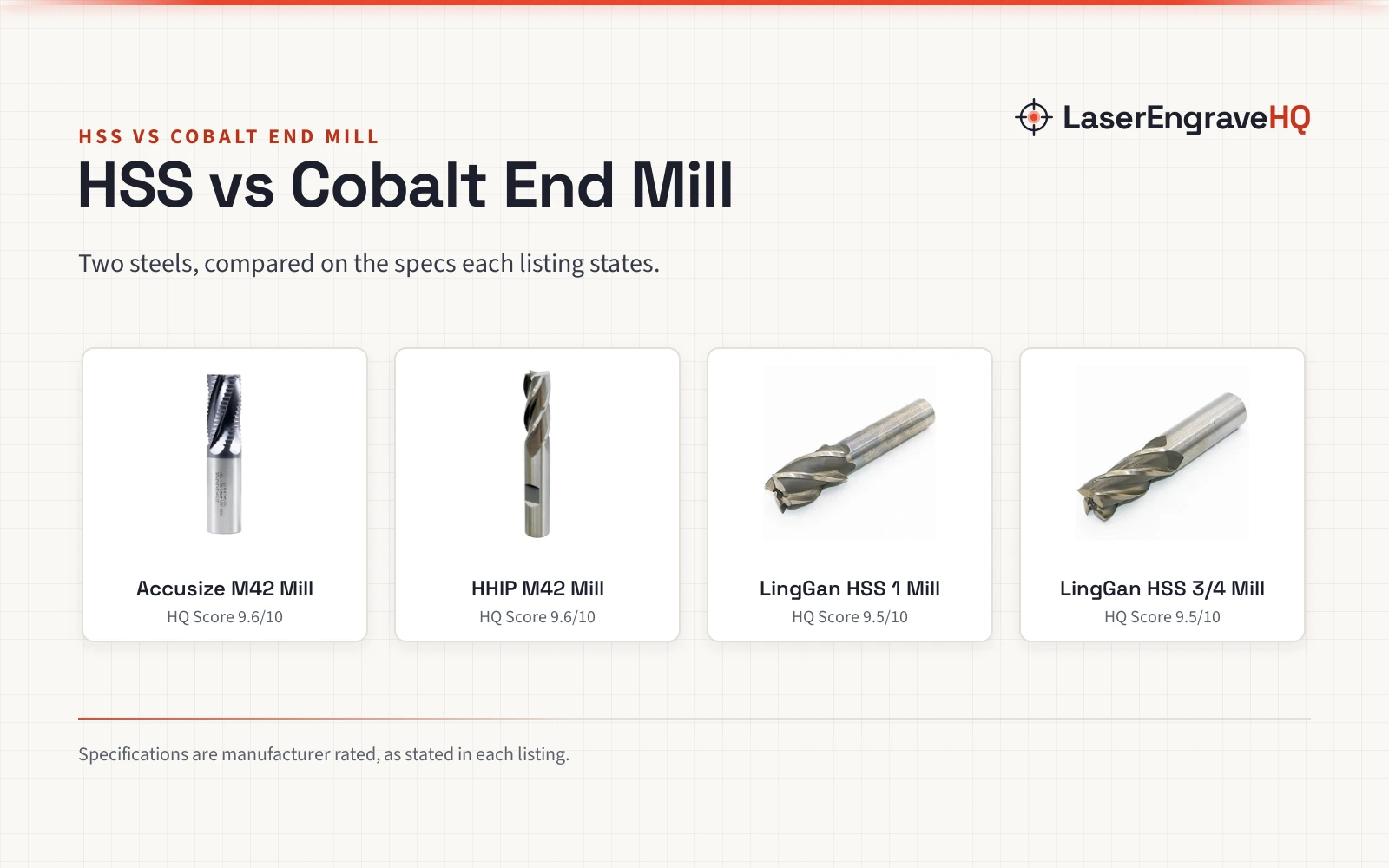
A compression bit combines upcut flutes at the tip with downcut flutes above, compressing material toward the core for clean top and bottom faces. SpeTool lists a solid carbide compression router bit with a 1/4 inch shank, 1/4 inch cutting diameter, 1 inch cutting length, and 2 flutes to combat delamination on plywood, oak, MDF and hardwoods. Compare profiles in our guide to CNC router bit types and our overview of the best CNC router bits.
Step 3: Pick the cutting profile for your project geometry
The profile shape determines the contour left in the workpiece.
Flat nose end mills have a flat tip with 90-degree corners, making them standard tools for cutouts, flat-bottom pockets, and slots. Genmitsu includes 2-flute flat nose end mills with cutting diameters from 1 mm to 3.175 mm in its MC50A set for slot milling and grooving.
Ball nose end mills feature a hemispherical tip ideal for 3D contours and relief carvings because the rounded nose eliminates stair-step ridges. SpeTool lists a 4-piece tapered ball nose set with a 1/4 inch shank, 0.5 mm tip diameter (0.25 mm radius), 5.2 single side degree, and 55HRC hardness for detailed 3D carving.
V-groove bits taper to an angled point for chamfering and decorative V-carving lettering. HQMaster includes 30-degree and 60-degree V-groove bits in its 8-piece 1/4 inch shank set, while SpeTool lists 60-degree and 90-degree V-groove cutters for signmaking. For sign projects, read how to V carve signs on a CNC and compare cutters in our V bit for CNC router guide.
Surfacing bits feature a wide diameter to flatten spoilboards and lumber. See how to set up a spoilboard on a CNC and compare tools in our best surfacing router bit guide.
Step 4: Balance flute count and chip clearance
Flutes slice material and clear chips, with flute count determining evacuation space.
For woodworking on desktop CNC routers, a 2-flute cutter balances edge finish and chip clearance. Two cutting edges leave ample valley space for chips to escape freely. SpeTool, SHARPRO, Genmitsu, Jiiolioa, and LUNYEE offer 2-flute designs across their 1/8 inch and 1/4 inch woodworking end mills.
For soft plastics and aluminum, single-flute cutters (O-flute bits) are preferred over multi-flute tools because a single wide flute ejects hot chips before they melt or weld. Multi-flute tools have narrower pockets requiring faster travel speeds; if travel is too slow relative to spindle speed, friction increases and wood scorches.
Step 5: Compare carbide grades and protective coatings
Cutter life depends on core material and surface coating.
Solid tungsten carbide provides the rigidity and edge retention required for CNC routing. LUNYEE specifies ultra-fine 0.2 μm tungsten carbide alloy for its end mills. SHARPRO controls tool error within -0.02 mm and maintains surface roughness below Ra 0.8 μm for smooth chip clearance.
Coatings add heat resistance and lubricity. Jiiolioa coats carbide spiral bits with nACo blue coating, listed for heat resistance and up to 2.5X longer life over uncoated bits. Genmitsu applies nano blue and titanium coatings across its 50-piece set for heat resistance in MDF, acrylic, and soft metals. Eyryfui uses nano blue coating on its 10-piece 1/4 inch shank set to resist oxidation during slotting. Compare options in our guides on the best CNC router bits for hardwood and the best end mill for aluminum.
Step 6: Plan conservative pass depths and feed rates
Tool deflection and bit breakage happen when taking overly deep cuts on lightweight desktop frames.
Cutting lengths differ across cutters. Eyryfui lists a 0.5 inch cutting length on 1/4 inch shank bits, Jiiolioa lists a 0.75 inch cutting length on a 1/8 inch diameter end mill, and SpeTool lists 1 inch and 1-1/4 inch cutting lengths on 1/4 inch compression bits. LUNYEE lists a 17 mm cutting length with a 38 mm overall length. While cutting deeper than flute length causes the smooth shank to rub against material, pass depths must remain much shallower than overall cutting length. Light step-downs prevent deflection and spindle bogging.
Listen during operation: vibration indicates chatter, while scorch marks mean the tool spins too fast for its travel speed. See our guide on CNC feeds and speeds for beginners.
Common mistakes to avoid
- Running an upcut spiral bit on delicate veneered plywood when a clean top face is required.
- Plunging straight down into solid material with a non-center-cutting bit instead of ramping along an angled path.
- Using an unverified collet adapter instead of a precision-matched collet, causing tool runout and chatter.
- Taking aggressive depth passes that exceed frame rigidity and snap slim carbide tools.
- Allowing chips to collect inside deep grooves, which traps friction heat and dulls edges quickly.
CNC bits explained for beginners: the short version
- Match shank diameter to your router collet (common sizes are 1/8 inch or 1/4 inch).
- Select downcut spirals for clean top faces, upcut spirals for deep clearing, and compression bits for sheet goods.
- Use flat end mills for cutouts, ball nose bits for 3D curves, and V-bits for lettering.
- Choose 2-flute bits for wood, and single-flute cutters for soft plastics or aluminum.
- Use coated carbide like nano blue or titanium to improve tool life.
- Take shallow step-down passes rather than cutting full depth in a single pass.
FAQ: lasers and CNC
What is the difference between upcut and downcut CNC bits?
An upcut bit pulls chips upward, clearing deep slots efficiently but splintering top wood fibers. A downcut bit pushes chips downward, keeping top veneer edges crisp while requiring shallow passes to avoid packing.
Which shank size should a beginner choose?
Choose the shank diameter matching your spindle collet, typically 1/8 inch on entry-level desktop machines or 1/4 inch on larger routers. Always use matching collets to minimize runout.
Can a beginner start with a mixed CNC router bit set?
Yes. A mixed collection provides flat end mills, ball nose cutters, and V-groove bits in one package. Browse the best CNC bit set for beginners to evaluate starter collections.
When should you use a compression router bit?
Use a compression bit on double-sided sheet goods like plywood or laminated MDF. Because flutes compress material inward from both faces, both surfaces stay splinter-free.
Why do small CNC bits break so easily?
Small 1/16 inch and 1/8 inch bits have thin carbide cores vulnerable to side load. Aggressive plunging, chip recutting, and deep passes cause most breaks.
How many flutes are best for cutting wood on a desktop CNC?
A 2-flute cutter is the most reliable choice for wood on desktop routers, balancing smooth cutting with open flute valleys that clear chips at standard spindle speeds.
Related: explore our CNC tooling guide, compare tools in our best CNC router bits review, and check starter options in our best CNC bit set for beginners guide. For setup, read how to choose a desktop CNC router and learn feed tuning with our CNC feeds and speeds for beginners guide.