Best FDM 3D Printing Filament (2026): 4 Picks Compared
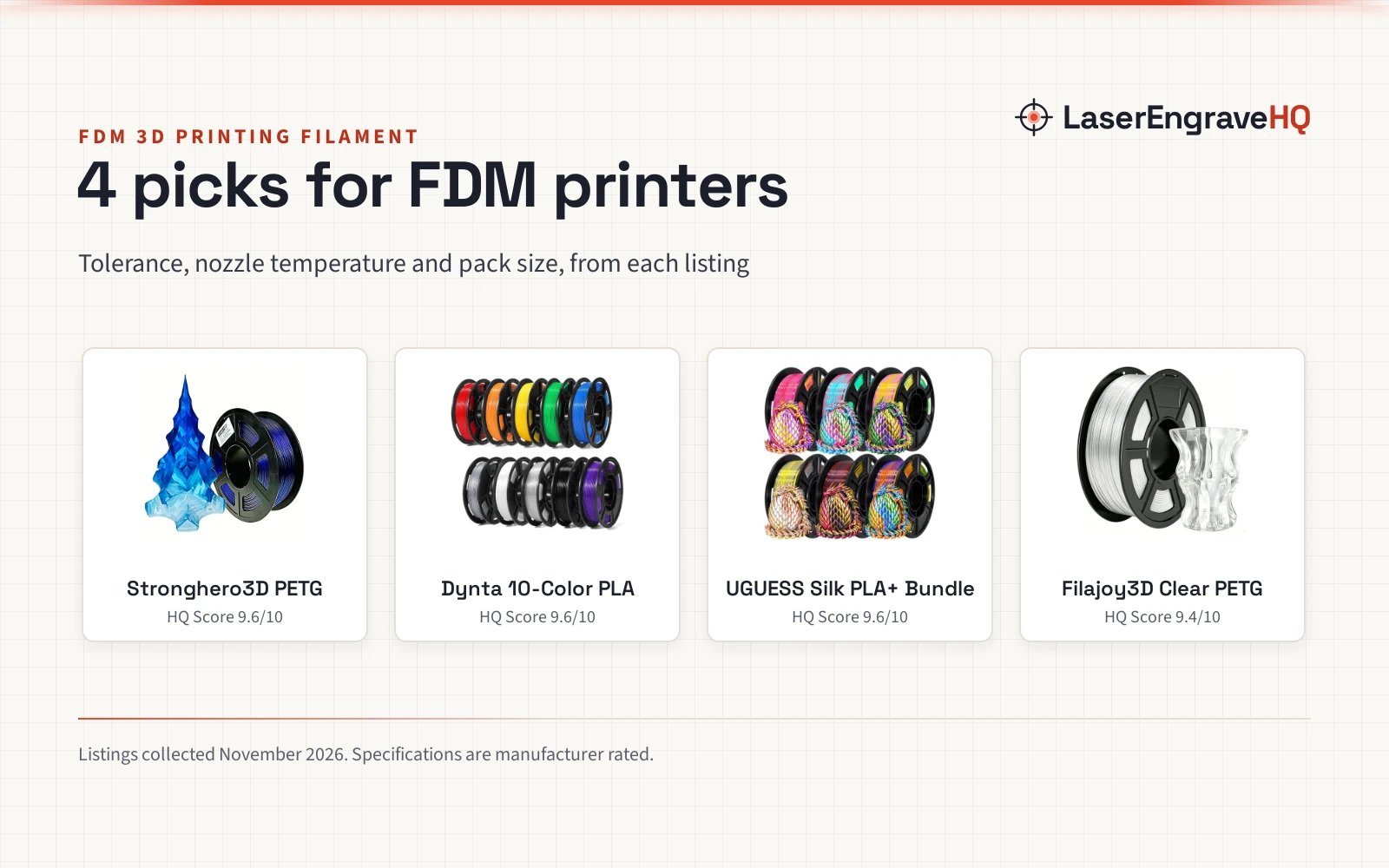
4 spools of PLA, PLA+ and PETG filament for FDM printers, compared by tolerance, nozzle temperature, pack size and warranty.

On this page
Top picks at a glance
As an Amazon Associate I earn from qualifying purchases.
- 1
 Best OverallStronghero3D PETG9.6/10View on Amazon
- 2
 Best for BeginnersDynta 10-Color PLA9.6/10View on Amazon
- 3
 Best Silk FinishUGUESS Silk PLA+ Bundle9.6/10View on Amazon
- 4
 Best Clear PETGFilajoy3D Clear PETG9.4/10View on Amazon
A spool of filament decides whether a print comes out clean or turns into a tangle of stringing and failed first layers, and the wrong material choice shows up in every layer that follows. Makers who print brackets, vases, miniatures and gifts for sale need a filament that feeds smoothly, sticks to the bed and holds its colour from the first layer to the last. This guide to the best fdm 3d printing filament compares spools in PLA, PLA+ and PETG, using only what each listing states about tolerance, temperature and pack size.
LaserEngraveHQ earns a commission from purchases made through these links, at no extra cost to you. Read our affiliate disclosure.
Quick picks
- Best Overall Stronghero3D PETG: A 1 kg translucent PETG spool with a stated 2 year warranty and a nozzle range of 220-250°C. Check price on Amazon
- Best for Beginners Dynta 10-Color PLA: 10 colours in 250 g spools with a ±0.02 mm tolerance, vacuum sealed with a desiccant pack. Check price on Amazon
- Best Silk Finish UGUESS Silk PLA+ Bundle: A 6-pack of tricolor silk PLA+ with a ±0.03 mm tolerance and a print speed of 50-200 mm/s. Check price on Amazon
- Best Clear PETG Filajoy3D Clear PETG: A transparent 0.25 kg PETG spool with a ±0.03 mm tolerance for lamps and decorative pieces. Check price on Amazon
Machines on the list
Stronghero3D PETG 3D Printer Filament
A translucent blue-gradient PETG spool, 1 kg of 1.75 mm filament with a stated 2 year warranty, for decorative prints that need PETG toughness.
Pros
- PETG toughness and layer bonding with a translucent blue gradient finish
- 1 kg spool at 1.75 mm for most FDM printers
- Nozzle 220-250°C and bed 70-85°C ranges stated in the listing
- Stated 2 year warranty, the only warranty term in this guide
Cons
- No diameter tolerance stated in the listing
- Blue gradient only, so no plain colour choice in this listing
- Listing gives no print speed, so speed is not stated
- Translucent finish suits decorative prints more than plain functional parts
Dynta 10 Colors 250g PLA 3D Printer Filament
10 colours of PLA in 250 g spools, 2.5 kg in total, with a ±0.02 mm tolerance and vacuum-sealed packs, aimed at beginners.
Pros
- ±0.02 mm tolerance, the tightest stated in this guide
- 10 colours in 250 g spools, 2.5 kg in total, for multi-colour work without opening a full 1 kg spool
- Each spool vacuum sealed with a desiccant pack
- Nozzle 190-230°C and bed 45-60°C ranges stated, with a 53 mm centre hub hole
Cons
- No warranty term stated in the listing
- 250 g spools run out faster than 1 kg spools on larger prints
- Listing advises using each spool within 3 months of opening
- PLA only, so no PETG option in this bundle
UGUESS Silk PLA+ 3D Filament Bundle
A 6-pack of silk tricolor PLA+ in 250 g spools, 1500 g in total, with a ±0.03 mm tolerance and gradient colour that shifts as the print grows.
Pros
- Tricolor gradient with a silk-like sheen across 6 colour combinations
- 6 spools of 250 g, 1500 g in total, for decorative miniatures and figurines
- ±0.03 mm tolerance with a stated print speed of 50-200 mm/s
- Vacuum-sealed with desiccants and a 24-hour support team stated in the listing
Cons
- No warranty term stated in the listing
- Gradient finish means the colour of a print depends on where the spool starts
- PLA+ only, so no PETG option in this bundle
Filajoy3D PETG 3D Printer Filament 1.75mm
A clear PETG spool, 0.25 kg of 1.75 mm filament with a ±0.03 mm tolerance, for transparent prints such as lamps and decorative pieces.
Pros
- Clear, glass-like transparency without a cloudy or milky look, per the listing
- ±0.03 mm tolerance with stable extrusion and low warping stated
- Nozzle 230-260°C, bed 65-75°C and print speed up to 220 mm/s stated
- 0.25 kg spool for a small transparent project
Cons
- No warranty term stated in the listing
- 0.25 kg is the smallest pack here, so it runs out fastest on larger prints
- Listing advises drying the filament before printing for the clearest results
- Transparent only, so no colour choice in this listing
Other machines to compare
 AMOLEN Silk PLA 3D Printer FilamentCheck price on Amazon
 SUNLU PLA 3D Printer FilamentCheck price on Amazon
 ELEGOO PLA 3D Printer Filament 1.75mm Black 1KGCheck price on Amazon
 ELEGOO PLA 3D Printer Filament 1.75mm Wood 1KGCheck price on Amazon
 ELEGOO PLA 3D Printer Filament 1.75mm Black 4KGCheck price on Amazon
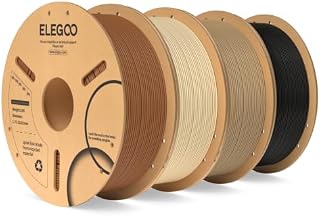 ELEGOO PLA 3D Printer Filament 1.75mm 4KG Brown/Beige/WoodCheck price on Amazon
Specs compared
| Filament | HQ Score | Material | Diameter | Tolerance | Nozzle temp | Pack | Warranty |
|---|---|---|---|---|---|---|---|
| Stronghero3D PETG | 9.6/10 | PETG | 1.75 mm | Not stated | 220-250°C | 1 kg | 2 years |
| Dynta 10-Color PLA | 9.6/10 | PLA | 1.75 mm | ±0.02 mm | 190-230°C | 2.5 kg | Not stated |
| UGUESS Silk PLA+ Bundle | 9.6/10 | PLA+ | 1.75 mm | ±0.03 mm | 200-240°C | 1500 g | Not stated |
| Filajoy3D Clear PETG | 9.4/10 | PETG | 1.75 mm | ±0.03 mm | 230-260°C | 0.25 kg | Not stated |
Size and performance figures are the brand’s ratings quoted from listings on 12 November 2026. Tolerance is the diameter tolerance each listing states, and pack size is the total filament in the listing.
How the picks are scored
Each filament is scored out of 10 on performance, build, value, safety and warranty, with the weights published on the scoring page. A spec the listing does not publish scores nothing.
| Product | HQ Score | Perf. /35 | Build /25 | Value /25 | Safety /10 | Warranty /5 |
|---|---|---|---|---|---|---|
| Stronghero3D PETG | 9.6 | 29 | 20 | 20 | n/a | 3 |
| Dynta 10-Color PLA | 9.6 | 30 | 21 | 22 | n/a | 0 |
| UGUESS Silk PLA+ Bundle | 9.6 | 29 | 21 | 21 | n/a | 0 |
| Filajoy3D Clear PETG | 9.4 | 28 | 19 | 15 | n/a | 0 |
We translate weighted points into a score with 9.2 as its floor and 9.8 as its cap; the straight-line conversion keeps the ranking exactly. Safety is scored for powered machines and any listing that states safety features; accessories without either are scored over the remaining 90 points.
What the listings tell you, and what they leave out
4 filament listings were read for this guide. Only 1 stated a warranty term, the Stronghero3D PETG with a 2 year term, and only 3 of the 4 stated a diameter tolerance. All 4 stated a nozzle temperature range and a bed temperature range, and 2 of the 4 are PETG while the other 2 are PLA or PLA+.
Pack size varies widely: the smallest spool holds 0.25 kg and the largest bundle holds 2.5 kg, with the 1 kg spool and the 1500 g bundle in between. Colour choice varies just as much, from the transparent spool to a bundle of 10 colours. No listing stated a print speed except the UGUESS bundle at 50-200 mm/s and the Filajoy3D spool at up to 220 mm/s.
Buying guide: choosing the best fdm 3d printing filament
PLA, PLA+ or PETG
PLA suits beginners and decorative prints, and the Dynta bundle lists school STEM projects and home hobbies among its uses. PLA+ adds toughness, and the UGUESS listing describes its modified PLA+ as tougher with stable forming and less warping. PETG suits parts that need toughness and durability, and the PETG picks here list lamps and decorative pieces among their uses. The choice comes down to the job: colour range and easy printing point to PLA, while toughness and a clear finish point to PETG.
Diameter tolerance
Tolerance states how closely the filament keeps to its stated diameter, and a tighter number means steadier extrusion. The Dynta bundle states ±0.02 mm, the tightest here, while the UGUESS bundle and the Filajoy3D spool state ±0.03 mm. The Stronghero3D listing states no tolerance, so there is nothing to compare against on that point.
Nozzle and bed temperature
Every listing here states a nozzle range and a bed range, and they differ by material. The Dynta PLA runs at a nozzle temperature of 190-230°C with a bed at 45-60°C, while the UGUESS PLA+ runs at 200-240°C with a bed at 50-65°C. The PETG picks run hotter: Stronghero3D at 220-250°C with a bed at 70-85°C, and Filajoy3D at 230-260°C with a bed at 65-75°C. Match the ranges to the printer and the material before loading a spool.
Pack size and spool size
Pack size decides how far a spool goes and how many colours sit on the shelf. The Dynta bundle holds 2.5 kg across 10 spools of 250 g, the UGUESS bundle holds 1500 g across 6 spools of 250 g, the Stronghero3D spool holds 1 kg, and the Filajoy3D spool holds 0.25 kg. Small spools suit trying a colour or a material, while larger packs suit makers who print often in the same material.
Storage and drying
Filament absorbs moisture from the air, and damp filament prints with bubbles and brittle layers. The Dynta and UGUESS listings state vacuum sealing with a desiccant pack, and the Stronghero3D listing advises keeping the filament dry before printing. The Filajoy3D listing advises drying the filament before printing for the clearest results, and the Dynta listing advises using each spool within 3 months of opening and securing the filament end in the spool holes after opening.
Keep filament dry between prints: store spools sealed with desiccant, secure the loose end in the spool holes so the winding stays neat, and dry a spool before printing when the listing advises it. Damp filament shows up as bubbles, stringing and brittle layers.
Project Match
Match the job to the pick:
- Miniatures and figurines with shifting colour: UGUESS Silk PLA+ Bundle
- Multi-colour prototypes and school projects: Dynta 10-Color PLA
- Translucent vases, lampshades and display pieces: Stronghero3D PETG
- Clear lamps and transparent decorative pieces: Filajoy3D Clear PETG
- Parts that need PETG toughness: Stronghero3D PETG or Filajoy3D Clear PETG
FAQ: lasers and CNC
What is the best fdm 3d printing filament for beginners?
The Dynta bundle is the beginner pick here: 10 colours in 250 g spools, a ±0.02 mm tolerance, vacuum sealing with a desiccant pack, and a stated nozzle range of 190-230°C. The UGUESS bundle is also aimed at beginners, with precision winding and a 24-hour support team stated in the listing.
Should I choose PLA or PETG?
PLA suits easy printing and colour range, and the Dynta bundle lists 10 colours for multi-colour modelling and prototype work. PETG suits tougher parts and clear or translucent finishes, and the Stronghero3D listing describes good toughness, durability and layer bonding. The UGUESS PLA+ sits between them, with the listing describing tougher PLA+ with stable forming.
What nozzle temperature should I use for PLA and PETG?
Follow the range each listing states. The PLA picks state 190-230°C for the Dynta bundle and 200-240°C for the UGUESS bundle. The PETG picks state 220-250°C for the Stronghero3D spool and 230-260°C for the Filajoy3D spool. Bed temperatures run from 45-60°C for the Dynta PLA to 70-85°C for the Stronghero3D PETG.
How should I store filament between prints?
Keep it dry and sealed. The Dynta and UGUESS listings state vacuum sealing with a desiccant pack, and the Dynta listing advises using each spool within 3 months of opening and securing the filament end in the spool holes. The Stronghero3D listing advises keeping the filament dry before printing, and the Filajoy3D listing advises drying the filament before printing for the clearest results.
What does a ±0.02 mm tolerance mean?
It means the filament diameter stays within 0.02 mm of the stated 1.75 mm along the spool, which the Dynta listing ties to consistent feed and smooth surface finishes. The UGUESS bundle and the Filajoy3D spool state ±0.03 mm, a slightly wider band. The Stronghero3D listing states no tolerance.
Related: the best PLA filament for 3D printers, best ABS filament for 3D printing, and best white PETG filament. Also see the filament storage rack, filament for outdoor use, and FDM vs resin 3D printer. Also see the multi-colour PLA filament.