Cw3000 vs Cw5000 Water Chiller: Which One Should You Buy?
A clear comparison of CW-3000 and CW-5000 water chillers for CO2 laser cutters, explaining passive radiator limits, active compressor cooling, and sizing rules.

On this page
Top picks at a glance
As an Amazon Associate I earn from qualifying purchases.
- 1
 Large Flow: 800GPH Water Pump with 6.5 ft Tubing and 49.6/10View on Amazon
- 2
 XPOWER P-230AT Mini Mighty 1/4 HP 925 CFM Centrifugal Air9.6/10View on Amazon
- 3
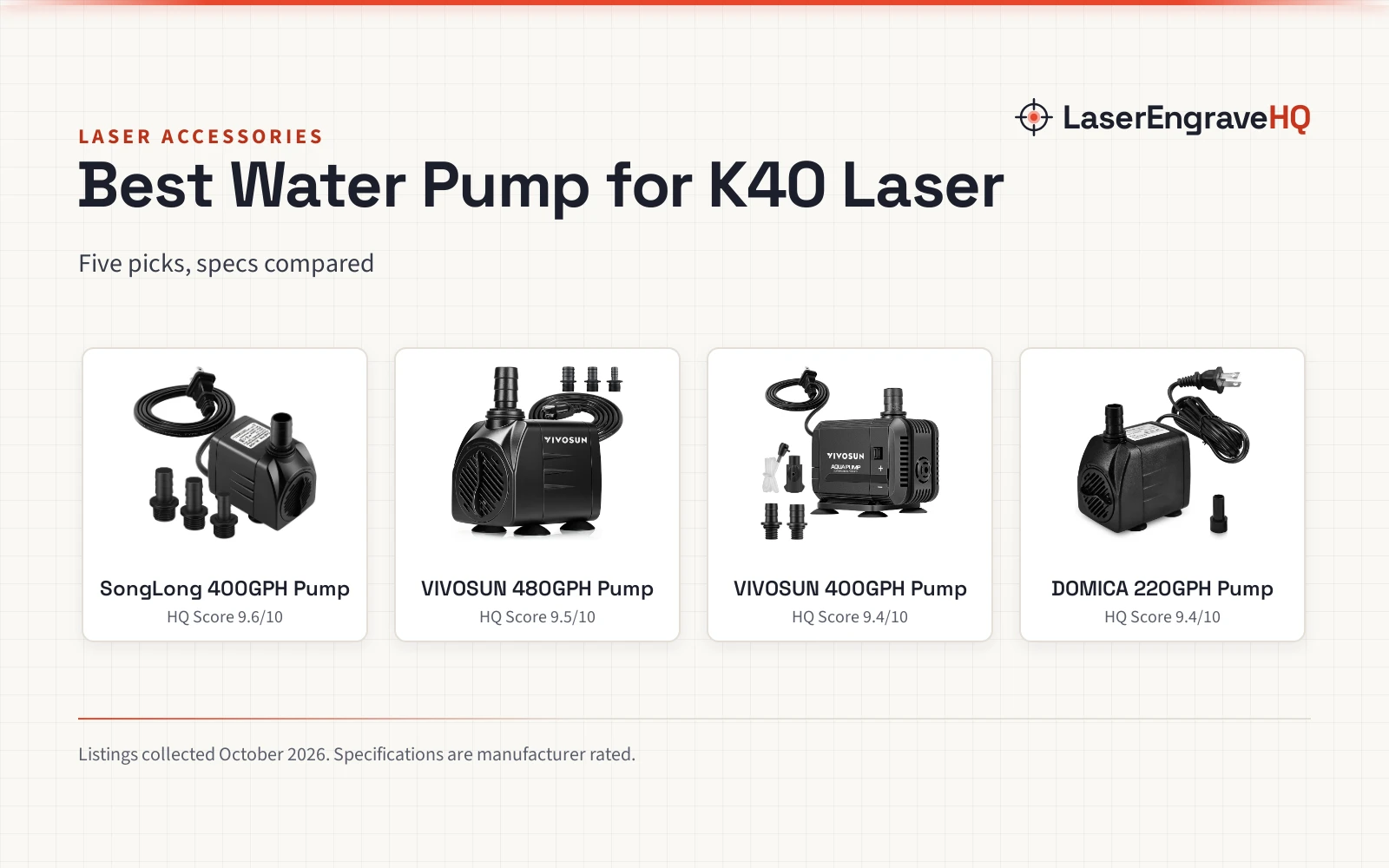
 SongLong 400GPH Submersible Water Pump 6.5ft High Lift for9.6/10View on Amazon
- 4
 Cloudray Water Chiller CW-5200DH 6L 0.81HP 3.43gpmView on Amazon
- 5
 S&A CW-5200DH 7L Industrial Water ChillerView on Amazon
- 6
 OMTech CW-3000 9L Industrial Water Chiller for CO2 Lasers upView on Amazon
- 7
 S&A CW-5000 DG Industrial Water Chiller 7L 1.14HP 2.64gpmView on Amazon
- 8
 OMTech CW-5200 6L Industrial Water Chiller For up to 150W CO2View on Amazon
- 9
 OMTech 6L Dual Industrial Water Chiller 0.9hp 3.2gpm WaterView on Amazon
When cutting acrylic signs, personalized tumblers, leather patches, or wooden gifts on a CO2 laser, choosing between a cw3000 vs cw5000 water chiller comes down to passive heat dissipation versus active refrigeration. A CW-3000 uses a radiator and fans to circulate coolant without a compressor, radiating heat away rather than chilling below ambient room temperature, which suits small 40W K40 machines and light engraving up to 50W in cool rooms. In contrast, a CW-5000 uses a dedicated refrigerant compressor to actively pull heat down below ambient air, making it the proper choice for continuous cutting and higher-wattage 60W, 70W, 80W, 90W, and 100W CO2 laser tubes during long production runs. The sections below explain how each cooling system operates, where their limits lie, and how to pick the right unit for your workshop.
Other machines to compare
 Cloudray Water Chiller CW-5200DH 6L 0.81HP 3.43gpmCheck price on Amazon
 S&A CW-5200DH 7L Industrial Water ChillerCheck price on Amazon
 OMTech CW-3000 9L Industrial Water Chiller for CO2 Lasers upCheck price on Amazon
 S&A CW-5000 DG Industrial Water Chiller 7L 1.14HP 2.64gpmCheck price on Amazon
 OMTech CW-5200 6L Industrial Water Chiller For up to 150W CO2Check price on Amazon
 OMTech 6L Dual Industrial Water Chiller 0.9hp 3.2gpm WaterCheck price on Amazon
LaserEngraveHQ earns a commission from purchases made through these links, at no extra cost to you. Read our affiliate disclosure.
Glass CO2 laser tubes convert only a fraction of electrical input into beam power, discharging the remaining energy directly into the circulating water. Without adequate heat extraction, coolant temperature climbs, reducing beam power and accelerating tube degradation. Choosing between radiator circulation and active compressor refrigeration determines whether your coolant stays stable across all seasons.
Step 1: Understand how passive radiator cooling works
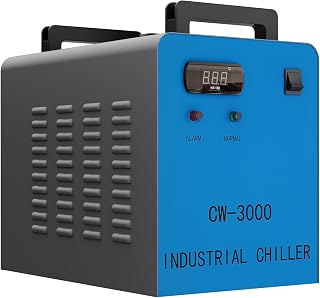
The CW-3000 is a closed-loop heat dissipator rather than a true chiller. It circulates coolant through the laser tube water jacket, routing warm water through finned radiator coils while fans pull ambient air across the fins.
OMTech lists its CW-3000 with a 2.4-gallon (9L) water tank, a 2.6 gpm flow rate (or 5 L/min water flow), and an empty weight of 20.9 pounds. OMTech states that this design radiates heat away rather than using refrigeration, using its powerful fans to radiate away 50W of heat from your machine for every 1°C rise in water temperature (listed as 50W/°C heat dissipation).
Without a compressor, heat transfer requires coolant to rise above ambient room air. If your workshop is warm, water temperature rises higher. For light hobby engraving, this circulation outperforms an open bucket, as detailed in our water chiller vs submersible pump laser guide, but it cannot chill water below ambient room temperature.
Step 2: Understand how active compressor refrigeration works
The CW-5000 is an active refrigerated chiller using a vapor-compression cycle. It houses a motorized compressor, condenser, expansion valve, and evaporator to extract heat from the water loop and exhaust it into the room.
S&A lists its genuine CW-5000 DG industrial water chiller with a 1.85 gallon (7L) water tank, standard R134a refrigerant, and a 2.64gpm flow rate. S&A lists its 1.1hp compressor (with 1.14HP in the title) cooling up to 3868 Btu per hour, with maximum cooling capacity listed at 1600W. S&A states that its dual mode temperature control includes constant mode (maintaining water temperature constant within 0.3°C between 5-40 degree) and intelligent mode (automatically adjusting water temperature according to indoor environment temperature).
For larger machines, S&A lists its CW-5200 with standard R410a refrigerant and a 0.9hp compressor cooling up to 5699 Btu per hour for 60W to 150W (and up to 150W-180W). OMTech lists its CW-5200 with a 1.6-gallon (6 L) water tank, 3.2 gpm flow rate, and 5186 BTU/h cooling capacity with a 0.9 HP compressor (and 0.58 hp in bullets). Cloudray lists its CW-5200DH with a 6L tank, 3.43gpm flow rate, 0.9HP compressor (0.81HP in title), 5596 Btu/h cooling capacity, utilizing Refrigerant R32 with a minimum temperature of 5 degrees. Learn more in our CO2 laser water chiller explained overview.
Step 3: Match cooling capacity to laser tube wattage
Laser power determines how much heat must be removed from the coolant loop to protect glass CO2 tube efficiency.
OMTech lists its CW-3000 for CO2 lasers up to 50W, specifically highlighting 40W K40 CO2 laser machines. At 40W or 50W output during intermittent engraving, heat generation is modest. OMTech states that its 50W/°C dissipation design can keep the machine cool if the room stays cool. Our K40 vs diode laser guide explains typical duty cycles for these entry machines.
However, sustained vector cutting or higher-power tubes generate heat that exceeds passive airflow limits. S&A lists its CW-5000 for 40W, 50W, 60W, 70W, 80W, 90W, and 100W CO2 laser machines, keeping machines up to 80W-100W cool during sustained cutting. Active compressor chilling prevents optical beam degradation and tube aging, as covered in our guide on how long CO2 laser tubes last. For power comparisons, see our 40W vs 50W CO2 laser comparison.
Step 4: Account for ambient room temperature and seasonal heat
Ambient room temperature divides passive and active cooling. A passive radiator like the CW-3000 cannot cool below room temperature. In a warm workshop, circulating water equilibrates above ambient, risking tube efficiency loss.
An active compressor chiller isolates cooling from room heat. S&A lists dual modes: intelligent mode automatically adjusts water temperature to the indoor environment, while constant mode maintains regulation within 0.3°C at a manually set target between 5-40 degree. On hot days, constant mode pulls coolant down to your target. Our water cooled vs air cooled CO2 laser guide outlines how ambient heat affects cutting consistency.
Step 5: Compare reservoir capacity and water flow rates
Coolant reservoir volume acts as a thermal buffer, while steady pump flow prevents hot spots inside the glass tube water jacket.
OMTech lists a 2.4-gallon (9L) enclosed tank for its CW-3000, while S&A lists a 1.85 gallon (7L) enclosed tank for the CW-5000. Both use enclosed reservoirs to reduce evaporation between refills.
OMTech lists a 2.6 gpm flow rate and 5 L/min water flow with brass ports on the CW-3000. S&A lists a 2.64gpm flow rate with a maximum flow of 13L/Min and precision-engineered brass ports on the CW-5000. For maintenance procedures, consult our CO2 laser maintenance checklist.
For weight, OMTech lists 20.9 pounds for the CW-3000, whereas S&A lists 24 kg for the CW-5000 due to its motor compressor and refrigeration hardware.
Step 6: Review alarm sensors, safety features, and port connections
Cooling failure can crack a glass tube if the laser fires without circulation. Both designs include safety alarms to guard against flow interruption.
OMTech CW-3000 includes internal sensors with digital monitoring, indicator lights, and audible alarms. S&A CW-5000 provides protection and alarm functions, including abnormal flow prompts, high water temperature alerts, and compressor overcurrent protection.
Both units feature rear alarm output ports to wire into the laser controller water protection terminal, halting beam firing if flow stops. Cloudray notes that pure water or ionized water can be used, with antifreeze added up to a maximum proportion of 30% for cold spaces. Setup steps are detailed in our guide on how to use CO2 laser cutting machine.
Step 7: Select the right cooling setup for your workshop
Choosing between these platforms depends on laser power, workload, and room conditions:
- Choose the CW-3000 if: you operate a 40W K40 desktop engraver or do light engraving up to 50W, keep your machine in a cool room, and prefer a lighter 20.9 pounds unit.
- Choose the CW-5000 if: you operate a 50W, 60W, 70W, 80W, 90W, or 100W CO2 laser cutter for sustained cutting, work in an unconditioned space, or need active cooling within 0.3°C.
For production shops running 150W to 180W tubes, upgrading to the CW-5200 platform provides extra cooling capacity. Compare machines in our best CO2 laser cutter for home use guide and our best laser engraver for small business guide.
Common mistakes to avoid
- Assuming the CW-3000 has a compressor: it is a passive radiator that cannot chill below room temperature.
- Running 60W, 80W, or 100W tubes on a CW-3000: passive dissipation cannot shed heavy cutting heat.
- Using tap water: minerals cause scale buildup; use pure or ionized water instead.
- Skipping the alarm wire: always connect the chiller alarm port to your laser controller.
- Overlooking warm room conditions: passive radiators lose efficiency as ambient temperatures climb.
Cw3000 vs cw5000 water chiller: the short comparison
- Cooling mechanism: CW-3000 is a passive radiator dissipator (OMTech lists 50W/°C dissipation); CW-5000 is an active refrigerated chiller (S&A lists a 1.1hp compressor cooling up to 3868 Btu per hour with R134a refrigerant).
- Tube compatibility: OMTech lists CW-3000 for lasers up to 50W (highlighting 40W K40 units); S&A lists CW-5000 for 40W, 50W, 60W, 70W, 80W, 90W, and 100W machines.
- Temperature control: CW-3000 tracks above ambient room temperature; S&A CW-5000 maintains temperature within 0.3°C in constant mode (5-40 degree range) or adjusts in intelligent mode.
- Tank capacity: OMTech CW-3000 has a 2.4-gallon (9L) tank; S&A CW-5000 has a 1.85 gallon (7L) tank.
- Weight: OMTech CW-3000 weighs 20.9 pounds; S&A CW-5000 weighs 24 kg.
- Verdict: Choose the CW-3000 for light 40W K40 or up to 50W hobby engraving in cool rooms; choose the CW-5000 for sustained cutting or 60W to 100W lasers.
Proper cooling protects your CO2 laser tube from thermal degradation, maintaining beam power and cutting quality.
FAQ: lasers and CNC
Can a CW-3000 cool water below ambient room temperature?
No. The CW-3000 has no compressor. OMTech states that it radiates heat away rather than using refrigeration, providing 50W/°C heat dissipation. Water temperature will always equilibrate above ambient room air.
Can I run an 80W or 100W CO2 laser with a CW-3000?
No. OMTech lists the CW-3000 for lasers up to 50W, primarily 40W K40 units. Tubes listed at 80W or 100W generate heat that overwhelms passive dissipation. S&A lists its active CW-5000 for 40W through 100W tubes, keeping machines up to 80W-100W cool.
What refrigerant does the CW-5000 water chiller use?
S&A states that its genuine CW-5000 water chiller uses standard R134a refrigerant. Step-up models like S&A CW-5200 use R410a, while Cloudray lists Refrigerant R32 for CW-5200DH.
What type of water should I put in a laser chiller?
Use pure water or ionized water to avoid mineral scaling. Cloudray notes pure water or ionized water can be used, with antifreeze up to a proportion of 30% for cold conditions.
Do I need a water chiller for a 40W K40 laser engraver?
A 40W K40 requires continuous circulation. While a bucket and pump work, a CW-3000 adds an enclosed 9L tank, radiator fans, brass ports, and flow alarms for clean workshop operation.
How often should I change the coolant in a CO2 laser chiller?
Inspect the water level observation window regularly. In an enclosed 9L or 7L reservoir, evaporation is low. Flushing and replacing coolant periodically prevents microbial growth and preserves heat transfer.
Related: the laser accessories hub, CO2 laser water chiller explained, water chiller vs submersible pump laser, and how long CO2 laser tubes last. Also see our best CO2 laser cutter for home use guide and CO2 laser maintenance checklist.