Water Chiller vs Submersible Pump Laser: Which One Should You Buy?
Compare water chillers and submersible pumps for CO2 laser tube cooling, covering heat control, tube protection, and workshop safety for clean cuts.

On this page
Top picks at a glance
As an Amazon Associate I earn from qualifying purchases.
- 1
 OMTech 100W CO2 Laser Engraver with 4 Way Pass Through Air9.7/10View on Amazon
- 2
 xTool S1 40W Laser Cutter and Laser Engraver for Tumblers9.7/10View on Amazon
- 3
 Cloudray Water Chiller CW-5200DH 6L 0.81HP 3.43gpmView on Amazon
- 4
 S&A CW-5200DH 7L Industrial Water ChillerView on Amazon
- 5
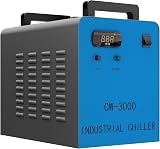 OMTech CW-3000 9L Industrial Water Chiller for CO2 Lasers upView on Amazon
- 6
 OMTech CW-5200 6L Industrial Water Chiller For up to 150W CO2View on Amazon
- 7
 S&A CW-5000 DG Industrial Water Chiller 7L 1.14HP 2.64gpmView on Amazon
- 8
 OMTECH 9L Industrial Water Chiller 2.6gpm Water CoolingView on Amazon
Makers cutting acrylic signs, personalized wooden plaques, or leather patches quickly face an essential equipment decision: how to keep the laser tube cool. When evaluating a water chiller vs submersible pump laser setup, the direct answer comes down to workload and tube power. A submersible pump in a distilled water reservoir works for light hobby engraving in brief runs on low-power machines, but an active refrigerated water chiller becomes necessary for continuous cutting, commercial production, and higher-power tubes (such as 60W to 150W) because it maintains a stable coolant temperature to preserve tube lifespan and beam quality.
Other machines to compare
 Cloudray Water Chiller CW-5200DH 6L 0.81HP 3.43gpmCheck price on Amazon
 S&A CW-5200DH 7L Industrial Water ChillerCheck price on Amazon
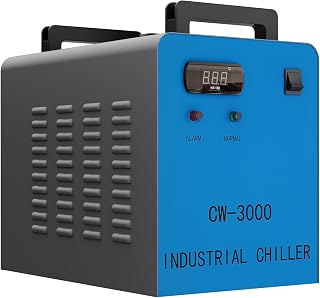 OMTech CW-3000 9L Industrial Water Chiller for CO2 Lasers upCheck price on Amazon
 OMTech CW-5200 6L Industrial Water Chiller For up to 150W CO2Check price on Amazon
 S&A CW-5000 DG Industrial Water Chiller 7L 1.14HP 2.64gpmCheck price on Amazon
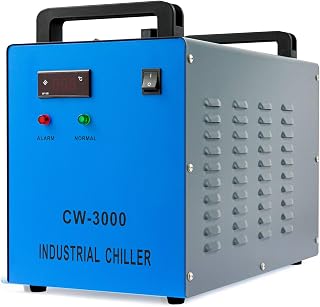 OMTECH 9L Industrial Water Chiller 2.6gpm Water CoolingCheck price on Amazon
LaserEngraveHQ earns a commission from purchases made through these links, at no extra cost to you. Read our affiliate disclosure.
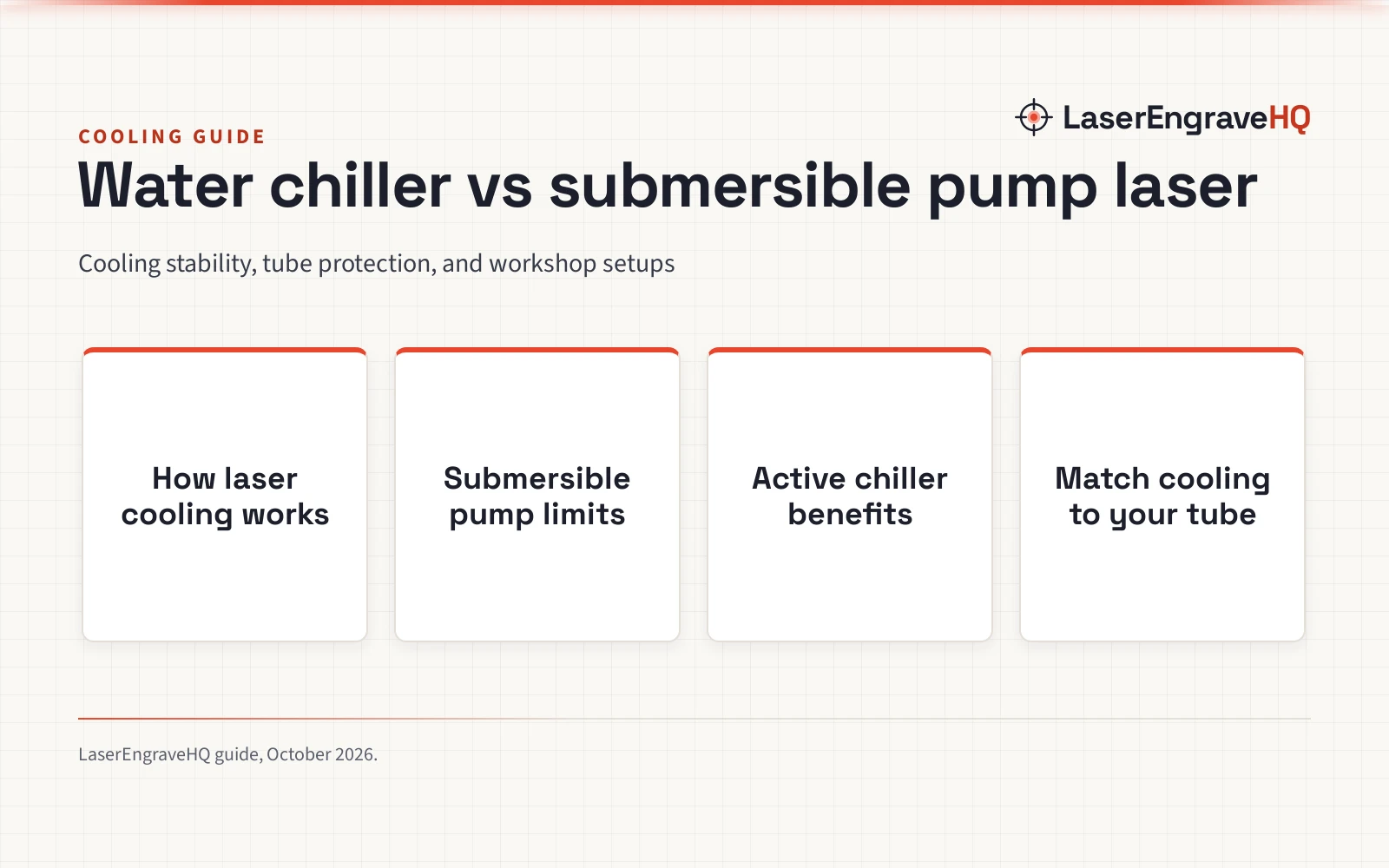
CO2 laser tubes rely on continuous water circulation to absorb waste heat generated by high-voltage gas excitation. Running a tube without coolant or allowing water to overheat degrades the gas mixture and can crack the glass envelope.
How CO2 laser tube cooling works
Glass CO2 laser tubes excite gas with high voltage, turning unharvested energy into heat. A water jacket circulates pure water to cool the core. If coolant stops or overheats, cutting power drops, beam quality degrades, and the tube deteriorates. For mechanics, see what is a CO2 laser engraver and how long CO2 laser tubes last.
The submersible pump setup: how it works and where it struggles
A starter setup submerges a pump in distilled water, circulating coolant through silicone tubing. Key limitations include:
- No refrigeration: Heat accumulates steadily during cutting runs.
- Erratic ice bottle cooling: Adding frozen bottles causes rapid thermal swings, stressing the glass tube and causing uneven cuts.
- Contamination and alarms: Open buckets gather dust, and basic pumps lack alarms to halt the laser if flow fails.
Water chiller vs submersible pump laser: key differences
Temperature stability is the main difference. S&A CW-5000 and CW-5200DH chillers maintain water constant within 0.3°C, while OMTech lists ±0.3°C control on the CW-5200. S&A rates cooling at 3868 BTU/Hour with a 1.1hp compressor on the CW-5000, and 5699 BTU/h with a 0.9hp compressor on the CW-5200DH. OMTech lists 5186 BTU/h on the CW-5200 (noting a 0.9 HP compressor, 0.58 hp in bullets), while Cloudray lists 5596 Btu/h on the CW-5200DH.
Flow and safety are also superior: S&A lists 2.64gpm on the CW-5000 and 3.4 gpm on the CW-5200DH; OMTech lists 3.2 gpm on the CW-5200, and Cloudray lists 3.43gpm. Dedicated chillers feature sealed tanks (7L on S&A, 6L on OMTech and Cloudray) with water level scales and alarm ports that stop the beam if circulation fails.
Passive cooling vs active refrigeration
Passive coolers like the CW-3000 lack compressors and cannot chill below room temperature. OMTech states the CW-3000 radiates 50W per 1 degree rise (50W/°C heat dissipation) with 2.6 gpm (5 L/min) flow and a 9L reservoir for lasers up to 50W. Cloudray lists 50W/°C cooling, a 9L tank, and 10L/min pump flow for 40W 50W machines.
Active chillers (CW-5000, CW-5200) use refrigeration with R134a, R410a, or R32. S&A provides Constant mode (within 0.3°C, 5-40 degree) and Intelligent mode (tracking room temperature). Cloudray notes a minimum temperature of 5 degrees on the CW-5200DH, cautioning against holding it. OMTech lists 433 watts input draw on the CW-5200, while the CW-5202 cools two CO2 lasers with two port sets and a 6L tank.
When a submersible pump is enough
A pump is acceptable for specific setups:
- Low-power hobby lasers: 40W K40 machines on light wood crafts produce modest heat that a reservoir absorbs during short jobs.
- Climate-controlled rooms: Air-conditioned rooms prevent rapid water warming.
- Starter setups: Beginners can start engraving while budgeting for upgrades. See K40 vs diode laser and laser engraver accessories for beginners.
When you must upgrade to an active water chiller
Upgrade to an active chiller when workshop demands rise:
- Higher tube power: S&A rates the CW-5000 for 40W to 100W (up to 80W-100W), while S&A, OMTech, and Cloudray specify CW-5200 units for 60W to 150W (up to 180W). Tubes at 60W and above require active cooling.
- Production cutting: Vector cutting thick acrylic or wood generates intense sustained heat.
- Warm workshops: Warm ambient air heats bucket reservoirs before cutting starts. See best CO2 laser cutter for home use and CO2 laser water chiller explained.
Cooling setup checklist for your workshop
- Pure distilled water: Use distilled or ionized water to avoid scale and electrical arcing. Cloudray notes antifreeze can be added up to 30% for freeze protection.
- Alarm interlock: Wire the chiller alarm plug to the controller to stop the beam if circulation fails.
- Secure tubing: Keep hoses kink-free on brass ports (0.4 in. OD on OMTech CW-5200; OD 10mm on Cloudray CW-3000). Purge bubbles before firing.
- Maintenance and safety: Inspect water scales and clean dust nets; see CO2 laser maintenance checklist. Vent fumes (best fume extractor for laser engraver), keep an extinguisher nearby (best fire extinguisher for laser engraver), and never cut PVC, vinyl, PVC faux leather, polycarbonate, or ABS.
Common cooling mistakes to avoid
- Firing the tube with trapped air bubbles in the cooling jacket.
- Using tap water that creates insulating mineral scale.
- Adding ice bottles to a bucket, causing rapid thermal cycling.
- Running without connecting the chiller alarm interlock to the laser.
- Operating high-power tubes on passive cooling inside warm rooms.
Water chiller vs submersible pump laser: the short version
- Submersible pumps suit brief engraving jobs on low-power machines like a 40W K40.
- Bucket setups lack active refrigeration and climb in temperature during continuous cutting.
- Passive CW-3000 units provide 9L capacity and 50W/°C dissipation but cannot chill below room temperature.
- Active CW-5000 (up to 80W-100W) and CW-5200 (60W to 150W) chillers maintain water constant within 0.3°C.
- Always connect the alarm output to stop the laser if flow fails.
FAQ: lasers and CNC
Can I use tap water in a laser water chiller or submersible pump?
No. Tap water deposits scale inside the tube and increases electrical conductivity. Use pure distilled or ionized water.
Can I add ice to a submersible pump bucket to keep temperatures down?
Ice causes rapid thermal swings, stressing the glass tube. Active chillers maintain a steady temperature automatically.
What is the difference between a CW-3000 and a CW-5000 or CW-5200 chiller?
The CW-3000 is a passive radiator radiating 50W per 1 degree rise without a compressor. CW-5000 and CW-5200 models use active refrigeration with R134a, R410a, or R32 to hold water constant within 0.3°C.
What laser power rating requires an active water chiller?
A 40W tube can run on a pump for brief runs, and passive CW-3000 units support up to 50W. Active chillers are recommended for 60W and above: S&A rates the CW-5000 for 40W to 100W (up to 80W-100W), while CW-5200 units cover 60W to 150W (up to 180W).
Can I run two laser engravers from one water chiller?
Yes. The OMTech CW-5202 cools two CO2 lasers with two port sets, a 6L tank, 0.9 HP compressor, and 5186 BTU/h capacity for lasers up to 150W.
Can antifreeze be used in a laser water chiller?
Cloudray states antifreeze may be added for freeze protection, up to a 30% limit.
Related: the laser engraver hub, CO2 laser cutters and laser accessories. Also see our CO2 laser water chiller explained, how long CO2 laser tubes last, and how to choose a laser engraver.