Whiteside RU2100 Review: Pros, Cons & Who It’s For
A research-based review of the Whiteside RU2100 spiral upcut router bit, covering its solid carbide specs, chip clearance, CNC woodworking fit, and listing gaps.

On this page
Top picks at a glance
As an Amazon Associate I earn from qualifying purchases.
- 1
 Whiteside RU2100 Spiral Upcut Router Bit9.6/10View on Amazon
- 2
 Whiteside 6210 CNC Spoilboard Surfacing Router Bit9.6/10View on Amazon
- 3
 Whiteside Router Bits RD2100 Standard Spiral Bit with Down9.6/10View on Amazon
When cutting mortises, deep grooves, or precision pockets on a CNC router or plunge router, chip evacuation determines whether flutes cut cleanly or overheat. This Whiteside RU2100 review examines a dedicated 1/4 in solid carbide upcut spiral router bit engineered to lift waste toward the router collet out of the cut channel. For woodworkers crafting signs, furniture joinery, or cut parts in hardwood, plywood, and MDF, continuous chip clearance keeps cutting edges cool and groove walls crisp. We have not used the router bit ourselves; this review is based on Whiteside’s Amazon listing and the specs Whiteside publishes there.
LaserEngraveHQ earns a commission from purchases made through these links, at no extra cost to you. Read our affiliate disclosure.

Whiteside RU2100 Spiral Upcut Router Bit
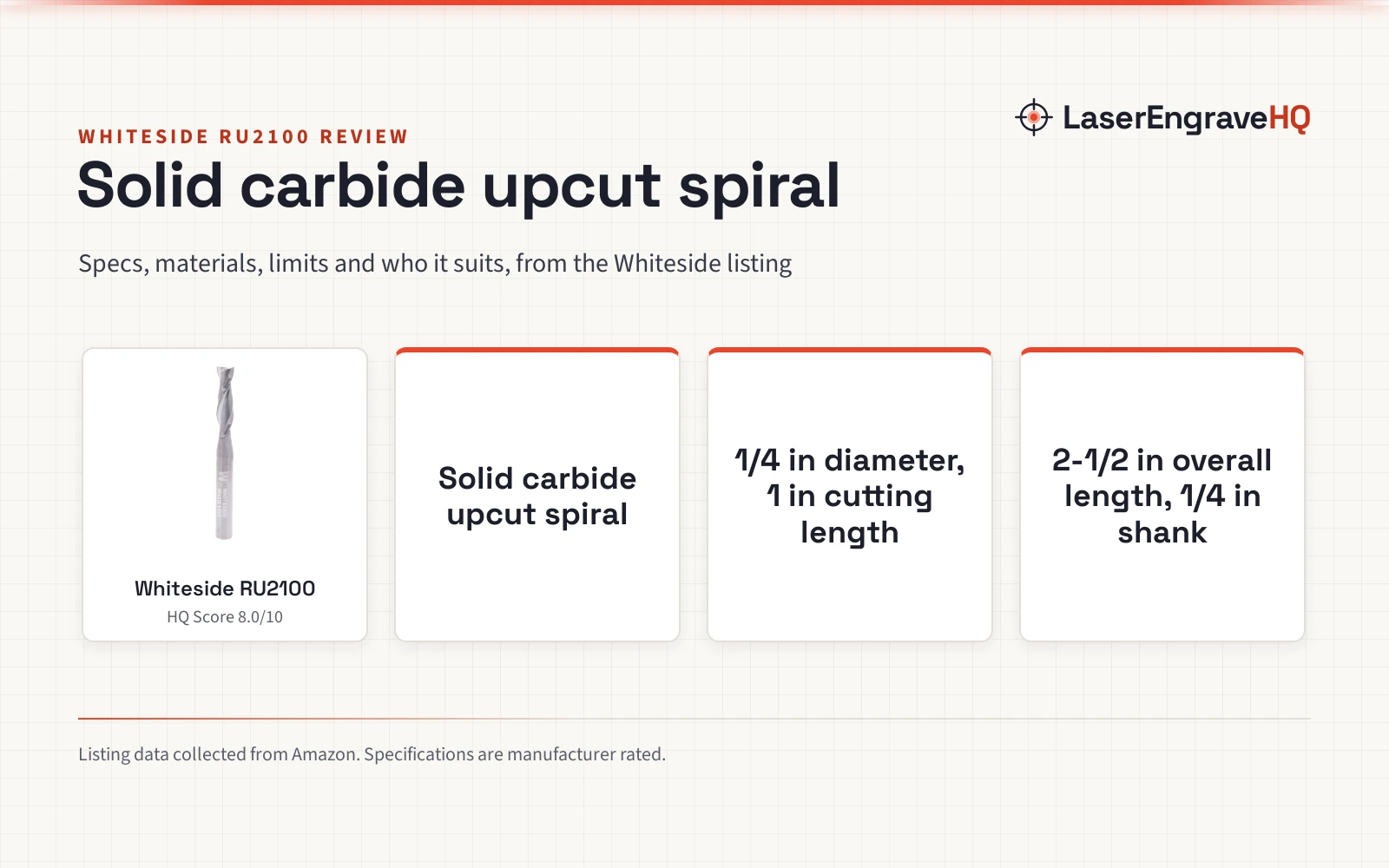
A solid carbide 2-flute upcut spiral bit with a 1/4 in shank, 1/4 in cutting diameter, and 1 in cutting length for CNC machines and router tables.
Pros
- Solid carbide construction with 2 flutes designed for smooth finishes and upward chip evacuation
- Plunge-capable geometry for grooving, dados, mortises, pockets, and slotting
- Versatile material compatibility across hardwoods, softwoods, plywood, MDF, and hard plastics
- Standard 1/4 in shank fits compact CNC routers, router tables, and hand-held routers
Cons
- No warranty term is stated on the listing
- Listing contradicts itself by listing carbide-tipped cut in the spec table despite solid carbide bullets
- Upcut spiral pulls chips toward the collet, which can cause tear-out on the face closest to the router
- Single bit pack with 1 in cutting length limits total cut depth to 1 in
Whiteside RU2100 review: the short verdict
The Whiteside RU2100 is a dedicated 2-flute upcut spiral router bit made from solid carbide. Its spiral action evacuates shavings rapidly toward the router collet, making it well suited for deep cuts, mortises, blind dados, and pocket clearing where packed chips would otherwise cause heat buildup and tool binding. For makers milling hardwoods, softwoods, plywood, MDF, or hard plastics on a CNC machine, plunge router, or router table, the bit delivers clean internal profiles and smooth edges on the side of the stock farthest from the router.
The main trade-offs are potential tear-out on the face closest to the router (such as the top surface on a CNC router or plunge router), a 1 in total cutting length limit, an unstated warranty term, and a contradiction in the listing between solid carbide bullets and a spec table entry that lists carbide-tipped construction.
Key specs
| Product | Cut Type | Material | Dimensions |
|---|---|---|---|
| Whiteside RU2100 | Upcut spiral | Solid carbide | 1/4 in diameter, 1 in cutting length, 1/4 in shank |
Specifications are manufacturer rated, as published on the Whiteside listing and collected 14 October 2026. The listing confirms a 1/4 in cutting diameter, a 1/4 in shank, a 1 in cutting length, and a 2-1/2 in overall length with 2 flutes in an upcut spiral configuration.
The router bit
What the Whiteside RU2100 does well
Rapid chip evacuation in deep cuts
The primary advantage of an upcut spiral bit is efficient chip evacuation. As the 2 flutes spin, the spiral helix pulls wood chips and dust toward the collet and out of the cutting path. In deep cuts, mortises, and enclosed channels, chips cannot pack around the cutting edge. This continuous evacuation reduces friction and heat, helping prevent burning on hardwoods and melting along edges when cutting hard plastics.
Plunge cutting and pocketing
The Whiteside RU2100 features plunge-capable end geometry. Many straight router bits without center-cutting geometry require ramping in from the edge of a board, but a plunge-capable spiral bit can enter vertically into the face of a workpiece. This capability makes the RU2100 practical for milling interior pockets, blind dados, mortise pockets, and decorative cutouts on a CNC machine or with a plunge base router.
Solid carbide rigidity
Whiteside lists the bit as solid carbide in its bullet specifications. Solid carbide provides greater rigidity and wear resistance than high-speed steel, reducing tool deflection under lateral cutting loads. On a CNC router, less deflection translates into straighter slot walls, consistent slot width, and smooth cut finishes.
Broad machine and material compatibility
With its standard 1/4 in shank, the RU2100 fits 1/4 in router collets across hand-held routers, router tables, and desktop CNC routers. The maker states compatibility across hardwoods, softwoods, plywood, MDF, and hard plastics, providing a dependable bit profile for diverse shop projects.
Limitations
- Tear-out on the face closest to the router. Because an upcut spiral shears toward the collet, the cutting edge exits through the stock surface closest to the router. On a CNC machine or plunge router, this means the upward action can lift surface fibers, causing tear-out on veneered plywood, double-faced laminates, or delicate grain on the top face.
- Listing contradiction on material type. The listing bullets explicitly state solid carbide, but the specification table lists “Carbide-Tipped Cut”. Based on the RU2100 model specs and bullet details, the bit is solid carbide, and the spec table note is an internal listing error that should be corrected.
- Cutting depth boundary. The bit has a stated 1 in cutting length and a 2-1/2 in overall length. The 1 in cutting length limits the total depth of cut, even across multiple passes. Jobs requiring deeper slotting or profiling in stock thicker than 1 in require tooling with longer flutes.
- Collet compatibility. The 1/4 in shank requires a matching 1/4 in collet. Spindles or rotary tools restricted to smaller collets cannot mount this bit without changing collet hardware.
- Warranty coverage not stated. Whiteside does not state a formal warranty period on the listing. Buyers seeking formal warranty protection should confirm terms directly with the manufacturer.
Upcut spiral vs downcut and compression bits
Choosing the correct spiral geometry depends on your joint design and material surface requirements. Spiral router bits come in distinct fluting styles, each handling chip flow and edge quality differently:
An upcut bit like the Whiteside RU2100 pulls chips toward the collet. This action makes it the right choice for deep grooves, mortises, blind slots, and through-cut parts where clearing chips out of the channel is essential. It produces a clean edge on the side of the material farthest from the router, but can leave frayed fibers on the side closest to the collet. For a detailed comparison of spiral mechanics, see our guide on upcut vs downcut end mill tooling.
A downcut bit directs cutting forces and chips away from the collet into the cut. On a CNC router, this downward action holds thin sheet stock against the spoilboard and leaves an exceptionally clean top edge, making it popular for shallow dados, inlays, pocketing, and delicate face veneers. However, downcut flutes pack chips into deep slots rather than clearing them, which can cause heat buildup in deep cuts. Read our overview on compression vs upcut router bit choices to compare both approaches.
A compression bit combines both geometries on a single tool, featuring upcut flutes at the tip and downcut flutes along the upper shank. When cutting at proper depth in sheet goods, compression bits pull upward on the bottom face while pressing downward on the top face, leaving crisp edges on both surfaces. Learn more about when this hybrid geometry is required in our guide on what is a compression router bit. To explore how solid carbide construction compares to steel tooling, visit our guide on carbide vs HSS router bits.
Who should buy it, and who should skip it
Buy it if you operate a CNC router, router table, or hand-held plunge router with a 1/4 in collet and frequently machine mortises, deep grooves, blind slots, or pockets in solid hardwoods, softwoods, MDF, or hard plastics. If rapid chip clearance and a clean edge on the side farthest from the router are your priorities, the RU2100 matches those needs.
Skip it if your primary work involves pre-finished plywood cabinets, double-faced melamine, or delicate decorative veneers where top-face chip-out on a CNC machine cannot be tolerated. In those applications, a downcut spiral or a dedicated compression router bit will deliver cleaner surface edges without splintering.
Alternatives
If you need alternative cutter profiles or complete bit sets, browse our roundup of the best CNC router bits for workshop machines, or consult our guide to the best CNC router bits for hardwood when planning heavy furniture cuts. Beginners looking to understand fluting styles, helix angles, and shank diameters before purchasing can review our articles on CNC router bit types and CNC bits explained for beginners. If you are configuring a new machine setup, see our guide on the best desktop CNC for beginners.
Routing and CNC milling throw high-velocity wood chips and produce fine dust. Always wear eye protection and hearing protection during machine operation. Insert the 1/4 in shank fully into the router collet past the minimum insertion depth before tightening securely. Inspect carbide flutes for chips or fractures prior to each cut. Run proper dust collection to capture airborne wood and plastic particulates, secure workpieces with reliable hold-down clamps, and never leave an operating router unattended. See our guides on dust collection for desktop CNC and clamping ideas on a CNC router.
Project Match
Here is how the Whiteside RU2100 matches typical workshop projects based strictly on the materials, machines, and tooling dimensions stated in the listing:
- Hardwood mortise and tenon joints: Suits deep mortising in oak, maple, or walnut. The upcut spiral evacuates waste efficiently from blind slots, keeping cuts cool. Stated material: hardwoods. Work area: Not stated.
- CNC pocketing and cabinet parts in MDF: Effective for clearing internal pockets, dado grooves, and shelving slots. The 2-flute spiral moves dense MDF dust out of the channel. Stated material: MDF. Work area: Not stated.
- Through-cutting solid softwood parts: Cuts cleanly through pine or cedar brackets and sign components, leaving a crisp edge on the face farthest from the router. Stated material: softwoods. Work area: Not stated.
- Precision slotting in hard plastics: Plunge-capable end geometry enables direct center entry for machining channels in rigid plastic blanks. Stated material: hard plastics. Work area: Not stated.
- Plywood cutouts: Cuts cleanly through structural plywood parts, though surface veneers closest to the router may require scoring to avoid fiber lift. Stated material: plywood. Work area: Not stated.
FAQ: lasers and CNC
What are the Whiteside RU2100 specs?
The Whiteside RU2100 features a 1/4 in cutting diameter, a 1/4 in shank, a 1 in cutting length, and a 2-1/2 in overall length. It is a 2-flute upcut spiral bit made from solid carbide, weighs 27.22 g, and requires a router with a 1/4 in collet.
Is the Whiteside RU2100 solid carbide?
Yes. The listing title and bullet points describe it as solid carbide. Although the Amazon specification table lists “Carbide-Tipped Cut”, this contradicts the bullets and product title. In our review, we identify this as a listing contradiction and note the tool is solid carbide.
What is an upcut spiral router bit used for?
An upcut spiral pulls chips toward the router collet, making it ideal for deep cuts, mortises, blind dados, and pocket clearing where chip buildup causes heat and binding. It leaves a clean edge on the side of the material farthest from the router.
Can the Whiteside RU2100 plunge cut?
Yes. The listing specifies the RU2100 as plunge-capable tooling, allowing vertical entry into workpieces to machine interior mortises, dados, slots, and pockets without requiring an edge start.
What materials does the Whiteside RU2100 cut?
The listing states the RU2100 performs across hardwoods, softwoods, plywood, MDF, and hard plastics.
What machines can run the Whiteside RU2100?
The maker lists the RU2100 for hand-held routers, router tables, and CNC machines equipped with a 1/4 in collet.
Related: the CNC tooling hub, CNC router bit types, and best CNC router bits.