Carbide vs Hss Router Bits: Which One Should You Buy?
A practical comparison of carbide vs hss router bits: compare heat resistance, edge retention, tool deflection, and workpiece materials to pick the right cutter.

On this page
Top picks at a glance
As an Amazon Associate I earn from qualifying purchases.
- 1
 SPEED TIGER ISE Carbide End Mill 1/8”9.8/10View on Amazon
- 2
 8PCS HSS 4-Flute End Mill Set CNC Milling Bits 1/16''-1/2''9.6/10View on Amazon
- 3
 1/4" HSS 4 Flute End Mill Cutter 2PCS CNC Milling Bits9.4/10View on Amazon
- 4
 Hiltex 10100 Tungsten Carbide Router BitsView on Amazon
- 5
 LU&MN Carbide Tipped Router Bit SetView on Amazon
- 6
 Shank Carbide Router BIT Set 15-Piece Brand: RYOBIView on Amazon
- 7
 Spiral Flush Trim Router BitsView on Amazon
- 8
 SpeTool 45 Degree V Groove Router Bit Carbide Tip V Bit withView on Amazon
- 9
 SpeTool V-Groove Carbide Router Bit 90 Deg Chamfer Bits forView on Amazon
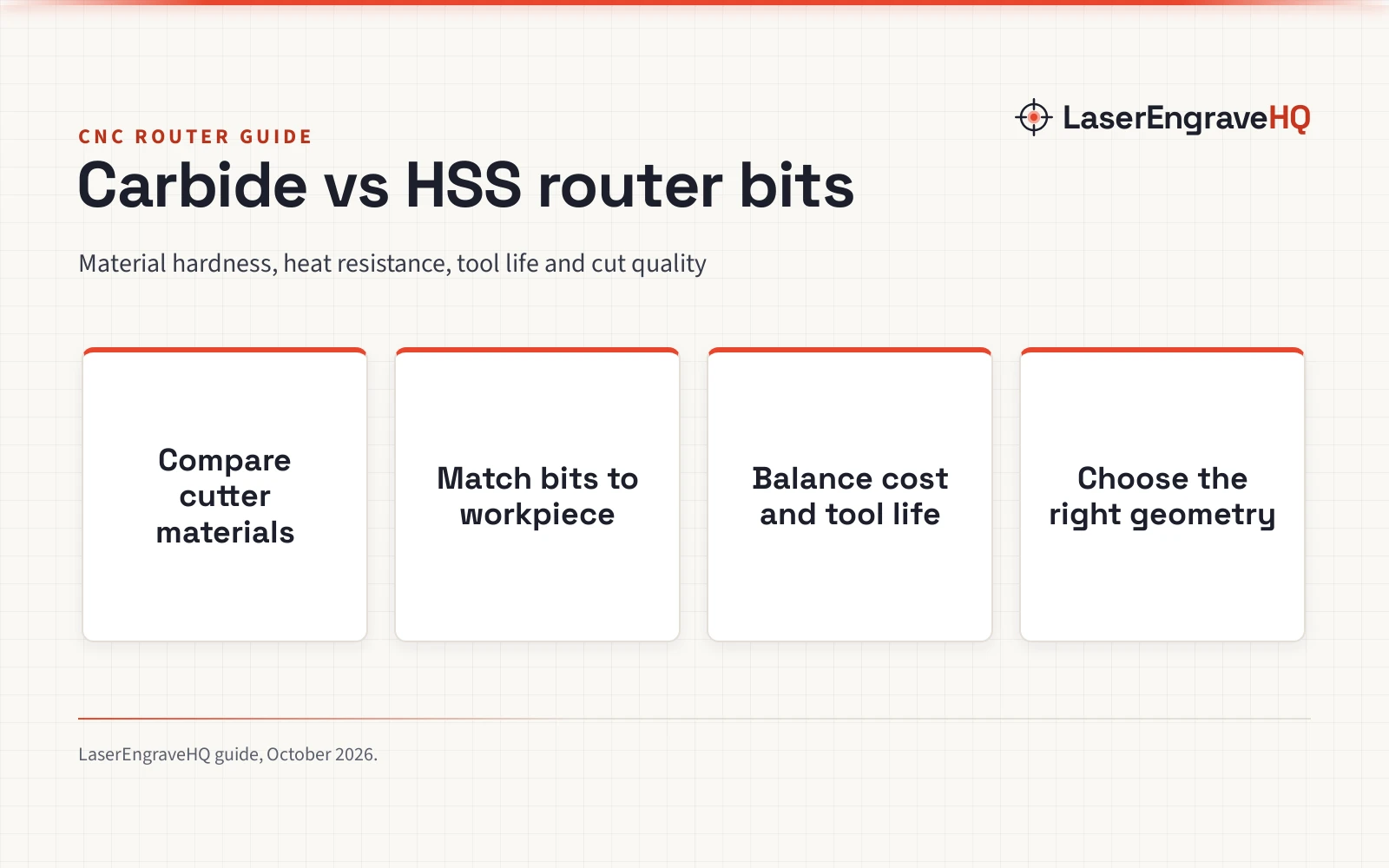
When routing wood signs, decorative plaques, or precision parts on a router table or CNC machine, choosing carbide vs hss router bits comes down to heat resistance, edge life, and material hardness. For almost every routing task in hardwoods, plywood, MDF, plastics, and non-ferrous metals, tungsten carbide router bits are the superior choice because their cutting edges stay sharp under friction heat. High-speed steel router bits make practical sense primarily for softwoods, lighter handheld routing where shock resistance is helpful, or occasional hobby work. The sections below walk through each factor step by step so you can match the right cutter material to your workshop workflow.
Other machines to compare
 Hiltex 10100 Tungsten Carbide Router BitsCheck price on Amazon
 LU&MN Carbide Tipped Router Bit SetCheck price on Amazon
 Shank Carbide Router BIT Set 15-Piece Brand: RYOBICheck price on Amazon
 Spiral Flush Trim Router BitsCheck price on Amazon
 SpeTool 45 Degree V Groove Router Bit Carbide Tip V Bit withCheck price on Amazon
 SpeTool V-Groove Carbide Router Bit 90 Deg Chamfer Bits forCheck price on Amazon
LaserEngraveHQ earns a commission from purchases made through these links, at no extra cost to you. Read our affiliate disclosure.
Listing specifications rarely state exact tool steel metallurgy or carbide binder ratios for every cutter. This guide relies strictly on published specifications for dimensions, carbide grades, and flute counts, without estimating unverified durability figures.
Step 1: Understand material hardness and heat tolerance
The main difference between carbide and high-speed steel is how each material handles heat. Routers and CNC spindles spin cutters at high speeds where friction generates intense thermal stress. Tungsten carbide is an extremely hard composite that retains its cutting edge at high temperatures. Some manufacturer listings specify carbide grades: for example, Hiltex lists machined YG8 tungsten carbide blades, KOWOOD lists C2 carbide, and MNA specifies C3 carbide. For a broader overview of cutter profiles, see our guide on CNC bits explained for beginners.
High-speed steel, abbreviated as HSS, is a carbon alloy steel formulated with tungsten, molybdenum, or chromium. While HSS is tough and sharpens easily, it softens at much lower temperatures than tungsten carbide. Continuous friction softens HSS cutting edges, causing premature dulling, torn grain, and burned workpieces.
Step 2: Match the cutter material to your workpiece
Your workpiece material helps determine whether HSS is practical or whether carbide is the better investment. Natural softwoods like pine and cedar exert low abrasive wear, allowing sharp HSS bits to produce clean cuts during intermittent routing passes.
Hardwoods like oak, maple, and walnut are denser and generate far more friction. Composite sheet goods like MDF and plywood contain abrasive resins and glues that dull HSS edges far more rapidly than natural lumber. Tungsten carbide resists this abrasive resin wear effectively. For hardwood projects, see our roundup of the best CNC router bits for hardwood. Non-ferrous metals and plastics also demand carbide: SpeTool lists a solid carbide single flute spiral cutter specifically for aluminum, acrylic, and plastics.
Step 3: Account for tool stiffness and breakage risk
Carbide provides exceptional hardness, but that hardness brings brittleness. High-speed steel is tougher and more ductile: if an HSS bit encounters sudden shock or chatter, the steel flexes rather than snapping. This makes HSS forgiving in handheld plunge routers where lateral pressure can vary.
Solid carbide is exceptionally rigid, resisting deflection under heavy cutting loads to deliver tight tolerances on CNC routers. However, solid carbide has minimal shock tolerance. Sudden drops onto hard surfaces or aggressive plunging can chip the edge or snap the shank. Reviewing an upcut vs downcut end mill comparison helps match flute direction to your clamping setup to prevent chatter.
Step 4: Choose between solid carbide and carbide-tipped bits
Carbide router bits are produced in two main formats: solid carbide and carbide-tipped cutters. Solid carbide bits are ground from a solid carbide rod, providing maximum rigidity for spiral end mills, compression cutters, and small-diameter tools. Read our guide on what is a compression router bit to see how solid spiral geometry controls surface tearout.
Carbide-tipped bits braze small tungsten carbide cutting inserts onto an alloy steel body and shank. This hybrid build pairs a shock-absorbing steel body with durable carbide cutting edges. Hiltex specifies hardened solid alloy steel construction with YG8 tungsten carbide blades, and PLATINUMEDGE similarly uses an alloy steel body with YG8 carbide cutting tips. For flush trimming, Freud lists a cutter featuring a steel body with a 1/4-inch shank diameter and a 1-inch carbide cutting height.
Step 5: Factor in router spindle speeds and feed rates
Router motors and CNC spindles operate across high rotational bands. If an HSS bit spins too fast relative to its feed rate, the flutes rub against the stock rather than shearing crisp chips. Rubbing creates friction heat, softening the steel and dulling the edge.
Tungsten carbide tolerates significantly higher surface speeds than high-speed steel without softening. While proper feed rates remain necessary to prevent rubbing and workpiece burning, carbide maintains its cutting edge through long CNC jobs where friction heat would rapidly compromise steel tools. When setting up your machine, our comparison of spindle vs router for CNC details how spindle power and runout affect cutter performance.
Step 6: Weigh purchase price against edge longevity
High-speed steel bits cost less upfront than carbide bits, making them tempting for single small craft jobs. Over regular shop use, however, carbide is far more economical. Carbide cutting edges outlast HSS edges by a wide margin, completing repeated hardwood or composite runs before requiring sharpening or replacement.
Dull bits also cost money through ruined stock and lost shop time. Selecting reliable tooling brands makes carbide accessible: see our guide to best router bit manufacturers. Multi-bit sets offer practical entry points: Hiltex and MNA list 15-piece sets, Hiltex lists a 24-piece set, MNA lists a 25-piece set, and KOWOOD and PLATINUMEDGE list 35-piece sets.
Step 7: Select the right shank size and flute count
Beyond material, selecting shank diameter and flute count ensures clean cuts and minimal vibration. Most router bits feature either a 1/4-inch shank or a 1/2-inch shank. Hiltex, MNA, and PLATINUMEDGE specify universal 1/4-inch shanks suited for compact routers and common collets. KOWOOD lists a 1/2-inch shank for its router bit set, providing additional shank mass that helps reduce deflection during heavy passes on larger routers.
Flute count controls chip clearance. Multi-piece woodworking sets from Hiltex, KOWOOD, and MNA specify 2 flutes across their cutters for balanced cutting in wood. For plastics and non-ferrous metals where chip evacuation is critical, single-flute cutters reduce heat buildup: SpeTool lists a single flute spiral cutter with a 1/4-inch shank, a 1/4-inch cutting diameter, and a 1/2-inch cutting length. For relief carving, compare tip styles in our ball nose vs flat end mill guide, or consult our best end mill for aluminum guide for metal cutting.
Common mistakes to avoid
- Running high-speed steel bits in abrasive sheet goods like MDF or plywood, causing rapid edge dulling.
- Dropping solid carbide bits onto hard machine tables or concrete floors, which chips brittle edges.
- Taking excessively deep passes with small-diameter carbide bits, snapping the cutter under sudden shock.
- Using high-speed steel cutters for automated CNC production, where frequent bit wear disrupts runtime.
- Failing to evacuate chips with dust collection, trapping cutting heat around the bit.
Carbide vs hss router bits: the short version
- Choose tungsten carbide router bits for hardwoods, plywood, MDF, plastics, and non-ferrous metals.
- Pick solid carbide spiral bits when maximum tool stiffness and fine finishes are required on CNC routers.
- Select carbide-tipped bits with steel shanks to balance affordable cost and long edge life on larger profiles.
- Reserve high-speed steel bits for softwoods, low-speed handheld routing, or occasional craft projects.
- Opt for a 1/2-inch shank whenever your router collet supports it to help minimize tool deflection.
- Maintain proper feed rates and chip evacuation during routing passes to prevent heat buildup.
For modern workshops and CNC routers, carbide provides far superior durability and cut quality, easily justifying its higher initial purchase price.
FAQ: lasers and CNC
Can I sharpen carbide router bits in a home workshop?
Sharpening carbide at home is difficult because tungsten carbide is harder than conventional grinding wheels. Resharpening carbide edges requires diamond abrasive wheels and precision jigs to preserve cutting angles. Most makers find it more practical to replace worn bits or use professional sharpening services.
Do carbide router bits break more easily than HSS bits?
Solid carbide bits are more brittle than high-speed steel, making them more vulnerable to impact breakage. Dropping a solid carbide cutter onto a concrete floor or aggressive plunging into hard stock can chip the cutting edge or snap the shank. Carbide-tipped bits are less vulnerable to snapping because they use a steel body, though their carbide tips can still chip. High-speed steel is ductile and flexes slightly under shock, making it more resistant to sudden impact breakage.
Can high-speed steel router bits cut non-ferrous metals like aluminum?
High-speed steel can cut aluminum under low-speed conditions with adequate lubrication, but high router speeds make dry cutting problematic. The friction heat generated during dry routing can cause aluminum chips to weld to HSS flutes, quickly clogging the bit. Solid carbide single-flute spiral cutters are widely preferred for routing aluminum and brass on CNC machines because they dissipate heat more effectively and clear chips quickly.
What is the difference between solid carbide and carbide-tipped router bits?
Solid carbide bits are ground entirely from a solid carbide rod, delivering maximum stiffness for small-diameter spiral bits and end mills. Carbide-tipped bits feature an alloy steel body with carbide cutting edges brazed onto the flutes, offering carbide heat resistance at a lower price point for larger profiling bits.
Why do carbide router bits carry a higher upfront cost than HSS?
Tungsten carbide uses raw materials such as tungsten and cobalt, which undergo high-temperature sintering and diamond grinding during manufacturing. Carbide-tipped bits also require precision brazing to bond tips to steel bodies. Although initial purchase prices are higher than HSS, carbide retains its edge longer, lowering overall tool replacement costs over time.
Which cutter material is recommended for desktop CNC routers?
Tungsten carbide is strongly recommended for desktop CNC routers. CNC toolpaths involve continuous automated cutting where edge dulling leads to dimensional drift and rough edge finishes. Solid carbide spiral bits provide the rigidity and heat resistance necessary for consistent cuts across wood, plastics, and non-ferrous materials.
Related: the CNC tooling hub, best CNC bit set for beginners and best CNC router bits. Also see our guide to CNC router bit types. Also see our overview of best desktop CNC for beginners.