Fume Extractor vs Exhaust Fan: Which One Should You Buy?
A detailed comparison of fume extractors and exhaust fans: learn how each ventilation method works, where each setup fits, and which one suits your workshop.

On this page
Top picks at a glance
As an Amazon Associate I earn from qualifying purchases.
- 1
 Laser Fume Extractor Compatible with 10 to 40W Laser9.5/10View on Amazon
- 2
 KQZ Laser Fume Extractor with Exhaust for Under 60W Laser9.5/10View on Amazon
- 3
 FC-2002 Laser Fume Extractor with H13 Filtration for Fume9.5/10View on Amazon
- 4
 FES150S Solder Fume Extractor 3-Stage Filtration SmokeView on Amazon
- 5
 Upgraded ToolBud Solder Fume Extractor with RemovableView on Amazon
- 6
 FumeClear FC-2001A Solder Fume ExtractorView on Amazon
- 7
 ATOMSTACK D5 Solder Fume ExtractorView on Amazon
- 8
 M-T 318 Solder Fume Extractor 216 m³/h Strong Suction SmokeView on Amazon
When you set up a laser to cut wood signs, personalize drinkware, or engrave leather patches, managing smoke is essential for workshop safety. Choosing between a fume extractor vs exhaust fan depends on whether your workspace allows direct outdoor venting. An exhaust fan is typically the most effective solution when you have a clear path to route ductwork outdoors away from shared spaces. It draws smoke, vapors, and heat straight outside without passing through dense filter media. A fume extractor is necessary when outdoor venting is impossible, such as in an apartment, basement, or enclosed office, pulling smoke through multi-stage filters before releasing cleaned air back into the room. This guide compares airflow, maintenance, and noise to help you choose the right setup.
Other machines to compare
 FES150S Solder Fume Extractor 3-Stage Filtration SmokeCheck price on Amazon
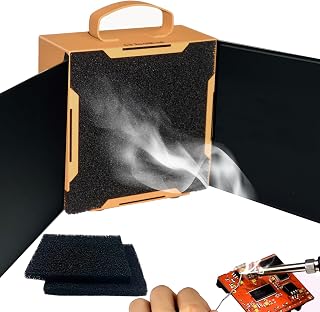 Upgraded ToolBud Solder Fume Extractor with RemovableCheck price on Amazon
 FumeClear FC-2001A Solder Fume ExtractorCheck price on Amazon
 ATOMSTACK D5 Solder Fume ExtractorCheck price on Amazon
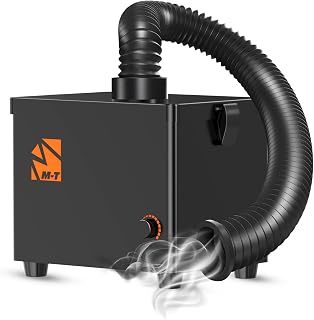 M-T 318 Solder Fume Extractor 216 m³/h Strong Suction SmokeCheck price on Amazon
LaserEngraveHQ earns a commission from purchases made through these links, at no extra cost to you. Read our affiliate disclosure.
Neither system eliminates the need for proper enclosure seals. An exhaust fan or fume extractor cannot capture airborne particles if your enclosure has large openings or poor airflow intake. Always pair your ventilation equipment with a well-fitted cover.
Step 1: Determine whether your workspace allows outdoor venting
Your building layout is the primary factor deciding between an exhaust fan and an indoor fume extractor. Before comparing models, evaluate your shop space, window access, and exterior surroundings.
If your laser sits in a garage, ground-floor workshop, or room with an exterior window, outdoor exhaust is usually straightforward. Routing flexible ducting through a window insert or wall port expels combustion byproducts completely outside, removing indoor smoke without consumable filters.
Outdoor venting is not always viable. Basements without windows, interior rooms, apartments, and leased spaces often prohibit exterior duct penetrations. Furthermore, if your vent faces a neighbor patio, air intake, or shared walkway, smoke and charred odors can trigger complaints. In these constrained environments, an indoor fume extractor is the practical solution.
Step 2: Understand how exhaust fans move laser smoke
An exhaust fan setup uses mechanical negative pressure to pull smoke from the machine enclosure and push it through sealed ducting outdoors. Rather than trapping contaminants inside, the fan discharges the contaminated air entirely outside.
Most makers install an inline duct fan between the enclosure port and an exterior termination vent. In our best exhaust fan for laser engraver guide, we examine how fan design affects performance. Positioning the inline fan near the exterior exit keeps the interior duct run under negative pressure, ensuring air pulls into the duct rather than leaking smoke into the room if a clamp loosens. For duct routing advice, see our guide on how to vent a CO2 laser outside.
The main advantage is high airflow volume with minimal ongoing expenses once installed. The tradeoff is the loss of conditioned room air, which pulls unconditioned outdoor air inside during extreme weather.
Step 3: Understand how fume extractors filter air indoors
A laser fume extractor is a self-contained purification unit that cleans smoke and volatile gases before recirculating air back into your workshop. As outlined in our best fume extractor for laser engraver comparison, true laser purifiers use multi-stage filtration to capture combustion residue:
- Pre-filter layer: A fibrous mat that captures large soot flakes and dust, protecting downstream filters from clogging.
- Particulate filter: A dense pleated HEPA barrier that captures sub-micron smoke particles and ash.
- Activated carbon bed: A thick layer of granular activated carbon that adsorbs volatile organic compounds and pungent odors.
Fume extractors allow safe operation without exterior wall access and preserve indoor temperature. However, dense media creates airflow resistance and requires regular cartridge purchases. To understand combustion hazards, see our guide on laser engraving smoke hazards.
Step 4: Compare airflow resistance and static pressure
The technical difference between an exhaust fan and a fume extractor centers on static pressure. Standard inline duct fans move high air volumes against low resistance, making them ideal for smooth duct runs. However, pulling air through dense HEPA and carbon media causes standard duct fan airflow to plummet.
Purpose-built fume extractors use high-pressure centrifugal turbines engineered to overcome dense filter resistance, maintaining suction as soot accumulates. This static pressure requires high motor torque, producing steady turbine sound and greater electrical draw than an inline fan.
Enclosure sealing is critical for both systems. Gaps reduce suction and allow smoke to drift into the room. Pairing your system with a properly fitted laser engraver enclosure maintains the directional draft needed to sweep fumes away from optics.
Step 5: Account for ongoing maintenance and filter replacement costs
Operating costs differ sharply between these approaches. An exhaust fan carries virtually no consumable expenses. Maintenance involves periodic duct inspection and wiping accumulated soot from the fan impeller.
A fume extractor requires recurring filter replacements. Pre-filters load quickly and need regular swaps to maintain airflow. The HEPA filter lasts longer but eventually clogs with fine soot. The activated carbon bed has finite adsorption capacity; once saturated, odors pass directly into the room, signaling it must be replaced.
Material choice directly affects filter life. Cutting dense engineered boards like MDF produces sticky resins that exhaust pre-filters rapidly, whereas light engraving on slate or anodized aluminum creates minimal residue. For high-volume cutting, filter replacement expenses add up quickly, making outdoor exhaust far more economical over time.
Step 6: Follow critical laser safety and enclosure guidelines
Proper air movement is only part of workspace safety. Establish a routine of checking duct connections and powering your ventilation before firing the laser. Review our laser engraver safety checklist for complete operational precautions.
Material safety requires absolute discipline. Never laser PVC, vinyl, PVC-based faux leather, polycarbonate, or ABS. Chlorinated polymers like PVC release corrosive hydrochloric acid gas that etches optics, corrodes machine rails, and damages lungs. Polycarbonate and ABS release thick smoke and toxic vapors that consumer filters cannot neutralize. Consult our guide on materials you should never laser cut for details.
Always keep a fire extinguisher nearby and never leave an active laser unattended. Balanced ventilation removes smoke without creating harsh drafts that fan embers.
Common mistakes to avoid
- Venting exhaust into an attic, crawlspace, or garage instead of outdoors, trapping soot and moisture in structural framing.
- Operating an open-frame laser without an enclosure and expecting an exhaust fan or extractor to capture floating fumes.
- Using undersized ductwork or sharp bends that restrict airflow and create backpressure.
- Ignoring saturated carbon filters, allowing volatile gases and odors to recirculate indoors.
- Cutting prohibited materials like vinyl under the assumption that consumer filters scrub corrosive acids.
Fume extractor vs exhaust fan: the short version
- Check your space: determine whether you can route ducting directly outside through a window or wall port.
- Choose an exhaust fan if outdoor venting is feasible: it provides high airflow without consumable filter expenses.
- Choose a fume extractor if outdoor venting is impossible: multi-stage filtration cleans smoke and odors indoors.
- Budget for upkeep: exhaust fans need occasional duct cleaning, while extractors require recurring filter replacements.
- Seal your enclosure: maintain negative pressure so smoke cannot leak into the room.
- Follow material safety: never cut chlorinated polymers or toxic substrates.
Proper ventilation protects your health, keeps machine optics clean, and ensures reliable cutting results.
FAQ: lasers and CNC
Can I use an exhaust fan if I live in an apartment?
Only if you can vent through a window without disturbing neighbors. If your window faces shared walkways, balconies, or courtyards, smoke and charred odors can prompt complaints or violate lease rules. In most apartments, a fume extractor is the safer choice.
Do laser fume extractors eliminate all smells?
A quality unit with an activated carbon bed captures most smoke odors and volatile organic compounds. However, some residual odor will escape when opening the enclosure lid, particularly when processing leather, acrylic, or fiberboard.
How often do laser fume extractor filters need replacement?
Replacement depends on cutting volume and materials. Pre-filters require frequent inspection and swaps as suction drops. Particulate filters last longer, while carbon media must be replaced as soon as odor breakthrough occurs in the exhaust stream.
Can I vent an exhaust fan into an attic or garage?
No. Exhaust ducting must always terminate outside the building envelope. Discharging exhaust into enclosed spaces traps soot, wood resins, and combustion gases inside your home framing, creating air quality and moisture hazards.
Do I need a fume extractor for a diode laser engraver?
Diode lasers produce the same smoke, soot, and chemical vapors as CO2 lasers on materials like wood, leather, and dark acrylics. If you cannot vent your diode laser outside using an exhaust fan and ducting, an indoor fume extractor is required.
Related: the laser safety category, our laser enclosure exhaust fan guide, our laser ventilation guide, our indoor laser engraver safety guide and our laser enclosure build guide.