What Is a DTF Oven and Do You Need One
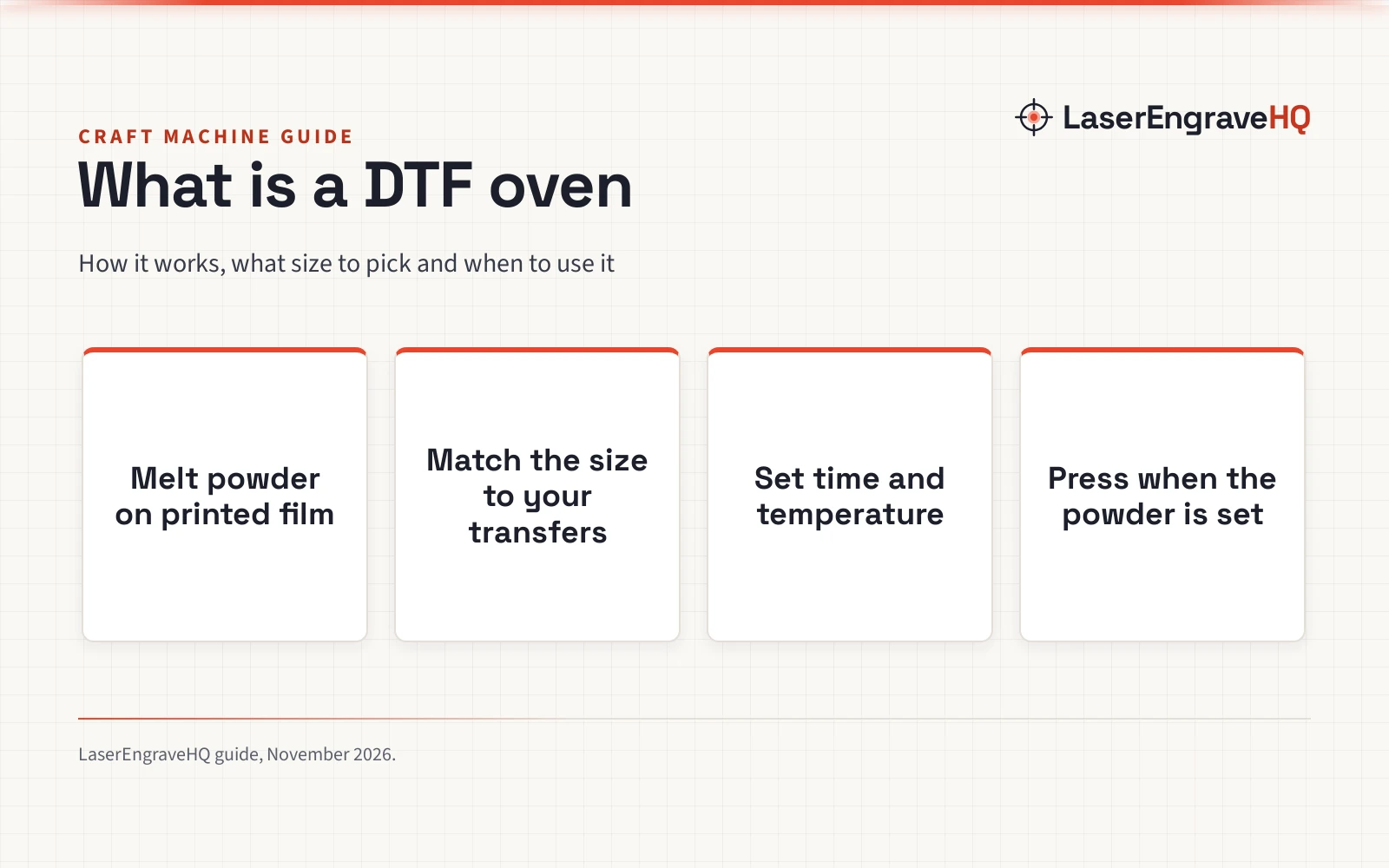
A DTF oven melts adhesive powder on printed film so the transfer is ready to press onto fabric.

On this page
Top picks at a glance
As an Amazon Associate I earn from qualifying purchases.
- 1
 Kminoteh DTF Ink -1500ML DTF Transfer Ink for PET Film9.7/10View on Amazon
- 2
 Procolored K13 Lite DTF Printer9.7/10View on Amazon
- 3
 Procolored K13 Lite DTF Printer9.7/10View on Amazon
A common question from makers who print their own transfers is simple: what is a DTF oven? A DTF oven is the heated box that melts adhesive powder on printed film so the transfer is ready to press onto fabric. The oven holds the film flat, warms it from above and below in many models, and gives the powder time to melt without scorching the print. This guide explains what a DTF oven does, how to use it, what size fits common transfer film, and when a maker needs one at all.
LaserEngraveHQ earns a commission from purchases made through these links, at no extra cost to you. Read our affiliate disclosure.
Listings give different time and temperature settings for the same job, so the figures in this guide are maker recommendations from the listings cited. Match the setting to the powder and film in use, and change a single setting at a time.
What Is a DTF Oven?
A DTF oven is a flat heated box built for the powder stage of DTF printing. After a design is printed onto PET film and adhesive powder is spread over the wet ink, the film goes into the oven so heat can melt the powder into a smooth coat. The melted powder bonds the printed design to fabric when the film is later pressed with a heat press. Without that heated step, the powder stays loose and the transfer has nothing to hold the ink to the fabric.
Dual-side models use a flat bed with heating plates above and below the film, so heat reaches the powder from above and below at once. Lamp models warm the film with 4 heating lamps, and hot air models move heated air across the film. Controls are a digital panel or a rotary knob for temperature and a timer, and the film slides in on a tray or lays flat on the bed. A DTF oven is not a heat press: the press applies heat and pressure to move a finished transfer onto fabric, while the oven only prepares the film.
How a DTF Oven Works
DTF printing moves a design from film to fabric in stages, and the oven handles the powder stage. A printer lays ink onto PET film, adhesive powder is dusted over the wet ink, and the loose powder is shaken off so only the inked areas stay coated. The film then goes into the oven, where heat melts the powder into a smooth, even layer. Once the film cools, the transfer is ready to press.
Heat has to reach every part of the film, or the powder melts in patches and the print suffers. Dual-side heating warms the film from above and below, which is why several listings describe top and bottom heating elements working together. A timer marks the end of the heating time, and some models add a buzzer or an LED alarm when the time is up.
How to Use a DTF Oven
Using a DTF oven follows the same pattern across the listings: set the temperature and time, let the oven reach the set temperature, place the powdered film in the oven, and wait for the timer. Makers give different settings, so start with the setting the powder maker recommends and adjust from there. Listings recommend 140°C for 180 seconds, one of them stating it as 284°F for 180 seconds with a maximum temperature of 302°F. A different listing recommends 140°C for 150 seconds, while a lamp model recommends 140°C for 360 seconds and a drawer model uses a default setting of 148°C (298°F) with a 360-second timer.
Preheating matters because the film should meet steady heat, not a rising temperature. A listing describes rapid preheating in 2-3 minutes, while a knob-control model asks for preheating 10-15 minutes in advance. Keep the film flat, and let the film cool before handling it. If the powder looks grainy or uneven, the film may need more time or a higher temperature; if the film darkens, lower the setting and shorten the time.
Maximum temperatures vary across the listings, from 150°C on several models to 155°C (311°F) on a lamp model, 160°C on a hot air model, and 180°C (356°F) on a drawer model. A larger open-top model lists a drying temperature setting of 311°F-347°F (155°C-175°C) with a time countdown setting of 210 seconds to 300 seconds. Match the setting to the powder and film in use.
What Size DTF Oven Do You Need
Size is about the film, not the oven body. Measure the largest film the shop prints, then match the oven heating area to it. A size seen often in the listings is a 13.4″ x 19.3″ heating area, which fits A3, A4, and A3+ transfers up to 12.9″ x 18.9″. A flatbed model lists an 18.9″ x 13″ heating area, and a compact dual-side model lists a 16.5″ x 12.6″ heating area, with a maximum film size of 12.5″ x 17″ on a hot air model.
Larger films need larger beds. A lamp model lists a maximum film size of 18.9in x 14.6in, a drawer model lists a maximum tray size of 13″ x 19″, and an open-top model from VORTRIDINO lists a maximum film size of 17in x 23.6in. Check the oven outer dimensions too: listed bodies include a compact 16.7 inches x 12.2 inches x 3.1 inches hot air model and a wide 25.2 inches x 15.75 inches x 5.12 inches dual-side model, so measure the bench before ordering.
Some dual-side models list 110V and 700W, another lists 110V and 900W, a compact dual-side model lists 950W, a lamp model lists 110V and 1280W, and the open-top model lists 110V, 1600W, and 14.6A, with a 220V, 1600W, and 7.3A option. Weight is listed for a hot air model at 8.1 pounds. Check the power supply and the warranty term on the listing before ordering.
Do You Need a DTF Oven?
A DTF oven earns its bench space when transfers are printed in batches. The oven heats the whole film at once, the timer keeps each sheet consistent, and the maker can load the next sheet while the previous sheet cools. That rhythm suits a shop that prints shirts, tote bags, and gifts in runs. A maker who prints a transfer now and then may get by without an oven, using a heat gun or a press to melt the powder, but the result depends on keeping the heat even by hand. For a sense of the running costs, see what DTF transfers cost.
Consider the film sizes in use, the bench space, and the power available. An oven that fits A3 film covers A4 and A5 film too, while an oven sized for A5 film cannot take a larger sheet. If the bench is small, a low-profile model takes less room; for long sessions, look for ventilation, overheat protection, and a smoke exhaust port in the listing. The listings describe integrated ventilation, a smoke exhaust port, a smoke filter, and overheat protection on various models.
FAQ: lasers and CNC
How hot should a DTF oven be?
Listings recommend 140°C for 180 seconds in several places, with a maximum temperature of 150°C on several models. A lamp model reaches a maximum of 155°C (311°F), a hot air model lists a range of 0-160°C, and a drawer model reaches a maximum of 356°F (180°C).
How long does a DTF transfer stay in the oven?
Recommended times in the listings are 180 seconds, 150 seconds, 360 seconds, and 210 seconds to 300 seconds, depending on the model and the powder. A hot air model describes even heating in 20-30 seconds per sheet. Watch the first sheet closely. See how long DTF transfers last.
Can a DTF oven handle A3 film?
Yes, most ovens in the listings fit A3, A4, and A3+ film. A 13.4″ x 19.3″ heating area fits transfers up to 12.9″ x 18.9″, an 18.9″ x 13″ heating area fits A3 and larger film, and a 17in x 23.6in model takes the largest sheets in the listings.
Does a DTF oven need ventilation?
Several listings describe ventilation, a smoke exhaust port, a smoke filter, or a hot air circulation system. Run the oven where air can move and follow the maker guidance for the model in use.
What power does a DTF oven use?
Listings show 110V supplies from 700W to 1600W, with 700W, 900W, 950W, 1280W, and 1600W models in the data. The open-top model also lists a 220V, 1600W, and 7.3A option.
Related: the craft machines hub, how DTF transfer works and how to make a DTF transfer. Also see DTF printer set up. Also see best heat press machine for small business.