Walking Foot vs Free Motion Quilting Foot: Which One Should You Buy?
A walking foot feeds quilt layers together for straight seams, while a free motion quilting foot releases the fabric so the sewer can steer curves, stippling and thread painting by hand.

On this page
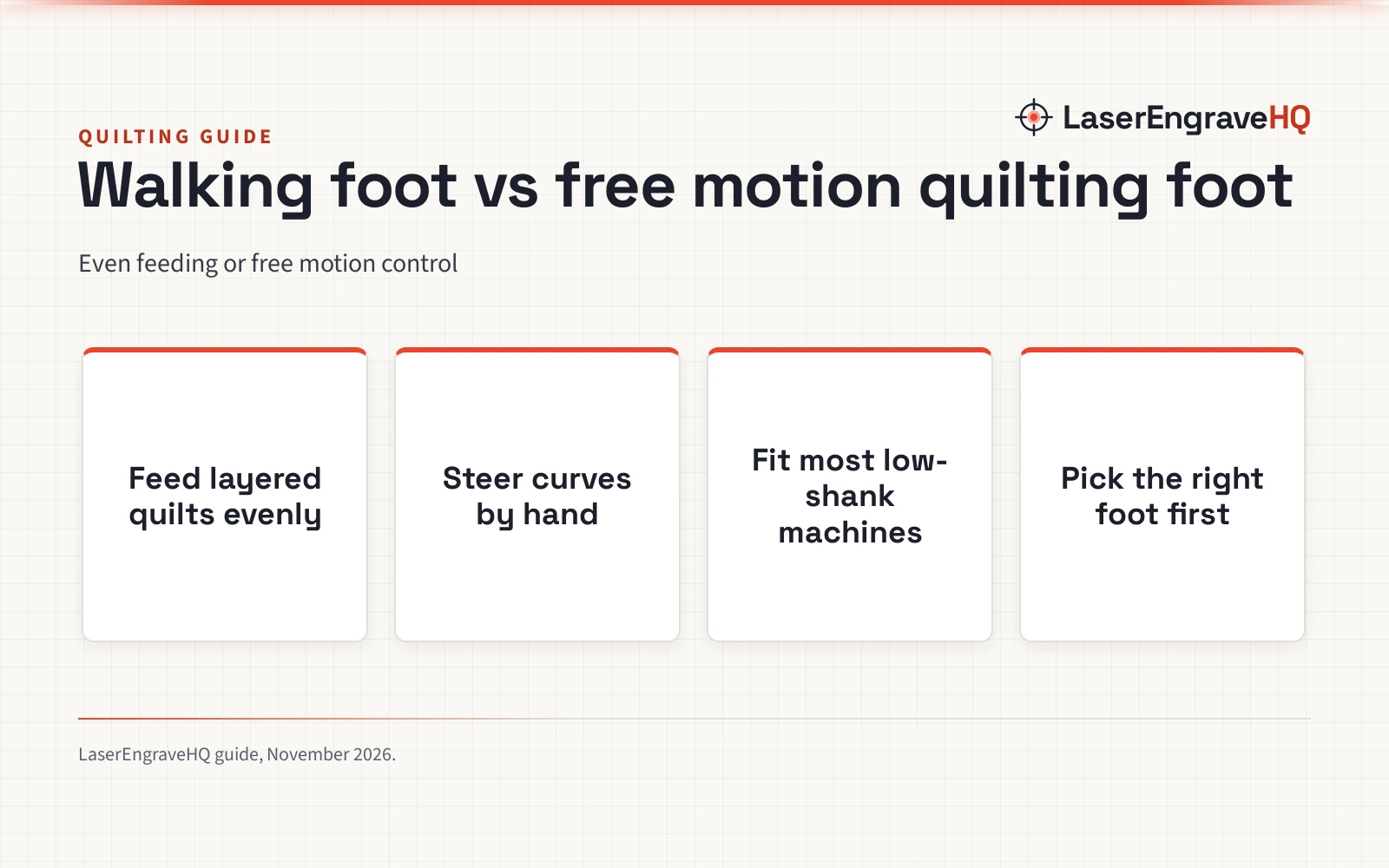
A walking foot vs free motion quilting foot choice comes down to who moves the fabric. A walking foot feeds the layers of a quilt through the machine together, so the top, batting and backing stay lined up while straight seams run. A free motion quilting foot does the opposite job: it releases the fabric so the sewer steers it by hand for curves, stippling and thread painting. This guide covers the free motion side, and the gear section below holds free motion feet alone, with no walking foot among them. Pick the walking foot for straight-line quilting through layers, and pick a free motion foot when the design curves.
As an Amazon Associate I earn from qualifying purchases. LaserEngraveHQ earns a commission from purchases made through these links, at no extra cost to you. Read our affiliate disclosure.
Walking foot vs free motion quilting foot: how they differ
The two feet solve different problems. A walking foot works with the machine feed, moving the top layer at the same pace as the bottom layer, which keeps long straight seams from shifting. A free motion quilting foot works with the needle instead: the spring-loaded foot rises and lowers with the needle, holding the fabric in place while a stitch forms and then letting it move between stitches. With the feed released, the sewer guides the fabric in any direction, which is what makes stippling, meandering and thread painting possible. One foot keeps layers lined up; the other hands control of the path to the sewer.
When a walking foot earns its place
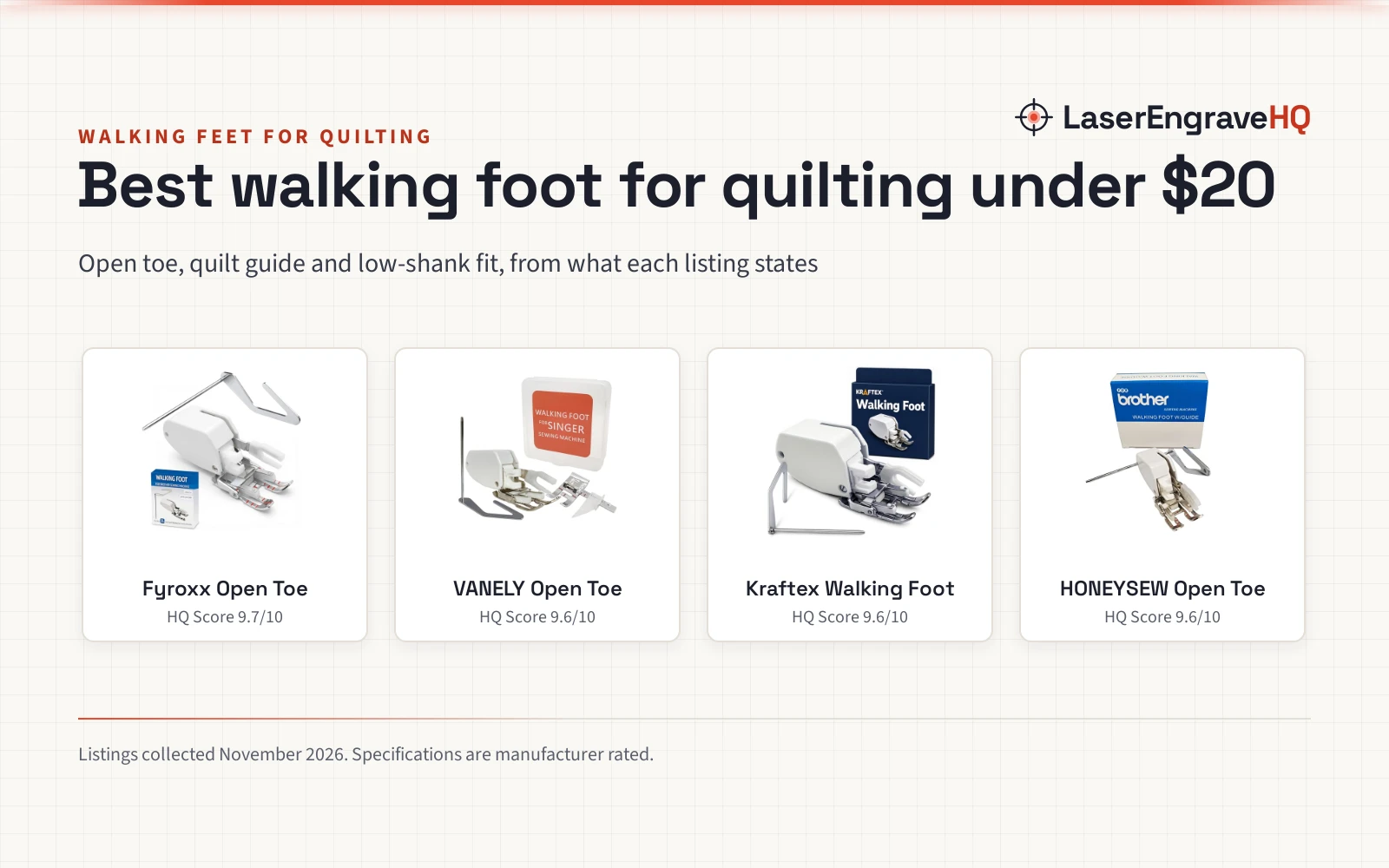
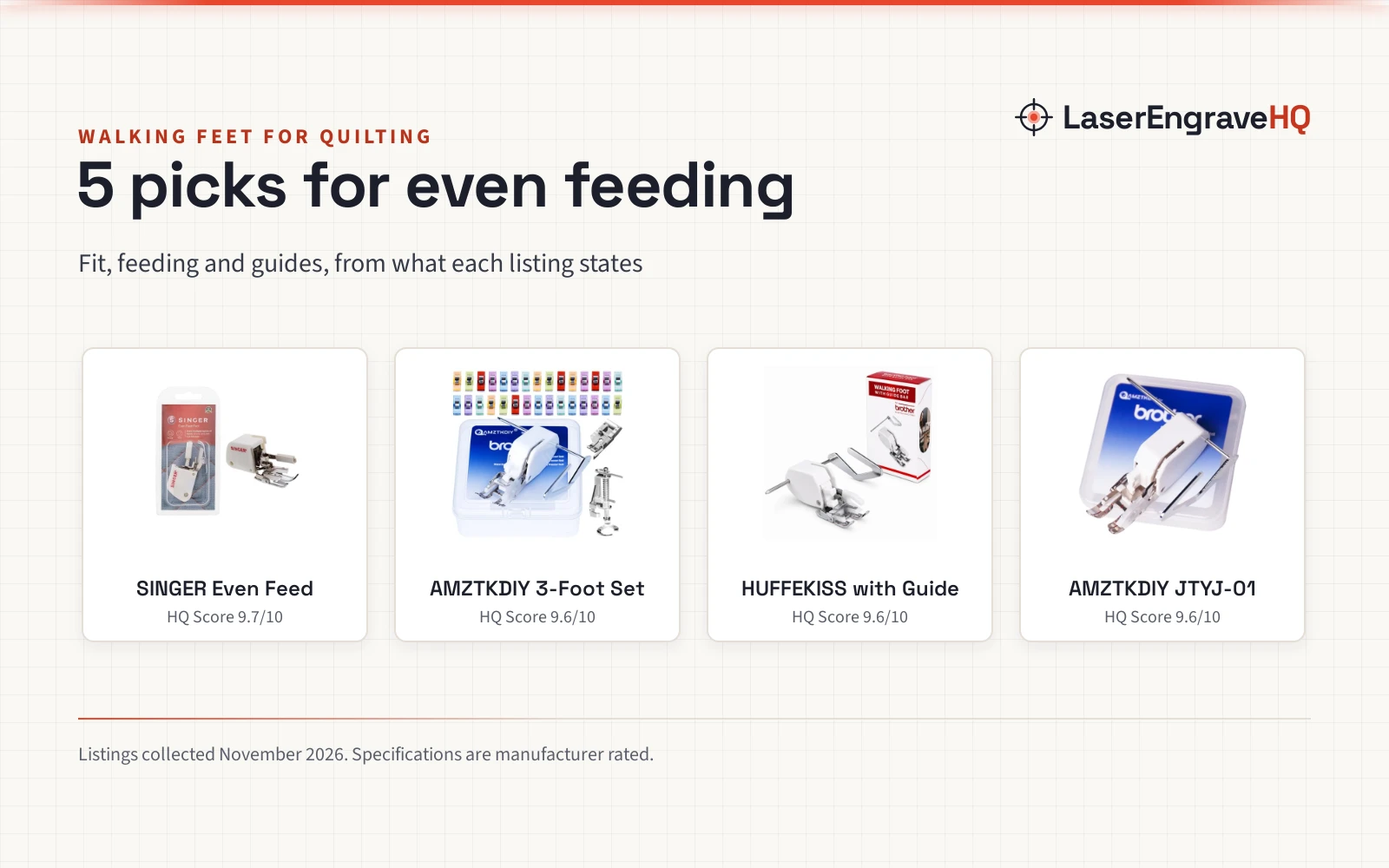
Reach for a walking foot when the quilt sandwich has to stay put: straight-line quilting, stitching in the ditch, and long seams across layered fabric. Even feeding matters when the layers are thick, since a shift halfway through a seam shows on the finished quilt. The walking foot is the wrong pick for curves and free-form designs, because it keeps feeding forward while the design needs to turn. For walking foot picks, see the best walking foot for quilting guide.
When free motion work calls for a spring foot
Free motion quilting starts when the machine stops feeding the fabric and the foot takes over holding it. The spring action in a spring foot keeps the fabric from lifting with the needle as each stitch forms, which helps keep thread breakage down when specialty or heavier threads are in use. A foot with an open front keeps the work in sight, so the sewer can follow a design in the fabric or lay down stippling and meandering lines with control. The same open front suits thread painting, where the stitching itself draws the design. If the plan is curves, loops and free-form fills, this is the foot for the job.
The free motion feet in this guide
The four feet below are all free motion feet for low-shank machines, in ranked order. Every one is metal, and every one fits the low-shank machines named in its own listing. The spring feet rise and lower with the needle, and the SA129 darning foot in the YICBOR set does the same. Check the fit list for your machine brand before ordering, since the lists differ.
FIKLOTA large metal free motion foot
The FIKLOTA foot leads the set. It is made of steel, with an open front that keeps the work visible and a spring action that keeps the fabric from lifting with the needle. That spring action helps keep thread breakage down with specialty or heavier threads. The maker pairs the foot with stippling, meandering and thread painting, and lists fit for Singer, Brother, Janome, Juki, Babylock, Elna, Kenmore, White, Necchi, Simplicity, Euro-Pro and New Home low-shank machines. The stated size is 1.34 inches by 1.42 inches.
YICBOR three-piece free motion set
The YICBOR set packs three feet: the P60432 spring foot, the SA129 darning foot and the 4021-L darning foot. The P60432 is the free motion quilting and embroidery foot, with the same spring action that keeps fabric from lifting and helps keep thread breakage down with specialty or heavier threads. The SA129 also works as a free motion foot: it rises and lowers with the needle so the fabric can move between stitches and stays held while stitches form. The 4021-L is a replacement low-shank darning foot for free motion sewing and quilting. The set fits low-shank domestic machines from Singer, Brother, Babylock, Euro-Pro, Kenmore, Janome, White, New Home, Simplicity, Juki, Necchi and Elna. It does not fit Pfaff, Bernina or Husqvarna Viking machines.
Stormshopping open-toe free motion foot
The Stormshopping open-toe foot is metal, with a 12mm wide hoop opening and a polished surface. The spring-loaded foot moves up and down with the needle and helps avoid skipped stitches, and the maker pairs it with thick materials such as hollow cotton and silk, plus leather fabrics. Its stated size is 1.97 inches by 1.18 inches. It fits most low-shank snap-on machines, including Brother, Toyota, Tesco, Babylock, Husqvarna Viking in the Husky Series, Euro-Pro, Janome, Kenmore, White, Juki, Bernina in the Bernette Series, New Home and Simplicity.
Stormshopping large free motion foot
The second Stormshopping foot is the large metal free motion foot, again with an open front and spring action for clear visibility and control. The spring action keeps the fabric from lifting with the needle as each stitch forms, which helps keep thread breakage down with specialty or heavier threads. The maker pairs it with stippling, meandering and thread painting. It fits most low-shank snap-on machines, including Brother, Toyota, Tesco, Babylock, Husqvarna Viking in the Husky Series, Euro-Pro, Janome, Kenmore, White, Juki, Bernina in the Bernette Series, New Home, Simplicity and Elna. The maker gives its size as Large, with no dimensions stated.
Fit check before you order
All four feet are low-shank feet, so the first check is the shank on your machine. The fit lists overlap but they are not the same: the YICBOR set leaves out Pfaff, Bernina and Husqvarna Viking, while the Stormshopping feet include Husqvarna Viking in the Husky Series and Bernina in the Bernette Series. Match the brand and series named in the foot’s own fit list with your machine, and keep the part number with the order: SS-Foot-04 for the Stormshopping open-toe foot, ESM16 for the FIKLOTA foot, CloseToe for the Stormshopping large foot, and 4021 for the YICBOR set. The YICBOR notes also call for the right needle for the thread in use; the best needle for machine quilting guide covers that pick.
FAQ: lasers and CNC
Which foot should I pick for straight-line quilting?
Pick a walking foot. It feeds the layers together so straight seams stay lined up, while a free motion foot releases the fabric for curves and free-form designs. This guide’s gear section holds free motion feet alone, so the walking foot side is covered in the walking foot guide linked above.
Can I quilt curves with a walking foot?
Not well. A walking foot keeps feeding the fabric forward, which suits straight seams and fights turns. Curves, stippling, meandering and thread painting call for a free motion foot, where the spring-loaded foot holds the fabric while each stitch forms and lets it move between stitches.
Do these free motion feet fit my sewing machine?
They fit most low-shank machines, but the fit lists differ by foot. The FIKLOTA foot lists Singer, Brother, Janome, Juki, Babylock, Elna, Kenmore, White, Necchi, Simplicity, Euro-Pro and New Home. The YICBOR set does not fit Pfaff, Bernina or Husqvarna Viking machines. Check the brand and series in the foot’s own fit list before ordering.
What is the spring action in a free motion foot for?
The spring-loaded foot rises and lowers with the needle. It holds the fabric in place while a stitch forms, keeps the fabric from lifting with the needle, and helps keep thread breakage down when specialty or heavier threads are in use. It also lets the fabric move between stitches, which is how the sewer steers curves by hand.
What comes in the YICBOR set?
Three feet: the P60432 spring foot for free motion quilting and embroidery, the SA129 darning foot that also works as a free motion foot, and the 4021-L replacement low-shank darning foot for free motion sewing and quilting. The set fits low-shank domestic machines from the brands in its fit list.
Related: the best walking foot for quilting, best sewing machine presser feet and best sewing machine for quilting. Also see the needle size for machine quilting guide.