Nylon vs Carbon Fiber Filament: Which One Should You Buy?
Glass fiber nylon against carbon fiber PETG and ASA, compared on heat resistance, print temperatures, strength and nozzle wear.

On this page
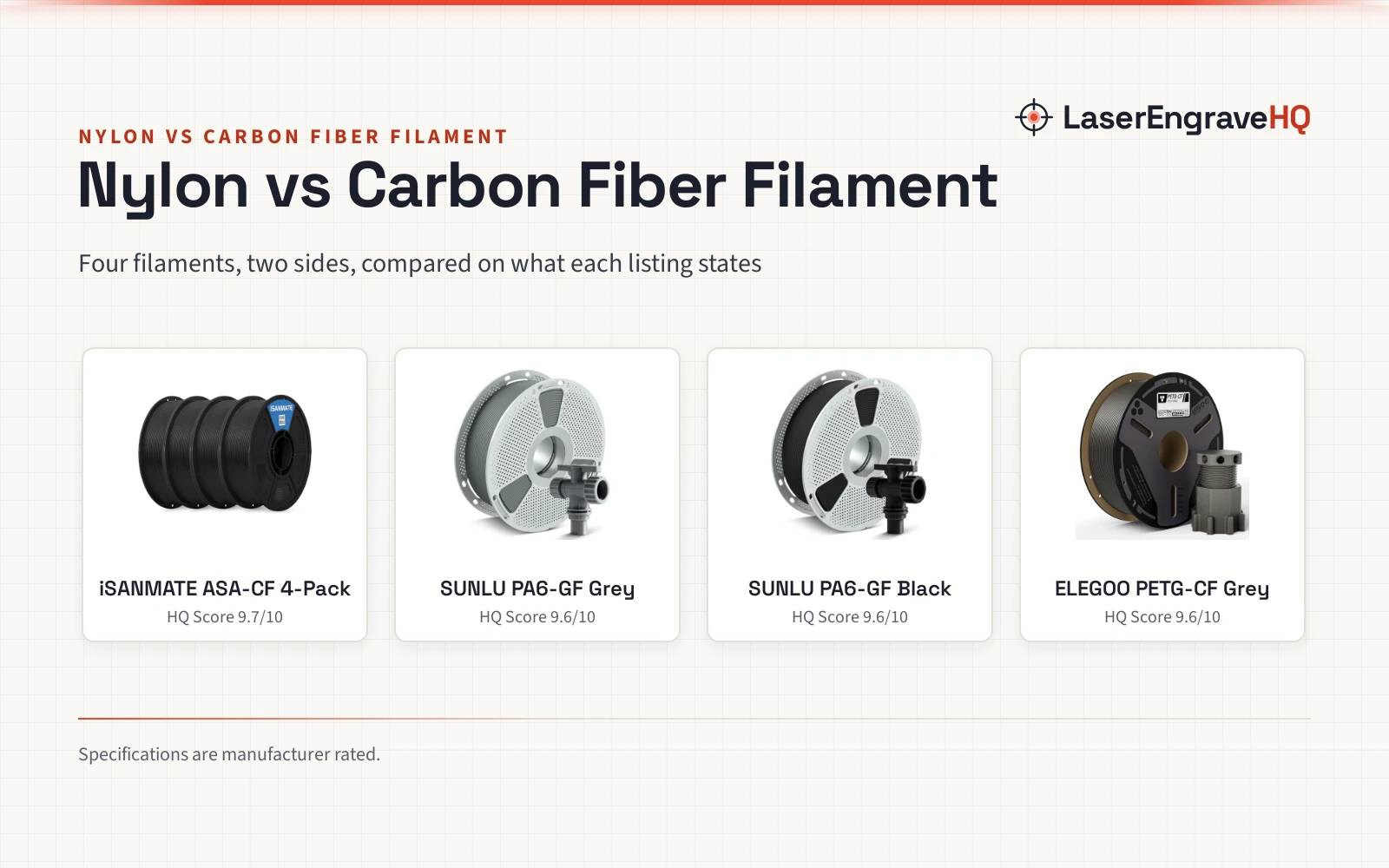
Top picks at a glance
As an Amazon Associate I earn from qualifying purchases.
- 1
 iSANMATE Carbon Fiber ASA Filament 1.75mm9.7/10View on Amazon
- 2
 SUNLU PA6-GF 25% Glass Fiber Nylon 1.75mm 3D9.6/10View on Amazon
- 3
 SUNLU PA6-GF 25% Glass Fiber Nylon 1.75mm 3D9.6/10View on Amazon
- 4
 ELEGOO PETG-CF 3D Printer Filament 1.75mm Gray 1KG9.6/10View on Amazon
A bracket that has to hold up under a motor, a housing that sits near heat, a part that lives outside in sun and rain: the filament you pick decides whether the print holds or fails. Nylon vs carbon fiber filament is the choice between a glass fiber nylon that takes heat and chemicals and carbon fiber blends built for stiffness and outdoor use. Pick nylon when the job needs a stated heat figure and chemical resistance; pick carbon fiber filament when the job needs UV and weather resistance or abrasion resistance for gears.
LaserEngraveHQ earns a commission from purchases made through these links, at no extra cost to you. Read our affiliate disclosure.
Verdict: pick the SUNLU PA6-GF nylon when the job needs a stated 205°C heat figure and chemical resistance; pick the iSANMATE ASA-CF when the job needs UV and weather resistance, and the ELEGOO PETG-CF when the job needs abrasion resistance for gears and bearings. The nylon side states a heat figure the carbon side does not give, while the carbon side states UV and weather resistance the nylon side does not.
Machines on the list
iSANMATE Carbon Fiber ASA Filament 1.75mm
A 4-pack of carbon fiber ASA filament, 1.75mm, with UV and weather resistance, a 240-270°C nozzle range and a matte black finish.
Pros
- 4-pack of 1kg spools for larger print runs
- UV and weather resistance for outdoor parts
- Nozzle 240-270°C, bed 80-100°C, speed 30-100mm/s
- Vacuum-sealed with desiccant to protect against moisture
Cons
- Enclosed printer recommended to limit warping and cracking
- Needs a hardened steel nozzle for the abrasive fiber
- No warranty term is stated
- No stated heat resistance figure
SUNLU PA6-GF 25% Glass Fiber Nylon 1.75mm 3D
A 1kg spool of glass fiber nylon filament, 1.75mm, 25% glass fiber, with 401°F (205°C) heat resistance and a reusable spool.
Pros
- Withstands 205°C, for engine components and high-temp molds
- 25% glass fiber, 75% PA nylon, for strength and stiffness
- Reusable spool, with drying up to 230°F (110°C)
- Chemical resistance to acids, fuels and cleaners
Cons
- Needs drying at 110°C for 4 hours before printing
- Not compatible with AMS or multi-color systems
- Needs a hardened steel nozzle; copper nozzles wear
- No warranty term is stated
SUNLU PA6-GF 25% Glass Fiber Nylon 1.75mm 3D
A 1kg spool of glass fiber nylon filament, 1.75mm, 25% glass fiber, with 401°F (205°C) heat resistance and a reusable spool, in black.
Pros
- Withstands 205°C, for engine components and high-temp molds
- 25% glass fiber, 75% PA nylon, for strength and stiffness
- Reusable spool, with drying up to 230°F (110°C)
- Smooth surface finish with low warpage
Cons
- Needs drying at 110°C for 4 hours before printing
- Not compatible with AMS or multi-color systems
- Needs a hardened steel nozzle; copper nozzles wear
- No warranty term is stated
ELEGOO PETG-CF 3D Printer Filament 1.75mm Gray 1KG
A 1kg spool of carbon fiber PETG filament, 1.75mm, with high impact strength, abrasion resistance and a fine matte finish.
Pros
- Carbon fiber PETG for strong, rigid functional parts
- Abrasion resistance and dimensional accuracy for gears and bearings
- Fine matte texture that reduces visible layer lines
- High impact strength, less prone to fracture under stress
Cons
- No print speed is stated
- No warranty term is stated
- Needs a hardened steel nozzle of no less than 0.4 mm
- No stated heat resistance figure
Other machines to compare
 Polymaker Fiberon PA612-CF15 Carbon Fiber Nylon FilamentCheck price on Amazon
 Polymaker Fiberon PA6-CF20 Carbon Fiber Nylon Filament 1.75mmCheck price on Amazon
 Creality Hyper PA6-CF Filament 1.75mm 1KGCheck price on Amazon
 SUNLU Easy PACheck price on Amazon
 SUNLU PA6-GF Glass Fiber Nylon Filament 1.75mmCheck price on Amazon
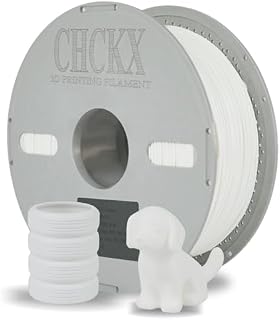 CHCKX PA6-GF 10% Glass Fiber Nylon Filament 1KG Heat to 135ーCCheck price on Amazon
Nylon vs Carbon Fiber Filament: Side by Side
| Spec | iSANMATE ASA-CF 4-Pack | SUNLU PA6-GF Grey | SUNLU PA6-GF Black | ELEGOO PETG-CF Grey |
|---|---|---|---|---|
| HQ Score | 61 | 60 | 59 | 58 |
| Side | Carbon fiber filament | Nylon | Nylon | Carbon fiber filament |
| Material | ASA with carbon fiber | PA6 nylon, 25% glass fiber | PA6 nylon, 25% glass fiber | PETG with carbon fiber |
| Diameter | 1.75mm | 1.75mm | 1.75mm | 1.75mm |
| Pack | 4 spools, 1kg each | 1kg spool | 1kg spool | 1kg spool |
| Nozzle | 240-270°C | 270-290°C | 270-290°C | 240-270°C |
| Bed | 80-100°C | 50-70°C | 50-70°C | 65-75°C |
| Print speed | 30-100mm/s | 50-120mm/s | 50-120mm/s | Not stated |
| Heat resistance | No figure stated | 401°F (205°C) | 401°F (205°C) | No figure stated |
| Warranty | Not stated | Not stated | Not stated | Not stated |
These numbers come straight from each maker’s listing and are rated, not measured by us (14 November 2026).
Heat resistance and print temperatures
The nylon side prints hotter at the nozzle: the SUNLU PA6-GF spools list a 270-290°C nozzle and a 50-70°C bed, and withstand 205°C. The carbon side lists a 240-270°C nozzle on both the ELEGOO PETG-CF and the iSANMATE ASA-CF, with a 65-75°C bed on the PETG-CF and an 80-100°C bed on the ASA-CF. The carbon listings state no heat resistance figure, so they leave that comparison unclear.
Strength, stiffness and wear
No shared strength figure is stated, so neither side wins on a number. The SUNLU nylon claims high impact and drop resistance without affecting interlayer adhesion, with low warpage and high dimensional accuracy. The ELEGOO PETG-CF claims high impact strength and toughness, with abrasion resistance and dimensional accuracy for gears, bearings and structural parts. The iSANMATE ASA-CF claims enhanced rigidity and dimensional stability, with reduced shrinkage and warping. All three fiber-filled filaments are abrasive: each listing recommends a hardened steel nozzle.
Outdoor use and weather
The carbon side states the outdoor protection. The iSANMATE ASA-CF states UV and weather resistance for outdoor applications, automotive components and mounting brackets, while the ELEGOO PETG-CF suits functional parts and outdoor items. The nylon side aims at automotive, electronics and industrial parts, with chemical resistance to acids, fuels and industrial cleaners, and the SUNLU spools suit engine components, electrical housings and high-temp industrial molds.
Nozzles, drying and storage
A hardened steel nozzle is the shared requirement: the SUNLU listing warns that a copper nozzle wears and recommends hardened steel, the ELEGOO listing recommends hardened steel of no less than 0.4 mm, and the iSANMATE listing recommends hardened steel for the abrasive fiber. Drying is stated on the nylon side: the SUNLU filament needs drying at 110°C for 4 hours, starting 6 hours after unpacking. The iSANMATE spools come vacuum-sealed with desiccant, and an enclosed printer is recommended for the ASA-CF. The SUNLU filament is not compatible with AMS or multi-color systems. See how long to dry filament for drying guidance.
Choose nylon if
- You need a stated 205°C heat figure for engine components, electrical housings or high-temp molds.
- You need chemical resistance to acids, fuels and industrial cleaners.
- You print on a standard FDM printer with a hardened steel nozzle and can dry the spool first.
Choose carbon fiber filament if
- You need UV and weather resistance for outdoor functional parts, as stated by the iSANMATE ASA-CF.
- You print gears, bearings or structural parts that need abrasion resistance.
- You want a matte carbon fiber finish, and the iSANMATE 4-pack covers larger print runs.
For more material options, see what is the best 3D printing filament.
Print with ventilation, keep the printer on a stable surface away from flammable materials, and fit the hardened steel nozzle the makers recommend for fiber-filled filament. Dry nylon filament as the maker directs before printing.
Project Match
- Engine components, electrical housings, high-temp molds: SUNLU PA6-GF grey or black, 205°C heat resistance.
- Outdoor functional parts, automotive components, mounting brackets: iSANMATE ASA-CF, UV and weather resistance.
- Gears, bearings, structural parts: ELEGOO PETG-CF, abrasion resistance and dimensional accuracy.
- Drone motor mounts, headlight brackets, aerospace seat frames: SUNLU PA6-GF, high impact and drop resistance.
- RC car components, garden fixtures, outdoor equipment housings: iSANMATE ASA-CF, UV and weather resistance.
FAQ: lasers and CNC
Is nylon or carbon fiber filament stronger?
No shared strength figure is stated, so the listings give no winner on a number. Pick by the job, not by a figure.
Do I need a hardened steel nozzle for carbon fiber filament?
Yes. The ELEGOO PETG-CF and iSANMATE ASA-CF listings both recommend a hardened steel nozzle, and the SUNLU nylon listing warns that a copper nozzle wears and recommends hardened steel too.
Does nylon filament need drying before printing?
The SUNLU PA6-GF listing says it needs drying 6 hours after unpacking, at 110°C for 4 hours, and the reusable spool allows drying up to 230°F (110°C). The iSANMATE ASA-CF spools come vacuum-sealed with desiccant for storage.
Can I print carbon fiber filament on any printer?
The filaments here are 1.75mm for most FDM printers, but the iSANMATE ASA-CF listing recommends an enclosed printer, and the ELEGOO PETG-CF listing calls for a hardened steel nozzle of no less than 0.4 mm.
Which filament suits outdoor parts?
The iSANMATE ASA-CF states UV and weather resistance for outdoor parts, and the ELEGOO PETG-CF suits functional parts and outdoor items. The SUNLU nylon states no UV or weather resistance.
Related: best 3D printing filament, how long to dry filament, types of PLA filament, how to choose a laser engraver and best laser engraver for beginners.