60W vs 80W CO2 Laser: Which One Should You Buy?
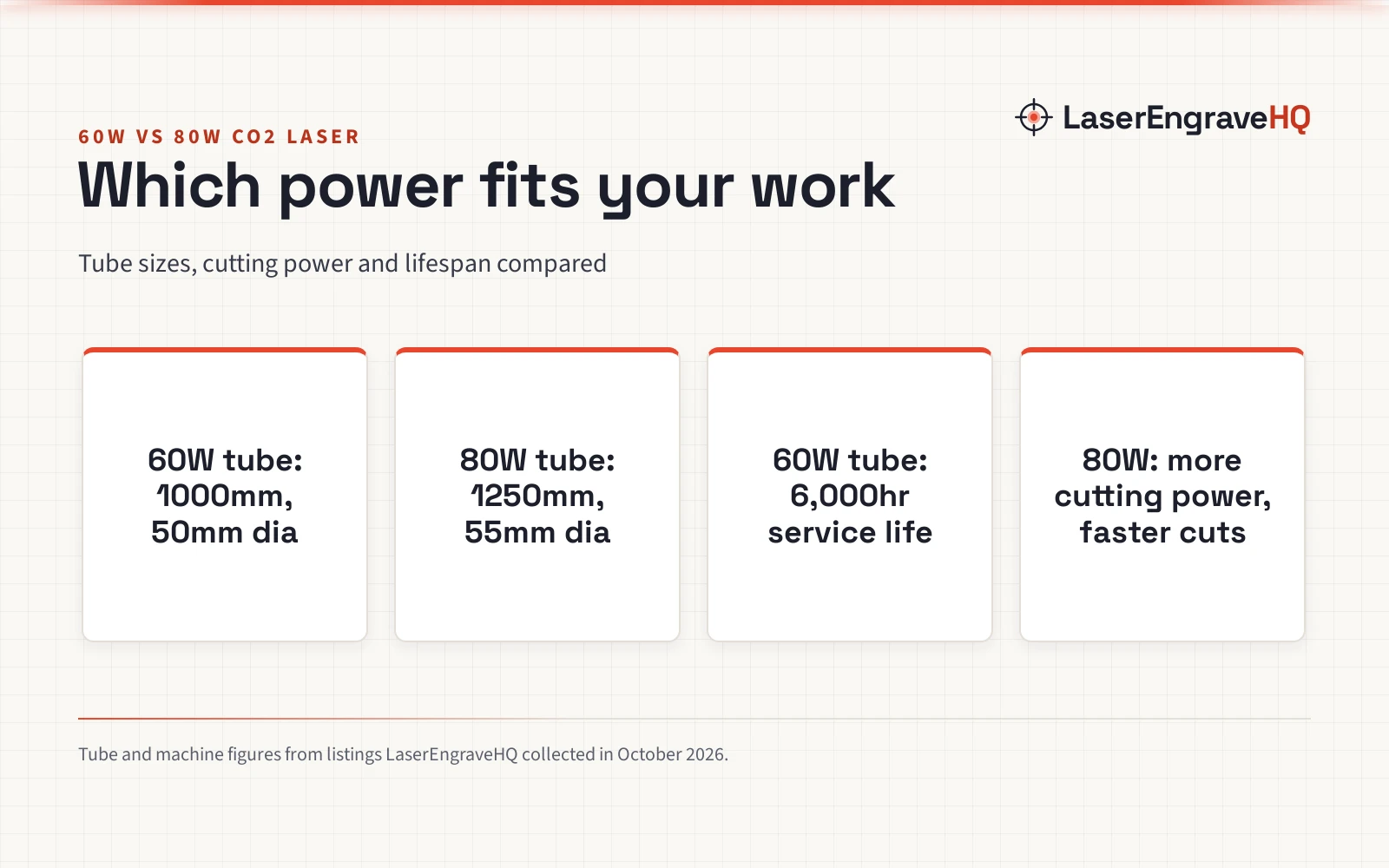
60W vs 80W CO2 laser: 80 watts cuts thicker and faster, 60 watts is the engraving sweet spot, and the 80W tube is physically…

CO2 laser cutters cut thicker wood and every kind of acrylic, including clear, and engrave glass, leather and stone. They need an exhaust route and tube cooling, so space planning matters as much as wattage.
Bare metal points to a fiber laser, clear acrylic to CO2, wood and leather on a budget to a diode, and thick stock or 3D carving to a CNC router. The Machine Finder narrows it down in five questions, and the material guide shows what each type can cut.
60W vs 80W CO2 laser: 80 watts cuts thicker and faster, 60 watts is the engraving sweet spot, and the 80W tube is physically…
A practical workshop guide explaining whether a CO2 laser can engrave brass, how marking sprays work on bare metal, and when to use a…
A step-by-step workshop guide on how to use a CO2 laser cutting machine safely: connect cooling, exhaust fumes, align mirrors, set focus and execute…
A practical comparison of Glowforge and OMTech laser machines across software control, cutting capability, workspace ventilation and maintenance demands.
A practical guide comparing RF metal tubes and DC glass tubes for CO2 lasers, covering beam quality, lifespan, cooling, costs and workshop setup.
A practical guide comparing K40 CO2 and diode laser engravers: understand beam differences, material capabilities, cooling and maintenance demands, and safety requirements before you…
A practical guide comparing the xTool P2S and Glowforge Pro HD across cutting capability, software options, rotary support, and workshop safety.
A practical step-by-step CO2 laser maintenance checklist covering daily optical cleaning, water cooling verification, mirror alignment, and mechanical upkeep.
A practical step-by-step guide to venting a CO2 laser outside safely, covering duct routing, exhaust fan sizing, window vent sealing, and backdraft prevention.
A step-by-step guide to aligning mirrors on a CO2 laser: set the beam from the tube to mirror 1, square the path across both…