Large Size Tap and Die Set: Sizes, Types and How to Use One
A large tap and die set runs up to the bigger thread sizes: what the sizes mean, which sets reach them, and how to pick one that covers the work.

On this page
Top picks at a glance
As an Amazon Associate I earn from qualifying purchases.
- 1
 toolant 127-Piece Metric & SAE Ratcheting Tap and Die Set9.7/10View on Amazon
- 2
 OMT Tap and Die Set9.7/10View on Amazon
- 3
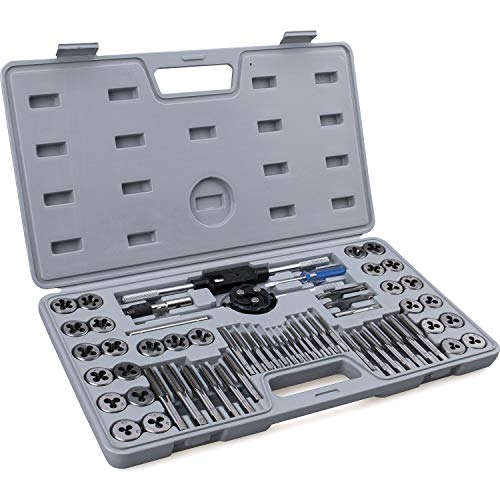 60-Pc Master Tap and Die Set9.6/10View on Amazon
A bolt that will not thread into a tapped hole, or a rod needing a thread, is where a large size tap and die set earns its keep. A tap cuts the internal thread in a hole, and a die cuts the external thread on a rod, so together they let a maker repair or cut threads instead of buying new. A large size tap and die set is a set whose range runs up to the bigger thread sizes, and this guide explains what counts as large, what the sizes mean, and how to pick the right set.
LaserEngraveHQ earns a commission from purchases made through these links, at no extra cost to you. Read our affiliate disclosure.
No set lists a size that reaches 1 inch. The largest SAE size listed is 3/4 inch, and the largest metric size listed is M18, so a set sold as going up to 1 inch needs a closer look at its size list.
Step 1: Tell a tap from a die
A tap and a die do opposite halves of the same job. A tap cuts the internal thread in a hole, the female half that a bolt screws into, while a die cuts the external thread on a rod or a bolt, the male half that screws into a nut or a tapped hole. Sets also split taps into taper taps and plug taps: the WAKUKA set lists 35 of each, with the taper tap starting the thread and the plug tap following it. Hex dies, the kind in the EFFICERE 86-piece and VEVOR sets, turn with a wrench or a socket, which helps in tight spaces and where more torque is needed, while round dies suit cutting a new thread. The how to tap and die guide walks through the hand movements for both tools.
Step 2: Read the size markings
Every tap and die carries its size, and the marking reads differently in SAE and metric. An SAE size such as 1/4-20 names the diameter first and the threads per inch second, so a 1/4-20 tap cuts a 1/4 inch thread with 20 threads to the inch. A metric size such as M10x1.5 names the diameter in millimeters first and the pitch second, so an M10x1.5 tap cuts a 10 mm thread with a 1.5 mm pitch. Pipe threads carry an NPT mark, such as 1/8-27 NPT, and coarse and fine versions of the same diameter, such as 1/4-20 and 1/4-28, are not interchangeable.
When the size on a bolt or a hole is unknown, a thread pitch gauge settles it. The gauge leaves match the thread profile and give the pitch, and most of the sets here include one or two gauges: the OMT 87-piece set includes 2 thread gauges, and the EFFICERE 86-piece set includes 2 thread pitch gauges. Check size and pitch against the gauge before cutting: a tap that is close but not exact cuts a thread the mating bolt will not fit. The thread pitch gauge guide covers gauges that read both SAE and metric threads.
Step 3: Decide what counts as large
Large is a range, not a single size. In the reference listings, the smaller SAE-only sets top out at 1/2 inch: the OMT 40-piece set runs from #4 to 1/2 inch, and the EFFICERE 40-piece set does the same. The mid-size combination sets reach 5/8 inch and M16: the OMT 87-piece set covers 4-40 to 5/8-18 inch and M3 to M16, and the EFFICERE 86-piece set covers the same range. The largest sets here reach 3/4 inch and 18 mm: the GEARWRENCH 114-piece (on Amazon) set ranges from 4-40 to 3/4 inch and 3 mm to 18 mm, and the WAKUKA 110-piece (on Amazon) set lists sizes up to 3/4-10 and 3/4-16 with metric sizes to 18×1.5.
The table below lines up the top sizes. A set counts as large when its top size covers the largest fastener on the job, so check the biggest bolt or hole first.
| Set | Top SAE size | Top metric size |
|---|---|---|
| OMT 40-piece SAE | 1/2 inch | SAE only |
| EFFICERE 86-piece | 5/8 inch | M16 |
| OMT 87-piece | 5/8 inch | M16 |
| GEARWRENCH 114-piece | 3/4 inch | 18 mm |
| WAKUKA 110-piece | 3/4 inch | 18 mm |
Step 4: Match the set to the material and the job
Most listings here name GCr15 bearing steel or high speed steel, and the OMT 87-piece and EFFICERE 86-piece sets add a titanium coating. Several listings state a hardness of 60 HRC: the EFFICERE sets and the Anfrere set state 60 HRC, while the VEVOR set states HRC56 bearing steel. A titanium coating and a stated hardness mark a set made for repeated use.
The listings cover carbon steel, cast iron, aluminum, brass, copper and stainless steel, and the EFFICERE and WYNNsky listings add wood and plastics. Check the wrenches too: the OMT 87-piece set includes 5 adjustable wrenches and a 5 inch center punch, and the GEARWRENCH set uses ratcheting T handles with a 5 degree swing arc and a reversing lever.
Step 5: Cut a thread without breaking the tap
A tap breaks when it is forced, crooked or starved of lubrication, so the routine is slow and square. Start with the hole drilled to the tap drill size, then check the tap size and pitch against a gauge. Hold the tap square to the work, turn it forward to cut, then back it off to break the chip before it packs the flutes. Use a tapping fluid on metal: the metal tapping fluid guide covers fluids for steel and aluminum. Keep the work clamped, wear eye protection, and stop at the first sign of binding.
Dies need the same care. Start the die square on the end of the rod, use the die stock or a wrench that holds the die firmly, and back off to clear chips the same way. Hex dies take a wrench or a socket, which helps where a round die stock will not fit. When a thread only needs cleaning up, a hex die can chase the old thread instead of cutting a new one.
Common mistakes to avoid
- Buying a set that stops below the largest fastener on the job.
- Mixing coarse and fine threads of the same diameter, such as 1/4-20 and 1/4-28, which look alike and do not fit each other.
- Starting a tap crooked, which cuts a thread that runs off square and binds the bolt.
- Forcing a tap through binding instead of backing off to clear the chip.
- Using a die to cut a new thread when the job only needs the old thread chased clean.
Large size tap and die set: the short version
- A tap cuts internal threads and a die cuts external threads.
- Read the size first: SAE gives diameter and threads per inch, metric gives diameter and pitch.
- Large means a range that runs up to the bigger sizes: 5/8 inch and M16 in the mid-size sets, 3/4 inch and 18 mm in the largest sets here.
- Check the top size against the largest fastener on the job before buying.
- Match the set to the material, and check the wrenches and gauges in the box.
- Cut slowly, keep the tap square, back off to clear chips, and use tapping fluid on metal.
FAQ: lasers and CNC
What is the largest size in a tap and die set?
In the reference listings here, the largest SAE size is 3/4 inch and the largest metric size is M18, and no listed size reaches 1 inch. Check the size list before ordering, since the piece count alone says nothing about the top size.
What is the difference between a tap and a die?
A tap cuts internal threads in a hole, the female half of the joint, while a die cuts external threads on a rod or a bolt, the male half. A tap needs a drilled hole to work in, and a die needs a rod of the right diameter to cut.
What do the numbers on a tap mean?
On an SAE tap such as 1/4-20, the first figure is the diameter and the second is the threads per inch. On a metric tap such as M10x1.5, the first figure is the diameter in millimeters and the second is the pitch. A thread pitch gauge reads both.
Can a tap and die set cut pipe threads?
Some sets include pipe thread sizes, such as 1/8-27 NPT in the EFFICERE and WYNNsky sets. Pipe threads taper, so a pipe tap only fits pipe work. Check that the set lists the NPT size needed before buying.
Do I need a thread pitch gauge?
A gauge is the quickest way to name an unknown thread, and most sets here include one or two. The gauge leaves match the thread profile and give the pitch, which a ruler cannot do on a fine thread. If the set has no gauge, a separate gauge that reads both SAE and metric threads is worth adding.
What material are taps and dies made from?
Most listings here name GCr15 bearing steel or high speed steel, with a titanium coating on the OMT 87-piece and EFFICERE 86-piece sets. Several state a hardness of 60 HRC, while the VEVOR set states HRC56 bearing steel.
Related: the CNC tooling hub, how to tap and die and tap vs thread mill. Also see the best thread pitch gauge. Also see the best metal tapping fluid.