How Do Tap and Die Sets Work for Threading
Taps cut internal threads in drilled holes and dies cut external threads on rods and bolts. Here is how tap and die sets work, step by step, with four sets compared.

On this page
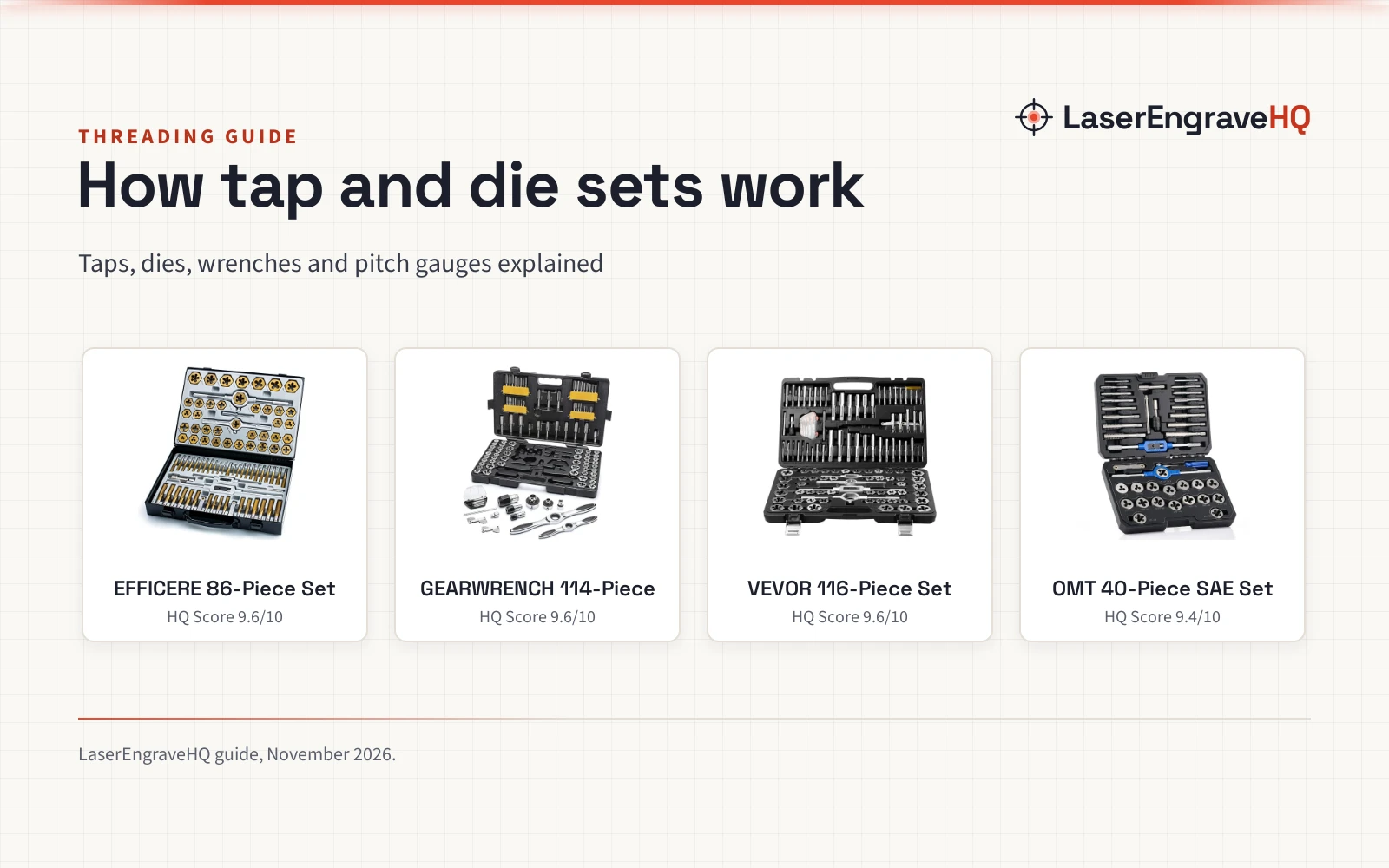
Top picks at a glance
As an Amazon Associate I earn from qualifying purchases.
- 1
 86-Piece Master Tap and Hex Die Set9.6/10View on Amazon
- 2
 GEARWRENCH 114 Piece Ratcheting Tap and Die Set9.6/10View on Amazon
- 3
 VEVOR Tap and Die Set 116 Pcs Metric and SAE Size9.6/10View on Amazon
- 4
 OMT SAE Tap and Die Set, Thread Repair and Cutting9.4/10View on Amazon
How do tap and die sets work? A tap cuts threads inside a drilled hole so a bolt or screw can thread into it, and a die cuts threads on the outside of a rod or bolt so a nut can thread onto it. Wrenches turn both tools by hand, a little at a time, with cutting oil to keep the cuts clean. The sets in this guide cover the sizes, handles and gauges for that work.
LaserEngraveHQ earns a commission from purchases made through these links, at no extra cost to you. Read our affiliate disclosure.
Threading by hand takes practice, and a tap can snap in a hole if it is forced. Work on scrap metal first, use cutting oil, and back the tap out often to clear chips before you turn it further.
86-Piece Master Tap and Hex Die Set
An 86-piece master set in titanium-coated high speed steel with SAE sizes #4 to 5/8 inch and metric M3 to M16, hex dies, handles and a metal case.
Pros
- SAE #4 to 5/8 inch and metric M3 to M16 in one set, coarse and fine
- High speed steel with titanium coating, heat treated to 60 HRC
- Hex dies turn with wrenches and sockets for leverage in tight spaces
- Metal storage and carry case with holders, stocks and gauges
Cons
- No warranty term is stated
- Hex dies need a wrench or socket rather than a round die stock
- Case measures 14.9 by 10.9 by 2.2 inches
- No ratcheting handles: dies turn with the included stocks
GEARWRENCH 114 Piece Ratcheting Tap and Die Set
A 114-piece ratcheting set with 48 SAE and metric taps and dies from 4-40 to 3/4 inch and 3 mm to 18 mm, plus screw extractors and thread gauges.
Pros
- Ratcheting T handles with a 5 degree swing arc and reversing lever
- 48 taps and dies in SAE and metric sizes
- Twist lock guide system keeps dies centered while cutting
- 5 screw extractors and SAE and metric thread gauges included
Cons
- No warranty: the maker lists it as a consumable
- Ratcheting wrench works with the GEARWRENCH pass thru socket system
- 48 taps and dies, fewer than the 86-piece set
- Case measures 21.0 by 13.0 by 3.0 inches
VEVOR Tap and Die Set 116 Pcs Metric and SAE Size
A 116-piece metric and SAE set in HRC56 bearing steel with 51 taps, 51 dies, hex dies, pitch gauges and 5 extractors in a storage case.
Pros
- 51 taps and 51 dies, the most cutting tools here
- Bearing steel hardened to HRC56 with 800°C heat treatment
- Hexagonal dies distribute force evenly during work
- Tapered teeth start threads smoothly and help prevent over-threading
Cons
- No warranty term is stated
- Heaviest set here by stated weight
- HRC56 steel sits below the 60 HRC of the EFFICERE set
- Two die wrench sizes, 25.4 mm and 38 mm, to match to each die
OMT SAE Tap and Die Set, Thread Repair and Cutting
A 40-piece SAE set in GCr15 bearing steel with 34 taps and dies from #4 to 1/2 inch, three tap wrenches and a 1 year warranty.
Pros
- 34 taps and dies in common SAE sizes, #4 to 1/2 inch
- Heat-treated GCr15 bearing steel resists wear and corrosion
- Three tap wrenches, a die wrench and a thread pitch gauge included
- 1 year warranty stated
Cons
- SAE sizes only: no metric taps or dies
- 34 taps and dies, the fewest cutting tools here
- Tap ends from 1/5 to 2/5 inch need the included wrenches
- Blow-molded case rather than a metal case
How do tap and die sets work: taps and dies explained
A tap is a hardened steel tool with cutting teeth and flutes. You turn it into a drilled hole and the teeth cut a spiral groove, the internal thread, into the wall of the hole. A bolt with the matching size and pitch then screws into that thread. Taps also clean up damaged threads: running the right tap through a rusty or crossed hole restores the thread shape, which the sets here call rethreading or thread repair.
A die does the mirror job. It is a ring or hex-shaped cutter with teeth on the inside. You turn it onto the end of a rod or a plain bolt and it cuts an external thread, so a nut can run along it. Dies also chase damaged bolt threads back into shape. Hex dies, like the ones in the EFFICERE and VEVOR sets, turn with a wrench or socket, while round dies sit in a die stock, the handle that holds and turns them. Tap wrenches grip the square end of a tap, and a thread pitch gauge, a fan of toothed blades, identifies the pitch of an existing thread so you pick the cutter that matches.
Cutting a thread by hand, step by step
Drill the hole first, sized for the tap you will use, then put a drop of cutting oil on the tap. Set the tap square to the hole and turn it forward a little, then back it out partway to break the chips. Keep that rhythm, forward a little and back a little, and add oil as you go. Forcing a tap in one long turn is how taps snap. Cutting an external thread follows the same rhythm: chamfer the end of the rod so the die starts straight, oil it, and turn the die on with the same forward-and-back motion, then run a nut along the new thread by hand to check the fit.
Repair work is gentler. To restore a damaged thread, pick the tap or die that matches the existing size and pitch, oil it, and turn it through the damaged section slowly. The cutter follows the old thread and cleans out rust, paint and flattened crests. Our companion guide on how to tap and die walks through the motions in more detail.
The tap and die sets for this work
Every step above needs the right cutter size and a handle that turns it straight, so the sets below are grouped by the threading work they cover.
Choosing sizes: SAE, metric and pitch
Thread sizes come in two families. SAE sizes are written as a screw number or a fraction of an inch, with a thread count after it, like the 1/4×20 and 3/8×16 sizes in the EFFICERE set. Metric sizes are written as a diameter in millimeters with the pitch after it, like M6x1.0 and M10x1.5. Coarse threads have fewer, deeper grooves; fine threads have more, shallower grooves and put more threads into thin material. Match the family to the fastener in front of you, and let the pitch gauge settle the question: mesh a blade with the thread and read the marking. If your work mixes both families, a combined set like the EFFICERE 86-piece or the VEVOR 116-piece (on Amazon) covers both, and our large size tap and die set guide covers the bigger diameters. More tooling guides live in the CNC tooling section.
Common mistakes to avoid
- Forcing a tap in one long turn instead of backing it out to break chips.
- Skipping cutting oil, which raises friction and tears the new thread.
- Starting a tap or die crooked, which cuts a thread no fastener will follow.
- Guessing the pitch instead of checking it with the gauge.
FAQ: lasers and CNC
What is the difference between a tap and a die?
A tap cuts internal threads inside a drilled hole, so a bolt screws into the hole. A die cuts external threads on a rod or bolt, so a nut screws onto it. Sets include both, with wrenches and stocks to turn them.
Can a tap and die set repair damaged threads?
Yes. Running the matching tap through a damaged hole, or the matching die over a damaged bolt, cleans out rust and flattened thread crests and restores the thread shape. Match the size and pitch first with the gauge so the cutter follows the old thread.
Should I buy an SAE set or a metric set?
Match the fasteners you work on. Older American machinery and hardware use SAE sizes, while most newer cars and equipment use metric. If you meet both, a combined set like the EFFICERE 86-piece (on Amazon) covers SAE #4 to 5/8 inch and metric M3 to M16.
What does a thread pitch gauge do?
It identifies the pitch of an existing thread. You hold its toothed blades against the thread until one meshes cleanly, and the marking on that blade tells you the pitch, so you choose the tap or die that matches.
What metals can these sets thread?
It depends on the set. The OMT set lists copper, aluminum, iron and carbon steel. The EFFICERE set lists wood, carbon steel, cast iron, aluminum, brass, copper and stainless steel. Check the materials named for the set you pick before you cut.
Why do taps break in the hole?
Usually from forcing the tap without backing it out, or from skipping cutting oil. Chips pack into the flutes, torque climbs, and the tap snaps. Turn forward a little, back out to break chips, and keep the cut oiled.
Related: how to tap and die, large size tap and die set and the CNC tooling hub.