Fiber Optic Laser Safety Glasses: How to Choose
How to choose fiber optic laser safety glasses: match the wavelength range and OD rating to your fiber laser, then check VLT, fit and certification marks.

On this page
Top picks at a glance
As an Amazon Associate I earn from qualifying purchases.
- 1
 LaserPair Laser Safety Glasses 200-460nm OD6+ & 800-1095nm9.7/10View on Amazon
- 2
 Cloudray CE 1064nm Laser Safety Goggles Protective Glasses9.5/10View on Amazon
- 3
 LaserPair Laser Safety Glasses 200-534nm and 740-1095nm Laser9.7/10View on Amazon
You mark metal tags, tools and parts for customers, and the beam that makes those marks is invisible while it works. Fiber optic laser safety glasses are the eyewear rated for that beam: they carry a stated wavelength range and an optical density rating that match a fiber laser, and this guide shows how to check the rating before you buy.
LaserEngraveHQ earns a commission from purchases made through these links, at no extra cost to you. Read our affiliate disclosure.
Eyewear protects only if its stated optical density and wavelength range match your machine. Tinted acrylic or orange shields without a rating are not protection, whatever color the lens is.
Step 1: Find the wavelength of your fiber laser
Start with the machine, not the glasses. Fiber lasers used for marking and engraving metal work in the infrared range, and reference listings for fiber laser eyewear name 1064nm as the typical wavelength, with 1070nm, 1080nm and 1100nm also named. Visible light runs from 400nm to 780nm, and wavelengths above 780nm are infrared and usually invisible, which is why you cannot judge a fiber beam by looking at the work area.
Check the wavelength printed on your machine or in its manual and write it down. A CO2 laser is listed at 10600nm in reference material, far from the fiber range, and eyewear rated for one type does not cover the other. Our laser engraver types guide compares diode, CO2 and fiber machines.
Step 2: Match the wavelength range on the glasses
Rated laser safety glasses state a wavelength range, and your machine wavelength has to fall inside it. Reference listings show ranges such as 800nm to 1100nm, 900nm to 1100nm and 740nm to 1100nm for fiber and infrared work. A range that ends below your machine wavelength does not cover your machine, even if the glasses are sold for lasers in general.
Read the full range, not just the headline. Some listings split the range into bands with a different rating in each band: 740 to 780nm at OD 5+, 780 to 820nm at OD 6+ and 820 to 1100nm at OD 7+. For a fiber laser at 1064nm, the band that matters is the one that contains 1064nm. If a listing gives no wavelength range, treat the glasses as unrated.
Fiber optic laser safety glasses: what the OD rating means
Optical density, written as OD, states how strongly the lens reduces laser light at the rated wavelengths. A higher OD number means stronger reduction at those wavelengths. Reference listings for fiber work state OD 4, OD 6+, OD 7+ and OD 8+ at ranges that include 1064nm. LaserPair lists 900 to 1100nm at OD 8+ for fiber laser and handheld laser welding use. Cloudray lists OD 6+ for 1064nm, 1070nm, 1080nm and 1100nm. FreeMascot lists OD 7+ for 800nm to 1100nm. TRQWH lists OD 7+ for 800nm to 1100nm. Laserlands lists OD4 for 1064nm.
OD only counts inside the stated wavelength range. Glasses rated OD 7+ for 800nm to 1100nm say nothing about a wavelength outside that range. This is also why regular safety glasses do not substitute: they carry no OD rating for laser wavelengths. Our laser safety glasses vs regular safety glasses comparison explains the difference, and OD6 vs OD7 laser safety glasses walks through the rating steps.
Step 3: Check visible light transmission and fit
Visible light transmission, written as VLT, states how much ordinary light passes through the lens. Reference listings state VLT figures of 6%, 29%, 30%, 31% and 65% on different models. A lower VLT figure means a darker lens. Match the figure to your workspace lighting: you still need to see the workpiece, the focus point and your controls clearly while you work.
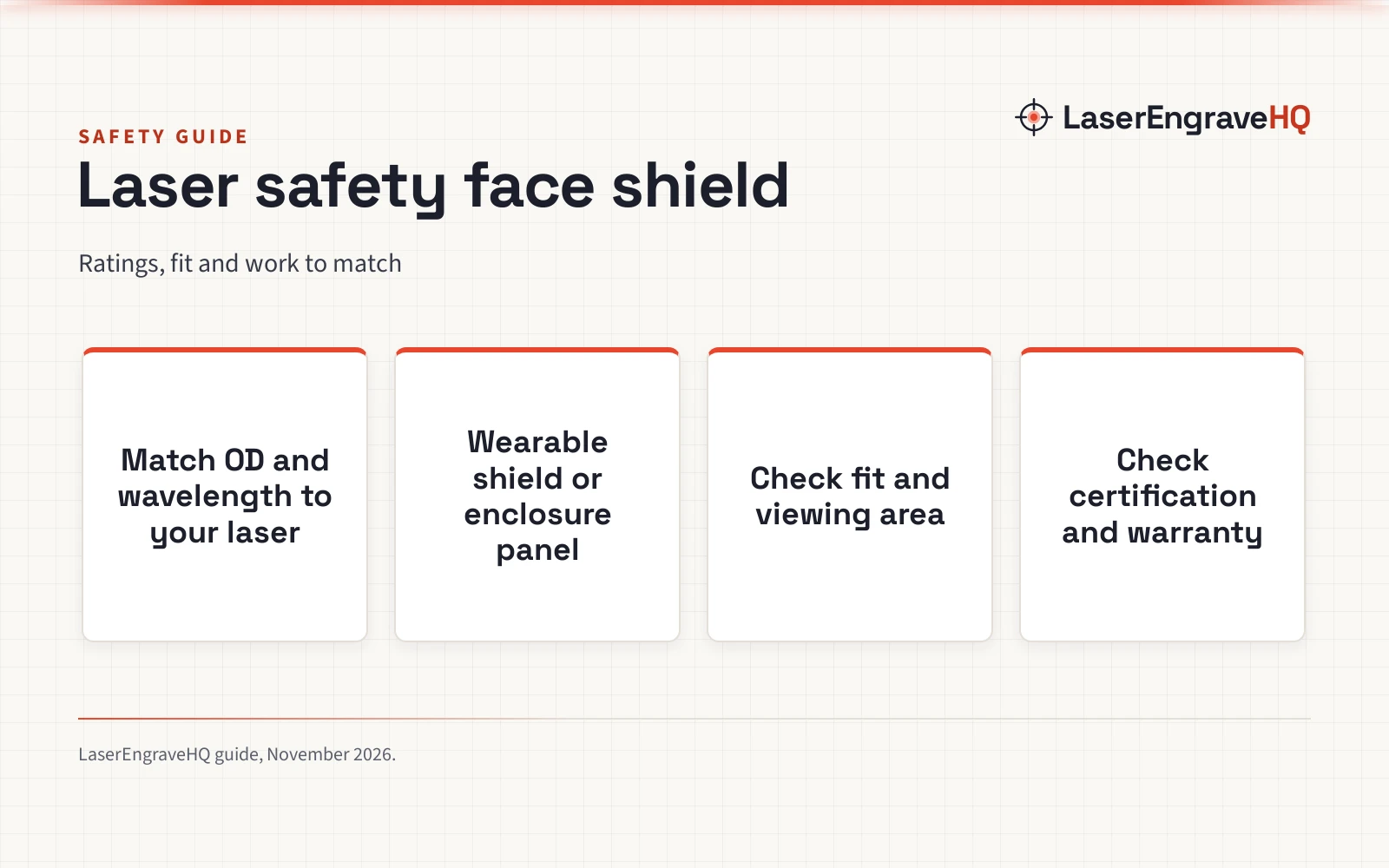
Fit matters as much as the rating. Look for a wraparound profile with side coverage, and check whether the frame fits over prescription glasses if you wear them. Reference listings describe wrap-around frames, ventilation against fogging and models made to wear over prescription eyewear. Our safety glasses over glasses guide covers fit options, and laser safety glasses vs acrylic shield explains why an unrated shield differs from rated eyewear.
Step 4: Read the certification marks
Listings state their standards in different ways. EN207 appears on several reference listings, including a CE certified model stated as compliant with EN207:2017 and models stated to meet EN 207:2009+AC:2011. One listing states ratings of 800 to 1100nm DIR LB5 and 1000 to 1090nm IR LB7, and another states 900 to 1100nm D LB6 and IR LB8. These LB ratings sit beside the OD figures and describe the lens performance in the terms of that standard.
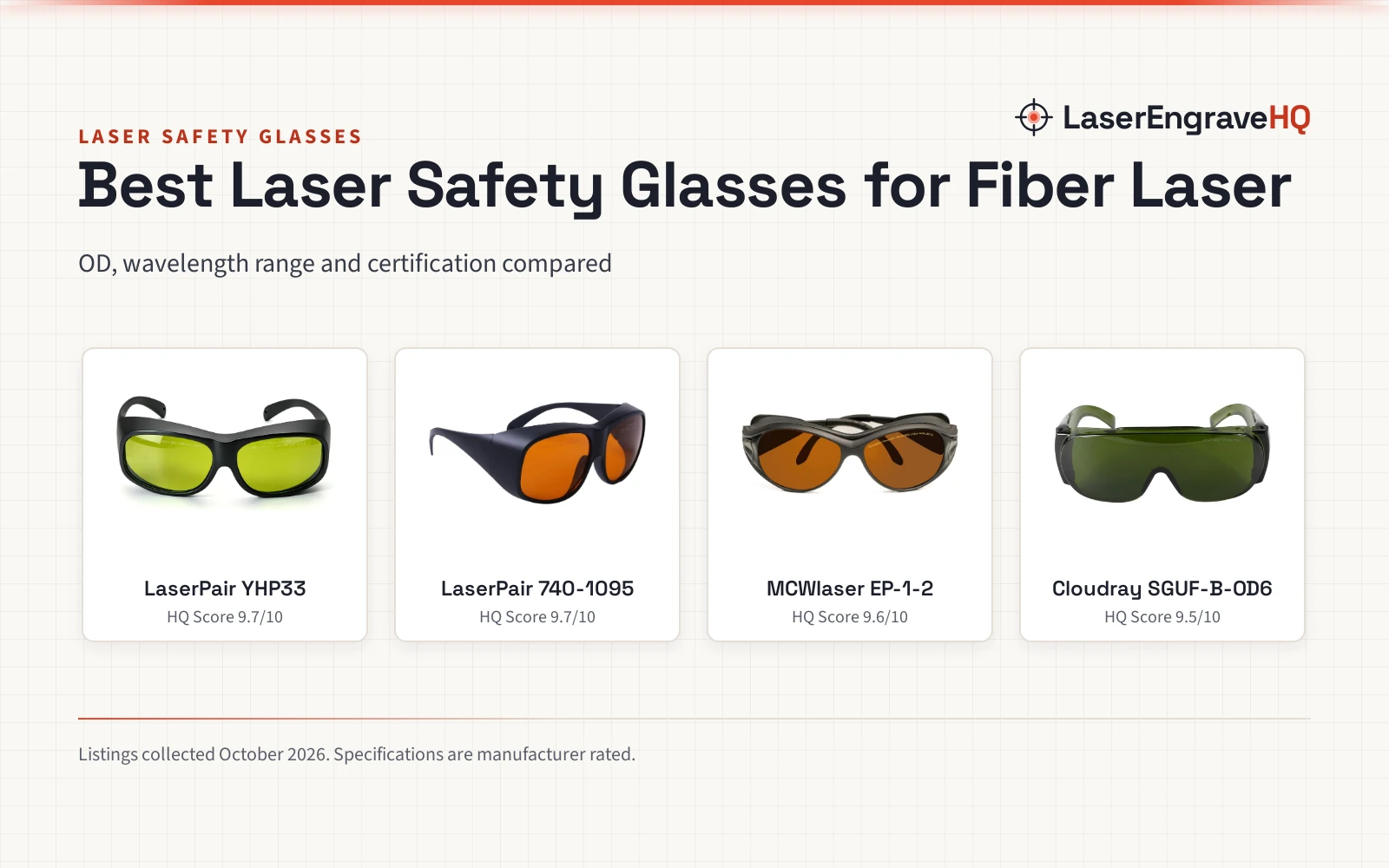
Use the marks as a cross-check, not as a shortcut: the wavelength range and OD rating still have to match your machine. The FDA Center for Devices and Radiological Health publishes guidance on laser products and instruments. Our best laser safety glasses for fiber laser guide sets stated ratings side by side.
Step 5: Care for the lenses and replace damaged pairs
Store the glasses in the case they ship with and clean them with a soft cloth, as reference listings direct. Keep harsh chemicals away from the lenses. Inspect the lens surface before each work session. Reference guidance for reflective-film lenses states that if the reflective film is scratched, the glasses can no longer be used and need to be replaced. A scratched reflective film is a reason to stop and replace the pair, not to keep working, and the guidance stated for your pair decides the call for other lens types.
If you run several machines, label each pair with the wavelength range it covers so nobody grabs the wrong pair at the bench. Keep the rest of the safety basics in place: ventilation for fumes, fire awareness while a job runs, and never lasering PVC, vinyl, PVC-based faux leather, polycarbonate or ABS. Browse the laser safety hub for the wider setup.
Common mistakes to avoid
- Buying glasses by lens color instead of by stated wavelength range and OD rating.
- Using eyewear rated for a diode or CO2 laser on a fiber laser because the frame looks the same.
- Reading only the headline OD figure and missing that the rating changes across wavelength bands.
- Wearing a tinted shield or regular safety glasses with no laser rating at all.
- Keeping a scratched pair in service after the lens film is damaged.
Fiber optic laser safety glasses: the short version
- Write down the wavelength of your fiber laser.
- Pick glasses whose stated wavelength range contains that wavelength.
- Check the OD rating inside that range.
- Check the VLT figure against your workspace lighting.
- Check fit, side coverage and the certification marks.
- Store the pair in its case and replace it if the reflective film is scratched.
Do those checks in order and the rating on the frame will match the machine on your bench.
FAQ: lasers and CNC
What wavelength do fiber optic laser safety glasses need to cover?
They need to cover the wavelength of your machine. Reference listings for fiber laser eyewear name 1064nm as the typical wavelength, with ranges such as 800nm to 1100nm and 900nm to 1100nm. Confirm the wavelength on your machine and pick a range that contains it.
What does OD mean on laser safety glasses?
OD is optical density: it states how strongly the lens reduces laser light at the rated wavelengths. Reference listings state OD 4, OD 6+, OD 7+ and OD 8+ for ranges that include 1064nm. The rating only applies inside the stated wavelength range.
Can I wear fiber laser glasses over prescription glasses?
Some models are made for that. Reference listings describe wrap-around frames and goggles that can be worn over prescription glasses. Check the stated fit for the model you pick, and make sure side coverage stays in place when worn over your frames.
Do diode laser glasses work for a fiber laser?
Only if the stated wavelength range and OD rating cover your fiber laser wavelength. Diode and fiber machines work at different wavelengths, so a pair rated for one type does not automatically cover the other. Read the range printed for the pair and compare it with your machine.
When should I replace laser safety glasses?
Replace them when the lens is damaged. Reference guidance for reflective-film lenses states that if the reflective film is scratched, the glasses can no longer be used and need to be replaced. Store the pair in its case and clean it with a soft cloth to protect the lens surface.
Related: the laser safety hub, best laser safety glasses for fiber laser and laser engraver types. Also see our how to choose a laser engraver guide.