Best Laser Safety Glasses for Fiber Laser (2026): Glasses Compared
Laser safety glasses compared by OD, wavelength range, transmittance and certification for fiber laser work at 1064 nm before ordering.

On this page
Top picks at a glance
As an Amazon Associate I earn from qualifying purchases.
- 1
 Best OverallLaserPair YHP339.7/10View on Amazon
- 2
 Widest RangeMCWlaser EP-1-29.6/10View on Amazon
- 3
 OD6 PickCloudray SGUF-B-OD69.5/10View on Amazon
- 4
 Range PickLaserPair 740-10959.7/10View on Amazon
- 5
 JILERWEAR Laser Safety Glasses OD 6+ for 180-540nm VioletView on Amazon
- 6
 xTool Laser Safety GlassesView on Amazon
- 7
 4 Pieces Laser Engraving Making Paper for Glass CeramicsView on Amazon
- 8
 Professional Laser Safety GlassesView on Amazon
A fiber laser marking run starts with a design on metal and a beam the eye cannot see, so the glasses on the bench matter as much as the machine settings. The wrong pair leaves the operator exposed, while the right pair matches the machine wavelength and optical density. The best laser safety glasses for fiber laser cover 1064 nm with a stated OD, and this guide compares glasses by OD, wavelength range, transmittance and certification, using only what each listing publishes.
LaserEngraveHQ earns a commission from purchases made through these links, at no extra cost to you. Read our affiliate disclosure.
Quick picks
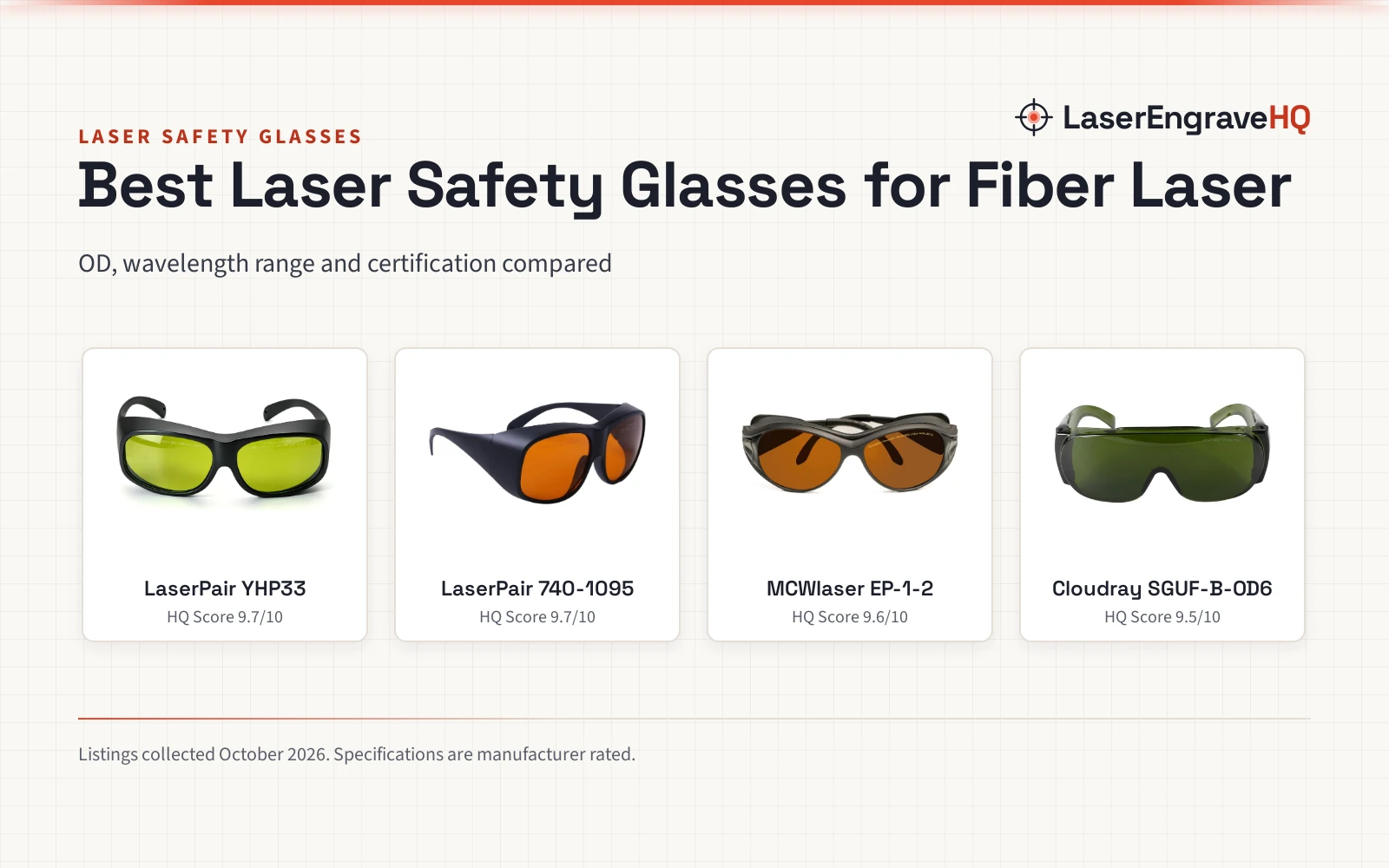
- Best Overall LaserPair YHP33: OD7+ at 800 to 1095 nm, covers 1064 nm, CE DIN CERTCO Check price on Amazon
- Widest Range MCWlaser EP-1-2: OD5+ at 190 to 540 nm and 800 to 1700 nm, EN 207:2017 Check price on Amazon
- OD6 Pick Cloudray SGUF-B-OD6: OD6+ with EN207, range stated 5000 to 11000 nm Check price on Amazon
- Range Pick LaserPair 740-1095: 200 to 534 nm and 740 to 1095 nm, lists 1064 nm Check price on Amazon
Machines on the list

LaserPair Laser Safety Glasses 200-460nm OD6
Safety glasses with OD6+ at 200 to 460 nm and OD7+ at 800 to 1095 nm, covering 1064 nm for fiber laser work.
Pros
- OD7+ protection from 800 to 1095 nm covers 1064 nm
- OD6+ from 200 to 460 nm for diode and UV work
- CE Certified by DIN CERTCO as multi-wavelength glasses, per the listing
- Wrap-around design with adjustable nose bridge and flexible temple arms
Cons
- Bullets state 43% visible light transmittance while the spec table states 50
- No warranty term is stated
- 43% transmittance dims the view compared with clear glasses
- One Size only, per the spec table

LaserPair Laser Safety Glasses 200-534nm
Laser safety goggles with OD 7+ protection for 180 to 534 nm diode wavelengths, DIN CERTCO EN207 certification and a TR90 wrap-around frame.
Pros
- CE certified by DIN CERTCO to EN207 and A1EN207 standards
- OD 7+ rating across 180 to 534 nm covers 405 nm, 445 nm and 450 nm blue diode lasers
- TR90 wrap-around frame features flank ventilation to reduce fogging
- 23% visible light transmission maintains clarity during alignment
Cons
- No warranty term is stated in the listing
- Heavier than simple glasses at 0.19 kg
- Listing warns not to use alcohol or alcohol disinfectant on the frame
- Temple to temple width is 20 cm, which may feel loose on smaller faces

Laser Safety Glasses OD5+ 190-540nm & 800-1700nm
Safety glasses with OD5+ at 190 to 540 nm and 800 to 1700 nm, covering 1064 nm, with an over-glasses fit.
Pros
- OD5+ from 800 to 1700 nm covers 1064 nm and 1080 nm
- OD5+ from 190 to 540 nm for blue, green and UV work
- EN 207:2017 standard stated, per the listing
- Over-glasses fit with flank and eyebrow protection
Cons
- Bullets state 35% transmittance while the spec table states 99.7%
- Spec table lists 10600 nm range and CO2 application against the fiber ranges in the bullets
- Spec table states Reflective Type protection while the bullets describe continuous absorption
- No warranty term is stated
Cloudray CE 1064nm Laser Safety Goggles Protective
Safety goggles titled for 1064 nm whose spec table states a 5000 to 11000 nm range and CO2 application instead.
Pros
- OD 6+ stated, with CE EN207 stated
- Shatter resistant and adjustable, per the spec table
- Hardened lens, per the spec table
- 99% ultraviolet light protection, per the spec table
Cons
- Title states 1064 nm while the spec table states a 5000 to 11000 nm range
- Spec table states CO2 application and 10600 nm typical wavelength against the fiber title
- Transmittance figures conflict: 50% V.L.T and 0.3 percentage in the spec table
- No warranty term is stated; the spec table only points to a warranty link
Other machines to compare
 JILERWEAR Laser Safety Glasses OD 6+ for 180-540nm VioletCheck price on Amazon
 xTool Laser Safety GlassesCheck price on Amazon
 4 Pieces Laser Engraving Making Paper for Glass CeramicsCheck price on Amazon
 Professional Laser Safety GlassesCheck price on Amazon
Specs compared
| Glasses | HQ Score | OD | Wavelength Range | VLT | Certification |
|---|---|---|---|---|---|
| LaserPair YHP33 | 9.7/10 | OD7+ / OD6+ | 200 to 460 nm, 800 to 1095 nm | 43% | CE DIN CERTCO |
| MCWlaser EP-1-2 | 9.6/10 | OD5+ | 190 to 540 nm, 800 to 1700 nm | 35% | EN 207:2017 |
| Cloudray SGUF-B-OD6 | 9.5/10 | OD 6+ | 5000 to 11000 nm (spec) | 50% and 0.3 stated | CE EN207 |
| LaserPair 740-1095 | 9.7/10 | Not stated | 200 to 534 nm, 740 to 1095 nm | Not stated | Not stated |
Specifications are manufacturer rated, as published on each listing and collected 12 October 2026.
Buying guide: the best laser safety glasses for fiber laser
Match OD and wavelength to the machine
A fiber laser works at 1064 nm, so the pair must state OD coverage that includes that wavelength. The LaserPair YHP33 states OD7+ from 800 to 1095 nm, and the MCWlaser states OD5+ from 800 to 1700 nm, so both state coverage at 1064 nm. The Cloudray title names 1064 nm, but its spec table states a 5000 to 11000 nm range, which does not include 1064 nm. The limited LaserPair title lists 1064 nm but states no OD, so protection cannot be confirmed from the title alone. A how to choose laser safety glasses guide covers matching in more depth.
Read the spec table against the title
Titles and spec tables disagree inside listings here, and the title and bullets win where they differ. The Cloudray title names 1064 nm and fiber use, while its spec table states CO2 application, a 10600 nm typical wavelength and conflicting transmittance figures, 50% and 0.3. The MCWlaser bullets state fiber ranges and 35% transmittance, while its spec table states a 10600 nm range, CO2 application and 99.7% transmittance. The YHP33 bullets state 43% transmittance while its spec table states 50. Where figures differ, compare the bullets first and treat the spec table as the weaker source.
Fit and visibility
Fit decides whether glasses stay on for a whole job. The YHP33 states a wrap-around fit with an adjustable nose bridge and flexible temple arms, the MCWlaser states an over-glasses fit with flank and eyebrow protection, and the Cloudray states a Regular fit with temples. Transmittance shapes the view: 43% on the YHP33 per its bullets and 35% on the MCWlaser per its bullets, against conflicting spec figures. A laser safety glasses guide covers fit and lens types. Try the fit with any prescription glasses before relying on a pair.
Warranty and care
No listing here states a warranty term. The Cloudray spec table points to a warranty link without stating a term, and the other listings state none at all. Care is stated plainly instead: the Cloudray listing states cleaning with a soft cloth, the YHP33 listing states a soft, lint-free cloth, and the MCWlaser listing states mild soap and water with storage away from direct sunlight. Value here comes from OD coverage and certification, not from warranty terms.
Wear glasses only where the stated OD and wavelength range match the machine in use. A tint or a title wavelength alone is not protection, and the Cloudray spec range here does not cover a fiber laser wavelength. Check the OD and range on the listing before running the machine, and keep the glasses on for the whole job.
Project Match
- Fiber laser work at 1064 nm: the LaserPair YHP33 and MCWlaser state OD coverage at that wavelength.
- Diode and blue laser work: the same pairs state 200 to 540 nm ranges.
- Over-glasses wear: the MCWlaser states an over-glasses fit; the YHP33 states a wrap-around fit and the Cloudray states a Regular fit.
How the scores add up
Each pair is scored on performance, build, value, safety and warranty, with the weights published on the How We Pick page. For glasses, safety means a stated OD with a wavelength range that matches the machine, plus a stated certification. The LaserPair YHP33 and MCWlaser state OD coverage at 1064 nm; the Cloudray spec range does not cover it. No listing states a warranty term. A figure the listing does not publish scores nothing.
| Product | HQ Score | Perf. /35 | Build /25 | Value /25 | Safety /10 | Warranty /5 |
|---|---|---|---|---|---|---|
| LaserPair YHP33 | 9.7 | 32 | 21 | 21 | 9 | 0 |
| MCWlaser EP-1-2 | 9.6 | 29 | 20 | 21 | 8 | 0 |
| Cloudray SGUF-B-OD6 | 9.5 | 26 | 20 | 19 | 7 | 0 |
Scores run from 9.2 to 9.8: each product’s point total is placed on that range, so more points always means a higher score.
FAQ: lasers and CNC
Does the Cloudray pair protect for a fiber laser?
Not on its stated spec figures: the title names 1064 nm, but the spec table states a 5000 to 11000 nm range and CO2 application, which does not cover 1064 nm. Check the listing before relying on it for fiber work.
What OD do the fiber-matching pairs state?
The LaserPair YHP33 states OD7+ from 800 to 1095 nm, and the MCWlaser states OD5+ from 800 to 1700 nm. Both ranges include 1064 nm.
What transmittance do these glasses state?
The YHP33 bullets state 43% against 50 in its spec table, and the MCWlaser bullets state 35% against 99.7% in its spec table. The Cloudray spec table states both 50% and 0.3.
Which pair fits over glasses?
The MCWlaser states an over-glasses fit. The YHP33 states a wrap-around fit, and the Cloudray states a Regular fit.
Related: best fiber laser engraver, laser safety, fiber laser engravers and how to choose laser safety glasses. Also see our best laser safety glasses for diode lasers.