Laser Safety Glasses vs Acrylic Shield: Which One Should You Buy?
A practical comparison of laser safety glasses vs acrylic shield protection: how optical density, wavelength filtering, and enclosures protect your eyes.

On this page
Top picks at a glance
As an Amazon Associate I earn from qualifying purchases.
- 1
 LaserPair Laser Safety Glasses 200-534nm and 740-1095nm Laser9.7/10View on Amazon
- 2
 CE 1064nm Laser Safety Goggles Protective Glasses Shield9.5/10View on Amazon
- 3
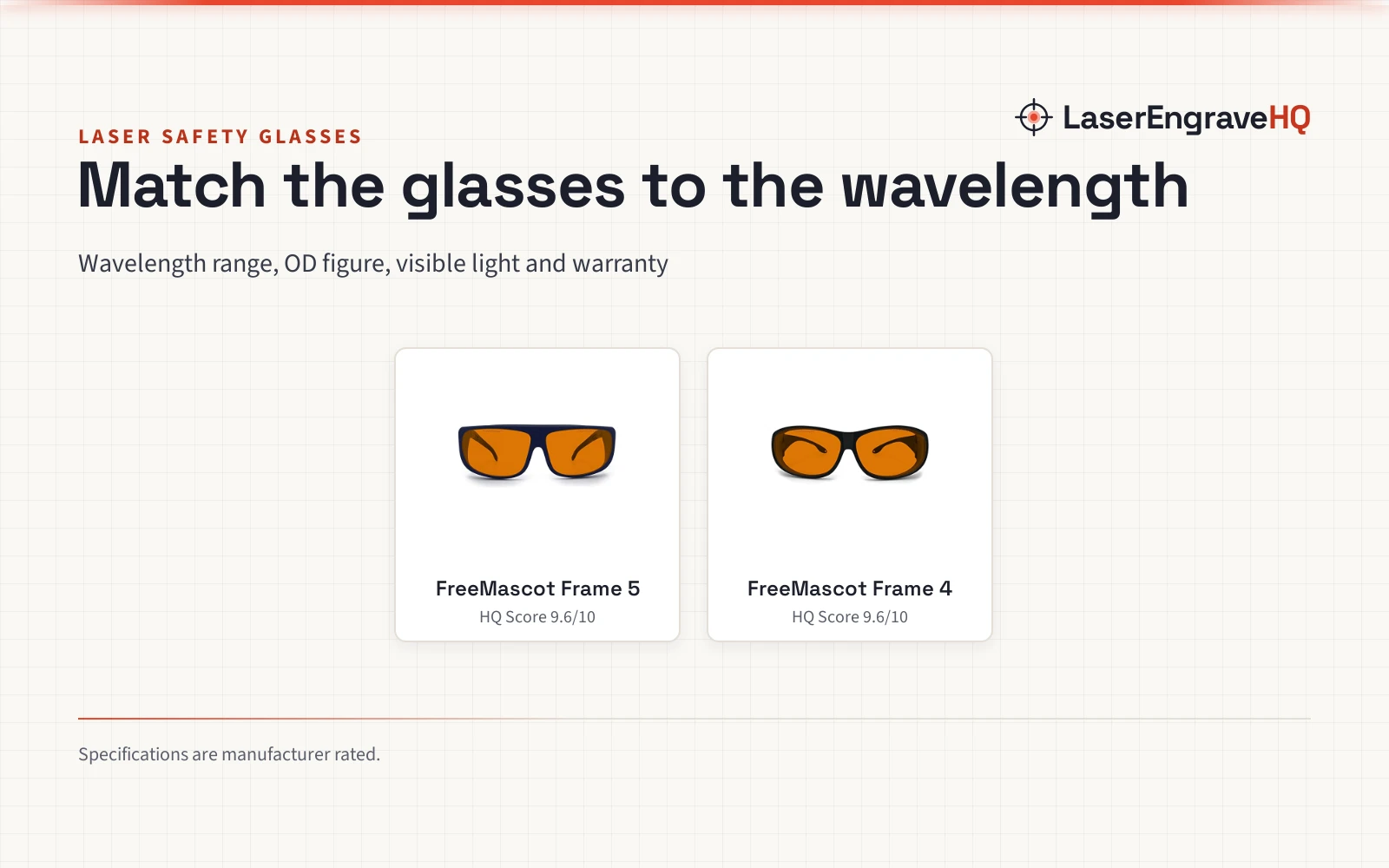
 FreeMascot Professional OD 6+ 190nm-490nm Wavelength9.7/10View on Amazon
- 4
 LaserPair Laser Safety Glasses 200-460nm OD6+ & 800-1095nmView on Amazon
- 5
 xTool Laser Safety GlassesView on Amazon
- 6
 JILERWEAR Laser Safety Glasses OD 6+ for 180-540nm VioletView on Amazon
- 7
 4 Pieces Laser Engraving Making Paper for Glass CeramicsView on Amazon
- 8
 Professional Laser Safety GlassesView on Amazon
- 9
 Phillips Safety Laser Safety Glasses for Co2/EximerView on Amazon
When setting up a laser to cut acrylic signs, personalize powder-coated drinkware, or engrave leather patches, deciding between laser safety glasses vs acrylic shield protection comes down to beam containment and line of sight. Laser safety glasses protect the wearer directly against diffuse reflections and stray scatter across all viewing angles, making dedicated eyewear essential whenever operating an open-frame diode or fiber machine. A certified enclosure creates a protective boundary for bystanders in your shop, but an open acrylic shield mounted to a laser head or resting on a workbench cannot substitute for certified safety glasses.
Other machines to compare
 LaserPair Laser Safety Glasses 200-460nm OD6+ & 800-1095nmCheck price on Amazon
 xTool Laser Safety GlassesCheck price on Amazon
 JILERWEAR Laser Safety Glasses OD 6+ for 180-540nm VioletCheck price on Amazon
 4 Pieces Laser Engraving Making Paper for Glass CeramicsCheck price on Amazon
 Professional Laser Safety GlassesCheck price on Amazon
 Phillips Safety Laser Safety Glasses for Co2/EximerCheck price on Amazon
LaserEngraveHQ earns a commission from purchases made through these links, at no extra cost to you. Read our affiliate disclosure.
Eyewear and acrylic panels shield your eyes only when their certified optical density matches the specific wavelength of your laser. Generic tinted plastic, unrated orange sheets, and standard workshop glasses offer no protection against laser radiation.
Step 1: Match optical protection to your laser wavelength
Laser radiation damages eye tissue because concentrated light focuses directly onto the retina or cornea. Because different laser sources emit light at different points along the electromagnetic spectrum, your protective barrier must match the exact beam type powering your machine. A shield or lens formulated to stop a specific beam will let an unmatched wavelength pass through completely unobstructed.
Diode lasers commonly emit blue visible light at 450nm. For multi-wavelength protection across both diode and fiber lasers, LP-LaserPair lists safety glasses delivering OD6+ protection from 200-460nm and OD7+ from 800-1095nm, covering 450nm diode and 1064nm infrared beams. For dedicated blue and violet diode setups, FreeMascot lists safety glasses delivering OD 6+ protection across 190nm-490nm, covering wavelengths such as 405nm and 445nm. For dedicated infrared marking, LP-LaserPair lists eyewear covering 740-1100nm with OD 7+ protection at 1064nm. While clear acrylic absorbs diffuse scatter from far-infrared CO2 lasers, it provides zero optical protection against 450nm blue diode light or 1064nm fiber beams, which pass through clear sheets without attenuation unless certified filtering dyes are present. To evaluate your setup, review our laser safety glasses guide.
Step 2: Understand optical density and visible light transmission
Optical density, abbreviated as OD, measures how much laser energy a protective filter blocks at a specified wavelength. Each increase in OD represents a logarithmic reduction in beam transmission, drastically cutting the energy that can reach the eye. When comparing protective equipment, higher optical density provides a wider safety margin against stray reflections.
The practical trade-off for high optical protection is visible light transmission, or VLT. VLT describes the percentage of normal ambient workshop light that passes through the filter so you can monitor your work area. For example, LP-LaserPair lists protective eyewear with 43% visible light transmission, while FreeMascot lists eyewear with 55% visible light transmission. A lens with balanced transmission lets you check alignment and monitor material engraving clearly without removing your eye protection. For an in-depth breakdown of protection levels, read our comparison on OD4 vs OD6 laser safety glasses.
Step 3: Evaluate line of sight and peripheral reflection risks
The fundamental physical difference between glasses and a shield is coverage angle. Laser safety glasses travel with your head, maintaining a close optical seal around your eyes. Quality frames feature wrap-around lenses and protective side shields that block peripheral light leaks when you bend down to check focal height or examine an engraved mark.
In contrast, an acrylic shield mounted to a laser head or set on a workbench only blocks light along a direct line of sight. When a beam hits an uneven workpiece, a reflective honeycomb bed, or an aluminum jig, diffuse scatter bounces outward in multiple directions. If you view the machine from an angle, look beneath the shroud, or stand to the side, scattered light bypasses a flat acrylic shield entirely. For makers operating an open gantry, an acrylic shroud on the module leaves wide peripheral gaps. Understanding these line-of-sight gaps is essential when comparing an open frame vs enclosed laser engraver.
Step 4: Compare wearable glasses against enclosure shields
Deciding when to use safety glasses versus an acrylic shield depends on whether your workshop relies on personal protective equipment or engineering controls. Each approach serves a distinct role in workshop safety management:
- Laser safety glasses: Provide dedicated personal protection for the machine operator. They protect against accidental specular reflections from metal blanks and diffuse scatter regardless of operator posture. However, glasses protect only the individual wearing them and can cause eye fatigue during extended jobs under low ambient lighting. Compare reliable options in our guide to the best laser safety glasses for diode lasers.
- Acrylic shield enclosures: Provide collective protection for everyone in the room by isolating the beam. A certified enclosure with filtered acrylic viewing panels keeps scattered radiation, smoke, and fumes contained within the workspace. Browse top protective setups in our roundup of the best laser engraver enclosure options.
- Small module shields: Small plastic shrouds attached to diode laser modules provide minimal scatter protection and must never be relied upon as primary eye safety. They do not block upward reflections when working with tall items or rotary blank attachments.
When operating an open-frame laser in a shared garage or basement where family members or visitors might enter, adding a physical enclosure is vital. For makers looking to construct their own protective hood, see our guide on how to build a laser engraver enclosure.
Step 5: Inspect certifications and checkable ratings
Never rely on unverified safety claims. A sheet of decorative orange acrylic bought from a plastics supplier or a pair of ordinary sunglasses might look similar to laser shielding, but unrated plastics lack certified dye concentrations and can transmit hazardous radiation straight to your retina. Proper protective gear displays checkable markings stamped directly on the frame or lens.
Look for recognized European and international standards such as CE EN207 or DIN CERTCO certification. In reference listings, LP-LaserPair lists certification by DIN CERTCO along with CE EN207 compliance, and FreeMascot lists CE EN207 compliance with stamped OD levels. A legitimate certification verifies that the filter material has undergone rigorous optical density and beam resilience evaluation. To understand how industrial standards classify machine safety, review our guide to Class 1 vs Class 4 laser classes. For selection guidance, see our walkthrough on how to choose laser safety glasses.
Step 6: Build a complete workshop eye safety workflow
Rather than treating laser safety glasses and acrylic shields as opposing choices, effective workshop practice combines them into a layered safety plan. A structured routine eliminates guesswork before firing your laser:
- Enclose the machine: House your open-frame laser inside an enclosure equipped with certified filtering acrylic panels. This contains smoke and creates a safe perimeter for your workspace. If you plan to upgrade to a turnkey enclosed setup, consult our review of the best enclosed laser engraver models.
- Wear glasses during setup: Keep your laser safety glasses on whenever focusing the lens, framing the job boundary, or running open alignment routines. Dedicated recommendations can be found in our guide to the best safety glasses for laser cutting.
- Establish a safety routine: Before pulsing the beam, verify that all bystanders have left the area or wear matching protective eyewear. Keep an operational checklist beside your machine; see our practical laser engraver safety checklist.
- Avoid hazardous materials: Optical gear shields your vision from light, but it cannot protect against corrosive gases. Never cut PVC, vinyl, PVC-based faux leather, polycarbonate, or ABS, as their vapors damage optical lenses and release airborne toxins. Consult our detailed guide on materials you should never laser cut.
Common mistakes to avoid
- Assuming an unrated orange acrylic sheet provides certified laser protection.
- Relying on a small laser module shield while operating without eye protection.
- Wearing safety glasses designed for a different wavelength than your laser source.
- Allowing family members or shop visitors into the room while running an open-frame laser.
- Neglecting eye protection during framing or manual beam focusing routines.
Laser safety glasses vs acrylic shield: the short version
- Laser safety glasses provide essential personal protection by sealing your eyes against stray beams and peripheral reflections.
- A certified enclosure provides collective protection by containing scatter within a physical barrier.
- Module-mounted acrylic shrouds and open shields leave peripheral gaps and do not eliminate the need for eyewear.
- Always verify that protective filters carry checkable ratings such as CE EN207 or DIN CERTCO certification.
- Match your protective gear to the exact wavelength of your laser, whether 450nm diode or 1064nm fiber radiation.
- The safest workshop setup pairs certified laser safety glasses with a fully enclosed protective barrier.
Treating eye protection as a layered system ensures you protect yourself while focusing blanks, while keeping the rest of your workshop safe while the job runs.
FAQ: lasers and CNC
Can an acrylic shield replace laser safety glasses?
An acrylic shield on the laser module or workbench cannot replace safety glasses. Only a certified, fully enclosed machine with filtered viewing panels and safety interlocks allows operation without individual eyewear, because it completely seals in the beam and halts operation when opened.
Are all orange acrylic sheets safe for diode lasers?
No. Standard decorative orange acrylic sheets filter general light but rarely block specific laser radiation. Certified laser acrylic contains specialized dyes formulated to provide high optical density at 450nm. Using unrated craft acrylic creates a false sense of security while letting hazardous beam scatter pass straight through.
What optical density do I need for workshop laser engraving?
Required optical density depends on your laser power and operating wavelength. Reference listings from LP-LaserPair and FreeMascot specify OD 6+ and OD7+ protection across their stated wavelength bands to attenuate beam transmission. Always verify your machine manufacturer documentation to confirm the exact optical density level required for your optical power output.
Can clear acrylic shields absorb scattered CO2 laser light?
Standard clear acrylic absorbs diffuse scatter at the far-infrared wavelength of CO2 lasers, making clear viewing panels standard on enclosed CO2 machines, though a direct focused beam will cut or scorch acrylic. Clear acrylic provides zero optical protection against 450nm blue diode lasers or 1064nm fiber lasers, which pass straight through clear material.
Why do safety glasses specify visible light transmission?
Visible light transmission indicates how much normal ambient room light passes through the protective filter. For example, reference listings from LP-LaserPair and FreeMascot publish 43% and 55% visible light transmission, allowing operators to monitor workpieces and controls clearly without needing to remove eye protection during machine operation.
Can bystanders watch a laser engraver without safety glasses?
Bystanders should never watch an open-frame laser without certified eye protection matched to the machine wavelength. Even diffuse scatter off a wooden board or metal surface can cause permanent retinal damage. If bystanders are present, house the laser inside a certified enclosure or equip everyone with matching eyewear.
Related: explore our laser safety hub, read our guide to the best safety glasses for laser engraving, learn about laser safety curtains, check our guide on the best fire extinguisher for laser engraver safety, and see our advice on do laser engravers need ventilation.