Can a 40 Watt Laser Cut Metal? Thickness Limits and Material Guide
An honest workshop guide explaining whether a 40 watt laser can cut metal, covering diode limits, foil cutting capacities, and safe marking methods.

On this page
Top picks at a glance
As an Amazon Associate I earn from qualifying purchases.
- 1
 xTool S1 40W Laser Cutter and Laser Engraver for Tumblers9.7/10View on Amazon
- 2
 ATOMSTACK Swift 12W Laser Engraver Cutter for Wood & Metal9.7/10View on Amazon
- 3
 xTool P2S 55W CO2 Laser Cutter9.7/10View on Amazon
- 4
 100 Pcs Metal Business Cards for Laser EngravingView on Amazon
- 5
 weparmeety 100 Pcs Metal Business Cards Aluminum LaserView on Amazon
- 6
 weparmeety 100Pcs 0.45 Metal Business Cards Aluminum LaserView on Amazon
- 7
 Brilliance Laser Inks Black Metal Liquid-Ready Laser MarkingView on Amazon
- 8
 12 Pcs 0.4mm 304 Stainless Steel Metal Business Card BlankView on Amazon
- 9
 50PCS 0.45mm Aluminum Metal Business Cards 3.4X2.13 inchView on Amazon
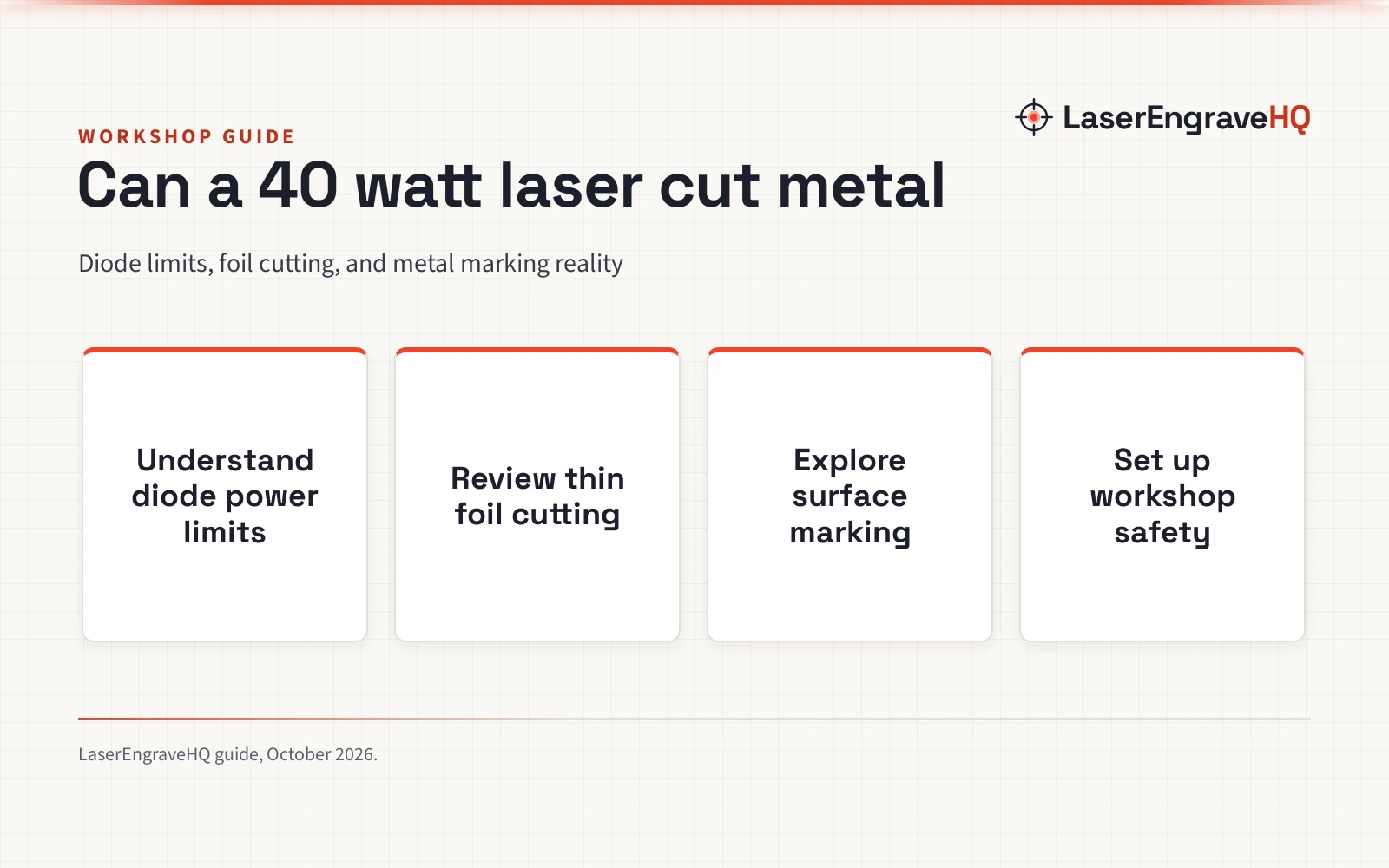
Can a 40 watt laser cut metal? The direct answer is no for structural metal and sheet stock, but yes for ultra-thin stainless steel foil down to 0.15mm (0.006″). A 40W diode laser lacks the beam wavelength and energy density to melt or vaporize thick steel, aluminum, brass, or copper. Instead, makers use a 40W machine primarily to mark bare stainless steel, etch coated metal blanks, and color engrave through surface oxidation. The sections below explain these physical limits step by step so you know exactly what a desktop machine can accomplish in your workshop.
Other machines to compare
 100 Pcs Metal Business Cards for Laser EngravingCheck price on Amazon
 weparmeety 100 Pcs Metal Business Cards Aluminum LaserCheck price on Amazon
 weparmeety 100Pcs 0.45 Metal Business Cards Aluminum LaserCheck price on Amazon
 Brilliance Laser Inks Black Metal Liquid-Ready Laser MarkingCheck price on Amazon
 12 Pcs 0.4mm 304 Stainless Steel Metal Business Card BlankCheck price on Amazon
 50PCS 0.45mm Aluminum Metal Business Cards 3.4X2.13 inchCheck price on Amazon
LaserEngraveHQ earns a commission from purchases made through these links, at no extra cost to you. Read our affiliate disclosure.
Diode lasers have advanced rapidly, but marketing claims often blur the line between surface marking and metal cutting. In desktop engraving, cutting metal means slicing through thin foil stock, not fabricating parts from sheet metal. Treat any claim of cutting solid metal plates with a diode module as marketing exaggeration.
Step 1: Understand diode optical power and wavelength
To understand why metal cutting is difficult for a diode laser, you must look at beam physics. Most desktop machines in the 40W class combine multiple smaller diode emitters into a single beam using combining optics. The maker Longer, for example, lists a 40W optical output module for its desktop machines. Optical output represents actual light delivered to the workpiece, whereas electrical power draw from the wall socket is substantially higher. Confusing optical output with electrical draw is a frequent source of disappointment for new buyers, as detailed in our guide to optical power vs electrical power.
Wavelength matters just as much as raw wattage. Diode cutters operate at a blue wavelength of 450nm. Shiny metals like aluminum, copper, and brass reflect almost all blue light at 450nm, preventing the beam from coupling thermal energy into the material. The beam energy bounces away rather than penetrating the surface. Steel absorbs blue light somewhat better than brass or aluminum, which makes surface marking feasible on stainless steel, but full kerf penetration through thick plates remains physically impossible at 40W.
Step 2: Check published metal cutting thickness limits
When a listing claims that a 40W machine cuts metal, the specification refers to specialized metal shim stock or ultra-thin foil. Longer lists a cutting capacity of 0.15mm (0.006″) stainless steel in a single pass for its 40W module. That thickness equals thin metal foil, comparable to a razor blade edge or craft foil. It is useful for cutting custom stencils, precision shims, or delicate craft inlays, but it cannot produce structural brackets, machine panels, or thick mechanical parts.
Attempting to cut metal thicker than foil leads to failure. Unlike organic materials such as wood or acrylic that vaporize into smoke and ash, metals possess high thermal conductivity. The heat introduced by the laser beam rapidly dissipates outward into the surrounding sheet stock. Instead of melting a clean cut line, the concentrated heat creates intense discoloration, surface bubbling, and severe thermal warping across the workpiece. For broader guidance on material limits, see our reference on metal for laser cutting.
Step 3: What a 40W laser can actually accomplish on metal
Although cutting solid metal plates is off the table, a 40W diode laser is exceptionally capable at surface processing. The high optical density of a focused 40W beam allows makers to perform durable surface marking on stainless steel without applying chemical marking pastes or sprays. The intense heat causes rapid surface oxidation that alters the optical properties of the steel, leaving crisp black marks that resist wear and weathering.
Furthermore, precise control over pulse frequency, travel speed, and focal height enables color engraving on mirrored stainless steel. By heating the steel surface to varying thermal levels, the laser produces controlled oxide layers that reflect distinct colors across the spectrum. A 40W diode unit also excels at vaporizing anodized coatings on aluminum blanks, removing paint from coated brass, and stripping powder coat from stainless steel drinkware. To explore machines designed for these techniques, read our review of the best laser engraver for metal, or see our workshop guide on whether can a diode laser engrave metal.
Step 4: Set up proper workspace ventilation and eye safety
Processing metal blanks on a desktop laser requires careful attention to safety protocols. When vaporizing surface coatings, paints, or residual oils from metal blanks, the process generates fine particulate matter and airborne chemical fumes. Operating indoors without ventilation poses serious air quality concerns. We recommend exhausting fumes directly outdoors with a dedicated blower or routing exhaust air through a certified multi-stage filter, as covered in our guide to the best fume extractor for laser engraver.
Eye protection is equally critical. The 450nm blue light produced by a 40W diode laser presents severe retinal hazards from both direct beam exposure and specular reflections bouncing off shiny metal surfaces. Standard workshop sunglasses or uncertified orange plastic covers provide zero protection. Reliable protection requires safety goggles with an optical density specification that explicitly matches the 450nm blue wavelength band, as outlined in our laser safety glasses guide. Furthermore, never process forbidden plastics such as PVC, vinyl, or ABS, which release corrosive chlorine gas when heated; consult our checklist of materials you should never laser cut.
Step 5: When to step up to fiber or CNC equipment
If your workshop production demands true metal cutting or deep engraving across bare metals, a 40W diode laser is simply the wrong tool for the job. Makers who need to cut sheet metal, fabricate structural brackets, or engrave bare brass, copper, and silver should consider dedicated alternatives.
A pulsed fiber laser delivers a tightly focused infrared beam that couples far more effectively into metal surfaces. While entry-level fiber units excel at high-speed marking and deep relief engraving, high-power industrial fiber systems are required to cut through thick steel plates cleanly. You can evaluate power thresholds in our detailed analysis on whether can a fiber laser cut metal, and browse top metal marking hardware in our guide to the best fiber laser engraver. For cutting structural aluminum plates or brass stock in a home workshop, a desktop CNC router equipped with carbide end mills remains a far more practical and cost-effective solution than any diode laser.
Common mistakes to avoid
- Assuming electrical input draw equals laser cutting capability on metal sheets.
- Attempting to cut through thick metal by running dozens of repeated passes.
- Processing shiny metals like bare copper or brass without understanding beam reflection risks.
- Using uncertified safety glasses that lack verified optical density for blue laser wavelengths.
- Neglecting ventilation when vaporizing protective oils, powder coats, or paint from metal blanks.
Can a 40 watt laser cut metal: the short version
- A 40W diode laser cuts ultra-thin stainless steel foil down to 0.15mm (0.006″), but cannot cut sheet metal or structural metal plates.
- Metals like aluminum, copper, and brass reflect 450nm blue diode light and conduct heat away too fast for kerf penetration.
- A 40W optical module is excellent for surface marking, surface oxidation, and color engraving on stainless steel.
- Always verify optical output rather than electrical power draw when reviewing manufacturer specifications.
- Wear certified eye protection matched to the beam wavelength and maintain active exhaust ventilation during all metal jobs.
- Choose a dedicated fiber laser or workshop CNC router when your projects require true metal cutting.
FAQ: lasers and CNC
Can a 40 watt diode laser cut aluminum or brass?
No. Aluminum and brass are highly reflective to the 450nm blue wavelength of a diode laser, and both metals conduct heat away from the beam rapidly. A 40W diode laser cannot cut aluminum or brass sheets. For cutting non-ferrous metals in a small workshop, a CNC router equipped with proper end mills is the correct tool.
Can a 40 watt laser engrave bare stainless steel without marking spray?
Yes. The concentrated optical power density of a focused 40W diode module generates sufficient heat at the focal point to create permanent dark oxidation marks on bare stainless steel without chemical sprays. Adjusting speed and focal height also produces vibrant color engraving.
What is the thickest metal a 40 watt laser can cut?
Published manufacturer specifications state a single-pass cutting capacity of 0.15mm (0.006″) stainless steel foil. The laser cannot penetrate solid sheet metal, metal brackets, or plate stock.
Can multiple passes allow a 40 watt laser to cut thicker steel?
No. Repeated passes do not succeed on thick metal because steel conducts thermal energy outward across the entire workpiece. The heat dissipates before melting through, causing surface distortion, heavy dross, and severe thermal warping rather than a clean through cut.
Do I need air assist when processing metal on a 40 watt laser?
Yes. Using air assist during metal marking and foil cutting blows away vaporized particles, prevents soot from settling back onto the focal lens, and keeps the beam path clear for consistent energy delivery.
What machine do I need to cut structural metal sheets?
Cutting structural sheet metal requires a dedicated high-power fiber laser cutting system or a plasma cutter. For workshop fabrication of aluminum and soft metals, a rigid CNC milling machine or router is typically the most accessible option.
Related: the laser engraver hub, best laser engraver for metal, best fiber laser engraver and 20W vs 40W diode laser.