Best Build Plate for Petg Bambu (2026)
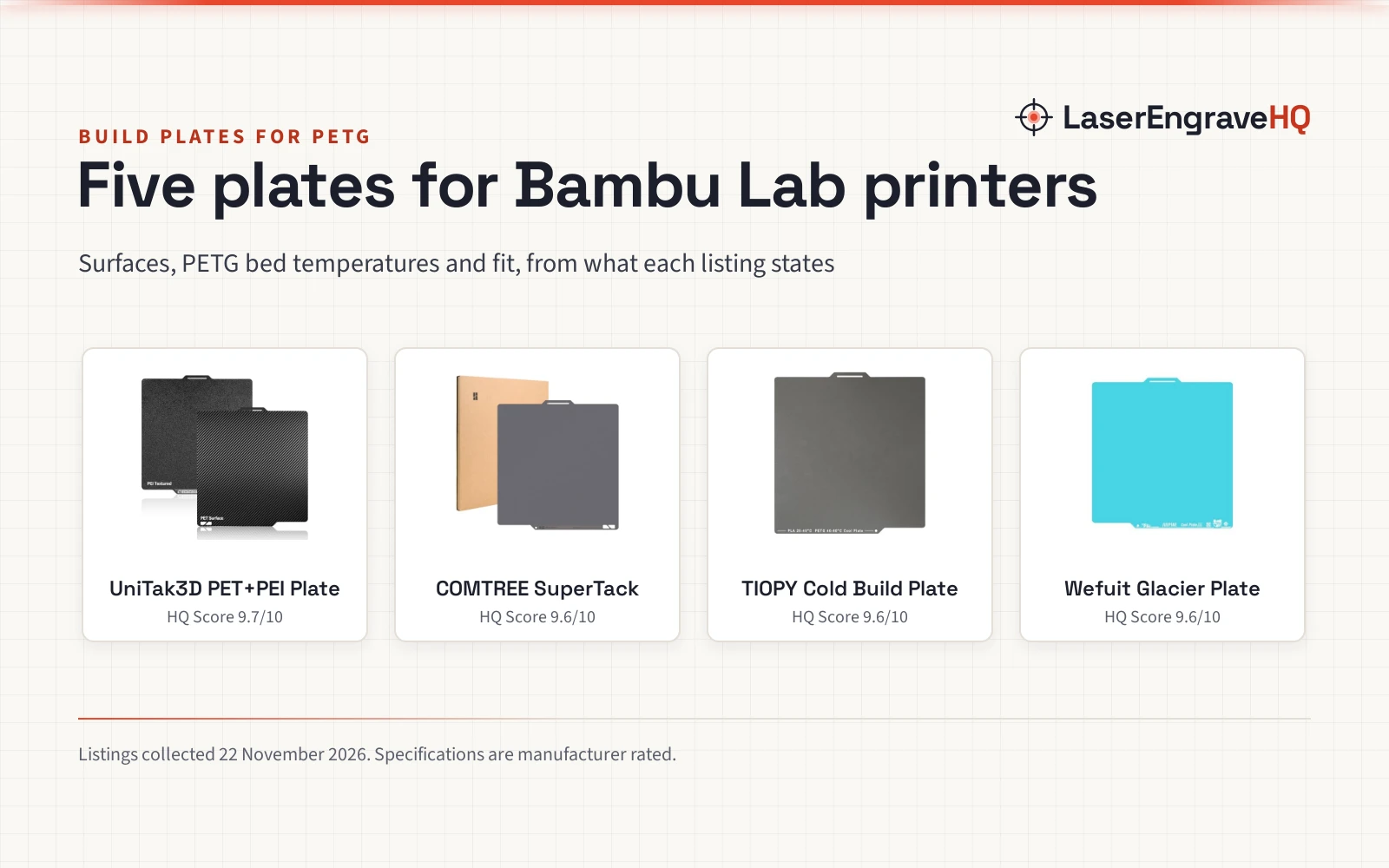
Five build plates for Bambu Lab printers, from a dual-sided PET and PEI plate to cold plates that print PETG at 40 to 60 degrees Celsius, compared by surface, size and bed temperature.

On this page
Top picks at a glance
As an Amazon Associate I earn from qualifying purchases.
- 1
 Best OverallUniTak3D PET+PEI Plate9.7/10View on Amazon
- 2
 Best for PETG at Low HeatTIOPY Cold Build Plate9.6/10View on Amazon
- 3
 Best Long-Life AdhesionCOMTREE SuperTack9.6/10View on Amazon
- 4
 Best for A1 MiniAJOYIB Cool Plate9.5/10View on Amazon
PETG is a forgiving filament until the print lifts at a corner or welds itself to the plate. The right surface holds the print flat through the whole job and lets it pop off clean when the plate cools, with no glue stick and no brim to trim. This guide covers the best build plate for petg bambu, comparing plates with a different surface on each side, cold plates and a SuperTack surface for Bambu Lab printers, so the choice comes down to size, surface and bed temperature.
LaserEngraveHQ earns a commission from purchases made through these links, at no extra cost to you. Read our affiliate disclosure.
Quick picks
- Best Overall UniTak3D PET+PEI Plate: Dual-sided PET and textured PEI at 257 by 257 mm, covering PLA, PETG, ABS, ASA, TPU, nylon, PA and PC, with a QR code for P2S and X2D printers. Check price on Amazon
- Best for PETG at Low Heat TIOPY Cold Build Plate: PETG at 40 to 60 degrees Celsius on a dual-sided cold plate at 257 by 257 mm, with glue-free adhesion. Check price on Amazon
- Best Long-Life Adhesion COMTREE SuperTack: SuperTack coating with less than 20 percent adhesion loss after 300 prints, for PLA and PETG at low bed heat. Check price on Amazon
- Best for A1 Mini AJOYIB Cool Plate: The only plate here stated for the Bambu Lab A1 Mini, at 184 by 184 mm, with PETG at 40 to 60 degrees Celsius. Check price on Amazon
Machines on the list
PET+PEI Build Plate for Bambu Lab
A dual-sided 257 by 257 mm spring steel plate for Bambu Lab printers, with a smooth carbon fiber PET side, a textured PEI side and a QR code for P2S and X2D printers.
Pros
- Textured PEI side covers PLA, PETG, ABS, ASA, TPU, Nylon, PA and PC
- PEI coating withstands up to 300 degrees Celsius
- Smooth PET side leaves a woven carbon texture on the print bottom
- QR code for automatic platform identification on P2S and X2D
Cons
- No PETG bed temperature is stated
- X1 users with QR errors must disable plate position detection
- Bed must be re-leveled when sides change
- Protective film must be peeled from the PET side before the first print
COMTREE Bamboo Original Cool Plate SuperTack
A dual-sided PEI SuperTack plate at 257 by 257 mm for Bambu Lab P1S, P1P, X1C, X1E and A1 printers, for PLA and PETG at low heatbed temperatures.
Pros
- SuperTack coating holds PLA and PETG at extremely low heatbed temperatures
- Less than 20 percent adhesion loss after 300 prints
- Dual-sided PEI gives two print surfaces on one plate
- Smooth matte finish on the bottom of the print
Cons
- TPU filament damages the plate and must not be printed on it
- Bamboo PLA Silk may damage printed models
- No PETG bed temperature figure is stated
- X2D and P2S users must disable plate position detection
Cold Build Plate for Bambu Lab
A dual-sided cold plate at 257 by 257 mm for Bambu Lab printers, for PLA at 25 to 45 degrees Celsius and PETG at 40 to 60 degrees Celsius, with no glue.
Pros
- PETG at 40 to 60 degrees Celsius, PLA at 25 to 45 degrees Celsius
- Dual-sided resin coating gives two print surfaces on one plate
- Glue-free adhesion for PLA and PETG
- Flexible spring steel bends to release prints
Cons
- PLA and PETG only; no ABS, ASA, nylon or PC
- Maximum temperature is 65 degrees Celsius
- Do not clean with IPA or alcohol
- X1C, P2S and X2D users must disable platform detection

Upgraded Build Plate with QR Code Smooth Cool
A smooth cool plate at 257 by 257 mm on a stainless steel base, with a sky-blue textured surface and a QR code.
Pros
- QR code for plate identification, except P2S and X2D
- Lists PLA, TPU, PETG, ABS and nylon
- Stainless steel base, sky-blue textured surface on both sides
- Wipes clean with water or alcohol
Cons
- QR code is not recognized on P2S and X2D models
- No maximum temperature is stated
- Sky-blue color does not transfer to the print bottom
- No warranty term is stated
AJOYIB Cool Plate for A1 Mini 184x184mm
A dual-sided cold plate at 184 by 184 mm for the Bambu Lab A1 Mini, for PLA at 25 to 45 degrees Celsius and PETG at 40 to 60 degrees Celsius, with no glue.
Pros
- Made for the Bambu Lab A1 Mini at 184 by 184 mm
- PETG prints at 40 to 60 degrees Celsius, PLA at 25 to 45 degrees Celsius
- Dual-sided resin coating gives two print surfaces on one plate
- Glue-free adhesion for PLA and PETG
Cons
- Fits only the Bambu Lab A1 Mini
- PLA and PETG only; no ABS, ASA, nylon or PC listed
- Maximum temperature is 65 degrees Celsius
- Do not clean with IPA or alcohol
Specs compared
| Model | HQ Score | Surface | Size | PETG | Materials | QR code | Warranty |
|---|---|---|---|---|---|---|---|
| UniTak3D PET+PEI Plate | 9.7/10 | Smooth PET and textured PEI | 257×257 mm | No temperature stated | PLA, PETG, ABS, ASA, TPU, Nylon, PA, PC | Yes, P2S and X2D | Not stated |
| COMTREE SuperTack | 9.6/10 | Dual-sided PEI, SuperTack | 257×257 mm | Extremely low heatbed temperature | PLA and PETG | Not stated | Not stated |
| TIOPY Cold Build Plate | 9.6/10 | Dual-sided resin coating | 257×257 mm | 40-60 degrees Celsius | PLA and PETG | Not stated | Not stated |
| Wefuit Glacier Plate | 9.6/10 | Sky-blue textured, stainless steel | 257×257 mm | Start at 30 degrees Celsius | PLA, TPU, PETG, ABS, nylon | Yes, except P2S and X2D | Not stated |
| AJOYIB Cool Plate | 9.5/10 | Dual-sided resin coating | 184×184 mm | 40-60 degrees Celsius | PLA and PETG | Not stated | Not stated |
Specs are what each manufacturer publishes as its rating on the listing, collected 22 November 2026.
Cold plates print PETG at low bed heat
Three of the five plates state a PETG bed temperature. The TIOPY and AJOYIB cold plates state PETG at 40 to 60 degrees Celsius, with a stated maximum of 65 degrees Celsius, while the Wefuit plate starts at 30 degrees Celsius and adds 5 degrees Celsius at a time until adhesion holds. The COMTREE SuperTack plate states only an extremely low heatbed temperature for PLA and PETG, and the UniTak3D plate states no bed temperature, only that its textured PEI coating withstands up to 300 degrees Celsius.
Best Build Plate for PETG Bambu: How to Choose
Match the plate size to your printer
Four of the five plates measure 257 by 257 mm, sized for Bambu Lab X1, P1S, P1P, A1 and related models. The AJOYIB plate measures 184 by 184 mm for the Bambu Lab A1 Mini, whose build area is 180 by 180 mm. Check the stated fit against the printer model before ordering.
PETG bed temperature
PETG on the cold plates prints at 40 to 60 degrees Celsius, with a stated maximum of 65 degrees Celsius. The Wefuit plate takes a different approach: start the bed at 30 degrees Celsius and raise it by 5 degrees Celsius at a time until the print holds. The UniTak3D textured PEI side carries a high-temperature powder coating that withstands up to 300 degrees Celsius, which covers PETG as well as ABS, ASA, nylon and PC. The COMTREE SuperTack coating holds PLA and PETG at an extremely low heatbed temperature, with less than 20 percent adhesion loss after 300 prints.
Dual-sided plates and QR codes
Every plate here prints on both sides. The UniTak3D plate pairs a smooth carbon fiber PET side with a textured PEI side, and the COMTREE plate is dual-sided PEI with a SuperTack coating on each side. The TIOPY and AJOYIB plates carry a resin coating on both sides. The UniTak3D plate carries a QR code for automatic platform identification on P2S and X2D printers. The Wefuit plate carries a QR code that is recognized except on P2S and X2D models. The TIOPY listing says to disable print platform detection on X1C, P2S and X2D models; the COMTREE listing says the same for X2D and P2S users.
Cleaning and care
The TIOPY and AJOYIB plates wipe clean with water only; both listings warn against IPA and alcohol. The Wefuit plate wipes with water or alcohol. The COMTREE plate cleans with water and detergent, and the maker warns against organic solvents, especially acetone. The UniTak3D plate needs its protective film peeled from the PET side before the first print, and the maker says to re-level the bed when switching sides and wait for the platform to cool before removing a model.
Project Match
- PETG parts at a low bed temperature: TIOPY Cold Build Plate and AJOYIB Cool Plate, both at 40 to 60 degrees Celsius.
- PETG, ABS, ASA, nylon and PC on one plate: UniTak3D PET+PEI Plate, with a textured PEI side covering that range.
- PETG parts with a smooth matte bottom: COMTREE SuperTack Plate, whose coating gives a smooth matte finish.
- A1 Mini prints: AJOYIB Cool Plate, the only plate here stated for the A1 Mini at 184 by 184 mm.
- TPU prints: UniTak3D PET+PEI Plate and Wefuit Glacier Plate list TPU; the COMTREE plate warns against TPU.
How the scores add up
Each plate is scored out of 10 on performance, build, value, safety and warranty. A spec the listing does not publish scores nothing. No plate here states a warranty term or a safety certification, so those two criteria score zero across the lineup.
| Product | HQ Score | Perf. /35 | Build /25 | Value /25 | Safety /10 | Warranty /5 |
|---|---|---|---|---|---|---|
| UniTak3D PET+PEI Plate | 9.7 | 32 | 22 | 21 | n/a | 0 |
| COMTREE SuperTack | 9.6 | 30 | 21 | 20 | n/a | 0 |
| TIOPY Cold Build Plate | 9.6 | 29 | 21 | 20 | n/a | 0 |
| Wefuit Glacier Plate | 9.6 | 28 | 20 | 20 | n/a | 0 |
| AJOYIB Cool Plate | 9.5 | 28 | 20 | 19 | n/a | 0 |
HQ Scores live on a 9.2 to 9.8 band: each machine’s weighted point total is projected onto it proportionally, and higher totals always show higher. Safety is scored for powered machines and any listing that states safety features; accessories without either are scored over the remaining 90 points.
FAQ: lasers and CNC
What bed temperature should PETG use on a Bambu Lab cold plate?
PETG prints at 40 to 60 degrees Celsius on the TIOPY and AJOYIB cold plates, with a stated maximum of 65 degrees Celsius. The Wefuit plate starts at 30 degrees Celsius and rises by 5 degrees Celsius at a time until adhesion holds. The COMTREE SuperTack plate holds PETG at an extremely low heatbed temperature.
Which build plate fits the Bambu Lab A1 Mini?
The AJOYIB Cool Plate, at 184 by 184 mm, is the plate here stated for the Bambu Lab A1 Mini, whose build area is 180 by 180 mm. The other four plates measure 257 by 257 mm and do not state fit for the A1 Mini.
Do I need glue on a PETG build plate?
No glue is needed on the plates here that state it. The UniTak3D textured PEI side prints PETG with no glue or brims, the TIOPY and AJOYIB cold plates print PLA and PETG without glue sticks, hairspray or tape, and the COMTREE plate holds PETG without adhesive.
Can I print TPU on the COMTREE SuperTack plate?
No. The maker says not to print with TPU filament, as it will damage the build plate. For TPU, the UniTak3D plate lists TPU on both its PET and PEI sides, and the Wefuit plate lists TPU among its materials.
Which plates have a QR code for Bambu Lab printers?
The UniTak3D plate carries a QR code for automatic platform identification on P2S and X2D printers. The Wefuit plate carries a QR code that is recognized except on P2S and X2D models. The TIOPY, AJOYIB and COMTREE plates state no QR code.
How do I clean a cold build plate?
Wipe the TIOPY and AJOYIB plates with clean water only; do not use IPA or alcohol on them. The Wefuit plate wipes with water or alcohol. The COMTREE plate cleans with water and detergent, and the maker warns against organic solvents, especially acetone.
Related: best PETG filament for Bambu A1, best PETG filament for Bambu P1S, best glue stick for 3D printer bed, best smooth build plate for 3D printer and the 3D printers hub.