Best 3d Scanner for Miniatures (2026): 4 Picks Compared
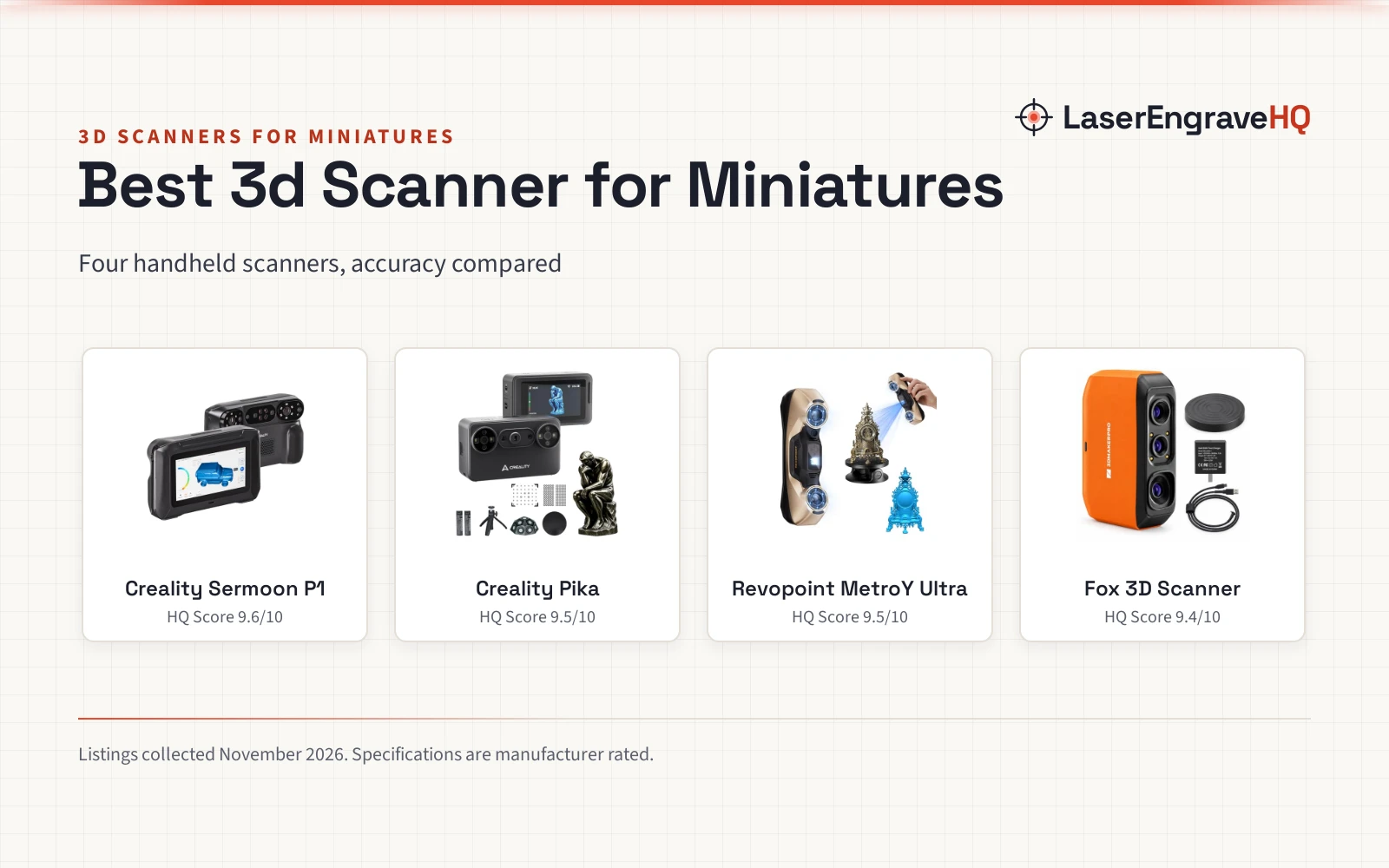
Four handheld 3D scanners compared by accuracy, scan range, speed, weight and export formats, for scanning tabletop miniatures to print.

On this page
Top picks at a glance
As an Amazon Associate I earn from qualifying purchases.
- 1
 Best OverallCreality Sermoon P19.6/10View on Amazon
- 2
 Best PortableCreality Pika9.5/10View on Amazon
- 3
 Best for BeginnersFox 3D Scanner9.4/10View on Amazon
- 4
 For Industrial WorkRevopoint MetroY Ultra9.5/10View on Amazon
A miniature painter wants a figure scanned cleanly enough to print again at the same scale, with the cloak folds and the sword edge intact. The best 3d scanner for miniatures is the one that resolves that fine detail without markers or spray, and exports a clean mesh to the printer. This guide compares four handheld scanners by accuracy, scan range, speed, weight and stated features.
LaserEngraveHQ earns a commission from purchases made through these links, at no extra cost to you. Read our affiliate disclosure.
Quick picks
- Best Overall Creality Sermoon P1: 0.02mm accuracy, 100FPS wired scanning and a built-in PC with 24GB RAM Check price on Amazon
- Best Portable Creality Pika: 0.03mm accuracy in a 260g pocket body with two hot-swappable batteries Check price on Amazon
- Best for Beginners Fox 3D Scanner: 0.07mm accuracy with AI SLAM marker-free tracking and one-click modeling Check price on Amazon
- For Industrial Work Revopoint MetroY Ultra: 0.01mm accuracy with 5 modes and up to 90 FPS Check price on Amazon
Machines on the list
Creality Sermoon P1 3D Scanner with Built-in PC
A standalone scanner with a built-in PC, 0.02mm accuracy and 100FPS wired scanning for CAD, reverse engineering and 3D printing.
Pros
- 0.02mm detail accuracy with 0.02mm + 0.06mm/m volumetric accuracy
- 100FPS wired and 60FPS wireless scanning, up to 1.74 million measurements per second
- Built-in PC with 24GB RAM and 256GB storage, no external computer needed
- Four modes: 22-line crossed blue laser, 7-line parallel laser, single-line blue laser and NIR structured light
Cons
- 1.83 pounds, the heaviest scanner here
- No warranty term is stated
- Scans up to 4000mm, so much of its range sits outside miniature work
- Built for automotive and industrial work, so some modes suit larger jobs than miniatures
Creality Pika 3D Scanner
A pocket-sized wireless scanner with 0.03mm accuracy, 7 parallel blue laser and NIR sources, and two hot-swappable batteries.
Pros
- 0.03mm accuracy with 7 parallel blue laser and NIR sources
- Scans objects from 5mm to 2000mm, from tiny components to large items
- Weighs 260g with a pocket-sized 100 x 60 x 42.5 mm body
- Two hot-swappable 3,350mAh batteries and built-in Wi-Fi 6, no laptop needed
Cons
- The recommended configuration lists 12GB RAM on Android and 32GB RAM on Windows and macOS
- Outdoor scanning to 80,000 lux is not needed for a desktop miniature setup
- AI body completion and retexturing add features a miniature workflow may not use
- Two hot-swappable batteries mean a spare to keep charged
Revopoint MetroY Ultra 3D Scanner, Up to 90 FPS
A blue laser and structured light scanner with 5 modes, up to 90 fps, 0.01 mm single-frame precision and Wi-Fi 6 wireless scanning.
Pros
- 0.01 mm single-frame precision with 0.015 + 0.04 mm x L (m) volumetric accuracy
- 5 scanning modes, including 34 laser cross-lines and a single-line mode for deep holes
- Scans dark, high-gloss and metallic parts without scanning spray
- Outdoor scanning up to 100,000 lux, with Wi-Fi 6 and a 5500 mAh battery grip
Cons
- No warranty term is stated
- No laser class is stated
- 90 fps needs an NVIDIA GPU; CPU scanning runs up to 60 fps
- Battery grip runs about 2.5 hours per charge
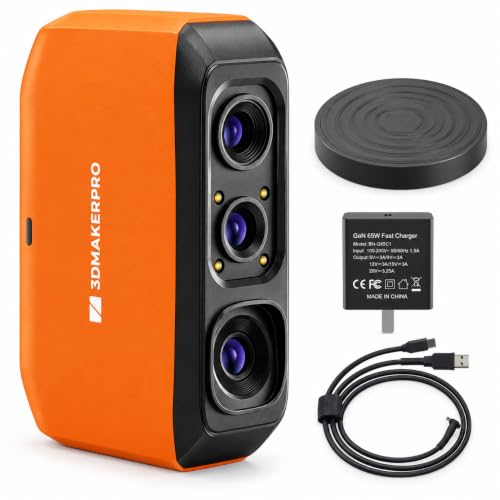
Fox 3D Scanner, 0.07mm Accuracy Portable 3D
A lightweight handheld scanner with 0.07mm accuracy, AI SLAM marker-free tracking and one-click modeling for 3D printing.
Pros
- 0.07mm accuracy with 0.10mm resolution for detailed miniature models
- AI SLAM tracking with marker-free scanning, and quick re-lock if tracking breaks
- Weighs only 210g, the lowest-weight scanner here
- One-click modeling with point cloud alignment, fusion, noise reduction and mesh optimization
Cons
- 0.07mm accuracy is the coarsest here, behind the 0.02mm and 0.03mm picks
- Scan range starts at 40mm, so smaller miniatures fall outside it
- Needs a computer with JMStudio software to scan
- Compatible with Windows 10/11 64-bit and macOS 12/13 only
Specs compared
| Scanner | HQ Score | Accuracy | Scan range | Speed | Weight | Warranty |
|---|---|---|---|---|---|---|
| Creality Sermoon P1 | 9.6/10 | 0.02mm | 5mm to 4000mm | 100FPS wired, 60FPS wireless | 1.83 pounds | Not stated |
| Creality Pika | 9.5/10 | 0.03mm | 5mm to 2000mm | 1-minute full-body scans | 260g | Not stated |
| Fox 3D Scanner | 9.4/10 | 0.07mm | 40mm to 1200mm | Not stated | 210g | Not stated |
| Revopoint MetroY Ultra | 9.5/10 | 0.01mm | Not stated | Up to 90 FPS | Not stated | Not stated |
We give each product’s specs as its manufacturer rates them; listings read 20 November 2026.
How to choose the best 3d scanner for miniatures
Accuracy decides the detail
The MetroY lists 0.01mm, the Sermoon P1 0.02mm, the Pika 0.03mm and the Fox 0.07mm. For a miniature, a finer figure means smaller features survive the scan, so match the figure to the smallest feature you want to keep. The Fox still suits larger figures and prototypes, but fine faces and weapons favor the finer picks. The types of 3D scanners guide explains handheld, desktop and laser scanners.
Scan range starts at the smallest miniature
The Sermoon P1 and the Pika both start at 5mm, while the Fox starts at 40mm. A 5mm start takes tiny components and jewelry-scale pieces, while a 40mm start suits larger figures. Check the smallest piece you plan to scan against the range before you buy.
Speed and tracking
The Sermoon P1 reaches 100FPS wired and 60FPS wireless, and the MetroY lists up to 90 FPS. The Fox uses AI SLAM tracking with marker-free scanning and re-locks if tracking breaks, so no markers or stickers are needed. The Pika adds intelligent anti-shake for stable capture while moving.
Weight, power and the computer
The Fox weighs 210g and the Pika 260g, both light for handheld sessions. The Pika runs on two hot-swappable 3,350mAh batteries with built-in Wi-Fi 6, while the Sermoon P1 carries its own computer with 24GB RAM and 256GB storage. The Fox connects to a computer running JMStudio, so check the system it needs before you buy.
Export to the printer
The Pika exports STL, OBJ, PLY and ASC with one-click export, and the Fox exports OBJ, STL, PLY and ASC too. The Sermoon P1 works with CrealityScan 4 on Windows and macOS. Match the export formats to the software and printer you already use, and see the how to use a 3D scanner guide for beginner steps.
Blue laser and structured light scanners throw bright light at the object. Keep the scanner pointed at the object, never at eyes, and follow the safety notes in the manual that came with your scanner.
Project Match
- Tiny components and jewelry-scale pieces: the Sermoon P1 and the Pika, both starting at 5mm.
- Tabletop miniatures and figurines: the Fox, with marker-free scanning from 40mm to 1200mm.
- Full-body scans and large assemblies: the Sermoon P1, to 4000mm, and the Pika, with 1-minute full-body scans.
- Industrial modeling and measurement: the MetroY, listed for industrial 3D modeling and measurement.
- Reverse engineering and CAD work: the Sermoon P1, with four laser and NIR modes and CrealityScan 4.
How the scores add up
Each scanner is scored on performance, build, value, safety and warranty, with the weights published on our How We Pick page. A spec the listing does not publish scores nothing. No scanner here states a warranty term, and none states a laser class or safety certification, so safety and warranty score nothing across the picks.
| Product | HQ Score | Perf. /35 | Build /25 | Value /25 | Safety /10 | Warranty /5 |
|---|---|---|---|---|---|---|
| Creality Sermoon P1 | 9.6 | 33 | 22 | 21 | 0 | 0 |
| Creality Pika | 9.5 | 30 | 21 | 21 | 0 | 0 |
| Fox 3D Scanner | 9.4 | 28 | 20 | 20 | 0 | 0 |
Point totals are scaled so the weakest reads 9.2 and the strongest 9.8, with everything between kept in order.
FAQ: lasers and CNC
What accuracy do I need to scan miniatures?
The finer the figure, the smaller the detail that survives. The MetroY lists 0.01mm, the Sermoon P1 0.02mm, the Pika 0.03mm and the Fox 0.07mm, so match the figure to the smallest feature you want to keep.
Do I need markers or spray to scan a miniature?
No. The Fox scans marker-free with AI SLAM tracking, and the Pika needs no spray for black or metal objects. The Sermoon P1 also scans dark surfaces without spray.
Can I scan a miniature without a computer?
The Sermoon P1 has a built-in PC with 24GB RAM and 256GB storage, so it runs on its own. The Pika connects to phones or PCs over Wi-Fi 6, and the Fox connects to a computer running JMStudio.
What file formats do these scanners export?
The Pika and the Fox both export OBJ, STL, PLY and ASC. The Sermoon P1 works with CrealityScan 4 on Windows and macOS.
Which scanner is best for the smallest miniatures?
The Sermoon P1 and the Pika both scan from 5mm, the smallest start here. The Fox starts at 40mm, so it suits larger figures.
Related: best 3d printer for dnd minis, best 3d printer for warhammer, 3d scanner for small parts and low cost handheld 3d scanner. Also see the best 3d printer for terrain.