Are 3D Printer Nozzles Universal? Thread and Size Check
Nozzles look alike, but thread, length and bore size vary by printer family, so this guide shows how to check fit before ordering a spare.

On this page
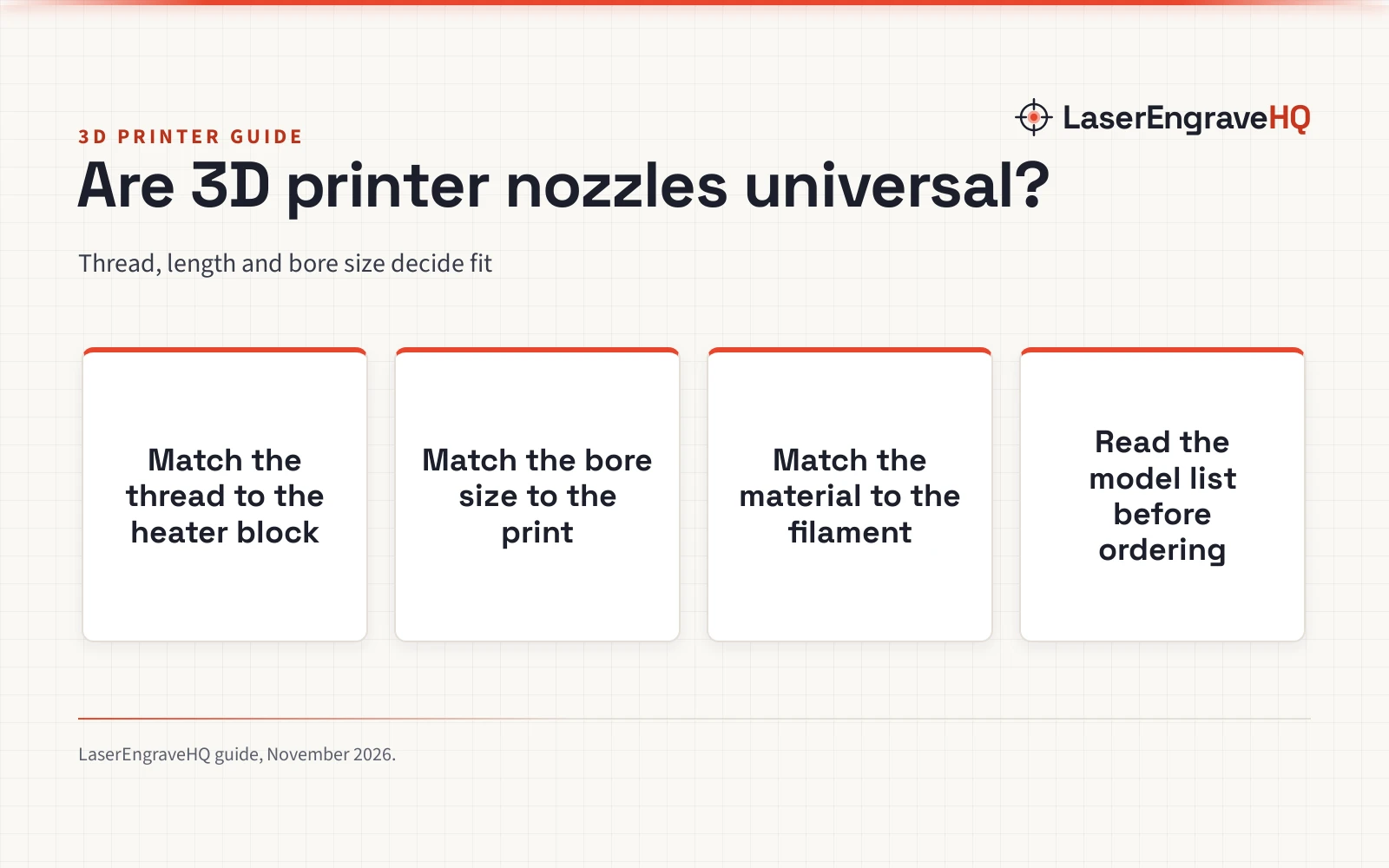
Are 3d printer nozzles universal? No. A nozzle that screws into a Creality K1 (on Amazon) will not always screw into a QIDI or an Ender-3, because the thread, the nozzle length and the bore size differ between printer families. The listings in this guide show why: a Creality K1 kit names K1, K1 Max, Ender 3 V3 KE, CR-10 SE and CR-M4, while a QIDI set names X-Max 3, Q1 Pro, X-Plus 3 and X-Smart 3, and a Lokkr set names MK8 thread for Ender-3 and Prusa i3 machines. Match the thread, the length and the bore size to the printer model before ordering, and the spare has the fit the printer needs.
As an Amazon Associate I earn from qualifying purchases. LaserEngraveHQ earns a commission from purchases made through these links, at no extra cost to you. Read our affiliate disclosure.
Are 3D Printer Nozzles Universal Across Brands?
No, and the model lists on the kits are the clearest sign. A Creality K1 kit names K1, K1 Max, Ender 3 V3 KE, CR-10 SE and CR-M4. A QIDI set names X-Max 3, Q1 Pro, X-Plus 3 and X-Smart 3. A Lokkr set states MK8 thread and names Ender-3, Ender-3 V2, Ender-5 Pro, Ender-5 Plus, Ender-6, Sermoon D1, Ender-3 Max and Prusa i3. The model lists do not overlap, so a nozzle built for a K1 hot end is not the same fit as an MK8 nozzle. Read the model list on the kit, and order the kit that names the printer on the desk. The 3D printer nozzle types guide explains the materials and uses behind each style.
Thread Type Decides Fit
Thread is the part that decides whether a nozzle screws into the heater block at all. The Lokkr set states MK8 thread and names Ender-3, Ender-3 V2, Ender-5 Pro, Ender-5 Plus, Ender-6 and Prusa i3 machines, plus E3D and MK8 heating blocks. The Creality K1 kit names a different family: K1, K1 Max, Ender 3 V3 KE, CR-10 SE and CR-M4. The QIDI set names QIDI X-Max 3, Q1 Pro, X-Plus 3 and X-Smart 3. When the model list on a kit does not name the printer on the desk, look for a kit that does, and check the heater block too, since the block and the nozzle thread work as a pair. The 3D printer hot end parts guide shows how nozzles and heater blocks sit together.
Length and Bore Size Matter Too
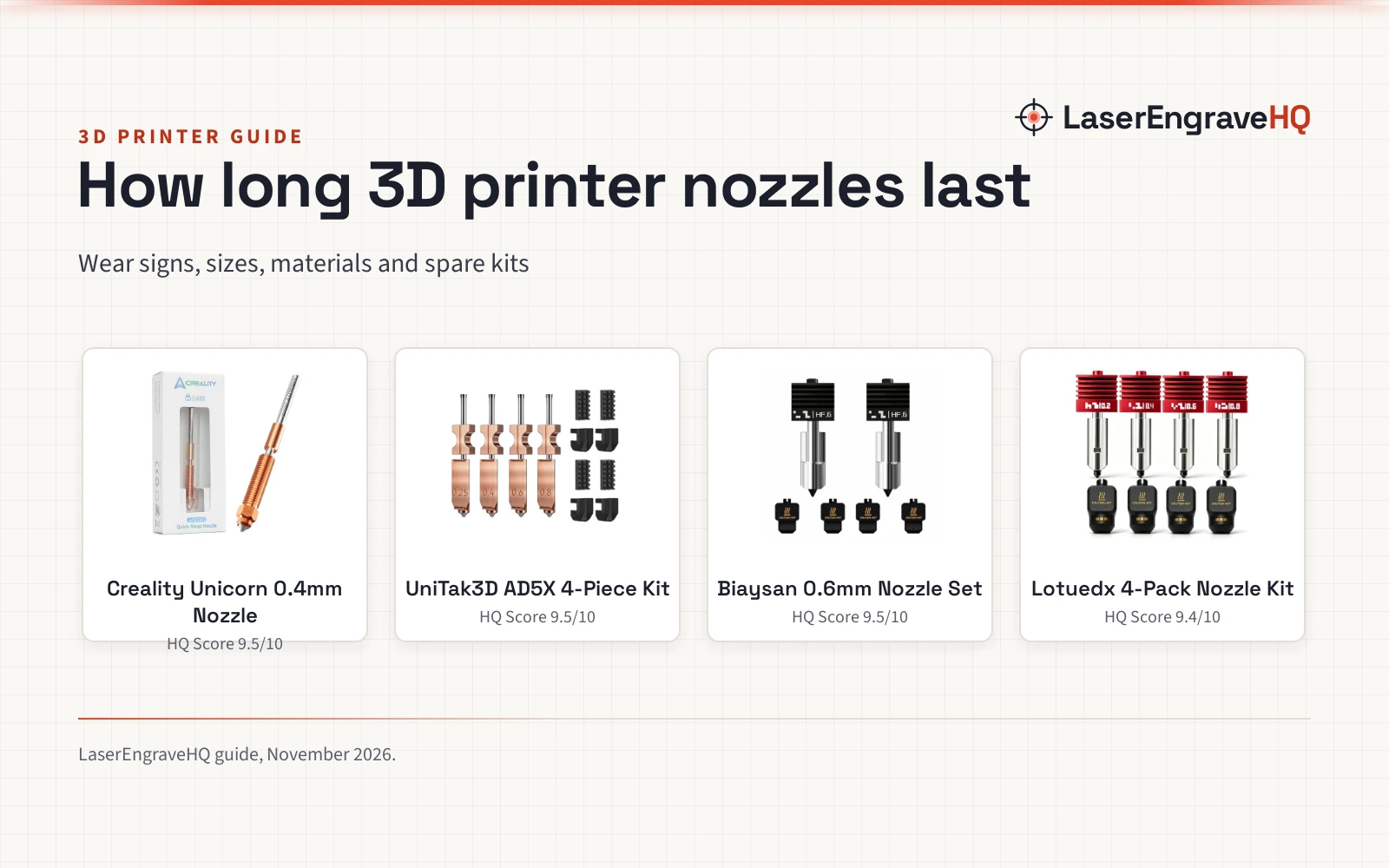
Even with the right thread, a nozzle of the wrong length changes how far the tip sits below the heater block, and the wrong bore size changes how wide each line of plastic comes out. The Creality kit lists 0.25mm, 0.4mm, 0.6mm and 0.8mm bores, and the QIDI set states a 1.75mm input diameter with a 0.4mm output diameter. A 0.4mm bore is the size in every kit in this guide, and it suits general printing. A 0.25mm bore lays down finer lines for small detail, while a 0.8mm bore lays down wider lines for coarser work. Pick the bore size from the print, not from habit, and match the filament size to the input diameter the set states. The filament size guide explains which filament size to buy, and the nozzle temperature guide covers temperature by filament type.
Nozzle Material and Filament
Brass, hardened steel and stainless steel all appear in these kits, and the maker of each kit names the filaments it suits. The brass K1 kit lists PLA, ABS, PETG, TPE, TPU and PC, and the maker states better thermal conductivity and high hardness. The hardened steel QIDI set lists PLA and ABS, and the maker states resistance to high temperature and wear, with a smooth inner wall and precise control of printing speed. The stainless steel Lokkr set states better thermal conductivity and higher hardness than brass, with a smooth inner wall for smoother filament flow. Match the material to the filament: a standard brass nozzle suits plain PLA and ABS, while the hardened steel set states resistance to high temperature and wear. When a kit does not name the filament, do not guess from the material alone.
How to Check Fit Before Ordering
Run through these checks in order, and order only when each one matches:
- Find the printer model on the printer or in its manual, then read the model list on the kit.
- Match the thread name, such as MK8, to the heater block.
- Match the bore size, such as 0.4mm, to the print.
- Match the filament, such as PLA or PETG, to the nozzle material.
- Check what the kit holds: a Lokkr kit holds 10 nozzles, 5 cleaning needles and 1 wrench, while a QIDI 17-piece set holds 10 nozzles, 5 cleaning needles, 1 protective tube and 1 curved tweezers.
When a nozzle needs swapping, the how to change a 3D printer nozzle guide walks through the swap.
Common Mistakes to Avoid
- Ordering by bore size alone and ignoring thread.
- Assuming a K1 nozzle fits an MK8 heater block.
- Picking a 0.8mm bore for tiny detail work.
- Skipping the model list on the kit.
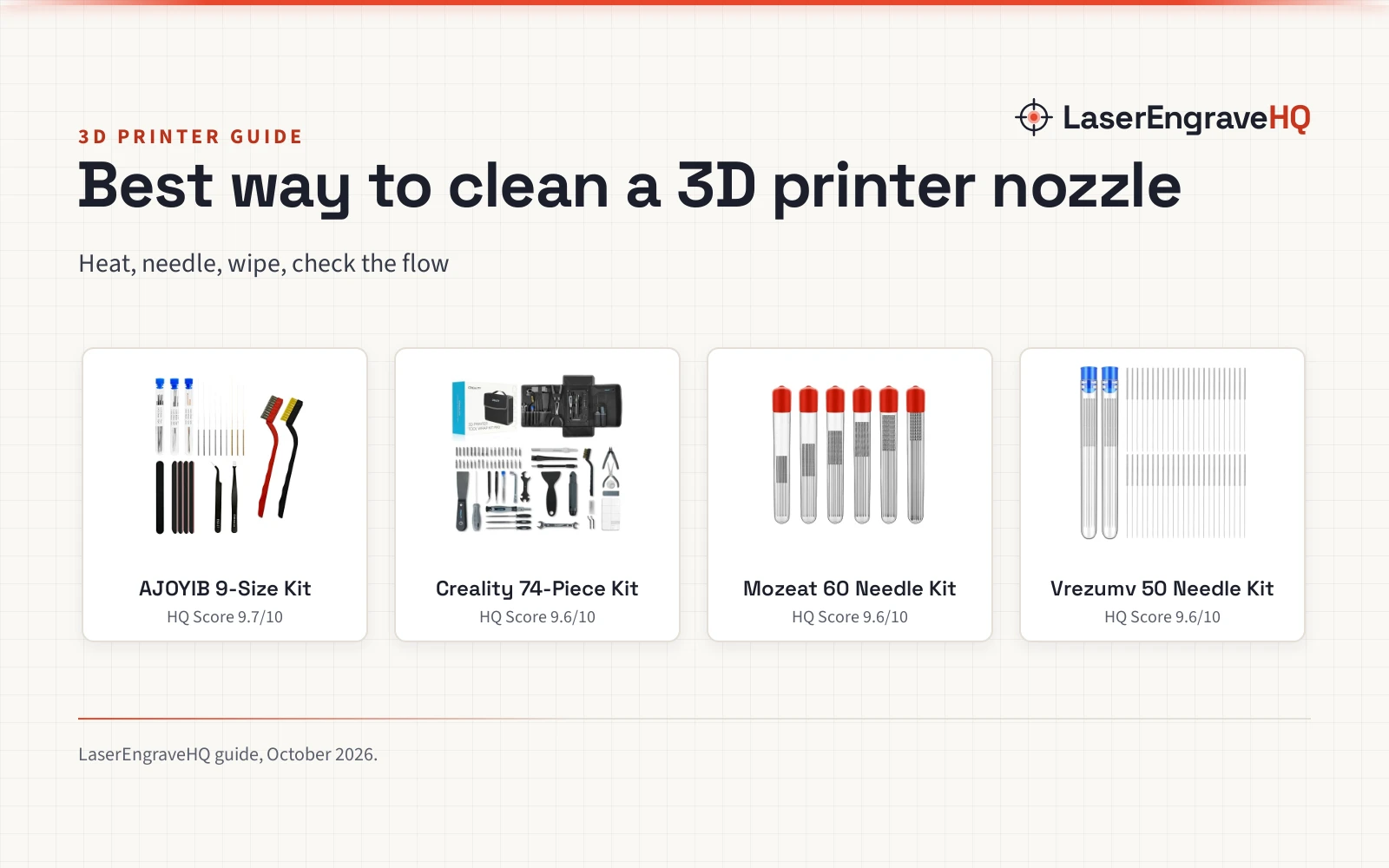
- Ordering a kit without cleaning needles and a wrench, then finding the old nozzle clogged and no cleaning needle in the box.
Are 3d printer nozzles universal: the short version
- No, nozzles are not universal across printer families.
- Thread decides fit: MK8, K1-style and QIDI sets name different printers.
- Bore size decides line width: 0.25mm, 0.4mm, 0.6mm and 0.8mm appear in the Creality kit.
- Input diameter matters: the QIDI set states 1.75mm in and 0.4mm out.
- Material follows filament: brass, hardened steel and stainless steel kits name PLA, ABS, PETG, TPE, TPU and PC.
- Read the model list on the kit before ordering.
FAQ: lasers and CNC
Can a Creality K1 nozzle fit a QIDI printer?
No. The K1 kit names Creality K1, K1 Max, Ender 3 V3 KE, CR-10 SE and CR-M4, while the QIDI set names QIDI X-Max 3, Q1 Pro, X-Plus 3 and X-Smart 3. The model lists do not overlap, so order the kit that names the printer on the desk.
What bore size suits general printing?
A 0.4mm bore. Every kit in this guide holds a 0.4mm nozzle, and the Creality kit also lists 0.25mm, 0.6mm and 0.8mm for finer or wider lines.
Does nozzle material matter?
Yes. The brass K1 kit lists PLA, ABS, PETG, TPE, TPU and PC. The hardened steel QIDI set states resistance to high temperature and wear, and the stainless steel Lokkr set states higher hardness than brass. Pick the material from the filament the printer runs.
How to Tell the Thread Type of a Nozzle?
Read the kit listing. The Lokkr set names MK8 thread and lists Ender-3, Ender-3 V2, Ender-5 Pro, Ender-5 Plus, Ender-6, Sermoon D1, Ender-3 Max and Prusa i3. If a listing does not name the thread, match by the printer model list instead.
What comes in a nozzle kit?
It varies. A Lokkr kit holds 10 nozzles at 0.4mm, 5 cleaning needles and 1 wrench. A QIDI 17-piece set holds 10 nozzles at 0.4mm, 5 cleaning needles, 1 protective tube and 1 curved tweezers. Read the package list before ordering, since a kit without cleaning needles holds nothing to clear a clog.
Related: the 3D printer hub, 3D printer nozzle types and how to change a 3D printer nozzle. Also see how long 3D printer nozzles last. Also see best way to clean a 3D printer nozzle.