RF vs Glass Tube CO2 Laser: Differences Explained
A practical guide comparing RF metal tubes and DC glass tubes for CO2 lasers, covering beam quality, lifespan, cooling, costs and workshop setup.

On this page
Top picks at a glance
As an Amazon Associate I earn from qualifying purchases.
- 1
 OMTech 100W CO2 Laser Engraver with 4 Way Pass Through Air9.7/10View on Amazon
- 2
 xTool P2S 55W CO2 Laser Cutter9.7/10View on Amazon
- 3
 OMTech K40+ 45W Desktop CO2 Laser Engraver & Cutter 12" × 8"9.6/10View on Amazon
- 4
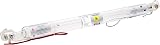 TEN-HIGH 40W CO2 Laser Tube 700mm D50mmView on Amazon
- 5
 SenTECH 40W CO2 Glass Laser Tube 700mm Length Dia 50mm forView on Amazon
- 6
 12 Colors Laser Marking Paper for CO2 Diode Engraver GlassView on Amazon
- 7
 TEN-HIGH 60W CO2 Laser Tube 1000mm D50mmView on Amazon
- 8
 Phillips Safety Laser Safety Glasses for Co2/EximerView on Amazon
- 9
 FreeMascot OD 6+ 9000nm-11000nm / 10600nm Wavelength CO2View on Amazon
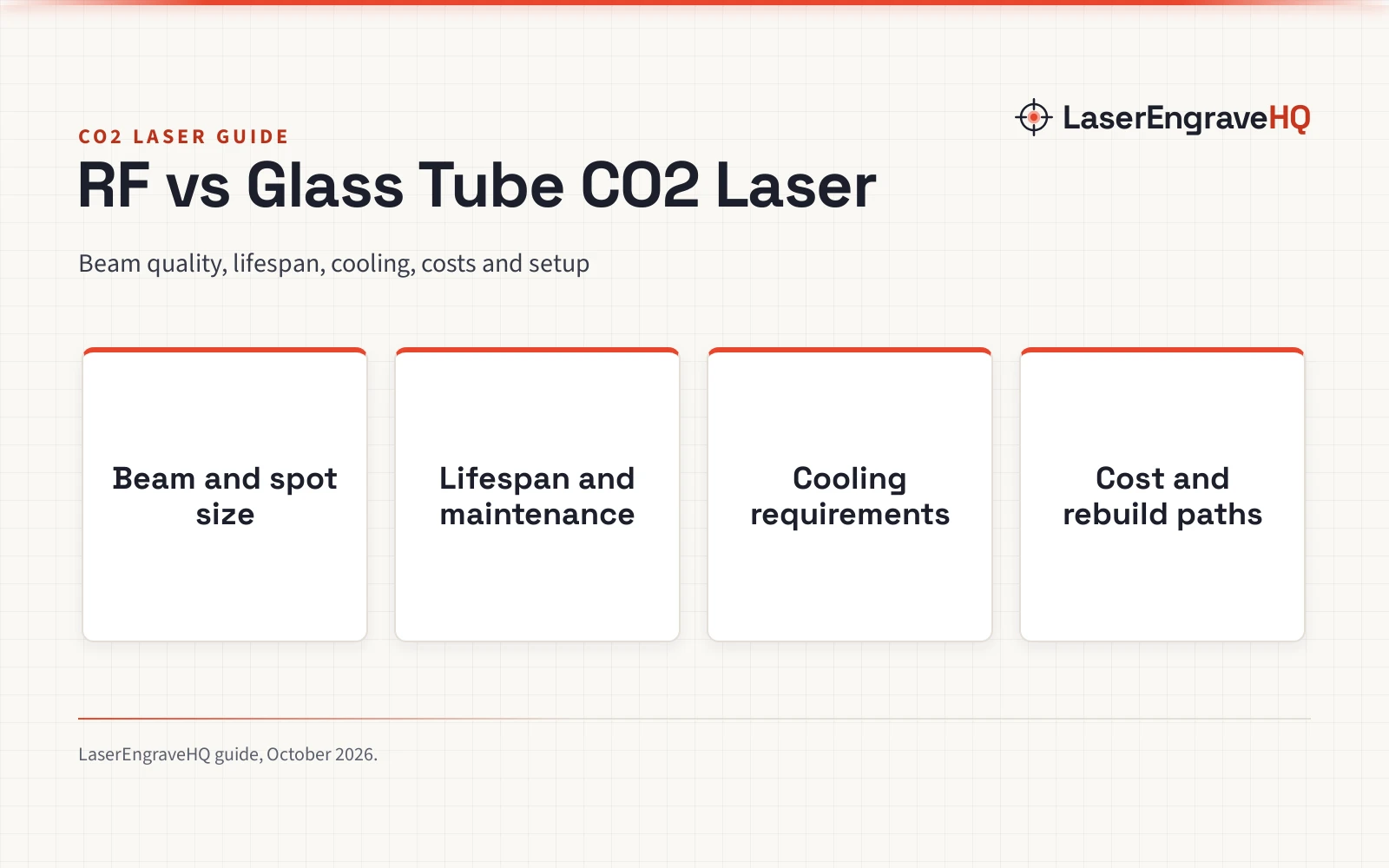
The core difference in an RF vs glass tube CO2 laser comes down to beam quality, lifespan, cooling and cost: radio-frequency (RF) all-metal tubes deliver a finer, faster-pulsing beam with multi-year durability and optional air cooling at a high initial price, while direct-current (DC) glass tubes provide high cutting wattage at a fraction of the upfront cost but rely on fragile glass envelopes, continuous water cooling and regular tube replacements. The sections below compare both technologies step by step across optical performance, service life and workshop requirements.
Other machines to compare
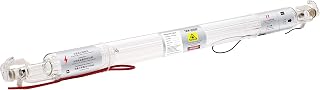 TEN-HIGH 40W CO2 Laser Tube 700mm D50mmCheck price on Amazon
 SenTECH 40W CO2 Glass Laser Tube 700mm Length Dia 50mm forCheck price on Amazon
 12 Colors Laser Marking Paper for CO2 Diode Engraver GlassCheck price on Amazon
 TEN-HIGH 60W CO2 Laser Tube 1000mm D50mmCheck price on Amazon
 Phillips Safety Laser Safety Glasses for Co2/EximerCheck price on Amazon
 FreeMascot OD 6+ 9000nm-11000nm / 10600nm Wavelength CO2Check price on Amazon
LaserEngraveHQ earns a commission from purchases made through these links, at no extra cost to you. Read our affiliate disclosure.
Commercial RF metal tube laser cutters are industrial systems that command substantial capital investments. Glass tube CO2 lasers remain the dominant choice for hobbyists and small businesses because replacement tubes and matching power supplies are readily available as modular components.
Step 1: Understand how beam generation and excitation differ
In a standard DC glass tube, carbon dioxide, nitrogen and helium are sealed inside a borosilicate glass chamber. Applying high direct-current voltage between an internal cathode and anode creates an electrical discharge. Published listings reflect these electrical demands: the Cloudray CR35 listing states a 13KV triggering voltage and 9KV working voltage, while the MCWlaser M60 specifies a 25KV trigger voltage, and the OMTech 60W tube operates at 18kV and 4mA. Because electrodes sit directly within the gas, continuous arc discharge gradually erodes the metal, contaminating the gas over time.
An RF metal tube uses electrodes excited by radio-frequency energy to excite gas inside an all-metal or ceramic sealed cavity. With no internal electrodes exposed to discharge, gas contamination from sputtering is eliminated. RF systems run on low-voltage DC power supplies, converting input to radio frequencies within an enclosed driver rather than routing tens of kilovolts across the chassis.
Step 2: Compare spot size and engraving resolution
Beam quality determines how fine a focal spot laser optics can produce on your workpiece. Most quality CO2 tubes target a TEM00 mode output for high center energy concentration. Published specifications for glass tubes from TEN-HIGH, Cloudray and MCWlaser highlight TEM00 mode output, while the OMTech 60W listing notes a 4 mm beam spot at its output lens.
An RF metal tube produces a consistent Gaussian profile with lower divergence over distance. When focused through identical optics, an RF beam converges to a tighter, more symmetrical spot than a typical glass tube. For raster engraving, this smaller spot size allows higher lines per inch, producing crisper typography and cleaner photo engraving on organic materials. A glass tube beam exhibits higher divergence, causing subtle spot elongation across large beds. Makers evaluating fine marking trade-offs often consider similar spot size factors in our guide comparing a diode vs CO2 laser.
Step 3: Evaluate lifespan and rebuild options
Operating longevity is a primary distinction between tube designs. In DC glass tubes, photochemical gas breakdown and electrode erosion occur during every firing cycle. Glass tubes also experience shelf degradation because helium slowly permeates through glass-to-metal seals. The Cloudray CR35 listing specifically notes that CO2 laser tubes are consumable items where prolonged storage results in power attenuation.
Published specifications illustrate expected service life across tiers. The MCWlaser M40 listing cites a 3,000 hours service life, while the MCWlaser M60 cites 4000+ Hours. OMTech lists a 6,000 hour service life for its 60W replacement tube, and premium RECI glass tubes from Cloudray and MCWlaser cite a 10,000 hours lifespan. When a glass tube fails, it must be replaced. For details on degradation, see our guide on how long CO2 laser tubes last.
In contrast, RF metal tubes feature hermetic metal-to-metal or ceramic seals that minimize gas leakage for multi-year industrial operation. When an RF tube eventually loses power, the metal body can be sent to a specialized rebuilder to be cleaned, refilled with fresh gas and resealed at a fraction of replacement cost.
Step 4: Check cooling requirements and workshop space
Thermal management is another major operational difference. DC glass tubes convert significant electrical input into waste heat that must be removed by circulating liquid through an outer water jacket. The MCWlaser M60 listing states that a 2-4L/min flow rate is required from a water cooling system. Maintaining circulation requires submersible pumps or refrigeration units, detailed in our guide to the CO2 laser water chiller explained.
Many low and mid-wattage RF tubes use integrated heat sinks and forced-air fans directly on their aluminum chassis, eliminating water reservoirs and chillers. High-wattage industrial RF units still use liquid cooling loops, but circulate fluid through durable metal housings rather than fragile glass.
Physical dimensions also affect workshop layout. Glass tube length scales directly with wattage: a TEN-HIGH 40W tube measures 700mm in length with a 50mm diameter, an MCWlaser M60 tube measures 1000mm with a 55mm diameter, a Cloudray 90W tube reaches 1250mm with an 80mm outer diameter, and an MCWlaser RECI 100W W4 tube reaches 1400mm. Accommodating these long tubes requires an extended machine cabinet. RF tubes use folded waveguide resonators in a compact metal block, fitting comparable power into a fraction of the length.
Step 5: Account for pulsing speed and power modulation
Pulsing performance defines how quickly a laser switches on and off during engraving. A DC glass tube relies on striking and extinguishing an electrical arc, creating a measurable firing latency. At high carriage speeds, a glass tube struggles to fire individual micro-dots rapidly enough, resulting in softened edges and overburned margins as the carriage changes speed.
RF metal tubes pulse instantaneously via radio-frequency modulation. Rapid rise and fall times allow precise bursts of energy at high carriage travel speeds, producing sharp vector transitions, clean dithering and consistent depth. Furthermore, while glass tubes require substantial strike voltage and struggle to fire consistently at low output percentages, RF tubes maintain stable firing down to low power levels, making them well suited for delicate paper, textile and thin veneer marking.
Step 6: Weigh upfront machine cost against long-term maintenance
Your workshop budget and production schedule will determine the right choice. Glass tube machines, such as those in our CO2 laser cutters section, feature a low barrier to entry. Replacement tubes are readily accessible from manufacturers like TEN-HIGH, Cloudray, MCWlaser and OMTech. Stated warranty coverage reflects this replacement cycle: TEN-HIGH offers a 3 months warranty, Cloudray provides 4 months on its CR35, MCWlaser provides a 6-Month warranty on its M60, OMTech includes a 9 month warranty, and RECI tubes from Cloudray and MCWlaser carry an 18 Months warranty.
RF metal tube machines require a larger upfront capital investment. For full-time production environments running multiple shifts daily, an RF system repays its cost through faster raster engraving speeds, reduced cooling maintenance on air-cooled units, multi-year operating durability and the ability to regas the core rather than purchasing replacement tubes.
Regardless of tube technology, observe strict material safety. Never laser PVC, vinyl, PVC-based faux leather, polycarbonate or ABS. Under laser heat, PVC and vinyl release toxic hydrogen chloride gas, while polycarbonate and ABS emit heavy soot and hazardous airborne compounds that damage optics and guide rails. Review our complete guide to materials you should never laser cut before loading unfamiliar blanks.
Common mistakes to avoid
- Choosing an oversized glass tube for raw cutting power when your core work is fine raster engraving.
- Running a DC glass tube without a flow sensor and temperature monitoring on the water loop.
- Storing spare glass tubes on a workshop shelf for extended periods, risking shelf power attenuation.
- Underestimating the cabinet clearance required to mount long glass tubes.
- Expecting a glass tube to fire cleanly at very low power percentages without losing arc stability.
RF vs glass tube CO2 laser: the short version
- RF tubes use all-metal sealed cavities excited by radio frequencies; glass tubes use high-voltage DC discharge through borosilicate glass.
- RF tubes produce a tighter, symmetrical beam spot suited for detailed engraving; glass tubes offer strong cutting power at lower initial cost.
- RF tubes run for multiple years and can be regassed; glass tubes are consumable items with figures ranging from 3,000 hours to 10,000 hours in published listings.
- Many RF tubes are air-cooled; glass tubes require continuous water cooling to prevent thermal fracture.
- RF tubes pulse rapidly with instant response; glass tubes experience firing latency during rapid raster moves.
- Glass tube systems dominate entry-level budgets; RF machines are commercial production investments.
Everything after that comes down to production volume: hobbyists and light craft shops achieve great results with glass tubes, while production facilities running daily engraving batches benefit from the speed and durability of RF metal sources.
FAQ: lasers and CNC
What is the main difference between an RF tube and a glass tube CO2 laser?
An RF tube uses an all-metal chamber excited by radio-frequency power, producing a finer beam, rapid pulsing and multi-year durability. A glass tube uses a borosilicate glass envelope excited by high-voltage DC, requiring water cooling and regular replacement but offering high cutting power at lower initial cost.
Do RF CO2 lasers require water cooling?
Many low and mid-wattage RF metal tubes use integrated heat sinks with forced-air fans, eliminating water cooling maintenance. High-power industrial RF lasers use liquid cooling loops through durable metal housings rather than glass envelopes.
Can a depleted RF laser tube be recharged or regassed?
Yes. Specialized facilities can open, clean, refill with fresh gas mixture and reseal metal RF tubes. Depleted glass tubes cannot be regassed and must be replaced.
How long do glass CO2 laser tubes last?
Service life depends on build quality, current and cooling maintenance. Published listings show figures from 3,000 hours on the MCWlaser M40 tube, 4000+ Hours on the MCWlaser M60, 6,000 hour on the OMTech 60W, up to 10,000 hours on RECI tubes from Cloudray and MCWlaser.
Why do glass tube CO2 lasers cost less upfront?
Glass tubes use standard blown borosilicate glass and basic internal electrodes, which are economical to produce compared to precision-machined metal chambers and RF electronics.
Which tube type is better for engraving fine photo details?
An RF tube is superior for detailed photo engraving. Its symmetrical Gaussian beam and instant pulse modulation create crisp micro-dots without the firing delay and spot divergence typical of DC glass tubes.
Related: the best CO2 laser cutter for home use, our guide on what is a CO2 laser engraver and the CO2 laser maintenance checklist. Also see our how to align mirrors on a CO2 laser. Also see our best laser engraver for small business.