Flying Optics vs Moving Material Laser Cutter: Which One Should You Buy?
Flying optics vs moving material laser cutter: flying optics moves the head over fixed material, moving material moves the bed under a fixed head. How they compare on speed, precision and work size.

On this page
Top picks at a glance
As an Amazon Associate I earn from qualifying purchases.
- 1
 xTool P3 80W Flagship CO2 Laser Cutter with Intelligent9.7/10View on Amazon
- 2
 OMTech Maker 90W CO2 Laser Engraver & Cutter with Water9.6/10View on Amazon
- 3
 OMTech K40+ 45W Desktop CO2 Laser Engraver & Cutter 12" × 8"9.6/10View on Amazon
- 4
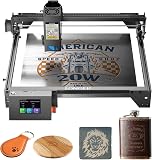 Longer New Upgrade RAY5 Laser Engraver CutterView on Amazon
- 5
 ACMER S2 Laser EngraverView on Amazon
- 6
 Ortur R1 5000mW Portable Laser Engraver and CutterView on Amazon
- 7
 LONGER B1 48W Laser Cutter and EngraverView on Amazon
- 8
 Twotrees TTS-20 Max 20000mW Laser Engraver and Cutter MachineView on Amazon
- 9
 ATOMSTACK Swift 12W Laser Engraver Cutter for Wood & MetalView on Amazon
Flying optics vs moving material laser cutter, the direct answer: flying optics moves the laser head over material that stays put, which is how nearly every desktop gantry machine works, while moving material designs keep the head fixed and move the work or the bed beneath it. For most buyers the choice is already made, because the machines in the listings are all flying optics gantries, but the difference matters when you compare machine types. This guide explains both designs step by step, with figures from real listings.
Other machines to compare
 Longer New Upgrade RAY5 Laser Engraver CutterCheck price on Amazon
 ACMER S2 Laser EngraverCheck price on Amazon
 Ortur R1 5000mW Portable Laser Engraver and CutterCheck price on Amazon
 LONGER B1 48W Laser Cutter and EngraverCheck price on Amazon
 Twotrees TTS-20 Max 20000mW Laser Engraver and Cutter MachineCheck price on Amazon
 ATOMSTACK Swift 12W Laser Engraver Cutter for Wood & MetalCheck price on Amazon
LaserEngraveHQ earns a commission from purchases made through these links, at no extra cost to you. Read our affiliate disclosure.
flying optics vs moving material laser cutter: the short version
- Flying optics: the laser head rides a gantry and moves over fixed material. Every diode machine in the listings works this way: the Longer RAY5 covers a 15.75 by 14.37 inch area at up to 24,000mm/min, and the ATOMSTACK Swift lists 400mm/s engraving.
- Moving material: the head stays fixed and the bed or the workpiece moves. Less common in lasers, more familiar from CNC routers, where the gantry or table motion is the whole machine.
- Precision lives in the motion system either way: the ACMER S2 lists 0.01mm precision and the ATOMSTACK Swift 0.06mm accuracy on flying optics gantries, so the design alone does not decide accuracy.
How flying optics works
In a flying optics machine, mirrors or the laser module itself travel on rails while the material lies still on the bed. On the diode gantries in the listings the module itself rides the rails, so the beam is generated at the head and there is no separate beam path to manage; on mirror-based CO2 machines the beam path does change length as the head moves, which their optics are designed to handle. Either way, the work never shifts, so registration stays put across long jobs. This is the standard layout for desktop diode lasers and enclosed gantry machines: the Longer RAY5, the LONGER RAY5 with its 400 by 400mm area, the ACMER S2 at 300 by 300mm and the Ortur R1 all move the head over a fixed bed.
The strengths are simplicity and scale. The material can be as heavy or awkward as the bed allows, because nothing has to move it, and the work area is whatever the gantry spans: 15.75 by 14.37 inches on the Longer RAY5 and 400 by 400mm on the LONGER RAY5. Speeds are high because only the light head moves: 24,000mm/min on the Longer RAY5, which is 400mm/s on the ATOMSTACK Swift, the same speed in different units. The weakness is moving mass at the extremes: a heavy gantry is harder to accelerate precisely, which is why the precision figures, 0.01mm on the ACMER S2 and LONGER RAY5, 0.06mm on the ATOMSTACK, 0.05mm on the Ortur R1, describe the motion system as much as the laser.
How moving material works
In a moving material design, the laser head is fixed and the bed carrying the workpiece travels beneath it. You see this layout more often in CNC routers than in lasers: the machine in our CNC router vs laser engraver comparison moves the work or the gantry together, and the same mechanics apply. The beam path stays constant, which is optically ideal, since nothing in the delivery changes during the job.
The strengths are a rock-steady beam and simple optics. The weaknesses are practical: now the machine must move the weight of the material plus the bed, so heavy stock slows the job and wears the motion parts, and the footprint grows because the bed has to travel its full range in the cabinet. That is why the laser market settled on flying optics for desktops: moving the light head costs less, runs faster and stays more compact than moving the work.
Which design fits your work
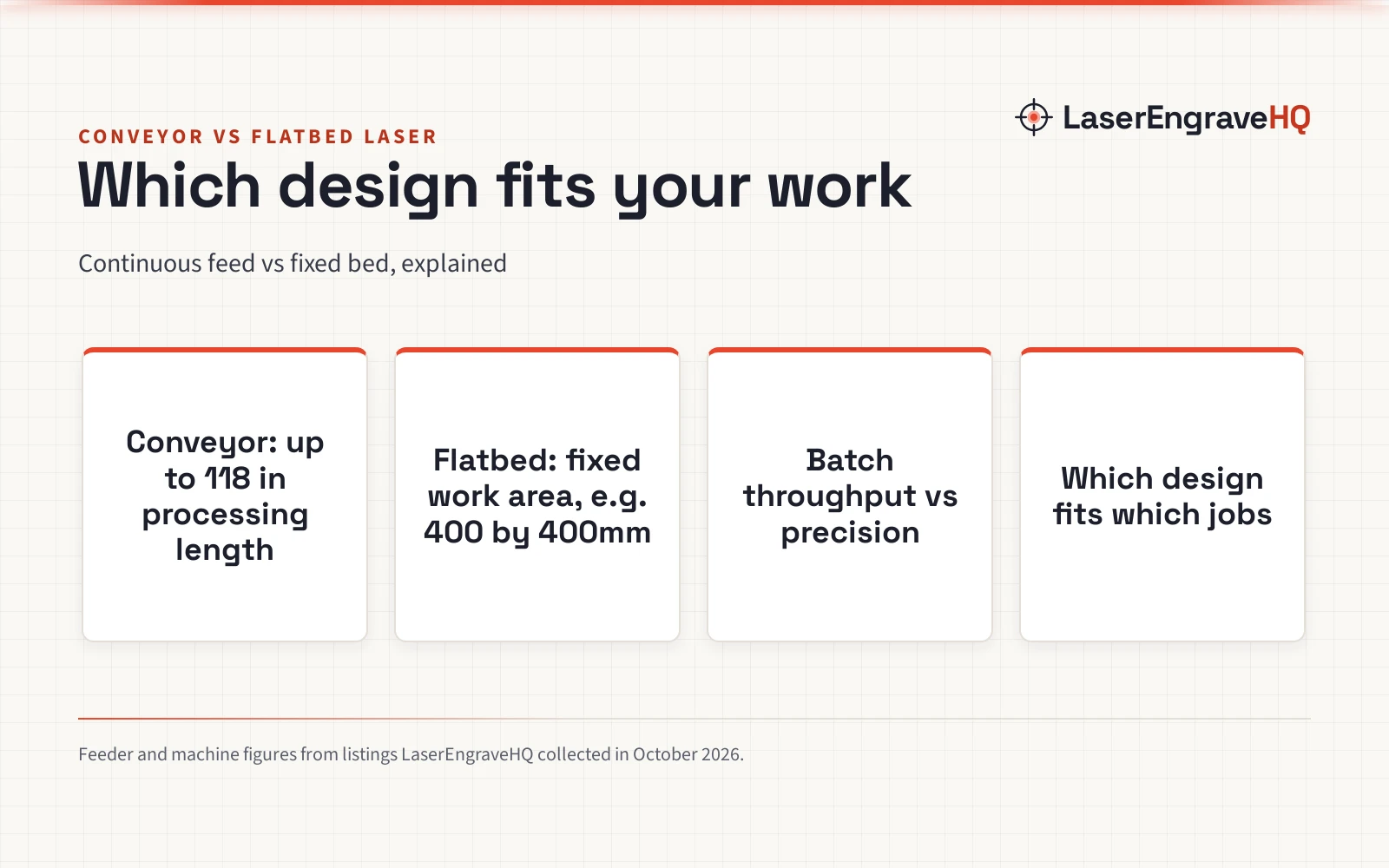
For engraving and cutting sheet goods, pick flying optics: it is what the listings sell, it handles full beds without moving them, and the speeds, up to 24,000mm/min on the examples here, suit production-style batch work. Compare precision figures between machines rather than between designs, since 0.01mm on one gantry beats 0.06mm on another regardless of layout.
Moving material matters when the process itself is the constraint: work where a fixed beam path is worth the mechanical cost, or machines built around a moving table, as in many CNC routers. If you are choosing between a laser and a mill for the same job, our CNC router vs laser engraver guide walks through that call, and choosing a laser engraver covers the buying decisions that matter more than the motion layout. For the enclosure question that affects both designs, see open frame vs enclosed machines.
FAQ: lasers and CNC
Are most laser engravers flying optics?
Yes. Every desktop gantry machine in the listings moves the head over fixed material, from the 5000mW Ortur R1 to the 20W Longer RAY5. Moving material layouts are rare in lasers and more common in CNC routers.
Which design is more accurate?
Either can be accurate; the motion system decides. The listings show 0.01mm precision on flying optics machines, so do not pick a layout expecting accuracy to follow automatically. Compare stated precision and real reviews instead.
Which is faster?
Flying optics is usually faster, because the machine moves only the light head. The examples here list up to 24,000mm/min, which is 400mm/s, on gantry machines, against 5000mm/min on the compact Ortur R1.
Does the design affect what I can cut?
Cutting ability comes from power and the material, not the motion layout. The LONGER RAY5 lists cutting 15mm pine and 8mm acrylic on a flying optics gantry, which the listing presents as this machine’s cutting range.
What is a galvo laser then?
A third layout: the head and the material both stay fixed while mirrors steer the beam. See what is a galvo laser for how that differs from gantry machines.
Related: choosing a laser engraver, CNC router vs laser engraver, open frame vs enclosed machines, and the diode laser engravers hub.