Water Cooled vs Air Cooled CO2 Laser: Which One Should You Buy?
A practical guide comparing water cooled and air cooled CO2 laser systems, explaining tube construction, heat dissipation methods, and workshop requirements.

On this page
Top picks at a glance
As an Amazon Associate I earn from qualifying purchases.
- 1
 OMTech 100W CO2 Laser Engraver with 4 Way Pass Through Air9.7/10View on Amazon
- 2
 VEVOR 60W CO2 Laser Engraver9.6/10View on Amazon
- 3
 xTool P2S 55W CO2 Laser Cutter9.7/10View on Amazon
- 4
 OMTech CO2 Laser Coolant Non Conductive Liquid Cooler HeatView on Amazon
- 5
 OMTech K40+ 45W Desktop CO2 Laser Engraver & Cutter 12" × 8"View on Amazon
- 6
 OMTech K40+ 45W CO2 Laser Engraver & Cutter with LaserView on Amazon
- 7
 OMTech K40+ 45W CO2 Laser Engraver & Cutter with Rotary AxisView on Amazon
- 8
 Brilliance Laser Inks Black Metal Liquid-Ready Laser MarkingView on Amazon
- 9
 Brilliance Laser Inks Copper-Tone Red Liquid-Ready MarkingView on Amazon
Whether you cut acrylic signs, personalized wooden boxes, leather patches, or custom gifts, choosing between a water cooled vs air cooled co2 laser determines your workshop plumbing, maintenance routine, and equipment expense. A water-cooled CO2 laser uses a sealed glass tube surrounded by circulating fluid to manage operating heat, delivering strong cutting power at an accessible price while requiring an external water pump or industrial chiller. An air-cooled CO2 laser relies on an all-metal radio-frequency (RF) tube with heatsinks and electric fans, eliminating liquid lines and water tanks completely but demanding a substantially higher initial investment. The sections below compare both cooling systems step by step so you can select the right tube technology for your workload.
Other machines to compare
 OMTech CO2 Laser Coolant Non Conductive Liquid Cooler HeatCheck price on Amazon
 OMTech K40+ 45W Desktop CO2 Laser Engraver & Cutter 12" × 8"Check price on Amazon
 OMTech K40+ 45W CO2 Laser Engraver & Cutter with LaserCheck price on Amazon
 OMTech K40+ 45W CO2 Laser Engraver & Cutter with Rotary AxisCheck price on Amazon
 Brilliance Laser Inks Black Metal Liquid-Ready Laser MarkingCheck price on Amazon
 Brilliance Laser Inks Copper-Tone Red Liquid-Ready MarkingCheck price on Amazon
LaserEngraveHQ earns a commission from purchases made through these links, at no extra cost to you. Read our affiliate disclosure.
Glass CO2 laser tubes must never fire without coolant actively circulating through their outer jackets. Running a glass tube dry, even for a brief alignment pulse or sample cut, risks thermal shock that can crack the glass or degrade internal gas mixtures permanently.
Step 1: Understand how CO2 laser tubes generate and shed heat
A CO2 laser excites a gas mixture of carbon dioxide, nitrogen, and helium to produce an infrared beam at a 10.6um wavelength, a figure TEN-HIGH lists for its glass tube. Only a portion of electrical input converts into optical beam output, while the rest becomes waste heat inside the discharge cavity. If excess heat is not removed immediately, gas temperatures climb, lowering molecular efficiency and causing beam power to fade.
Glass tubes cannot shed this heat through ambient air because borosilicate glass acts as an insulator. To solve this, glass tubes incorporate a concentric outer water jacket where coolant flows directly over the discharge core. In contrast, RF metal tubes use aluminum enclosures that conduct heat rapidly toward external cooling fins, where fans blow air across the heatsink without requiring liquid circulation.
Step 2: Compare glass DC tubes and metal RF tubes
Glass DC tubes are standard on desktop and benchtop cutters like those featured in our best CO2 laser cutter for home use guide. These tubes use direct-current high voltage to excite the gas. For example, Cloudray lists its CR35 tube with a 720mm length and 50mm outer diameter, operating at 13KV triggering voltage, 9KV working voltage, 4mA triggering current, and 20mA maximum working current for a rated power of 35W and maximum power of 45W. OMTech lists a 60W replacement tube measuring 1000 mm (39.3″) long and 50 mm (2″) wide, operating at 18kV and 4mA with a 4 mm focused beam spot. TEN-HIGH lists a 700mm long, 50mm diameter 40W tube suitable for 40~45W machines.
Because glass tubes require liquid cooling, each tube features molded glass inlet and outlet ports. In contrast, all-metal RF tubes enclose the gas mixture within an aluminum slab with integrated radio-frequency electrodes. Because aluminum transfers heat quickly, cooling fans blowing over finned heatsinks maintain safe temperatures on low-to-mid power RF machines. For a technical comparison of beam characteristics, see our guide on RF vs glass tube CO2 laser systems.
Step 3: Choose between bucket pumps and industrial chillers
A water-cooled machine requires external circulation gear. Beginners often start with a submersible pump in a bucket of distilled water, but water temperature rises during longer jobs. As covered in our guide on a water chiller vs submersible pump, a dedicated chiller provides far greater reliability.
Chillers divide into passive radiator units and active refrigerated compressors. Passive units, such as the OMTech CW-3000, radiate heat away without a compressor at a rated 50W/°C heat dissipation, holding a 9L reservoir (2.4 gallons) and pumping 5 L/min (2.6 gpm flow rate) for machines up to 50W. Cloudray also lists a CW-3000 with a 9L tank, 10L/min pump flow, 10m pump lift, and 50W/°C cooling capacity drawing 0.4~0.9A.
Active compressor chillers use refrigeration to hold stable fluid temperatures regardless of room climate. S&A rates its CW-5000 chiller with an R134a refrigerant system, a 1.1hp compressor, a 7L water tank (1.85 gallons), a 2.64gpm flow rate, and 3868 BTU/Hour cooling capacity to hold temperatures constant within 0.3°C for lasers from 40W to 100W, allowing manual setting between 5-40 degree. OMTech offers the CW-5200 with 5186 BTU/h cooling capacity and a 6L tank (1.6 gallons) with ±0.3°C regulation for tubes up to 150W, while VEVOR specifies its CW-5200DG chiller with 5460 BTU/h capacity, a 1.8 gal (7L) tank, and a 3.4 GPM flow rate maintaining fluid within ±0.5°F (±0.28°C). For setup details, see our CO2 laser water chiller guide.
Air-cooled CO2 lasers eliminate this external hardware entirely, operating without water tanks, plumbing lines, flow sensors, or chiller power draw.
Step 4: Maintain beam quality and continuous cutting stability
Operating heat directly affects cutting consistency. When a glass tube runs hot, output power drops, meaning identical cut files may fail to penetrate wood or acrylic near the end of a job. With an active refrigerated chiller holding fluid within 0.3°C, a glass tube delivers steady power throughout extended runs.
Air-cooled RF tubes also maintain stable beam mode because their metal structures shed heat continuously through high-volume fans. RF tubes produce a circular TEM00 beam mode with high energy concentration, a mode Cloudray also highlights for its catalyst-coated glass tube. However, during hot summer weather, an air-cooled machine relies entirely on ambient airflow, whereas a refrigerated chiller cools fluid below room temperature.
Step 5: Control workshop climate and prevent freeze damage
Many makers operate laser cutters in unheated garages or outbuildings. In freezing winter weather, water inside a glass tube can freeze, expand, and shatter the glass casing. To prevent freezing, makers use temperature control or specialized fluid. OMTech produces a prediluted ethylene glycol based laser coolant that resists freezing down to -31F with ultra low conductivity of 10µS/cm to prevent electrical arcing, noting 2 year general support and 3 months for unsealed use. OMTech explicitly warns that automotive antifreezes should not be used in laser tubes because their higher viscosity and pH levels deteriorate laser output power and lifespan.
Air-cooled RF tubes contain no fluid lines, eliminating freeze cracking risks completely in unheated workshops.
Step 6: Plan tube replacement costs and routine maintenance
Glass CO2 tubes are consumable items. Over time, internal gas mixtures gradually deplete. OMTech rates its 60W glass tube for a 6,000 hour service life with a 9 month warranty. Cloudray lists a 4 month maintenance period for its CR35 tube. Replacing a glass tube requires connecting high-voltage wiring, attaching silicone hoses, and purging air bubbles from the water jacket. For servicing schedules, consult our CO2 laser maintenance checklist and our guide on how long CO2 laser tubes last.
In contrast, RF metal tubes run for extended periods before requiring factory gas refurbishment, though replacement power units represent major investments. Routine maintenance also differs: water systems require inspecting brass ports, flushing fluid, and checking flow alarms, while air-cooled systems require keeping fan grills and heatsink fins free of workshop dust.
Step 7: Match the cooling method to your production workload
For hobbyists and craft studios, water-cooled glass tube lasers provide an effective balance of cutting power and cost. You can purchase a capable cutter, pair it with a chiller, and replace consumable tubes as needed. If you plan to sell engraved goods, explore machine options in our best laser engraver for small business guide, or compare beam technologies in our diode vs CO2 laser breakdown. If shopping for your first machine, review how to choose a laser engraver.
Air-cooled RF CO2 lasers fit production facilities and clean design studios where external chillers and fluid tanks are impractical. If workspace is limited and maintenance must be minimal, an air-cooled RF laser offers turn-key convenience.
Regardless of cooling method, all CO2 lasers generate smoke when processing wood, leather, and acrylic. Always exhaust emissions outdoors or through a filter from our fume extractor guide. Never process hazardous materials: see our guide on materials you should never laser cut to avoid PVC, vinyl, and ABS fumes that release toxic gases. For eye safety, verify that your eyewear matches the 10.6um wavelength listed by TEN-HIGH with certified optical density, following our laser safety glasses guide.
Common mistakes to avoid
- Running a water-cooled glass tube without verifying active liquid flow, which cracks the tube.
- Using automotive antifreeze instead of dedicated low-conductivity laser coolant or distilled water.
- Relying on an open water bucket in dusty workshops where airborne shavings contaminate the pump.
- Allowing water-cooled machines to sit in sub-freezing temperatures without drain-down or freeze protection.
- Overlooking regular cleaning of heatsink fins and cooling fan intake filters on air-cooled machines.
- Failing to provide adequate workshop ventilation and fume extraction regardless of cooling type.
Water cooled vs air cooled co2 laser: the short version
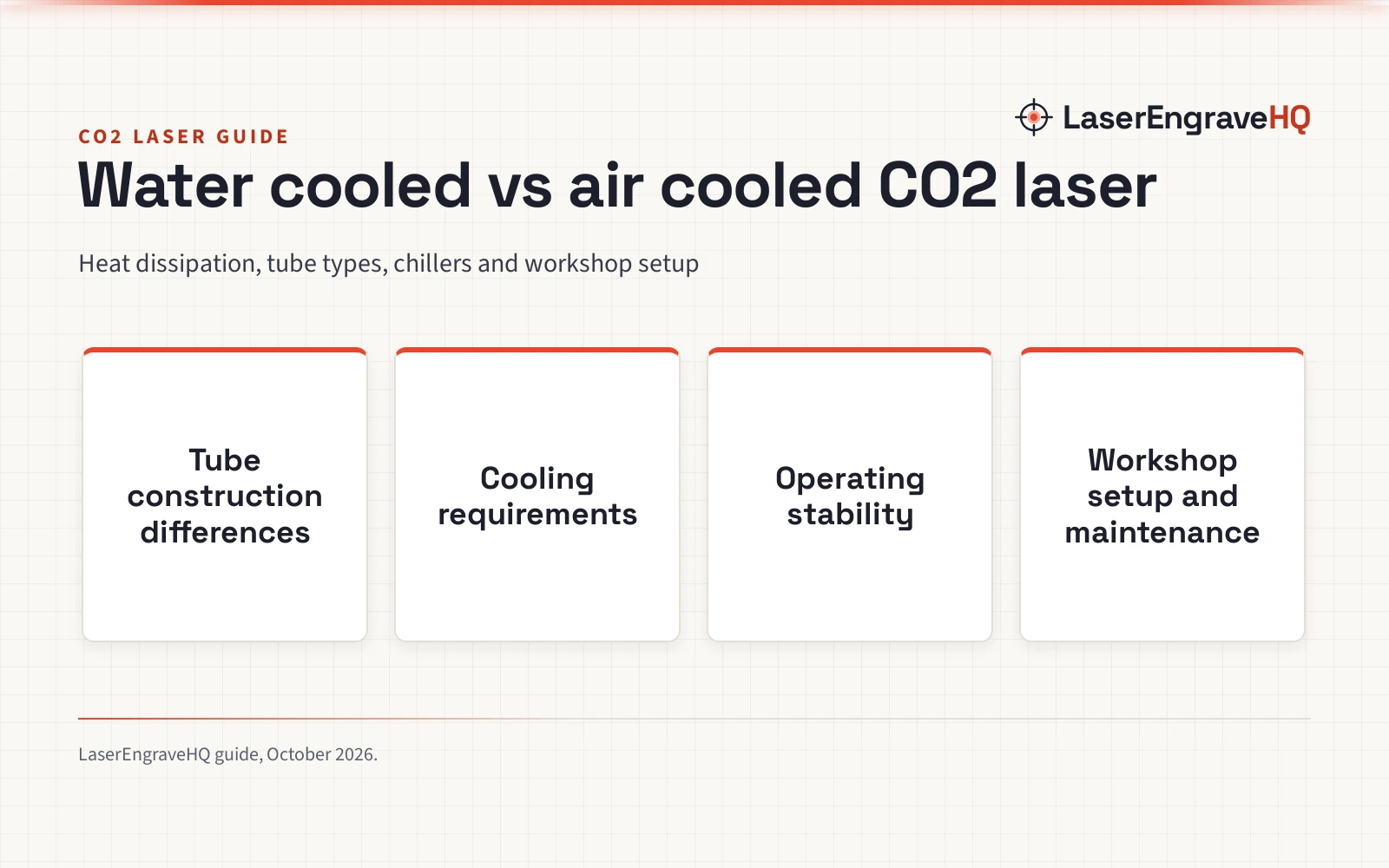
- Tube construction: Water-cooled systems use glass DC tubes with liquid jackets; air-cooled systems use metal RF tubes with heatsinks and fans.
- Cooling equipment: Glass tubes require an external pump or chiller; air-cooled RF tubes need only clean airflow clearance.
- Temperature stability: Active refrigerated chillers maintain fluid within 0.3°C; air-cooled lasers depend on ambient room climate.
- Workshop freezing: Glass tubes risk burst damage below freezing without coolant; air-cooled tubes contain no liquid to freeze.
- Initial investment: Glass-tube machines are much more affordable to acquire; RF air-cooled machines command premium commercial pricing.
- Maintenance demands: Water cooling requires fluid changes and hose inspections; air cooling requires heatsink dusting and fan checks.
For most craft businesses and makers, a water-cooled glass tube paired with a refrigerated chiller offers the most cost-effective cutting performance. Air-cooled RF machines remain the choice for compact studios and commercial production lines requiring zero plumbing.
FAQ: lasers and CNC
Can a glass CO2 laser tube run with air cooling instead of water?
Glass tubes cannot run on air cooling because borosilicate glass acts as a thermal insulator. Without water flowing through the outer jacket to remove heat, the gas overheats rapidly, causing power loss and cracking the glass casing.
What happens if a CO2 laser cooling system overheats?
When coolant temperature climbs, laser efficiency drops significantly, causing cuts to lose penetration depth. Prolonged overheating accelerates gas degradation and can crack the tube.
Can I use automotive antifreeze in my CO2 laser chiller?
OMTech explicitly warns against automotive antifreeze in its coolant specifications, stating that higher viscosity and pH levels deteriorate laser output power and tube life. Use distilled water or specialized laser coolant with low conductivity.
Is a passive radiator chiller enough for a 40W or 50W CO2 laser?
A passive chiller like the OMTech or Cloudray CW-3000 provides 50W/°C heat dissipation for lasers up to 50W with a 9L reservoir. It works for short jobs in cool rooms, but active refrigerated chillers like an S&A CW-5000 holding 0.3°C stability are required for hot environments or continuous cutting.
Why are air-cooled RF CO2 lasers more expensive than glass tube machines?
Air-cooled RF tubes use precision-machined metal chambers, integrated radio-frequency power supplies, and durable optical components. They operate on low-voltage DC power rather than multi-kilovolt lines and can be refurbished, whereas glass tubes are consumable sealed units.
How often should you replace the water in a laser cooling reservoir?
Distilled water in open buckets should be replaced frequently to prevent algae and dust contamination. Enclosed chiller reservoirs, such as the 6L or 9L tanks on industrial chillers, run longer between refills, particularly when filled with low-conductivity coolant.
Related: the CO2 laser hub, laser engraver guide, and best CO2 laser cutter for home use. Also see our CO2 laser water chiller guide. Also see our RF vs glass tube CO2 laser comparison.