What Is MOPA Laser and Which Engraver to Buy
A MOPA laser is a fiber laser with adjustable pulses for color marking, metal engraving and fine detail on metal: how it works and what to check before buying.

On this page
Top picks at a glance
As an Amazon Associate I earn from qualifying purchases.
- 1
 Cloudray 60W JPT MOPA Fiber Laser EngraverView on Amazon
- 2
 ComMarker B6 60W JPT Mopa Fiber Laser EngraverView on Amazon
- 3
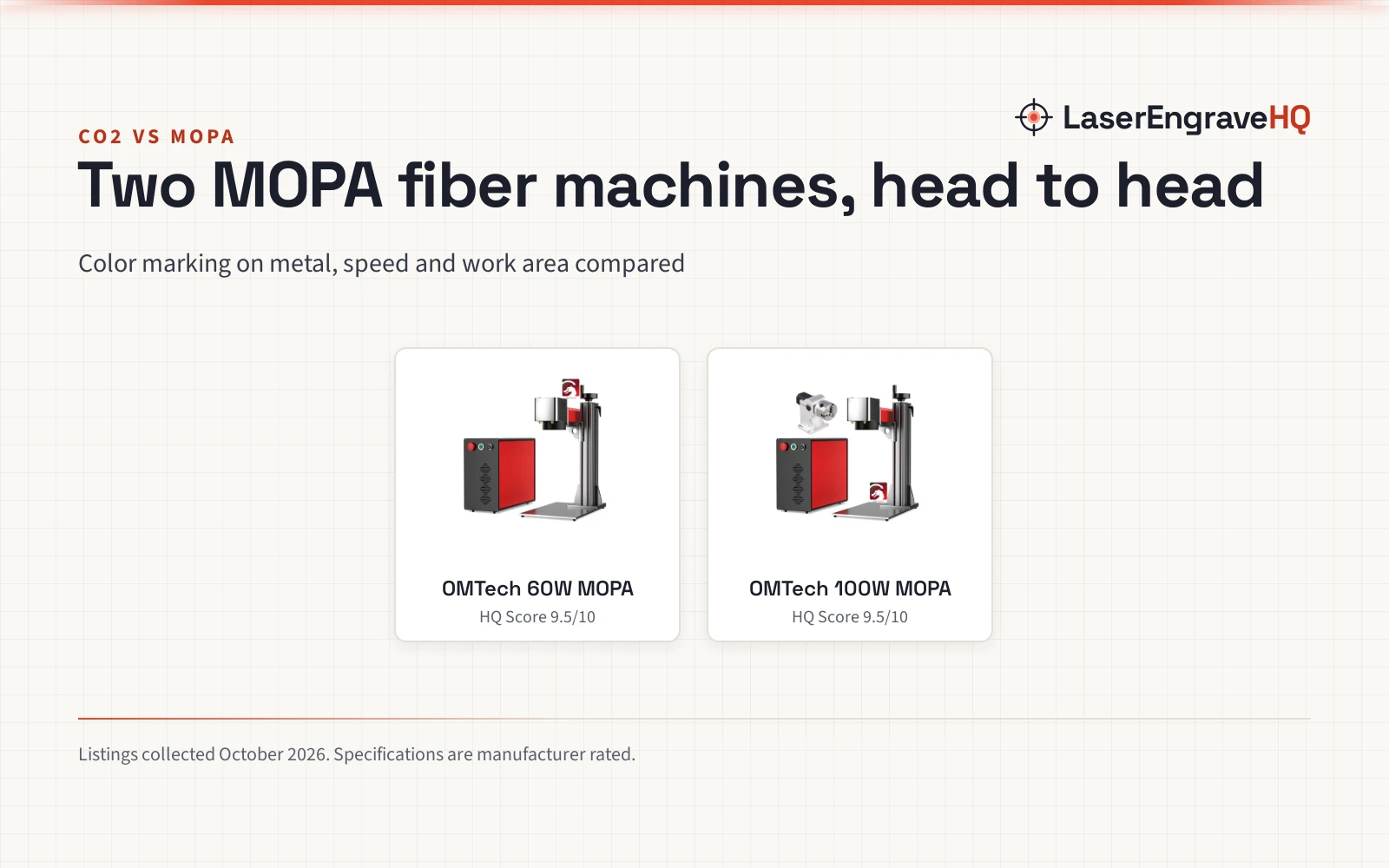
 OMTech 60W MOPA Fiber Laser Engraver with LightBurn for MetalView on Amazon
- 4
 Monport 30W JPT & MOPA Fiber Laser Engraver With 3D & DeepView on Amazon
- 5
 Monport 60W JPT & MOPA Fiber Laser Engraver with 3D & DeepView on Amazon
- 6
 US Stock Ovsuqu Galvo Laser JPT M7 MOPA 100W Fiber LaserView on Amazon
Picture a small workshop bench with a stack of blank steel tags, a few brass coins and a tray of anodized aluminum plates waiting for a mark that will not rub off. That is the job a MOPA laser is built for. What is mopa laser, in plain terms? It is a fiber laser whose pulse can be tuned, so one machine can mark metal in color, engrave metal, and keep fine detail on small parts.
Other machines to compare
 Cloudray 60W JPT MOPA Fiber Laser EngraverCheck price on Amazon
 ComMarker B6 60W JPT Mopa Fiber Laser EngraverCheck price on Amazon
 OMTech 60W MOPA Fiber Laser Engraver with LightBurn for MetalCheck price on Amazon
 Monport 30W JPT & MOPA Fiber Laser Engraver With 3D & DeepCheck price on Amazon
 Monport 60W JPT & MOPA Fiber Laser Engraver with 3D & DeepCheck price on Amazon
 US Stock Ovsuqu Galvo Laser JPT M7 MOPA 100W Fiber LaserCheck price on Amazon
LaserEngraveHQ earns a commission from purchases made through these links, at no extra cost to you. Read our affiliate disclosure.
Every figure in this guide comes from a maker listing: power, work area, speed, accuracy and lifespan figures are quoted as stated, and anything a listing does not state is marked as not stated.
What Is MOPA Laser?
A MOPA laser is a fiber laser built around a master oscillator power amplifier source. The name describes the design: a low-power oscillator shapes each pulse, and an amplifier raises it to working power. Because the pulse is shaped before it is amplified, the operator can change the pulse width and the frequency instead of accepting one fixed pulse.
Most MOPA engravers in these listings use a JPT source. Two listings state a 1064nm wavelength: the ComMarker B6 (on Amazon) and the AchiPrin machine (on Amazon). Monport lists a frequency range of 1-4000kHz and a pulse width range of 2-500ns for its JPT MOPA models, and those ranges are what make color marking possible: different settings heat stainless steel differently, and the surface shows a different color for each setting.
How a MOPA Laser Works
Inside the machine, a galvo scanner head steers the beam across the work area, and an F-theta lens keeps the beam focused from the center to the edges. A red dot pointer helps with focus, and on some models a touch screen handles auto focus. Common software choices in the listings are LightBurn and EZCAD2, with BSLcad included on some Monport models.
Several listings state a marking speed of up to 10,000mm/s, while the ComMarker B6 lists an engraving speed of 15,000mm/s. Marking accuracy of 0.01mm is stated on several models, and the Creality Falcon T1 (on Amazon) lists repeat accuracy down to 0.001mm, depending on the module. Several listings state a lifespan of up to 100,000 hours for the laser source.
What a MOPA Laser Can Mark
Metal is the home ground for a MOPA laser. Listings name stainless steel, aluminum, brass, gold, silver, copper, titanium and alloys, plus painted products and non-transparent plastics. Color marking is the headline use: stainless steel color marking, brass color marking and aluminum blackening are listed for Monport JPT MOPA models, and Cloudray describes 100+ color markings from its 60W machine.
Deep work depends on the model, so read the listing for the exact machine. Cloudray states deep engraving capability of 0.5mm for its 60W machine, and Monport describes 2.5D metal engraving and deep metal engraving for its 30W JPT MOPA models, with some metal sheet cutting. The same maker states the opposite for one 60W model: mild metal marking only, with no deep engraving and no sheet cutting. Round objects are covered by a rotary axis: the AchiPrin machine includes a D80 rotary axis for rings, pipes, bottles, cups and shafts, with 360-degree continuous marking.
MOPA vs Standard Fiber Laser
A standard fiber laser fires a fixed pulse, which marks metal well but gives the operator little room to change how the mark looks. A MOPA laser adds adjustable pulse width and frequency, so the same machine can switch between a light surface mark, a deep engraving and a color mark on stainless steel. The fiber vs MOPA laser for metal comparison walks through the metal side in detail, and the CO2 vs MOPA laser engraver and diode vs MOPA laser engraver pages cover the other laser types. For a different angle, see MOPA laser vs UV laser.
What to Look for When Buying a MOPA Engraver
MOPA engravers in the listings range from 30W to 100W, with 60W the most common power. Work areas run from 110x110mm to 300x300mm depending on the lens.
- Power: do not judge depth by watts alone. Monport lists deep engraving and some sheet cutting for its 30W JPT MOPA models, while one 60W Monport model lists mild marking only, with no deep engraving and no sheet cutting. Check the listing for the exact model.
- Work area: Cloudray ships 2 F-theta lenses covering 110x110mm and 200x200mm; Monport lists 150x150mm for one 60W model and 175x175mm as the optimal area for its MOPA models; AchiPrin ships 175mm and 300mm lenses.
- Speed and accuracy: 10,000mm/s is the common rated speed, with 15,000mm/s on the ComMarker B6; accuracy of 0.01mm is stated on several models.
- Software: LightBurn and EZCAD2 are the usual choices, with BSLcad on some Monport models and EZCAD on the AchiPrin machine, which lists 9 language options.
- Safety class: Class 1 on the ComMarker B6 and the enclosed Creality Falcon T1; Class 2 on the Cloudray machine (on Amazon). Monport listings state different classes: one 30W model states Class 5, while one 60W model states Class 1 in one place and Class 5 in another, so check the listing for the exact model.
- Support and warranty: AchiPrin lists a 24-month warranty on the laser source and core parts; OMTech lists 2 years of support; ComMarker lists a 1 year warranty for the B6.
- Size and weight: the Cloudray machine lists a gross weight of 43 lbs, while the ComMarker B6 lists a weight of 13kg.
Safety Basics for MOPA Engravers
Enclosed Class 1 machines are the calmest option, since the beam stays inside the housing. Open-frame machines need more care: wear the goggles that ship with the machine, and check that they match the wavelength. AchiPrin ships protective goggles rated OD6+ for 1064nm.
Ventilation matters on every job, since engraving smoke needs to leave the room. Keep a suitable extinguisher within reach and never leave a running job unattended. Never laser PVC, vinyl, PVC-based faux leather, polycarbonate or ABS: those materials can release harmful fumes and damage the machine.
Common Mistakes to Avoid
- Buying on power alone and ignoring work area, lens choice and software.
- Expecting deep engraving from a model whose listing states mild marking only.
- Skipping a focus check and blaming the machine for a faint mark.
- Marking PVC or vinyl without checking the material first.
- Leaving a running job alone in the room.
What Is a MOPA Laser: The Short Version
- A MOPA laser is a fiber laser with adjustable pulse width and frequency.
- That control gives color marking on stainless steel and aluminum blackening.
- It marks metal, anodized aluminum, painted products and some plastics.
- Deep engraving depends on the model, so check the listing.
- Look for power, work area, lens choice, software and laser class before buying.
FAQ: lasers and CNC
Can a MOPA laser mark color on metal?
Yes, on the metals the listings name. Stainless steel color marking, brass color marking and aluminum blackening are listed for Monport JPT MOPA models, and Cloudray describes 100+ color markings from its 60W machine. The color comes from the heat of the pulse, so the exact shade depends on the settings.
Is a MOPA laser good for jewelry?
Jewelry is one of the main uses named in the listings. Rings, bracelets, pendants, dog tags and metal rods are all named, and a rotary axis handles round pieces: the AchiPrin D80 rotary axis lists rings, pipes, bottles, cups and shafts, with 360-degree continuous marking.
What is the difference between a MOPA laser and a fiber laser?
A MOPA laser is a type of fiber laser, not a separate laser family. The difference is the pulse: a standard fiber laser fires a fixed pulse, while a MOPA laser lets the operator adjust pulse width and frequency. That adjustment is what makes color marking possible.
Can a MOPA laser cut metal?
It depends on the model. Monport describes some metal sheet cutting for its 30W JPT MOPA models, while the same maker states no sheet cutting for one 60W model, which is sold for mild marking only. Deep engraving of 0.5mm is stated for the Cloudray 60W machine.
Related: the fiber vs MOPA laser for metal, what is a fiber laser engraver and 20W vs 30W fiber laser. Also see the CO2 vs MOPA laser engraver. Also see the laser engraver maintenance guide.