Upcut vs Downcut Router Bit: Which One Should You Buy?
A practical guide to upcut vs downcut router bit spiral geometry, chip evacuation direction, surface edge quality, and how to choose each for CNC routing.

On this page
Top picks at a glance
As an Amazon Associate I earn from qualifying purchases.
- 1
 SpeTool Upcut Spiral Router Bits 1/4 Inch Shank with Coating9.7/10View on Amazon
- 2
 SpeTool 5PCS Spiral Downcut Router Bits 1/4" Shank 1" Cutting9.7/10View on Amazon
- 3
 1/8 Router Bits 1/4 Shank9.7/10View on Amazon
- 4
 1/4 Spiral Upcut Router BitView on Amazon
- 5
 1/8 Router Bit 1/4 ShankView on Amazon
- 6
 Upcut Spiral Flush Trim Router BitView on Amazon
- 7
 Whiteside RU5150 Spiral Upcut Straight Router Bit: 1/2 InchView on Amazon
- 8
 ZahyoX 1/4 Inch Upcut Spiral CNC Router Bit for WoodView on Amazon
- 9
 Whiteside RU2100 Spiral Upcut Straight Router Bit: 1/4 InchView on Amazon
When routing wood signs, furniture parts, or decorative panels on a CNC machine, choosing between an upcut vs downcut router bit comes down to chip direction and edge quality: an upcut bit pulls chips upward to keep deep mortises clear, though it can fray top veneers; a downcut bit pushes chips downward for a crisp top face, though it can cause bottom blowout on through-cuts. The sections below explain flute mechanics, edge quality, workholding, and bit selection step by step.
Other machines to compare
 1/4 Spiral Upcut Router BitCheck price on Amazon
 1/8 Router Bit 1/4 ShankCheck price on Amazon
 Upcut Spiral Flush Trim Router BitCheck price on Amazon
 Whiteside RU5150 Spiral Upcut Straight Router Bit: 1/2 InchCheck price on Amazon
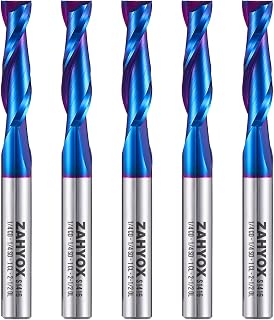 ZahyoX 1/4 Inch Upcut Spiral CNC Router Bit for WoodCheck price on Amazon
 Whiteside RU2100 Spiral Upcut Straight Router Bit: 1/4 InchCheck price on Amazon
LaserEngraveHQ earns a commission from purchases made through these links, at no extra cost to you. Read our affiliate disclosure.
Choosing between an upcut and downcut spiral bit is about managing chip evacuation and edge tear-out. Upcut spirals pull chips upward away from deep cuts, while downcut spirals press downward to preserve clean top surfaces.
Step 1: Examine flute helix direction and cutting force
Spiral router bits feature cutting edges that wrap around the tool body in a continuous helix, acting like an Archimedes screw to dictate chip travel and mechanical cutting forces.
An upcut bit combines a right-hand helix with clockwise spindle rotation. As the flutes shear wood fibers, the upward spiral scoops chips toward the collet, creating an axial lifting force that pulls the workpiece toward the spindle. For example, SpeTool lists solid carbide upcut bits with 2 flutes in a 1/4 inch cutting diameter and 2 inch cutting length, designed for smooth slotting and mortising. SHARPRO lists upcut bits with 2 flutes, a 1/4 inch shank, a 1/8 inch cutting diameter, and a -0.02 mm dimensional tolerance.
A downcut bit reverses this geometry by pairing a left-hand helix with clockwise spindle rotation. The downward flutes push chips toward the spoilboard, directing mechanical force into the table to press the workpiece down.
Step 2: Compare chip evacuation and heat management
Chip evacuation is the primary mechanical advantage of an upcut bit. When cutting wood, chips must clear quickly so the flutes do not recut trapped waste, which causes friction, tool heating, and scorched edges.
Because an upcut bit draws chips upward, waste ejects cleanly out of the kerf and into your dust extraction stream. SpeTool highlights this flute design for efficient chip removal and reducing heat buildup across softwoods, hardwoods, plywood, oak, and MDF. In deep mortises and plunge cuts, upward evacuation prevents kerf clogging. Pairing an upcut cutter with adequate extraction, such as the setups in our dust collector guide, keeps channels clear.
Downcut bits push waste downward. In blind grooves or deep pockets, chips pack into the bottom of the cut beneath the tip, causing friction, heat, and tool deflection. Consequently, downcut bits should not be used for deep, narrow blind mortises.
Step 3: Evaluate top-surface versus bottom-surface edge quality
The direction the cutting edge shears wood grain dictates where tear-out occurs.
An upcut bit cuts upward against the unsupported top face of the board. On veneers, laminates, or figured hardwoods, this upward pull can cause splintering along the top rim. However, because bottom cutting edges shear upward into the solid core of the board, bottom fibers remain supported, yielding a clean bottom edge. Whiteside Router Bits notes in its listing for upcut spirals that the upward cutting action creates a clean edge on the side of the material farthest from the router. For example, Whiteside Router Bits lists an upcut spiral with a 1/2 inch shank, 1/2 inch cutting diameter, 1 flute, and a 3-1/2 inch overall length.
Downcut bits deliver the reverse result. Downward slicing presses top wood fibers against the board core, leaving a splinter-free top edge ideal for surface engraving and pre-finished plywood. On through-cuts, however, downward force pushes unsupported bottom fibers out, creating blowout on the underside. For broader tooling comparisons, see our guide to CNC router bit types and our review of the best CNC router bits for hardwood.
Step 4: Account for workholding stability and lifting forces
Cutting forces directly impact workholding security. Because an upcut bit pulls upward, it exerts vertical tension on the workpiece. If you are routing thin sheet goods or small parts held only with light clamps or double-sided tape, an upcut spiral can lift material off the spoilboard, causing chatter or dislodging parts. Practical hold-down methods, such as those in our guide to clamping ideas on a CNC router, are essential for upcut routing.
Downcut bits press material firmly against the spoilboard, helping keep thin sheets flat and preventing small nested parts from shifting without oversized tabs.
When machining heavy hardwood stock with rigid clamping, large upcut bits remove material efficiently. For instance, SpeTool lists upcut bits with a 1/2 inch shank, 1/2 inch cutting diameter, 1-1/4 inch cutting length, and 3 inch total length, with an HRC55 hardness for heavy-duty mortising and carving.
When to choose a compression router bit instead
When a through-cut requires clean edges on both the top and bottom faces, neither a standard upcut nor downcut bit produces clean results on both sides in a single pass. That job requires a compression router bit.
A compression bit combines upcut flutes at the tip with downcut flutes on the upper body. These opposing forces compress fibers toward the center of the panel, eliminating tear-out on both faces in plywood and laminated sheet goods.
Compression bits require sufficient cut depth so the upcut tip passes through the bottom while downcut flutes engage the top surface. Learn more in our guide on what is a compression router bit and compare profiles in our compression vs upcut router bit breakdown. If assembling a starter set, see our best CNC bit set for beginners.
Common mistakes to avoid
- Routing deep blind mortises with a downcut bit, packing chips and overheating the cutter.
- Using an upcut bit on delicate veneer without surface masking to prevent top tear-out.
- Routing small parts with an upcut bit without tabs or rigid clamps to stop upward lift.
- Expecting a downcut bit to produce clean bottom edges on through-cuts.
Upcut vs downcut router bit: the short decision guide
- Choose an upcut bit when milling mortises, deep pockets, or clearing chips with dust extraction.
- Choose a downcut bit for shallow inlays, lettering, or through-profiles in veneered panels where top finish matters most.
- Choose an upcut bit for thick solid hardwood secured with rigid clamps.
- Choose a downcut bit for thin stock or small cutouts prone to lifting.
- Choose a compression bit for through-cuts needing clean top and bottom faces.
Matching spiral geometry to your cut saves tool life and finishing time.
FAQ: lasers and CNC
Can I use an upcut router bit in a handheld router?
Yes, solid carbide upcut bits work in handheld routers with a matching collet. SpeTool and SHARPRO list upcut bits with a 1/4 inch shank that fit handheld plunge routers and CNC spindles. Securely clamp your workpiece so upward cutting forces do not lift the board.
Why do downcut router bits burn wood in deep grooves?
Downcut flutes push chips downward into the cut. In deep grooves or blind mortises, trapped chips cannot escape, causing the spinning tool to recut waste, generate frictional heat, and scorch the wood.
Does a downcut router bit leave a rough bottom edge?
Yes, in through-cuts. Downward cutting forces push unsupported bottom fibers out through the underside, causing blowout and splintering. For clean dual faces, choose a compression bit.
Which router bit is better for cutting acrylic and plastics?
Upcut spiral bits are preferred for plastics because rapid chip evacuation prevents chip re-welding. SHARPRO lists single flute upcut bits with a 1/4 inch shank, 1/4 inch cutting diameter, and 1 inch cutting length designed for acrylic, plastic, and aluminum.
How do I identify whether a router bit is upcut or downcut?
Hold the bit vertically with the shank up and cutting tip down. Look at the flutes on the side facing you: if flutes slope upward from left to right like a right-hand helix, it is an upcut bit. If flutes slope downward from left to right like a left-hand helix, it is a downcut bit.
Related: explore our guide to the best CNC router bits, review top cutters in our best CNC router bits for hardwood roundup, compare materials in our carbide vs HSS router bits guide, and browse brands in our best router bit manufacturers overview. For machine setups, read our guide for the best desktop CNC for beginners and visit the CNC tooling hub.