Tapered Ball Nose vs V Bit: Which One Should You Buy?
A practical CNC tooling guide comparing tapered ball nose end mills and V bits for 3D relief carving, grooving, sign making, and edge detailing.

On this page
Top picks at a glance
As an Amazon Associate I earn from qualifying purchases.
- 1
 SpeTool 5Pcs Tapered Ball Nose Carving End Mill 1/8 inch9.6/10View on Amazon
- 2
 SPEED TIGER ISE Carbide End Mill 1/8”9.8/10View on Amazon
- 3
 Genmitsu 4pcs 2-Flute Tapered Ball Nose End Mills Tungsten9.6/10View on Amazon
- 4
 YONICO Tapered Endmill Ball Nose Router Bits CNC EngraverView on Amazon
- 5
 Yakamoz V-Groove and Round Nose Router Bit SetView on Amazon
- 6
 Whiteside Router Bits 1404 Round Nose Bit with 1/4-Inch RadiusView on Amazon
- 7
 Whiteside Router Bits 1403 Round Nose Bit with 3/16-InchView on Amazon
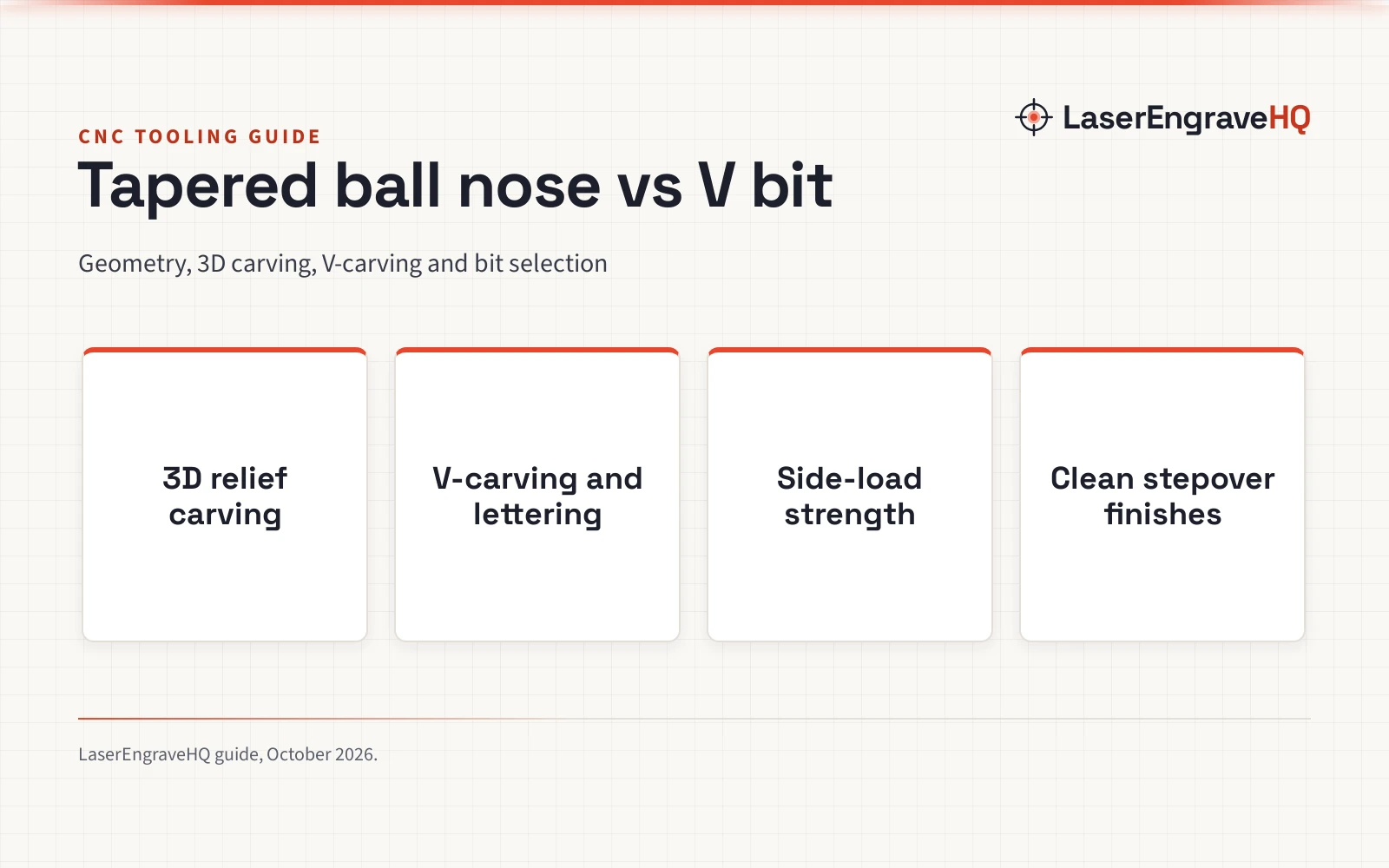
When routing wood signs, decorative plaques, custom cabinet doors, and detailed molds on a CNC machine, deciding between a tapered ball nose vs v bit comes down to cutting profile and surface geometry. A tapered ball nose bit is built for organic 3D relief carving and flowing contours because its rounded tip leaves shallow cusps that blend together across curved surfaces. A V bit is engineered for sign making, decorative grooving, lettering, and crisp chamfers because its straight angled cutting edges create sharp interior corners and precise line definition. The sections below compare both tool designs across geometry, deflection resistance, toolpaths, and project selection so you can pick the right cutter for your workshop.
Other machines to compare
 YONICO Tapered Endmill Ball Nose Router Bits CNC EngraverCheck price on Amazon
 Yakamoz V-Groove and Round Nose Router Bit SetCheck price on Amazon
 Whiteside Router Bits 1404 Round Nose Bit with 1/4-Inch RadiusCheck price on Amazon
 Whiteside Router Bits 1403 Round Nose Bit with 3/16-InchCheck price on Amazon
LaserEngraveHQ earns a commission from purchases made through these links, at no extra cost to you. Read our affiliate disclosure.
Tapered ball nose cutters and V bits serve distinct cutting roles rather than competing for the exact same toolpaths. Most CNC sign makers and woodworkers keep both bit styles in their collet rack, running V bits for crisp lettering and decorative borders while reserving tapered ball nose bits for smooth 3D dimensional carvings.
Step 1: Compare bit geometry and tip profiles
The defining contrast between these bits is the shape of the cutting tip and the flute taper. A tapered ball nose end mill combines a hemispherical rounded ball tip with flutes that taper outward along the length of the tool toward the shank. This tapered conical core provides significant structural reinforcement compared to straight-shank ball end mills, allowing a very fine cutting tip to resist bending forces during deep cutting operations. SpeTool lists 2-flute solid carbide tapered ball nose end mills with small tip radii such as 0.25mm, 0.75mm, 1.0mm, 1/64″, 1/32″, and 1/16″, paired with single side taper angles such as 2.24°, 3.20°, 3.58°, and 5.38°. EANOSIC also lists solid carbide tapered ball nose bits featuring a 1/32″ or 1/16″ radius with single side taper angles like 3.6° and 5.4°.
In contrast, a V bit features straight cutting edges that converge at a sharp point or a minuscule flat tip without a rounded ball nose. As a V bit plunges deeper into material, the width of the carved groove widens directly with cut depth. That geometry makes V bits the standard choice for decorative V-grooving, prism-carved lettering, and chamfered edges, where the sharp point defines crisp vector paths and the angled flutes carve distinct beveled sidewalls.
Step 2: Match the tool to 3D reliefs or sign lettering
Your design requirements guide which cutter belongs in your spindle. If your project involves a 3D relief model, such as a topographic map, a sculpted wildlife scene, a dished bowl, or a dimensional face, a tapered ball nose bit is the proper tool. Because the tip is rounded, each parallel toolpath pass overlaps the previous pass with gentle scallops rather than sharp ridges. When running a finishing toolpath with a tight stepover, the rounded tip sweeps across contoured slopes, compound curves, and organic transitions without leaving flat steps.
For lettering, line art, and traditional wooden signage, a V bit is vastly superior. Computer-aided design software uses V-carving toolpaths that lift the bit in Z as vectors narrow and plunge deeper where vectors widen. This dynamic motion creates crisp, faceted corners and clean mitered junctions that a rounded ball tip cannot reproduce. Attempting to carve fine serif letters with a tapered ball nose leaves rounded, blunted internal corners. For sign makers looking to master this technique, our guide on how to V carve signs on a CNC walks through vector setup and toolpath generation.
Step 3: Evaluate side-load strength and tool deflection
Bit deflection causes chatter, poor surface finishes, and broken carbide. Solid carbide is exceptionally rigid and holds a keen edge, but slender straight bits can snap under heavy lateral loads. Both tapered ball nose cutters and V bits solve the deflection problem through geometry, but they distribute cutting forces differently.
A straight ball end mill with a tiny tip radius has a thin neck that flexes easily during deep clearing. A tapered ball nose bit solves this by widening continuously from the ball tip up to the shank. For example, SpeTool listings show 1″ cutting lengths with a 1/4″ shank and substantial single side taper angles, while EANOSIC lists 2-flute bits with a 1″ cutting length and a rigid 1/4″ shank. The thick conical web behind the cutting tip provides stiffness, allowing the tool to plunge deeper into hardwood and mold stock without snapping. If you are comparing tool stiffness for general milling, our overview on ball nose vs flat end mill options covers straight flute dynamics.
A V bit also has tremendous rigidity because its body expands rapidly above the point. However, the delicate tip of a sharp V bit carries minimal carbide mass. If you plunge a pointed V bit too aggressively into dense hardwoods, the microscopic tip can chip. Once the sharp tip breaks, fine lettering lines become ragged and lose depth precision.
Step 4: Understand stepover, feed rates, and surface finish
The toolpath strategy for a tapered ball nose bit differs completely from a V-carve toolpath. With a tapered ball nose, surface quality depends on your stepover percentage. A finer stepover leaves smaller scallop heights, producing a silky wood surface that requires minimal hand sanding before finishing. A coarser stepover reduces machine run time but leaves visible ridges across curved surfaces. In production work, makers often rough out bulk waste with a flat end mill before sending in a tapered ball nose bit for the final pass.
V-carve toolpaths do not rely on standard raster stepovers across a curved surface. Instead, the CNC follows vector centerlines, adjusting cut depth so the angled cutting flutes touch both vector boundaries simultaneously. When clearing flat pockets between raised letters with a V bit, CAM software often pairs the V bit with a flat clearing end mill to speed up cycle times. Balancing feed rate and spindle speed prevents burning on hardwood and melting on plastics. For general feed and speed formulas, consult our workshop guide on CNC feeds and speeds for beginners.
Step 5: Select the right shank diameter and coating
Collet compatibility and tool selection depend on your machine’s spindle setup. SpeTool listings offer tapered ball nose end mills with 1/8″ and 1/4″ shanks, matching two widely used collet sizes on desktop and benchtop CNC routers. A 1/8″ shank fits compact router chucks for light detail carving, while a 1/4″ shank offers a larger clamping surface that adds rigidity against vibration during heavier cuts.
Tool coatings reduce friction and prolong sharpness under heat. SpeTool listings specify TiAlN and ZrN coatings with a 55HRC rating, noting suitability for hardwoods, oak, plywood, MDF, acrylic, and non-ferrous metals like aluminum and copper alloys. EANOSIC listings feature blue nano nACo coating, citing up to 2.5X longer life compared to uncoated bits, and state suitability for hardwoods, MDF, aluminum alloy, and steel. Coating performance depends on heat management and cutting conditions, but coatings can help maintain edge sharpness when cutting abrasive sheet goods like MDF or dense hardwoods. To explore broader tooling collections, see our guide to the best CNC router bits for hardwood.
Common mistakes to avoid
- Using a tapered ball nose bit for sign lettering and expecting crisp, sharp corners.
- Carving deep 3D topography with a V bit, which creates faceted steps instead of smooth organic curves.
- Skipping a roughing pass on deep 3D reliefs and forcing a fine tapered ball nose bit to clear full stock depth.
- Feeding a pointed V bit too fast into dense knots, causing the fragile tip to fracture.
- Selecting a coarse stepover on 3D finishing passes, leaving prominent tool marks that demand extensive hand sanding.
Tapered ball nose vs v bit: the short version
- Choose a tapered ball nose bit when machining continuous 3D relief carvings, sculpted topography, and curved decorative surfaces.
- Choose a V bit when cutting signs, decorative grooves, chamfered edges, and crisp lettering.
- Rely on the tapered conical body of a tapered ball nose bit for deflection resistance during deep 3D contouring.
- Use a tight stepover with a tapered ball nose to minimize scallop marks on finished parts.
- Keep both cutter styles in your tooling collection to handle dimensional reliefs as well as crisp sign engraving.
Selecting between these cutters is not a matter of which tool is superior overall, but which cutting profile matches your design vectors.
FAQ: lasers and CNC
Can you use a tapered ball nose bit for lettering?
You can cut raised or recessed letters with a tapered ball nose bit, but the interior corners will always have rounded edges equal to the tool radius. For traditional signs with crisp, pointed corners and sharp serif details, a V bit is the proper tool.
Can you carve 3D reliefs with a V bit?
A V bit can clear 3D toolpaths, but its straight cutting edges leave sharp V-shaped grooves between passes instead of smooth, blended scallops. This requires extensive sanding and often distorts the organic contours of a 3D model.
Why does a tapered ball nose bit have angled sides?
The side taper thickens the tool body from the fine ball tip up to the shank. This conical structure provides rigidity, preventing the slender cutting tip from deflecting or snapping under lateral cutting forces during deep carving.
What materials can you cut with these bits?
Solid carbide cutters handle a broad selection of workshop materials. SpeTool reference listings state compatibility with hardwoods, oak, plywood, soft wood, MDF, acrylic, aluminum, and copper alloys, while EANOSIC listings also include steel alloys and cast iron. V bits made of solid carbide are similarly used across hardwoods, softwoods, plywood, and plastics for decorative sign carving.
Do coated carbide bits last longer than uncoated bits?
Tool coatings help reduce friction and resist heat buildup during cutting. For example, EANOSIC listing claims cite up to 2.5X longer life for blue nano nACo coated bits compared to uncoated cutters, though actual tool life varies with material hardness, feed rates, and chip clearing.
Related: the CNC tooling guide, best V bits for CNC router, and best CNC router bits. Also see our guide to CNC router bit types and how to V carve signs on a CNC.