Standard Temperature of Chiller: How to Set a Laser Water Chiller
There is no single standard chiller temperature: compressor chillers publish a settable range and control precision, and this guide shows how to choose a setting for a CO2 laser.

On this page
Top picks at a glance
As an Amazon Associate I earn from qualifying purchases.
- 1
 OMTech CW-5200 6L Industrial Water ChillerView on Amazon
- 2
 OMTech CW-3000 9L Industrial Water Chiller for CO2 Lasers upView on Amazon
- 3
 The Pod Company Standard Water ChillerView on Amazon
You are midway through a batch of engraved signs when the cut quality starts to drift and the tube feels warmer than it should. The fix usually sits under the bench, in the water chiller, and the question behind it is the standard temperature of chiller you should actually run. There is no single factory standard that fits every machine. Compressor chillers let you set a target temperature yourself or let the unit track the room, and the right choice depends on the mode your chiller offers and how tightly it holds the setting.
Other machines to compare
 OMTech CW-5200 6L Industrial Water ChillerCheck price on Amazon
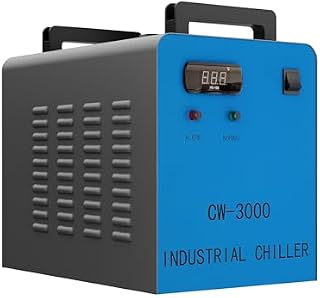 OMTech CW-3000 9L Industrial Water Chiller for CO2 Lasers upCheck price on Amazon
 The Pod Company Standard Water ChillerCheck price on Amazon
LaserEngraveHQ earns a commission from purchases made through these links, at no extra cost to you. Read our affiliate disclosure.
What the standard temperature of chiller means
When makers ask about a standard temperature, they usually mean the setpoint the cooling water should hold while the tube runs. Chiller makers do not publish one universal setpoint. Instead, they publish a settable range and a control precision. S&A, for example, states that its CW-5200DH and CW-5000 chillers can be set manually between 5 and 40 degrees, with dual mode temperature control in automatic and intelligent forms. Cloudray states a minimum temperature of 5°C (41°F) on its CW-5202. So the practical answer is a range you choose from, not one fixed number, and your laser maker’s manual is the place to confirm what your tube expects.
The setpoint also interacts with the room. A chiller set far below room temperature works harder and can sweat condensation on hoses and fittings, while a setpoint close to room temperature is easier to hold. That is why the same chiller can be right for one workshop and wrong for another, even on the same machine.
Constant mode versus intelligent mode
Several compressor chillers in this class offer the same pair of modes. In constant temperature mode, you set the desired temperature and the chiller maintains it. VEVOR states that its compressor chiller maintains the set temperature within ±0.5°F (±0.28°C) in constant mode. In intelligent mode, the chiller adjusts the water temperature automatically according to the ambient temperature, so the water follows the room instead of fighting it. S&A describes the same split as constant and intelligent temperature modes, with automatic adjustment according to the indoor environment temperature.
Constant mode suits work where repeatability matters from run to run, because the water temperature stays where you put it. Intelligent mode suits shops where the room temperature swings during the day, because the chiller tracks the room rather than holding an absolute number. Most of these units show the current water temperature on a display, so you can see what the tube is actually getting. Our CO2 laser water chiller explained guide covers how these units are sized and set up.
How tightly the control holds the setting
The precision figure tells you how far the water temperature wanders from the setpoint. OMTech states ±0.3°C temperature control on the CW-5200, with internal sensors that keep temperatures within 0.3°C of constant and alarms when adjustments are needed. S&A states the same 0.3°C figure on its CW-5200DH and CW-5000. Cloudray states ±0.1°C precision temperature control on the CW-3000, with intelligent and constant temperature modes. VEVOR states ±0.28°C in constant mode. A tighter figure means the tube sees steadier water temperature during long runs, which is what you want when a job runs for hours.
Alarms matter as much as precision. Several chillers in this class include water flow alarms and over-temperature alarms, and S&A adds compressor overcurrent protection. If the working water temperature climbs too high, the unit warns you instead of letting the tube cook quietly. Check that the alarm functions are enabled before a long job, not after one.
Compressor chillers versus radiator-style coolers
Not every unit called a chiller can hold a set temperature. Radiator-style coolers such as the CW-3000 class move heat away with fans rather than refrigeration. OMTech rates its CW-3000 at 50W/°C heat dissipation, meaning the water temperature rises with the room and the heat load, so there is no fixed setpoint to dial in. Compressor units such as the CW-5200 class refrigerate the water and hold a chosen temperature. OMTech rates the CW-5200 at 5186 BTU/h cooling capacity for CO2 lasers up to 150W, and Cloudray rates the CW-5202 at 5,186 BTU/h with a 6L tank. If your question is about a standard temperature setting, you are asking about the compressor class. The CW3000 vs CW5000 water chiller comparison walks through that split.
Setting the temperature on your chiller
Start from your laser maker’s manual, since the tube maker sets the cooling requirements for the tube. Then pick the mode: constant mode when you want the same water temperature every run, intelligent mode when you want the water to follow the room. Set the target inside the range your chiller allows, and watch the display during the first long job to confirm the unit holds it. Keep the tank filled, and check the level through the observation window or water level gauge on your unit. If you run antifreeze, Cloudray states the proportion should not exceed 30%, and the water choice itself is covered in our distilled vs deionized water for CO2 laser guide.
Watch for the alarms while you work. A flow alarm or over-temperature alarm during a job means the cooling loop needs attention before the next run: check the water level, the hoses and the inlet and outlet ports. The water chiller vs submersible pump guide explains when a chiller earns its place over a simple pump.
FAQ: lasers and CNC
What is the standard temperature for a laser chiller?
There is no single standard setpoint. Compressor chillers publish a settable range instead: S&A states a manual range between 5 and 40 degrees on the CW-5200DH and CW-5000, and Cloudray states a minimum of 5°C (41°F) on the CW-5202. Your laser maker’s manual gives the cooling requirement for your tube.
Should I use constant mode or intelligent mode?
Use constant mode when you want the water held at one set temperature run after run. Use intelligent mode when you want the chiller to adjust automatically according to the ambient temperature. VEVOR states the pair of modes on its CW-5200DG, and S&A offers the same pair on its CW-5200DH and CW-5000.
How precise is chiller temperature control?
It depends on the unit. OMTech and S&A state control within 0.3°C of constant, Cloudray states ±0.1°C on the CW-3000, and VEVOR states ±0.28°C in constant mode. The figure describes how far the water temperature wanders from the setpoint.
Can a CW-3000 hold a set temperature?
The CW-3000 class cools with fans rather than refrigeration, so the water temperature follows the room and the heat load. OMTech rates it at 50W/°C heat dissipation. A compressor unit such as the CW-5200 class is the one that holds a chosen setpoint.
What happens if the water gets too warm?
Several chillers in this class include over-temperature alarms that warn you when the working water temperature is too high, plus water flow alarms for circulation problems. Stop the job, check the water level and hoses, and let the unit recover before running again.
Related: the CO2 laser water chiller explained guide, CW3000 vs CW5000 water chiller and water chiller vs submersible pump laser.