Resin Vacuum Chamber vs Pressure Pot: Which One Should You Buy?
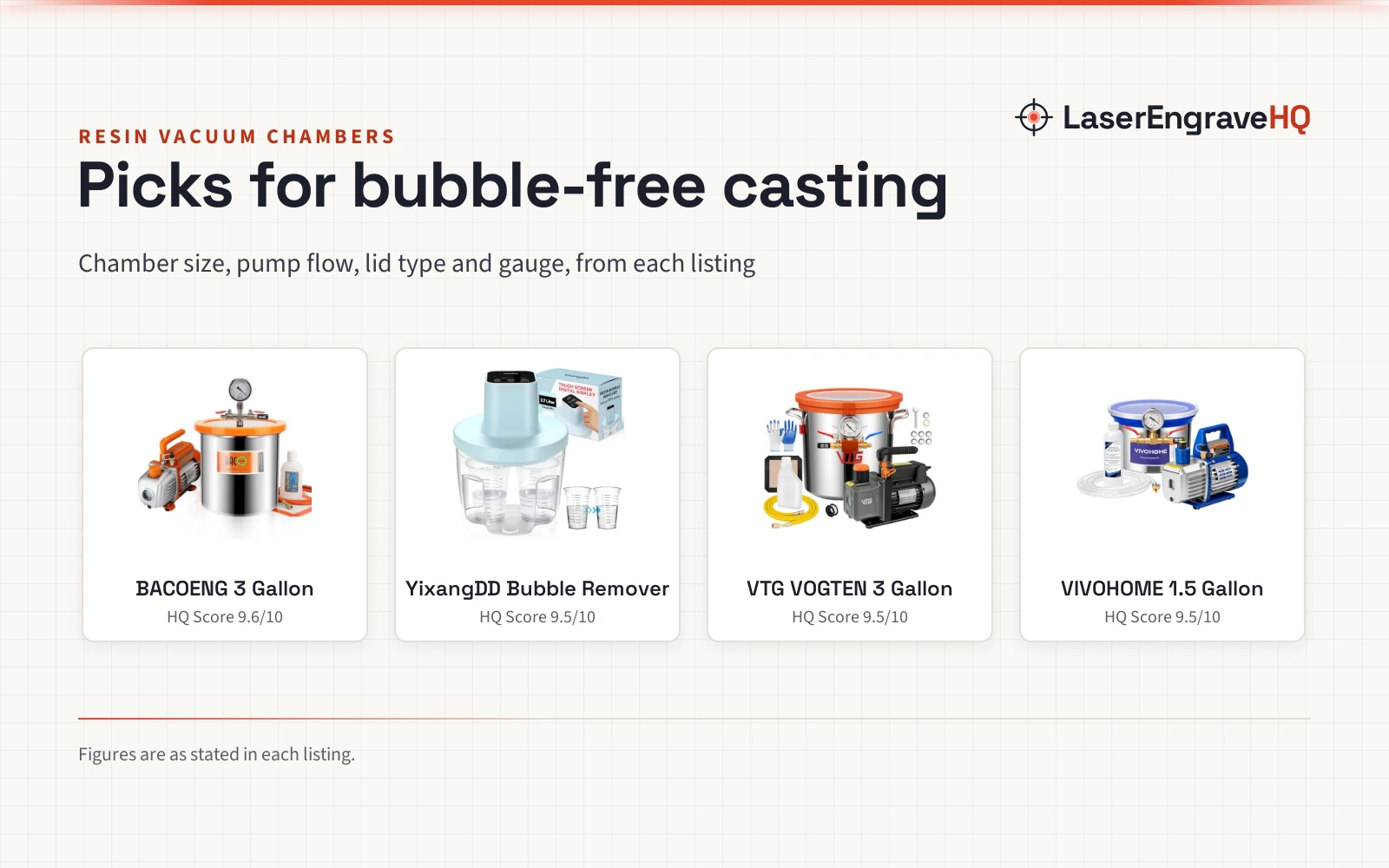
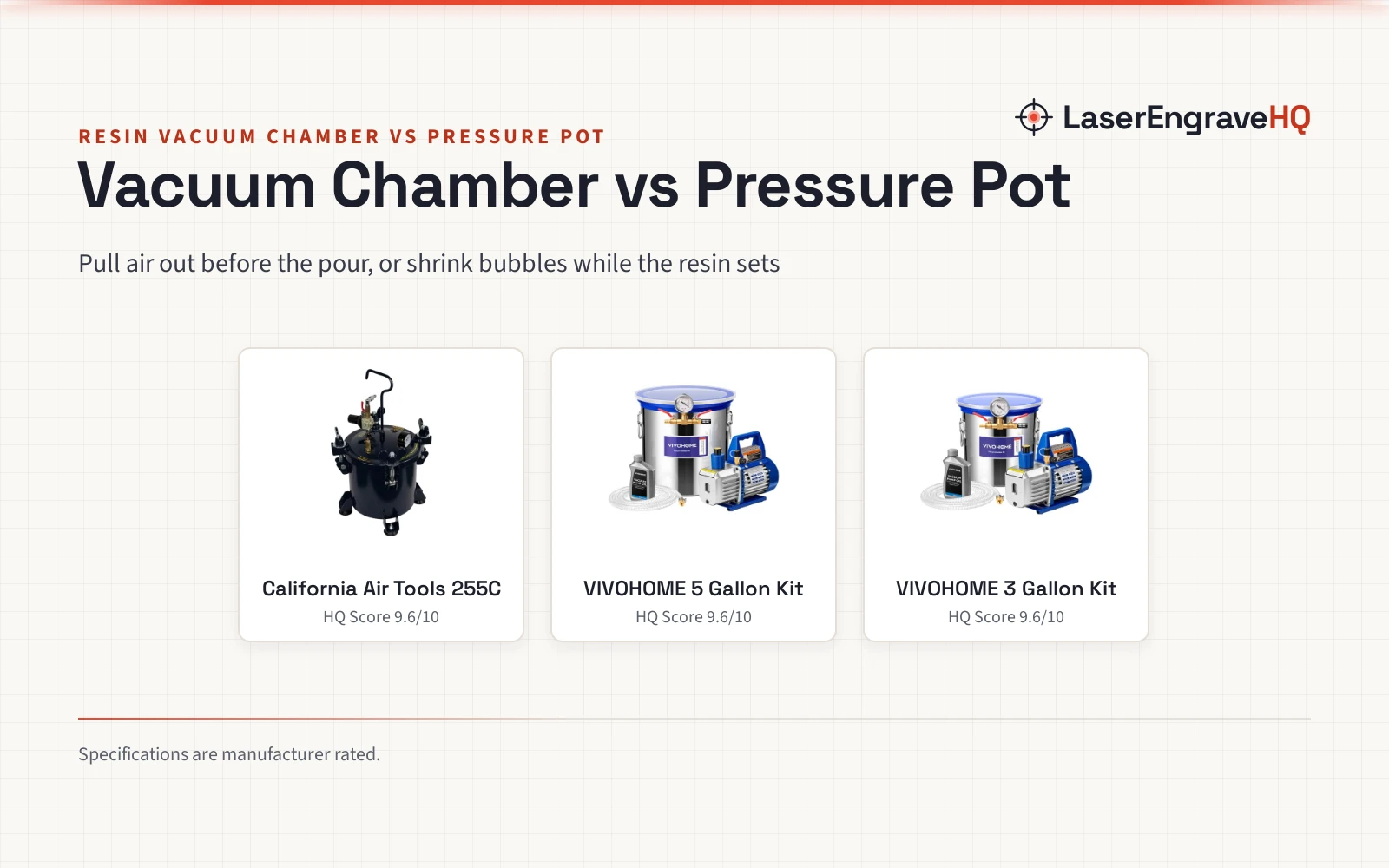
A vacuum chamber pulls air out of resin before the pour, while a pressure pot shrinks bubbles while the resin sets; this comparison weighs the VIVOHOME chambers against the California Air Tools 255C on what each listing states.

On this page
Top picks at a glance
As an Amazon Associate I earn from qualifying purchases.
- 1
 California Air Tools 255C 2.5 Gallon Pressure Pot9.6/10View on Amazon
- 2
 VIVOHOME 5 Gallon Acrylic Vacuum Chamber with 3.59.6/10View on Amazon
- 3
 VIVOHOME 3 Gallon Acrylic Vacuum Chamber with 3.59.6/10View on Amazon
A bubble in a resin pour can ruin a piece that took hours to mix, and makers deal with it in opposite ways. A resin vacuum chamber vs pressure pot choice comes down to when the air leaves: pull it out before the pour, or shrink it under pressure while the resin sets. This comparison walks through the VIVOHOME vacuum chamber kits and the California Air Tools pressure pot using what each listing states, so the pick matches how the reader casts.
LaserEngraveHQ earns a commission from purchases made through these links, at no extra cost to you. Read our affiliate disclosure.
Verdict: pick the California Air Tools 255C pressure pot if the pour is already in the mold and the goal is fewer visible bubbles while it sets, with a stated warranty behind it. Pick a VIVOHOME vacuum chamber if the air must come out of the resin before pouring: the 5 gallon kit for larger batches, the 3 gallon kit for smaller pours. The pot lists a pressure relief valve and a stated warranty; the chambers lead on watching the degassing through a clear lid.
Machines on the list
California Air Tools 255C 2.5 Gallon Pressure Pot
A 2.5 gallon coated steel pressure pot for epoxy resin casting, with a regulator, ball valve and relief valve, rated to 80 PSI maximum and 60 PSI working pressure.
Pros
- 80 PSI maximum and 60 PSI working pressure, as stated
- Regulator, on/off ball valve and pressure relief valve included
- 1 Year Limited Warranty stated
- 22-pound build with a handle, easy to carry
Cons
- No pressure gauge stated
- No lid or gasket details stated
- 2.5 gallon capacity is the smallest of the 3
VIVOHOME 5 Gallon Acrylic Vacuum Chamber with 3.5
A 5 gallon 304 stainless steel vacuum chamber kit with a 3.5 CFM 1 stage pump, a 0.55 in acrylic lid and a gauge for epoxy resin degassing.
Pros
- 5 gallon chamber takes larger pours than the 3 gallon kit
- 3.5 CFM 1 stage pump pulls down to 5 Pa
- Clear 0.55 in acrylic lid shows degassing while it runs
- Complete kit: gauge, 5ft hose, 0.35 qt pump oil, silicone pad, tool kit
Cons
- No warranty term stated
- 24.3 pounds, heavier than the 3 gallon kit at 20.2 pounds
- Acrylic lid suits resin and silicone defoaming; wood stabilizing needs the tempered glass lid model
VIVOHOME 3 Gallon Acrylic Vacuum Chamber with 3.5
A 3 gallon 304 stainless steel vacuum chamber kit with a 3.5 CFM 1 stage pump, a 0.55 in acrylic lid and a gauge for epoxy resin degassing.
Pros
- 3.5 CFM 1 stage pump pulls down to 5 Pa
- Clear acrylic lid lets the maker watch bubbles leave
- 20.2 pounds, less than the 5 gallon kit at 24.3 pounds
- Die-cast aluminum pump housing with a cooling fan and non-slip base
Cons
- No warranty term stated
- 3 gallon capacity suits smaller batches
- Acrylic lid suits resin and silicone defoaming; wood stabilizing needs the tempered glass lid model
- Lid needs a press to start the seal on first use
Other machines to compare
 Resin Bubble RemoverCheck price on Amazon
 VEVOR 2 Gallon Vacuum ChamberCheck price on Amazon
 BACOENG 3 Gallon Tempered Glass Lid Vacuum Chamber for ResinCheck price on Amazon
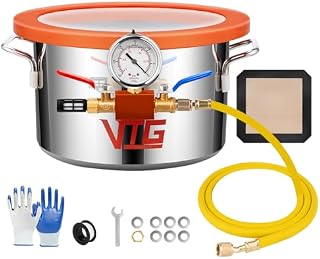 VTG VOGTEN 1.5 Gallon Vacuum Chamber with Tempered Glass LidCheck price on Amazon
 VEVOR 5 Gallon Vacuum ChamberCheck price on Amazon
 VTG VOGTEN 3 Gallon Vacuum Chamber with PumpCheck price on Amazon
Side by side
| Spec | California Air Tools 255C | VIVOHOME 5 Gallon Kit | VIVOHOME 3 Gallon Kit |
|---|---|---|---|
| HQ Score | 78 | 69 | 68 |
| Capacity | 2.5 Gallon | 5 Gallon | 3 Gallon |
| Pump or pressure | 80 PSI maximum, 60 PSI working | 3.5 CFM pump, -29.9 inHg maximum vacuum | 3.5 CFM pump, -29.9 inHg maximum vacuum |
| Chamber | Coated steel tank | 304 stainless steel, 0.04 in thick | 304 stainless steel, 0.04 in thick |
| Lid | Not stated in the listing | 0.55 in acrylic, withstands 160°F | 0.55 in acrylic, withstands 160°F |
| Weight | 22-pound per the bullets | 24.3 pounds | 20.2 pounds |
Specs are what each manufacturer publishes as its rating on the listing, collected 5 November 2026.
Resin Vacuum Chamber vs Pressure Pot: How They Differ
A vacuum chamber and a pressure pot attack the same problem from opposite directions. The VIVOHOME kits pull air out of mixed resin under vacuum before the pour. The California Air Tools pot takes the poured mold and holds it under pressure, at a maximum of 80 PSI and a working pressure of 60 PSI, so bubbles shrink while the resin sets.
That timing difference decides the workflow. Degassing before the pour suits resin that must look clear in the mold. Pressing after the pour suits molds where the resin is already placed and the maker wants the bubbles shrunk out of sight while the piece sets.
Capacity and Size
Capacity is where the 3 listings split: the VIVOHOME 5 gallon kit holds the largest chamber, the 3 gallon kit sits in the middle, and the California Air Tools pot is the smallest at 2.5 gallon. The pot’s internal space measures 9 1/4 in wide x 10 in deep, with an exterior of 10 3/8 in wide x 18 in high including the handle. The VIVOHOME listings give the same 10.8 x 4.5 x 9.0 in spec table dimensions for the 3 gallon and 5 gallon listings, so the true footprint of the 5 gallon kit is unclear.
Safety and Warranty
The 255C lists a pressure relief valve, a regulator and an on/off ball valve, plus rubber feet that keep the tank steady, and it carries a 1 Year Limited Warranty. The VIVOHOME kits name no warranty term; what they list instead is a silicone gasket and O-ring seal, a dual-scale gauge and a 0.55 in acrylic lid that withstands 160°F. The pump is rated for 41°F-104°F.
Choose the California Air Tools 255C if
- The resin is already in the mold and the bubbles must go while it sets.
- A stated 1 Year Limited Warranty matters.
- A regulator, ball valve and relief valve matter more than a clear lid.
Choose a VIVOHOME Vacuum Chamber if
- The air must leave the resin before the pour.
- Watching the degassing through a 0.55 in acrylic lid matters.
- The pours run large, so the 5 gallon kit fits, or small, so the 3 gallon fits.
Project Match
- Epoxy resin casting with bubbles pulled out before the pour: VIVOHOME 3 gallon or 5 gallon kit.
- Epoxy resin casting with bubbles shrunk while the resin sets: California Air Tools 255C.
- Resin and silicone defoaming under a clear lid: VIVOHOME kits.
- Essential oil extraction, vacuum packaging or lab use: VIVOHOME kits, per the listing.
- Wood stabilizing: Not stated as a fit for the acrylic lid; the listing points to the tempered glass lid model.
FAQ: lasers and CNC
Should I buy a resin vacuum chamber or a pressure pot?
Buy a vacuum chamber if the air must leave the resin before the pour; buy a pressure pot if the resin is already in the mold and the bubbles must shrink while it sets.
What size vacuum chamber do I need for resin casting?
The listings here offer 3 gallon and 5 gallon chambers with the same 3.5 CFM pump. Pick the 5 gallon kit for larger batches and the 3 gallon kit for smaller pours; the spec table gives the same dimensions for the sizes, so confirm the footprint first.
How much pressure does the California Air Tools 255C hold?
The listing states a maximum pressure of 80 PSI and a working pressure of 60 PSI, with a regulator, ball valve and relief valve.
Can I use a VIVOHOME vacuum chamber for wood stabilizing?
The listings say the 0.55 in acrylic lid suits resin and silicone defoaming. For wood stabilizing, the listings point to the tempered glass lid model instead.
What comes in the VIVOHOME vacuum chamber kit?
Each kit includes the chamber, a 3.5 CFM pump, a gauge, a 5ft hose, 0.35 qt pump oil, a silicone pad and a tool kit, plus 2 inlet fittings in 1/4 in SAE and 1/2 in ACME sizes.
Related: best resin vacuum chamber, water washable vs standard resin, 3D printer resin vs filament cost and ABS-like vs standard resin.