Problems With 3D Printing: How a Deburring Tool Cleans Up Prints
Problems with 3D printing leave brims, rafts and support marks behind, and a hand deburring tool clears them; this guide matches each deburring set to the cleanup it handles.

On this page
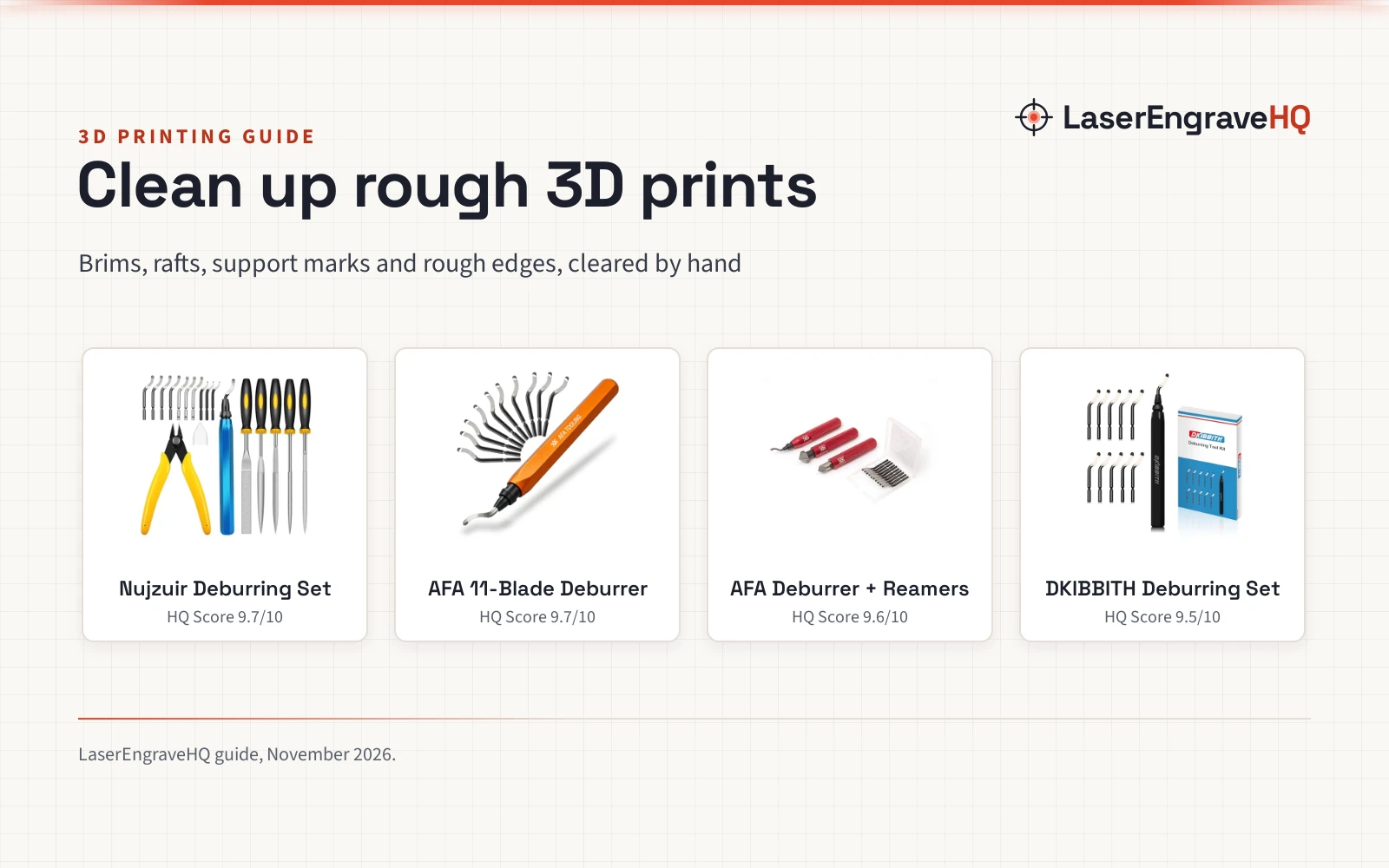
Top picks at a glance
As an Amazon Associate I earn from qualifying purchases.
- 1
 3D Printer Deburring Tool Set with 11pc High Speed9.7/10View on Amazon
- 2
 AFA Tooling Deburring Tool, 11 M2 HSS Blades9.7/10View on Amazon
- 3
 AFA Tooling Deburring Tool Set & 2 Countersink9.6/10View on Amazon
- 4
 DKIBBITH Deburring Tool Set 11 Pieces of High9.5/10View on Amazon
The problems a deburring tool fixes show up after the print finishes, as a brim that clings to the base, a raft that leaves a rough face, support marks on an overhang, or a sharp edge where the print met the bed. This guide names the common cleanup faults, shows how a hand deburring tool clears them, and matches the deburring sets in the gear section to the cleanup each one handles.
LaserEngraveHQ earns a commission from purchases made through these links, at no extra cost to you. Read our affiliate disclosure.
3D Printer Deburring Tool Set with 11pc High Speed
11 steel blades, a 5-piece needle file set and micro flush-cut pliers.
Pros
- 11 blades: 5 BS1010 M2, 3 BS1018 M35 cobalt, 3 BK3010 for small holes
- 5-piece needle file set, 6 inches (150 mm), diamond coating
- Micro flush-cut pliers, 10-mm jaw, 21-degree head, cut copper and soft metal wire up to 16-gauge (1.3 mm)
- 360-degree rotating head for straight, curved and small-hole edges
Cons
- No warranty term is stated
- No handle length is stated
- Pliers are rated for wire up to 16-gauge (1.3 mm)
- No storage case is stated
AFA Tooling Deburring Tool, 11 M2 HSS Blades
11 blades with a 148 mm CNC aluminum handle, made for brims, rafts and support marks.
Pros
- 11 BS1010 M2 high-speed steel blades tempered to HRC 62 to 64
- 148 mm (5.8 in) CNC aluminum handle, 12 mm hexagonal grip
- 360-degree rotation reaches edges, cross bores and recesses
- Made for brims, rafts and support artifacts on PLA, PETG, ABS, resin prints
Cons
- No warranty term is stated
- All 11 blades are the BS1010 shape
- No countersink reamer is included in this kit
- The 80% longer edge life is the maker's claim
AFA Tooling Deburring Tool Set & 2 Countersink
11 blades with two 90-degree countersink reamers and a knurled aluminum handle.
Pros
- 11 HSS blades: 1 pre-installed plus 10 extra BS1010 replacements
- Two 90-degree HRC 62 to 64 reamers for chamfers and hole enlarging
- Swivel head removes burrs from uneven surfaces
- Knurled aluminum handle, protective case for extra blades
Cons
- No warranty term is stated
- No blade hardness figure beyond the reamers' HRC 62 to 64
- No handle length is stated
- No filament types are named
DKIBBITH Deburring Tool Set 11 Pieces of High
11 pieces with high-speed steel blades and a black anodized aluminum hex handle.
Pros
- 11 pieces with 10 extra blades in an organized case
- High-speed steel blades for smooth deburring
- Blade rotates in the handle for round workpieces
- Black matte hex anodized aluminum handle resists rolling and dropping
Cons
- No warranty term is stated
- No blade type codes or hardness figure is stated
- No handle length is stated
- No countersink reamer is included in this kit
Problems With 3D Printing: The Faults a Hand Tool Fixes
A brim or a raft holds the print to the bed, and the edge it leaves behind is a common cleanup job. Support structures hold up overhangs and leave marks where they touch the model. Holes and bores can print with a rough rim, and recesses can collect small ridges that a finger can feel. A deburring blade rides along the edge and shaves the ridge away, while the swivel head follows curves and uneven surfaces. The blade types in these sets match the job: BS1010 blades for general edges, BS1018 cobalt blades for hard metals, and BK3010 blades for small holes.
The sets here state work on resin prints and on metal, plastic, PVC, copper, brass and aluminum, and one set names PLA, PETG, ABS and resin prints. Match the blade type to the material, and see our best FDM 3D printing filament guide for filament choice.
How a Deburring Tool Works
A deburring tool is a handle with a small blade that turns inside it. The blade sits in a swivel head, so it follows the edge instead of digging into it, and the handle turns the cutting edge to the working angle. One set here, the AFA 11-Blade Deburrer, uses a spring-loaded collar that holds the blade in place and releases it for a fast change. The handles in these sets use a hex or knurled grip for control, and the hex-shaped handles keep the tool from rolling off the bench. The blades are high-speed steel made to hold an edge on metal, plastic and resin.
The Nujzuir set adds a needle file set for fine detail after the blade, plus micro flush-cut pliers for wire. The AFA set with reamers adds two countersink reamers that cut a chamfer and enlarge a circular opening. Store spare blades in the case that comes with the set, where one is included, and keep the blade covered when the tool is not in use. A blade that stays sharp cuts with light pressure, so let the edge do the work instead of pressing hard on the print.
The Deburring Tools That Finish the Job
Each set below handles a different part of the cleanup: blades for edges and brims, files for fine detail, pliers for wire, and reamers for chamfers and holes.
Which Tool for Which Print Problem
- Brim and raft edges on PLA, PETG, ABS or resin prints: the AFA 11-Blade Deburrer, made for brims, rafts and support artifacts on those materials.
- Small holes and fine detail: the Nujzuir Deburring (on Amazon) Set, with BK3010 blades for small holes and a needle file set for detail.
- Chamfers and enlarged openings: the AFA Deburrer + Reamers, with two 90-degree countersink reamers.
- Round workpieces such as pipes and tubes: the DKIBBITH Deburring (on Amazon) Set, whose blade rotates inside the handle.
- Wire trimming: the Nujzuir Deburring Set, whose pliers cut copper and soft metal wire up to 16-gauge (1.3 mm).
FAQ: lasers and CNC
What causes rough edges on a 3D print?
Brims, rafts and support structures leave ridges where they meet the model, and holes can print with a rough rim. A deburring blade rides along the edge and shaves the ridge away. BS1010 blades cover edges, while BK3010 blades fit small holes.
Can a deburring tool clean up resin prints?
Yes, where the listing states resin. The AFA 11-Blade Deburrer states it cleans brims, rafts and support artifacts from PLA, PETG, ABS and resin prints. The Nujzuir and DKIBBITH sets also state resin work.
Which blade type fits small holes?
The BK3010 blade fits small-hole deburring, and the Nujzuir set includes 3 BK3010 blades for that job. Its 5-piece needle file set follows the blade for fine detail work.
Do I need a countersink reamer for 3D prints?
Only if you cut chamfers or enlarge circular openings. The AFA Deburrer + Reamers includes two 90-degree countersink reamers for wood, plastic and metal. A maker who only cleans brims and support marks needs no reamer.
How do I change a blade on a deburring tool?
It depends on the set. The AFA 11-Blade Deburrer uses a spring-loaded collar for retention and rapid blade changes. The Nujzuir set uses a rotating head that allows easy replacement.
Related: CNC tooling hub, best tools to clean up 3D prints and best hand tools for cleaning up 3D prints. Also see our flush cutters and cleaning kit for 3D printing.