Prescription Laser Safety Glasses: Options Explained
Prescription laser safety glasses explained: fit-over frames, prescription inserts and direct lenses, and how to match optical density and wavelength to your laser.

On this page
Top picks at a glance
As an Amazon Associate I earn from qualifying purchases.
- 1
 LaserPair Laser Safety Glasses 200-534nm and 740-1095nm Laser9.7/10View on Amazon
- 2
 FreeMascot Professional OD 6+ 190nm-490nm Wavelength9.7/10View on Amazon
- 3
 LaserPair Laser Safety Glasses 200-460nm OD6+ & 800-1095nm9.7/10View on Amazon
Prescription laser safety glasses are laser eyewear that protects your eyes while keeping your prescription correction in place. They come as fit-over goggles that sit over everyday glasses, as inserts that carry a prescription behind a rated lens, or as lenses ground to your prescription in a rated frame. The right pair starts with your laser, not with the frame: match the optical density and the wavelength range to the machine you run, then pick the style that fits your face and your prescription.
LaserEngraveHQ earns a commission from purchases made through these links, at no extra cost to you. Read our affiliate disclosure.
Eyewear protects only if its listing states an optical density and a wavelength range that matches your laser. A tinted lens with no stated rating is not protection, even if it looks dark.
Step 1: Match the glasses to your laser
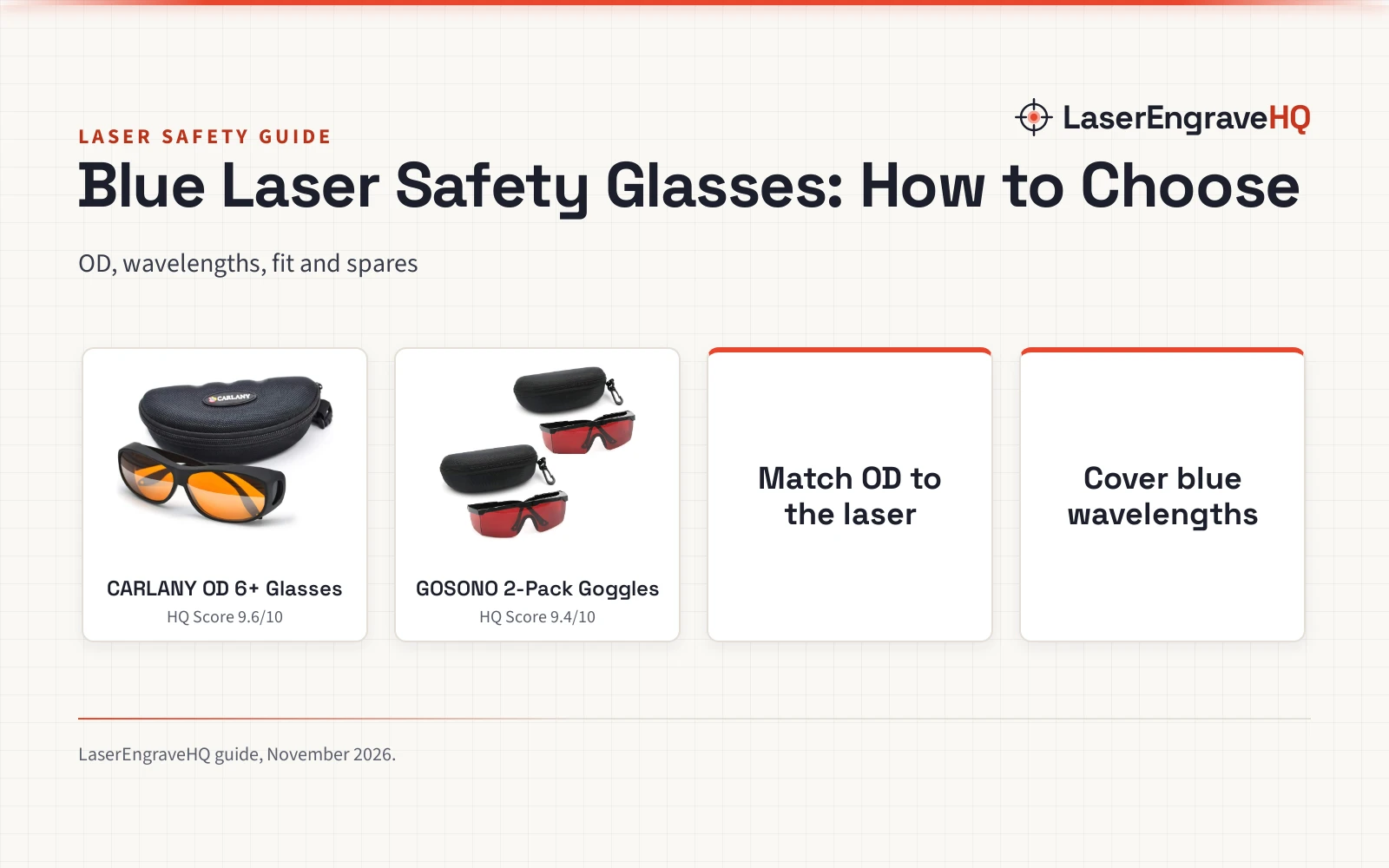
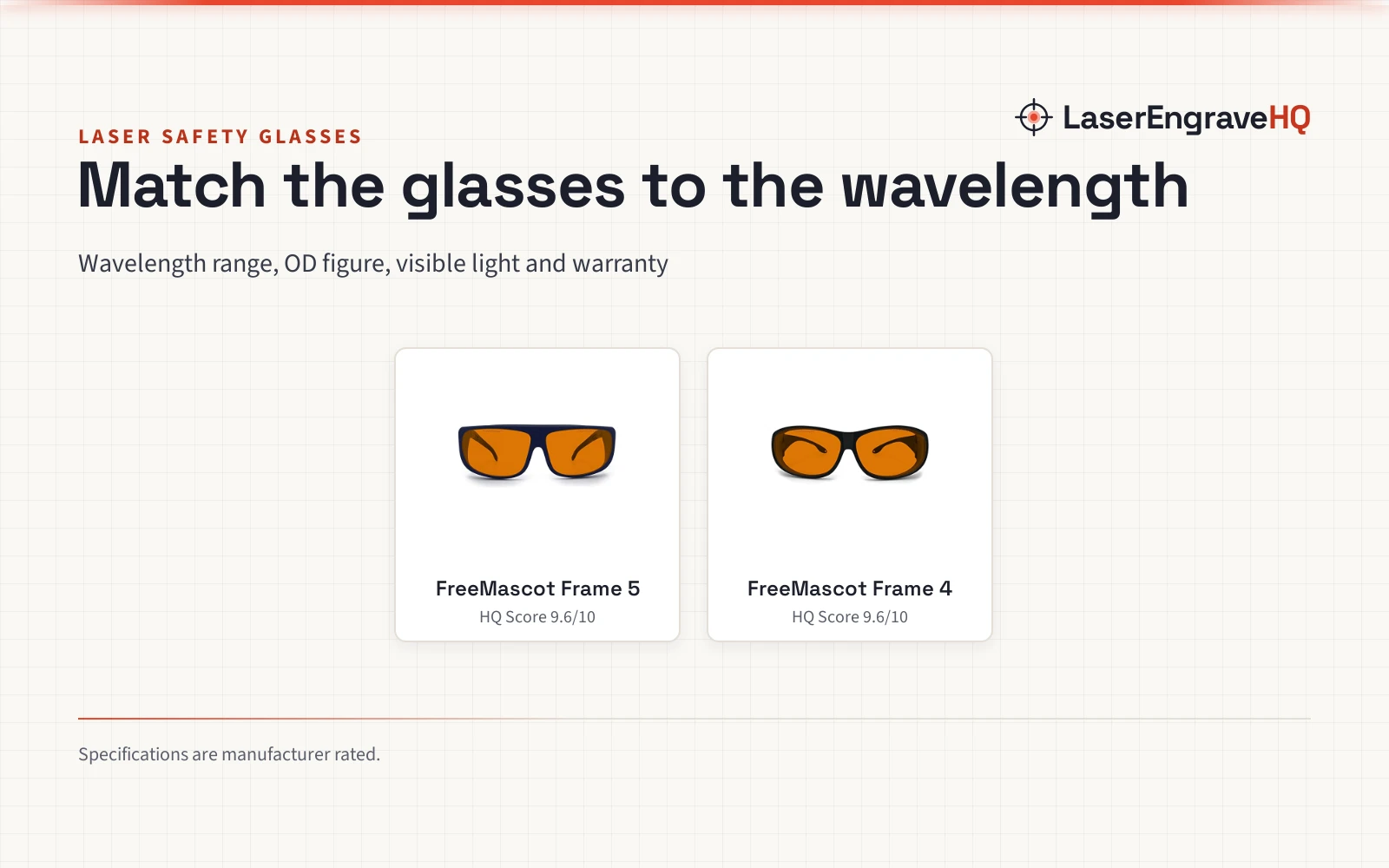
Start with the wavelength your laser runs at, then find glasses whose stated range covers it. FreeMascot lists its IPL glasses at 200nm-2000nm with OD 4+, and Bantida lists the same 200nm-2000nm range at OD 4+. For a CO2 laser, CARLANY lists OD 5+ across 9000nm-11000nm at 10600nm. JILERWEAR lists dual-band cover at 180-540nm and 750-1100nm with OD6+, and LaserPair lists 740-1100nm with OD 5+, OD 6+ and OD 7+ by band. A pair rated for one band does not cover another unless its stated range includes it, so check the range line before the frame style. Our blue vs green laser safety glasses guide compares lens colors by wavelength.
Step 2: Choose how your prescription fits
Fit-over frames are the simplest route: FreeMascot makes a fit-over frame that fits over prescription glasses, CARLANY says its frame fits over most prescription frames, JILERWEAR uses oversized lenses to cover prescription glasses, and LaserPair says its goggles can be worn over prescription glasses. Prescription inserts sit behind the rated lens and keep the front lens untouched, while direct prescription lenses are ground to your correction in a rated frame. Inserts and direct lenses need an eye prescription and a supplier who works with rated frames, so fit-over styles are the simplest route for buyers who already own glasses. See our safety glasses over glasses guide for styles that fit.
Step 3: Check fit, comfort and what you can see
Visible light transmittance, or VLT, says how much ordinary light reaches your eyes through the lens. FreeMascot and Bantida list 15% transmittance, JILERWEAR lists more than 30%, LaserPair lists 31%, and CARLANY lists more than 90% for its CO2 glasses. A higher figure means a brighter view of the work area, while a lower figure means a darker view, so weigh the number against the lighting in your shop. Bantida lists an anti-fog frame, and LaserPair lists side ventilation that prevents fogging. JILERWEAR lists legs that adjust in three positions, and CARLANY lists a lightweight black nylon frame.
Step 4: Read the standards on the listing
A stated standard tells you which rules the glasses were made to meet. FreeMascot lists EN207 approval on its fit-over model, Bantida lists CE certification and ANSI Z87.1, CARLANY lists CE certification and EN207 approval, JILERWEAR lists CE PPE certification to EN207:2017, and LaserPair lists CE certification to EN207:2017. Look for the standard, the optical density and the wavelength range on the same listing, and treat a listing that states none of them as unrated eyewear. Our laser safety glasses guide explains optical density and wavelength in more depth.
Step 5: Store them, clean them and check them
Keep the glasses in their case between jobs so the lenses stay clean and unscratched. FreeMascot and CARLANY include a storage case and a cleaning cloth, and LaserPair includes a protective storage case and a cleaning cloth. LaserPair says to clean with a soft cloth only and no harsh chemicals. Check the lenses before each session and set aside any pair with a cracked lens or a loose frame until you can replace it.
Common mistakes to avoid
- Buying glasses by frame style before checking the wavelength range.
- Using tinted shop glasses or sunglasses with no stated optical density.
- Assuming one pair covers every laser in the shop.
- Skipping the fit check and wearing glasses that slide or pinch.
- Storing the glasses loose where lenses can scratch.
Prescription laser safety glasses: the short version
- Find your laser wavelength and the optical density you need.
- Pick a fit-over frame, an insert or a direct prescription lens.
- Check visible light transmittance for a clear view of the work.
- Confirm a stated standard, optical density and wavelength range.
- Store the glasses in their case and clean them with a soft cloth.
FAQ: lasers and CNC
Can I wear laser safety glasses over my prescription glasses?
Yes, with a fit-over style. FreeMascot, CARLANY, JILERWEAR and LaserPair all list frames made to fit over prescription glasses. Check the frame size against your everyday glasses before you buy.
What optical density do I need for my laser?
It depends on your laser. Read the wavelength and the optical density on the listing and match both to your machine: FreeMascot and Bantida list OD 4+, CARLANY lists OD 5+, JILERWEAR lists OD6+ and LaserPair lists OD 5+, OD 6+ and OD 7+ by band. A higher optical density blocks more of the beam at the stated wavelength.
Do I need different glasses for a CO2 laser and a fiber laser?
Yes, unless one listing covers both ranges. CARLANY lists its CO2 glasses at 9000nm-11000nm, while LaserPair lists 740-1100nm for fiber, Nd:YAG and diode lasers. A pair rated for one range is not rated for the other unless its stated range includes both.
What does visible light transmittance mean?
It is the share of ordinary light that passes through the lens. FreeMascot and Bantida list 15%, LaserPair lists 31% and CARLANY lists more than 90%. A higher share gives a brighter view of the work area.
Can I use regular sunglasses instead of laser safety glasses?
No. Sunglasses carry no stated optical density or wavelength range for lasers. Use eyewear only if its listing states an optical density and a wavelength range that matches your laser.
How do I clean laser safety glasses?
Wipe them with a soft cloth and keep them in their case. LaserPair says to use a soft cloth only and no harsh chemicals. FreeMascot, CARLANY and LaserPair all include a cleaning cloth with the glasses.
Related: the laser safety hub, best laser safety glasses for diode lasers and best laser safety glasses for fiber laser. Also see our laser safety glasses vs regular safety glasses.