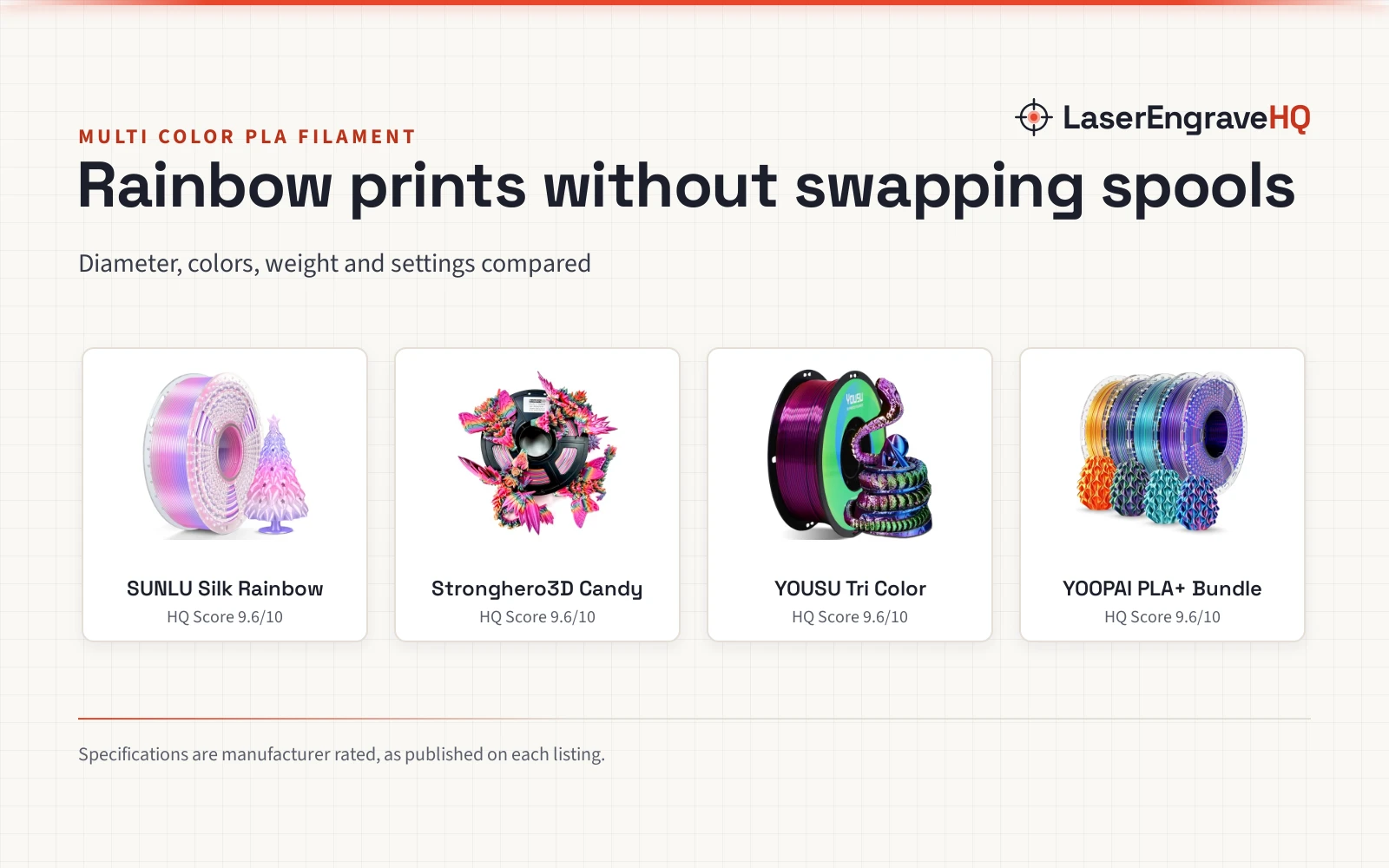
PLA Filament Color Chart: Available Colors
A plain guide to the colors PLA filament comes in, what each color suits, and how to pick a spool with the shade and finish a project needs.

On this page
A pla filament color chart shows every color a PLA filament line comes in, side by side, so a maker can pick a spool that matches the object taking shape on the print bed. Instead of guessing from a small thumbnail, the chart lays out the full range, from black and jade white through red, green, yellow and orange, and the guide below explains how to read it, what each color suits, and how to keep the printed color close to the color on the chart.
As an Amazon Associate I earn from qualifying purchases. LaserEngraveHQ earns a commission from purchases made through these links, at no extra cost to you. Read our affiliate disclosure.
A color on a screen and the same color in printed plastic rarely match exactly. Light in the room, the finish of the plastic and the settings on the printer all shift how a shade looks, so treat the chart as a guide to the range and print a small swatch before starting a large object.
How to read a pla filament color chart
A chart groups colors by family: neutrals, warm colors and cool colors. Neutrals such as black, grey and jade white suit parts that need to look plain and tidy, while warm colors such as red, yellow and orange draw the eye and suit toys, signs and display pieces. Cool colors such as dark blue and green sit in the middle and suit plant pots, organizers and household items. Read the chart in daylight where possible, since warm indoor light can shift a pale shade toward cream and mute a cool bright shade such as dark blue or green.
Some charts show each color as a flat swatch and some show a printed sample. A printed sample tells more, because layer lines and surface shine change how deep a color looks. When a chart shows a finish, note whether the surface looks glossy or matte, since a glossy surface reflects light and makes a color look brighter, while a matte surface softens it. A maker lists a glossy surface effect with uniform color tone for its bundle, which is the kind of detail worth looking for on any chart.
The colors PLA filament comes in
The bundle used as the reference for this guide comes in a set of 8 colors: black, jade white, grey, red, dark blue, green, yellow and orange. The set covers the neutrals a maker reaches for most often, plus a clear shade from each bright family, so a small shelf can cover signs, toys, plant pots, organizers and household items.
- Black: suits signs, frames and parts where the color should stay out of the way, and it shows layer lines less than pale shades.
- Jade White: a soft white, suited to ornaments, plant pots and pieces that need a clean, pale finish.
- Grey: a middle neutral for organizers, brackets and household items where black feels too dark.
- Red: a bright warm color for signs, toys and display pieces that need to stand out.
- Dark Blue: a deep cool color for organizers, awards and parts that need a calm, solid look.
- Green: suits plant pots, garden markers and playful pieces.
- Yellow: a bright color for signs, toys and markers; pale shades show layer lines more, so a smooth finish helps.
- Orange: a warm bright color for toys, signs and display pieces.
A maker does not need every shade a store sells. A set that holds black, a white, a grey and a few bright colors covers most everyday prints, and a bright spool can be added later for a project that calls for it.
How to pick a color for a project
Start from the object, not the spool. A sign needs a color that reads well from across a room, so dark lettering on a pale base or pale lettering on a dark base works well. A toy or display piece can carry a bright color, since the color is part of the charm. A household item such as an organizer or a plant pot usually looks better in a calm color that fits the room.
Light matters as much as the spool. A color that looks rich under a desk lamp can look flat in daylight, so check the chart and a printed swatch in the light where the finished object will live. Glossy filament reflects more light and looks brighter than matte filament in the same shade, so the finish deserves as much thought as the hue.
When a project mixes colors, keep the palette small. A base color plus a bright accent reads cleaner than a mix of many bright shades, and it keeps the print simple, with fewer spool changes and less leftover filament. Browse the 3D printer hub for printers that handle PLA well, and see the strongest PLA filament guide for a broader look at what PLA can do. New to printing? The how to 3D print for beginners guide walks through the early prints.
Print settings that keep colors true
Color starts with the spool, but heat and speed shape how it lands. The maker of the reference bundle lists a nozzle temperature of 205–220°C, with 210°C for the first layer, and a bed temperature of 55–65°C. Print speed is listed at 200-400 mm/s, with 400 mm/s as the top of the range. Those figures belong to that bundle, so check the spool in hand before borrowing them for another brand.
Filament size matters too. The bundle lists a diameter of 1.75 mm with an accuracy of ±0.03 mm, which is the common size for most desktop printers. A spool that measures true to its stated size feeds evenly, and even feeding helps keep the color even from the first layer to the last. The how thick is 3D printer filament guide explains which size fits which printer.
Print a small swatch in the chosen color before starting the full object. A swatch shows the true shade, the surface shine and how the color looks next to the other colors in the project. If the shade looks wrong, check it in the light where the finished object will live before changing the spool.
Storing filament so colors stay bright
PLA picks up moisture from the air, and damp filament prints with a dull finish and can snap while feeding. The maker vacuum seals each spool with desiccant to keep it dry in transit and in storage, and that same habit works at home: keep spools sealed and dry between prints. The PLA filament storage guide covers how long a spool can sit out.
If a spool keeps snapping, the guide to PLA filament breaking walks through the causes. A dry box or a sealed bag with desiccant keeps a spool ready for the next project, and a dryer helps when a spool has already picked up moisture. The filament dryer guide compares dryer picks for Bambu printers.
A small color set that covers most projects
For a maker starting a shelf of PLA, the 8-color bundle named above is a practical shape: 8 spools at 0.25 kg each, 2 kg in total, listed at 4.4 lbs. That spread holds a neutral set and a bright set, so signs, toys, plant pots, organizers and household pieces can all come from the same shelf. The maker is UJOY3D, and the figures here are the ones that maker lists for its Hyper PLA+ bundle.
Buy the set for the range it covers. If a project needs a shade the set lacks, add a spool in that color rather than a new set. Keep the spools sealed, dry and out of direct sun to help the colors stay true from the first spool to the last. The maker also lists 100% virgin raw material for the bundle, with no recycled impurities, and steady printing quality batch to batch.
FAQ: lasers and CNC
What colors does PLA filament come in?
PLA comes in a wide range, from black, white and grey through red, yellow, orange, green and dark blue, and the bundle in this guide lists 8 of them. Matte, glossy, silk and transparent finishes widen the range further.
Does the printed color match the color chart?
Close, but rarely exact. Light, finish and print settings all shift how a shade looks, so print a small swatch in the chosen color before starting a large object. A swatch in daylight shows the true shade better than a thumbnail.
Which PLA color hides layer lines best?
Dark colors such as black and dark blue show layer lines less than pale shades such as jade white and yellow. A smooth finish and even feeding help too, so keep the spool dry and print a swatch before a large object.
Can PLA colors be mixed in the same print?
Yes, with a printer that swaps filament or pauses for a spool change. Keep the palette small: a base color plus a bright accent reads cleaner than many bright shades together, and it keeps the print simple.
How should PLA filament be stored to keep colors bright?
Keep spools sealed and dry, away from damp air and direct sun. The maker vacuum seals each spool with desiccant, and the same habit at home helps keep colors bright and filament feeding smoothly. See the PLA filament storage guide for how long a spool can sit out.
Related: the 3D printer hub, strongest PLA filament guide and how to 3D print for beginners. Also see the types of PETG filament.