OD4 vs OD6 Laser Safety Glasses: Which One Should You Buy?
OD4 and OD6 laser safety glasses compared on optical density, wavelength coverage, visible light transmission, comfort, and workshop safety.

On this page
Top picks at a glance
As an Amazon Associate I earn from qualifying purchases.
- 1
 Laser Safety Glasses 532nm OD6 180nm-532nm Wavelength9.6/10View on Amazon
- 2
 Laser Safety Glasses9.4/10View on Amazon
- 3
 LaserPair Laser Safety Glasses 200-534nm and 740-1095nm Laser9.7/10View on Amazon
- 4
 LaserPair Laser Safety Glasses 200-460nm OD6+ & 800-1095nmView on Amazon
- 5
 OD6 Laser Safety Glasses UV light Violet Blue for 405nmView on Amazon
- 6
 Professional OD6+ CO2 Laser Safety GlassesView on Amazon
- 7
 xTool Laser Safety GlassesView on Amazon
- 8
 JILERWEAR Laser Safety Glasses OD 6+ for 180-540nm VioletView on Amazon
- 9
 4 Pieces Laser Engraving Making Paper for Glass CeramicsView on Amazon
When setting up a workshop to engrave wooden signs, cut acrylic blanks, or mark leather patches, eye protection is the first safety requirement you must resolve. Choosing between od4 vs od6 laser safety glasses comes down to laser power output and the optical density required to reduce beam exposure below hazardous thresholds. For lower-power desktop diode systems, OD4 safety glasses may satisfy safety calculations for diffuse reflections, whereas OD6 laser safety glasses deliver substantially higher optical attenuation for higher-power laser setups where a higher protection margin is required. This comparison evaluates od4 vs od6 laser safety glasses, examining optical density, wavelength coverage, visible light transmission, comfort, and workshop safety using published listing specifications.
LaserEngraveHQ earns a commission from purchases made through these links, at no extra cost to you. Read our affiliate disclosure.
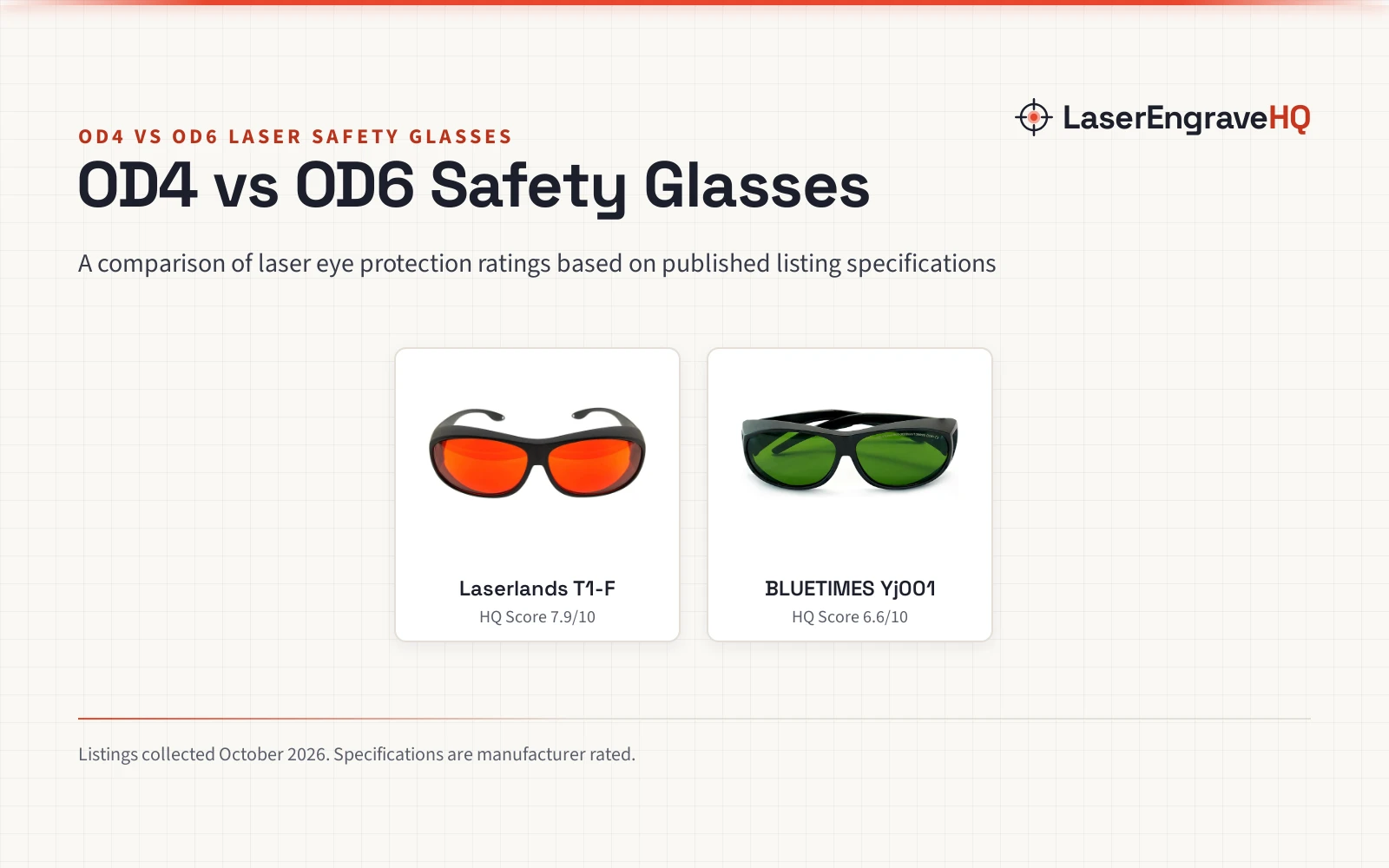
Verdict: choose OD4 laser safety glasses if you operate lower-power desktop laser engravers where an OD4 rating satisfies your machine’s optical safety requirements. Choose OD6 laser safety glasses if you run higher-power laser equipment where higher optical attenuation is required, provided the lenses explicitly match your machine’s emission wavelength. Between our featured OD6 listings, the Laserlands T1-F ranks highest with stated 180nm to 532nm coverage, 48% visible light transmission, and CE certification, while the BLUETIMES listing provides full-rim polycarbonate construction but leaves wavelength boundaries and visible light transmission unstated.
Machines on the list
Laser Safety Glasses 532nm OD6 180nm-532nm
OD6 laser safety goggles providing protection across 180nm to 532nm wavelengths with 48% visible light transmission and an included case.
Pros
- OD6 rating across 180nm to 532nm covering common 405nm, 445nm, and 450nm blue diode wavelengths
- Stated 48% visible light transmission helps keep the work area clear to see
- CE certified protection stated in the listing specifications
- Includes a protective storage case and states a 3 months warranty
Cons
- Protection ends at 532nm and does not cover infrared or CO2 wavelengths
- Listing shows contradictory colors, stating brown in one field and green in another
- The 3 months warranty is brief
- Listing notes makeup removal under recommended uses rather than laser engraving

Laser Safety Glasses, OD6+ Laser Glasses Eye
Full-rim polycarbonate laser safety glasses with an OD6+ rating and 99.9% ultraviolet light protection.
Pros
- OD6+ protection rating stated for high-power laser attenuation
- Full-rim polycarbonate frame and polycarbonate lens construction
- Stated 99.9% ultraviolet light protection with UV coating
- Lightweight build designed for indoor workshop use
Cons
- Listing does not state specific nanometer wavelength coverage
- Visible light transmission percentage is not stated
- No warranty term is stated
- Storage case is not stated as an included component
Other machines to compare
 LaserPair Laser Safety Glasses 200-460nm OD6+ & 800-1095nmCheck price on Amazon
 OD6 Laser Safety Glasses UV light Violet Blue for 405nmCheck price on Amazon
 Professional OD6+ CO2 Laser Safety GlassesCheck price on Amazon
 xTool Laser Safety GlassesCheck price on Amazon
 JILERWEAR Laser Safety Glasses OD 6+ for 180-540nm VioletCheck price on Amazon
 4 Pieces Laser Engraving Making Paper for Glass CeramicsCheck price on Amazon
Side by side
| Product | HQ Score | Optical Density | Wavelength | Visible Light Transmission | Warranty |
|---|---|---|---|---|---|
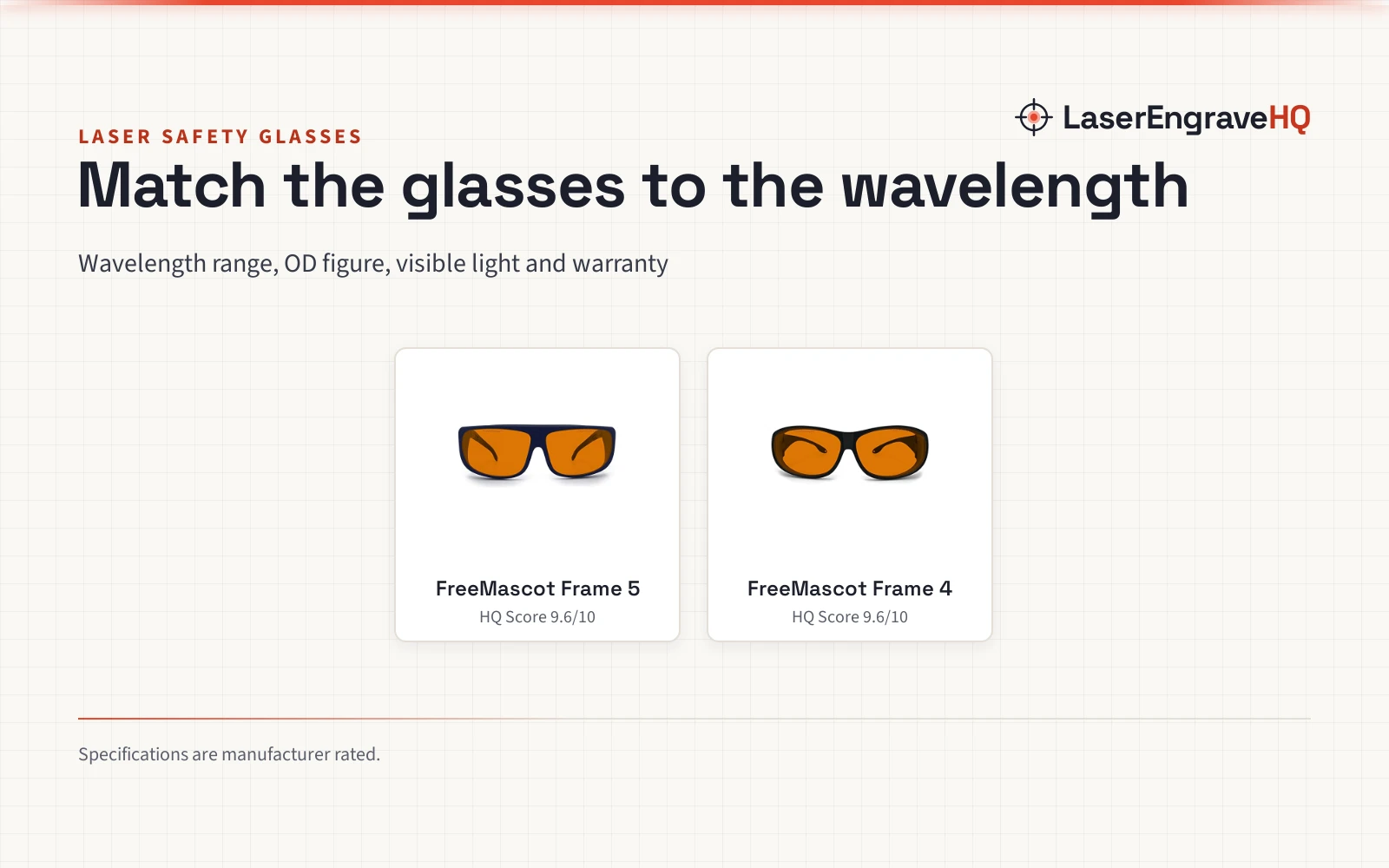
| Laserlands T1-F | 9.6/10 | OD6 | 180nm to 532nm | 48% | 3 months |
| BLUETIMES Yj001 | 9.4/10 | OD6+ | Not stated in the listing | Not stated in the listing | Not stated in the listing |
Specifications are manufacturer rated, as published on each listing and collected 14 October 2026.
OD4 vs OD6 Laser Safety Glasses: Optical Density Explained
Optical density, abbreviated as OD, measures a filter lens ability to attenuate laser radiation at a specific wavelength. Every whole unit increase on the optical density scale represents a tenfold increase in beam attenuation. An OD4 rating reduces transmitted beam energy by four orders of magnitude, which may suffice for lower-power lasers where diffuse reflection exposure is low. An OD6 rating reduces transmitted beam energy by six orders of magnitude, providing a higher safety margin necessary for higher-power laser modules and closer operating distances.
Wavelength Coverage and Laser Compatibility
Optical density ratings are meaningless without matching wavelength coverage. Protective eyewear only shields against wavelengths the filter material is chemically formulated to absorb or reflect. The Laserlands example specifies protection across 180nm to 532nm wavelengths, directly covering 405nm, 445nm, and 450nm blue diode lasers, as well as 473nm and 532nm beams. In contrast, the BLUETIMES listing highlights suitability for laser cutting, welding, cleaning, and marking, but does not publish specific nanometer wavelength limits in its listing details. Never assume a set of laser goggles protects against every beam source.
Visible Light Transmission and Visibility
Visible light transmission, or VLT, measures the percentage of ambient visible room light that passes through the protective filter to your eyes. VLT depends on the filter dye chemistry and which portion of the visible spectrum is blocked, rather than optical density alone. For filters blocking visible green or blue wavelengths, higher optical density can reduce ambient light, making workshop detail work harder to see. The Laserlands example states a 48% visible light transmission percentage, allowing operators to monitor cutting lines and workpiece placement. The BLUETIMES listing does not state a visible light transmission percentage, leaving optical clarity unstated in the product specifications.
Frame Design and Workshop Comfort
Eyewear must fit securely around the facial contours to prevent peripheral laser scatter from bypassing the lenses. The Laserlands example uses a full-rim plastic and polycarbonate frame with scratch-resistant coating, weighing 0.2 kg, packaged in dimensions of 7.13 x 3.78 x 3.35 inches, and includes a protective storage case. The BLUETIMES listing describes a lightweight full-rim polycarbonate frame with a universal fit, though an included protective case is not stated.
Safety Standards and Verification
Workshop eye safety demands reliable verification rather than unsubstantiated claims. The Laserlands listing explicitly lists CE certification for its OD6 protective goggles. The BLUETIMES listing states 99.9% ultraviolet light protection with a protective UV coating, but omits specific third-party safety certifications or standard markings. Always inspect protective glasses for permanent markings indicating the OD rating and wavelength coverage on the frame or lenses.
Support and Warranty Terms
Laserlands provides a stated 3 months warranty for its safety goggles. The BLUETIMES listing states no warranty duration in its product details, directing customers to click for external warranty information.
Choose the Laserlands T1-F if
- You operate a blue diode laser engraver between 180nm and 532nm.
- You want stated 48% visible light transmission to monitor cutting and engraving lines clearly.
- CE certification, an included storage case, and a stated 3 months warranty matter to your workshop setup.
Choose the BLUETIMES Yj001 if
- You want an all-polycarbonate full-rim frame for general workshop wear.
- You need lightweight protective eyewear with stated 99.9% ultraviolet light protection.
- Unstated nanometer wavelength boundaries and unstated visible light transmission percentages fit your workshop plan.
For more eyewear options, see best laser safety glasses for diode lasers.
Project Match
- Diode laser wood engraving and acrylic cutting (450nm): Laserlands T1-F, with stated protection from 180nm to 532nm and 48% visible light transmission; work area is not stated on either listing.
- Leather patch marking and electronics fabrication: Laserlands T1-F, backed by CE certification and stated electronics and manufacturing industry suitability; work area is not stated.
- Industrial laser welding and marking: BLUETIMES Yj001, which lists manufacturing, laser welding, and marking applications, though specific wavelength bounds and work area remain not stated.
Eyewear protects your eyes only when the optical density and rated wavelength match your specific laser source. Never look directly into a laser beam, even while wearing protective goggles. Always inspect frames for light leaks, keep a fire extinguisher nearby, ventilate exhaust fumes properly, and never cut vinyl or PVC materials. For detailed guidance on ratings and optical filters, consult our laser safety glasses guide.
FAQ: lasers and CNC
What is the difference between OD4 and OD6 laser safety glasses?
The difference lies in optical density, which measures how much beam energy a filter attenuates at a specific wavelength. An OD6 filter provides higher optical attenuation than an OD4 filter, blocking a substantially greater proportion of laser energy. While OD4 may suffice for lower-power laser systems, OD6 provides an expanded protection margin for higher-power lasers, provided the filter wavelength matches the laser beam.
Can OD4 safety glasses protect against blue diode lasers?
OD4 safety glasses can provide adequate protection against scattered light from lower-power blue diode lasers if the glasses are explicitly rated for 405nm to 450nm wavelengths. However, for higher-power diode modules, OD6 eyewear provides a safer margin against accidental reflections.
Does higher optical density always reduce visible light transmission?
Not necessarily. Visible light transmission depends on which wavelengths the filter blocks and the dye chemistry used. Eyewear filtering infrared lasers can maintain high visible light transmission even at high optical densities because the blocked energy lies outside the visible spectrum. For visible lasers such as blue or green diodes, higher optical density often requires darker filtering dyes that can reduce ambient visibility. The Laserlands example preserves a stated 48% visible light transmission percentage across its 180nm to 532nm range, keeping cutting lines visible.
Are OD6 safety glasses suitable for fiber lasers?
Only if the eyewear explicitly specifies protection across fiber laser emission wavelengths in the infrared spectrum. An OD6 rating across 180nm to 532nm protects only against violet, blue, and green beams, and will not protect against infrared fiber systems. Always verify that the nanometer coverage matches your laser source.
How do I verify the protection rating on my safety glasses?
Legitimate laser safety glasses have their optical density rating, wavelength range, and safety certification permanently stamped or engraved on the lenses or frame. Never rely on unverified tinted eyewear without clear markings.
Related: laser safety glasses guide, how to choose laser safety glasses, best laser safety glasses for diode lasers, and the laser safety category.