Router Bit Shank Sizes Explained
Router bit shank sizes decide which bits fit your router, and this guide explains the common sizes, how to match the collet, and the mistakes that cost makers the most time.

On this page
Top picks at a glance
As an Amazon Associate I earn from qualifying purchases.
- 1
 1/4 Inch Shank 90 Degree V Groove Router Bit Set9.4/10View on Amazon
- 2
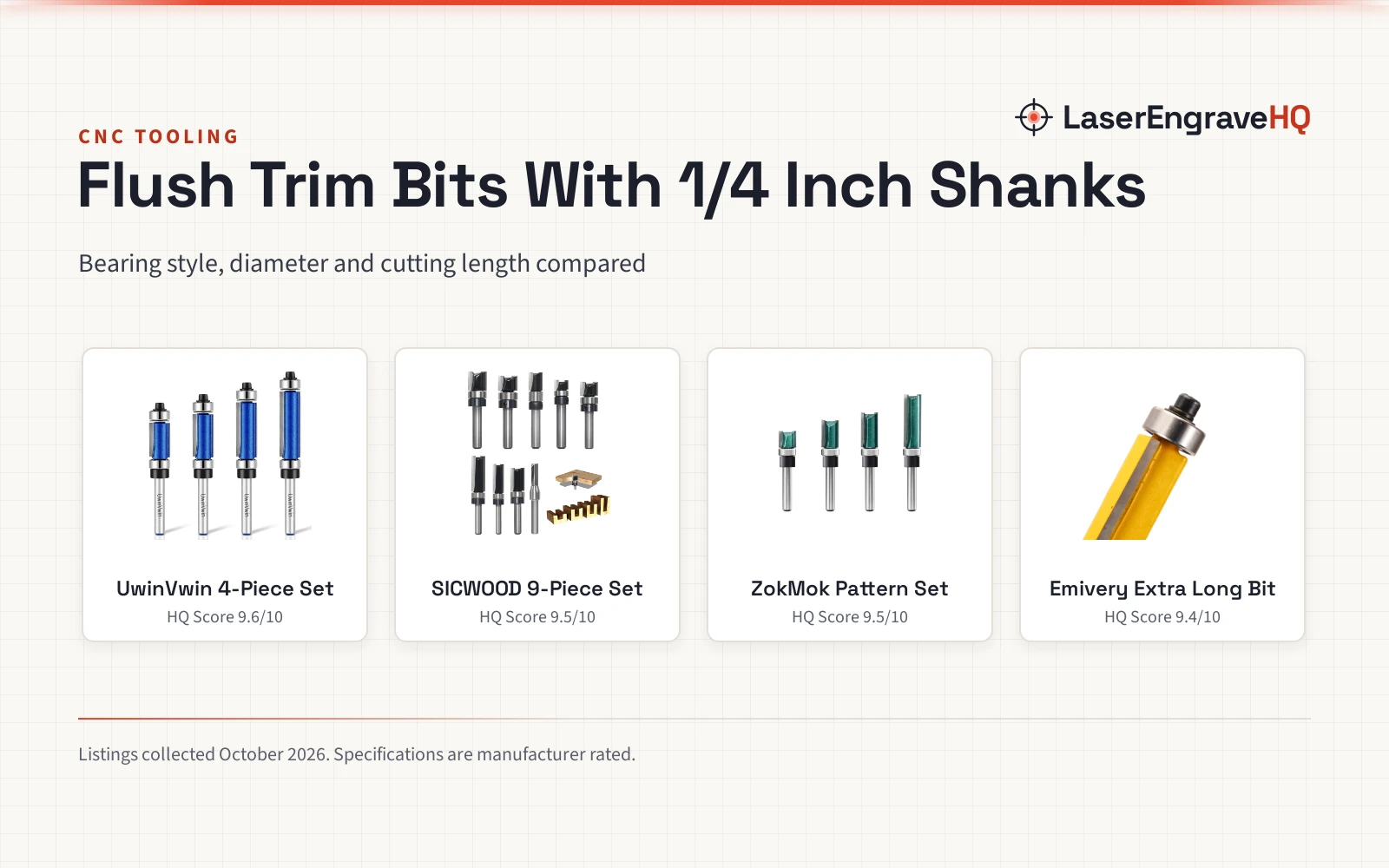
 Pattern Flush Trim Router Bits 1/4 Shank9.5/10View on Amazon
- 3
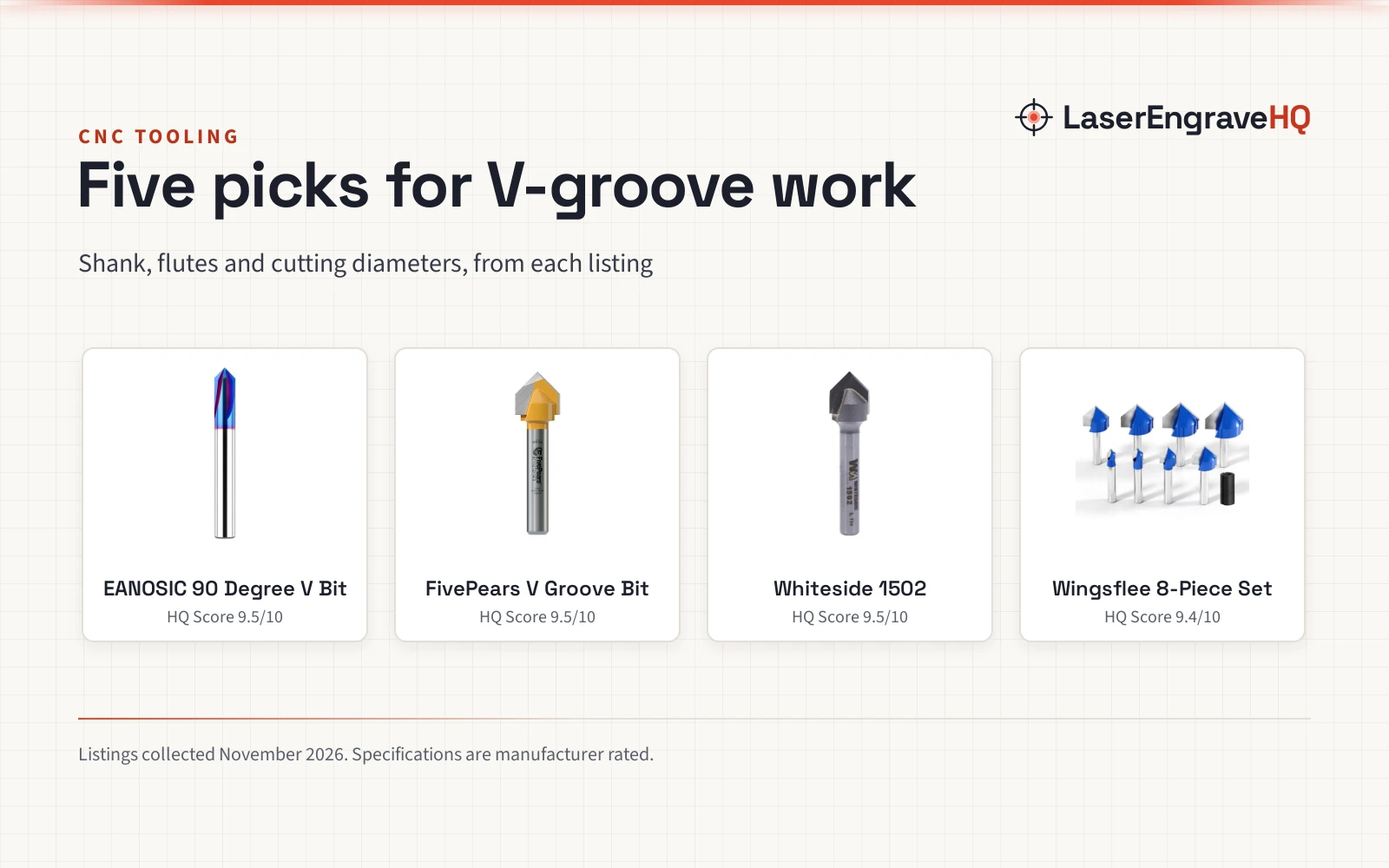
 EANOSIC 90 Degree V Bit 1/4" Shank9.5/10View on Amazon
Router bit shank sizes describe the diameter of the straight shaft that slides into the router collet, and that single measurement decides whether a bit fits the router at all. A bit with the wrong shank size cannot seat in the collet, no matter how well the cutter suits the job. This guide explains what the shank measurement means, which sizes show up in the sets makers actually buy, and how to match a bit to the collet before ordering.
LaserEngraveHQ earns a commission from purchases made through these links, at no extra cost to you. Read our affiliate disclosure.
Every router bit set behind this guide uses a 1/4-inch shank, including the SKIL, AKYPACH and CATITO sets cited below. The 1/2-inch size in this guide comes from general workshop practice for larger cutters, not from a listing here, so treat it as background and always confirm the shank size on the listing before ordering.
Router bit shank sizes: what the number measures
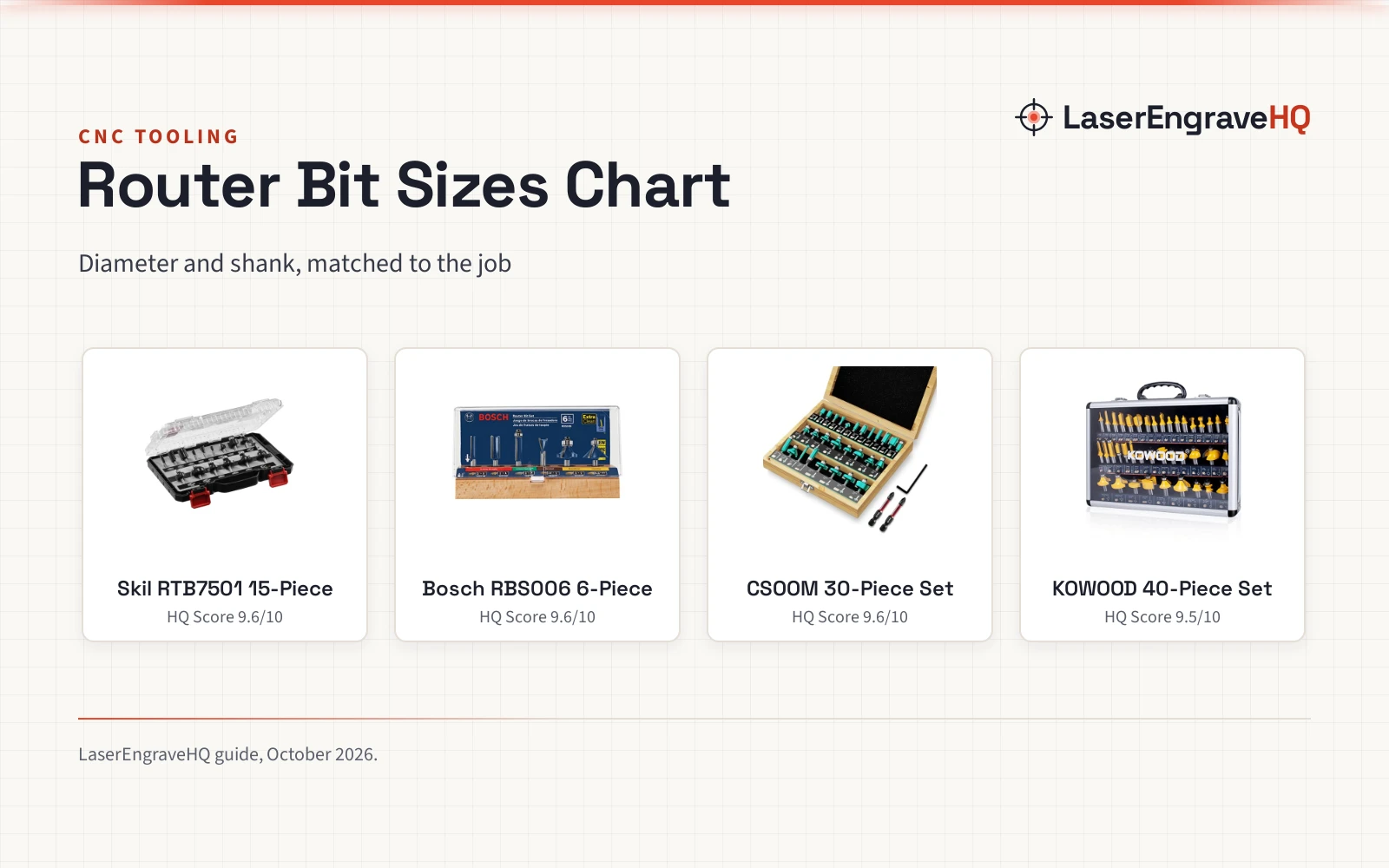
The shank is the smooth, straight part of the bit that the collet grips. The cutter is the shaped part that meets the wood. The SKIL 15-piece set lists both measurements, and the two figures answer different questions. A SKIL 15-piece set shows the split clearly: every bit in the set rides a 1/4-inch shank, while the cutters run from 1/4 inch to 3/4 inch across straight, cove, dovetail, roundover, V-groove, corebox, chamfer, rabbeting and Roman ogee profiles. Straight bits come in 1/4, 1/2 and 3/4 inch, cove bits in 1/4 and 1/2 inch, dovetail bits in 3/8 and 1/2 inch, roundover bits in 1/4, 1/2 and 3/8 inch, and the V-groove bit measures 5/8 inch. The set also lists a 45-degree chamfer bit, and all of it sits on that 1/4-inch shank.
Shank size stays fixed inside the sets behind this guide. The AKYPACH 15-piece (on Amazon) set and the CATITO 100-piece (on Amazon) set both list a 1/4-inch shank on every bit, and the SKIL 30-piece set states compatibility with routers that accept 1/4-inch shank bits. When a listing names a single shank size, that size covers the whole set. See the compression vs spiral router bit guide for how cutter shape changes the cut once the shank fits.
The 1/4-inch shank: the size in most starter sets
The 1/4-inch shank is the size that shows up in the starter sets behind this guide. SKIL pairs it with carbide-tipped cutting edges and fully heat-treated shanks and bodies in both its 15-piece and 30-piece sets, and the 15-piece set adds an interlocking case with a clear lid. AKYPACH builds its 15-piece set around a 1/4-inch shank with tungsten carbide cutters and a wooden index case, and CATITO offers a 100-piece set on the same 1/4-inch shank with YG8 tungsten carbide blades in an aluminum storage box.
A 1/4-inch shank suits compact routers and the small collets those machines carry. Makers of these sets describe the size as stable with less vibration during use, and the sets cover the profiles a new shop reaches for first: straight cuts, roundovers, coves, dovetails and chamfers. For a first set, the best router bit for beginners guide pairs shank size with cutter choice.
When a 1/2-inch shank fits better
A 1/2-inch shank gives the collet more surface to grip, and that extra grip suits larger cutters and heavier passes. The trade is fit: a 1/2-inch shank needs a 1/2-inch collet, and a router that only carries a 1/4-inch collet cannot take it. Check the collet sizes the router accepts before ordering a bit in this size, and keep the shank and the collet matched as a pair.
Speed also changes with cutter size, not with the shank alone. The router bit speed chart pairs cutter diameter with material, so use it alongside the shank size when planning a cut.
How to match a bit to your router collet
Matching takes a minute and saves a wasted order. Work through the checks in order:
- Read the collet size: find it on the router itself or in the router manual, and keep it in mind before shopping.
- Check the listing: confirm the shank size on the bit listing and buy only the size the collet accepts.
- Seat the bit: slide the shank into the collet so most of the shank sits inside the collet without pushing it all the way to the bottom, then tighten the collet nut firmly.
- Confirm the fit: a bit that rocks or slides in the collet is not seated right, so stop and recheck the collet size before switching the router on.
Common mistakes to avoid
- Ordering by cutter size alone. A 3/4-inch straight bit can still ride a 1/4-inch shank, as the SKIL 15-piece set shows, so read the shank figure apart from the cutter figure.
- Assuming one set means one shank. The sets here share a 1/4-inch shank, but always confirm the shank size on the listing for the set in the cart.
- Cutting metal with wood bits. AKYPACH and CATITO both warn against cutting ferrous metal, steel, iron and sand, and both sets suit wood, MDF, plywood and particle board instead.
- Skipping the collet check. A bit that never seats wastes the order and the afternoon, and a loose bit is a safety risk.
Router bit shank sizes: the short version
- The shank is the shaft the collet grips; the cutter is the shaped part that meets the wood.
- Starter sets here use a 1/4-inch shank, with cutters from 1/4 inch to 3/4 inch.
- A 1/2-inch shank suits larger cutters and needs a matching 1/2-inch collet.
- Match the shank to the collet before ordering, and read the shank figure apart from the cutter figure.
- Wood bits stay on wood, MDF, plywood and particle board, never on metal.
FAQ: lasers and CNC
What shank size do most router bits use?
Most starter sets use a 1/4-inch shank. The SKIL, AKYPACH and CATITO sets behind this guide all use a 1/4-inch shank, and a 1/2-inch shank shows up on larger bits for bigger cutters.
Can I use a 1/4-inch shank bit in a 1/2-inch collet?
No. The collet must match the shank size, so a 1/4-inch shank needs a 1/4-inch collet. Use the collet that matches the bit, or choose a bit that matches the collet on the router.
Does shank size change the cut?
The shank changes grip and stability, while the cutter shape changes the profile. A 1/4-inch shank suits the starter sets here, and makers describe it as stable with less vibration, while a 1/2-inch shank gives the collet more surface to grip on larger cutters.
What is the difference between shank size and cutter size?
Shank size is the diameter of the shaft that fits the collet, and cutter size is the width or shape of the cutting edge. In the SKIL 15-piece set, the shank stays 1/4 inch while cutters run from 1/4 inch to 3/4 inch, so those figures answer different questions.
How do I know which collet my router takes?
Read the collet size on the router or in its manual, and match the bit shank to that size. The SKIL sets state compatibility with routers that accept 1/4-inch shank bits, which is the wording to look for on any listing.
Related: the CNC tooling hub, router bit speed chart and best carbide tip router bit set. Also see the best router bit for beginners guide.