Coated vs Uncoated Carbide End Mills: Which One Should You Buy?
A guide to coated vs uncoated carbide end mills: what AlTiN, AlCrN and TiAlN coatings do, when bare carbide wins for aluminum, and how to choose by material and machine.

On this page
Top picks at a glance
As an Amazon Associate I earn from qualifying purchases.
- 1
 SPEED TIGER ISE Carbide End Mill 1/8”9.8/10View on Amazon
- 2
 SPEED TIGER EISE 1/8" Carbide Square End Mill9.8/10View on Amazon
- 3
 SpeTool 1/8 Inch Spiral Router Bits Up Down Compression Bit9.7/10View on Amazon
- 4
 1/8" 4-Flute Square End Mill AlTiN Coated CarbideView on Amazon
- 5
 1/8" 4-Flute Ball Nose End MillView on Amazon
- 6
 1/4" 4-Flute Square End Mill AlTiN Coated CarbideView on Amazon
- 7
 NZ 4 Flute 1/16" Square End Mill TiSiN-Coated Carbide forView on Amazon
- 8
 SpeTool 5PCS O Flute TAC Coated Spiral CNC Router Bit 1/4View on Amazon
- 9
 3/16 Compression Router BitView on Amazon
Coated vs uncoated carbide end mills comes down to heat and material. A coating like AlTiN, AlCrN or TiAlN adds heat resistance, oxidation resistance and longer edge life, which pays off in hard steels and long production runs. A bare, uncoated carbide edge stays sharper and runs cleaner in aluminum and other non-ferrous metals, where coatings can cause material to stick. Pick by the material you cut most, not by the coating’s marketing.
Other machines to compare
 1/8" 4-Flute Square End Mill AlTiN Coated CarbideCheck price on Amazon
 1/8" 4-Flute Ball Nose End MillCheck price on Amazon
 1/4" 4-Flute Square End Mill AlTiN Coated CarbideCheck price on Amazon
 NZ 4 Flute 1/16" Square End Mill TiSiN-Coated Carbide forCheck price on Amazon
 SpeTool 5PCS O Flute TAC Coated Spiral CNC Router Bit 1/4Check price on Amazon
 3/16 Compression Router BitCheck price on Amazon
LaserEngraveHQ earns a commission from purchases made through these links, at no extra cost to you. Read our affiliate disclosure.
What a coating does
A coating is a thin hard layer over the carbide that helps it handle heat and wear better than the bare edge alone. The listings describe the job in similar terms: one AlTiN listing says high aluminum content provides excellent hot hardness and oxidation resistance; another says AlTiN offers resistance to high-temperature oxidation and limits material adherence to the flute surface. An AlCrN listing claims high precision with an error within plus or minus 0.02 mm, and says the AlCrN coating provides stable, precise machining under high-temperature conditions. A TiN-coated ball nose set is described as improving heat resistance and reducing wear. None of these are magic; they are the makers’ stated reasons the edge lasts longer in hot, hard cuts.
When coated wins
Coated end mills earn their keep in steels. One AlTiN listing rates its 4-flute mills for carbon steels around HB225, alloy steels HB225 to 325, pre-hardened steels up to HRC45 and hardened steels HRC40 to 45, plus cast iron. An AlCrN listing names alloy steel HB 125 to 400, stainless steel HB 200 to 300 and cast iron HB 155 to 260. A TiAlN listing suits materials under HRC 50, naming steels, stainless steel, copper and copper alloys. A 1/8 in TiAlN example at HRC55 lists carbon steel, mould steel, inconel, stainless steel and titanium alloy for side milling, end milling and finish machining. If your work is mostly steel, stainless or hardened stock, the listings point to coated.
When uncoated wins
Bare carbide wins in aluminum and non-ferrous metals. The clearest example in the listings is a 3-flute, 45-degree helix uncoated end mill made for high velocity milling of aluminum and other non-ferrous materials, with the flute geometry tuned for harmonic balance at high speed and smooth cutting. The counterpoint comes from a coated listing itself: one AlTiN maker notes its mill can machine aluminum, but is not as effective on aluminum as on steel. An uncoated 8-piece metric set, 2 to 12 mm in 4-flute carbide, is listed for general metal processing and CNC work. For aluminum-heavy shops, uncoated is the listing-backed choice.
Coating types you will see
AlTiN shows up most: the listings credit it with hot hardness, oxidation resistance and longer tool life in harder materials and high-temperature work. AlCrN appears on a 2-flute 1/8 in example aimed at alloy steel, stainless and cast iron, with the high-temperature stability claim. TiAlN appears on several 1/4 in and 1/8 in examples for steels and stainless, with one listing noting broad chip grooves for evacuation. A ball nose set for steels credits its titanium-based coating with improved heat resistance and reduced wear. Treat each as the maker’s description of its own product, not as a universal ranking.
coated vs uncoated carbide end mills: how to choose
Start with material. Mostly steel, stainless or hardened stock: go coated, and match the coating’s stated range to your stock, like the HRC40 to 45 range on one AlTiN listing. Mostly aluminum or non-ferrous: go uncoated, like the 3-flute 45-degree helix example built for aluminum. Mixed work on a desktop CNC: a TiAlN 4-flute in 1/4 in is the generalist the listings describe, with one maker rating it for materials under HRC 50 across steels, stainless, copper and copper alloys.
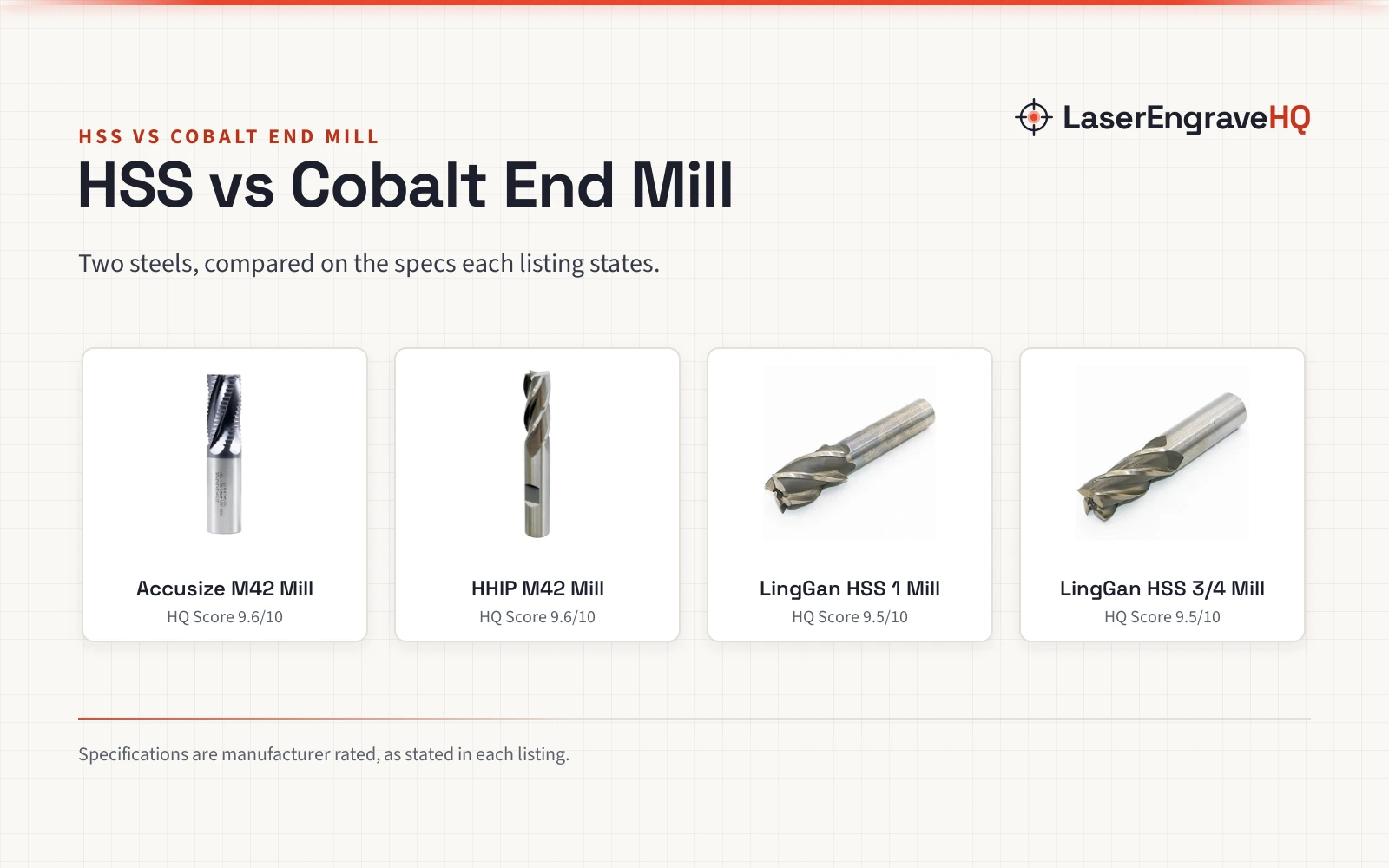
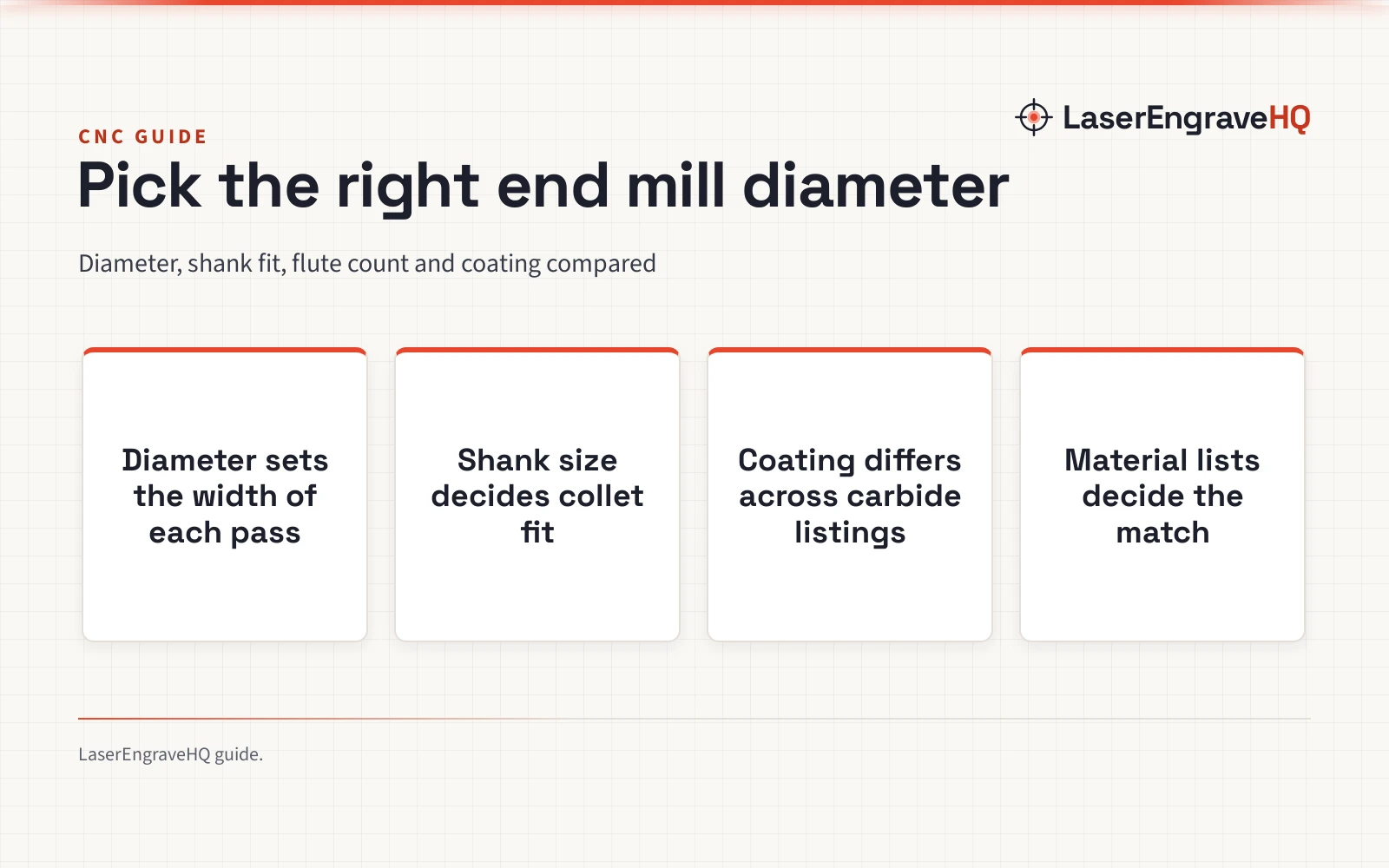
Then match the tool to the machine. Check shank diameter against your collet: the listings show 1/8 in and 1/4 in shanks most often, with a 5/16 in shank on the ball nose example and a 1/2 in cutting diameter on the uncoated aluminum example. Check cutting length and overall length against your depth of cut; examples run from 1/2 in of cut on a 1-1/2 in tool to 1-1/2 in of cut on a 4 in tool. Flute count matters too: 2-flute designs give more chip clearance, 4-flute designs give more rigidity for finishing. See our two flute vs four flute end mill guide for the trade-off, and carbide vs high speed steel end mill for why carbide beats HSS on heat.
Flutes, helix and edge prep
Flute count and helix shape the cut as much as the coating. A 2-flute design gives greater chip clearance space, per one AlTiN listing, which helps chip evacuation and prevents clogging. A 4-flute design brings rigidity: one metric set uses a large core diameter to enhance rigidity and keep cutting and chip removal stable, and its high-precision edge suits shallow slots, profile milling and finish machining. One AlCrN listing uses unequal edge spacing to reduce vibration for high-speed machining. Helix angles in the listings run 30 degrees on two AlTiN examples and 45 degrees on the uncoated aluminum example, where the steeper helix supports harmonic balance at high speed. Match flutes to the job: fewer flutes for chip-heavy roughing, more flutes for rigid finishing.
FAQ: lasers and CNC
Are coated end mills worth it?
For steels and long runs, the listings say yes: coatings add heat and oxidation resistance that extends edge life. For aluminum and short runs in soft material, an uncoated edge is often the better value.
Can I use a coated end mill on aluminum?
Yes, but one AlTiN listing notes its mill machines aluminum less effectively than steel. For aluminum-heavy work, the listings point to uncoated tools like the 3-flute 45-degree helix example built for non-ferrous milling.
What does AlTiN coating do?
Per the listings, it adds hot hardness and resistance to high-temperature oxidation, limits material sticking to the flutes, and extends tool life in harder materials. It is the most common coating in the listings here.
Do uncoated end mills work on steel?
Yes. An uncoated 8-piece metric carbide set is listed for metal processing and CNC work, and the uncoated set’s listing credits carbide with high hardness, wear resistance and stronger heat resistance than HSS. Coated simply lasts longer in the hardest steels.
Which coating is best for stainless steel?
The listings name AlCrN for stainless HB 200 to 300 and TiAlN examples for stainless among steels and titanium alloys. Match the coating’s stated hardness range to your stock rather than picking by name alone.
Related: best CNC router bits for hardwood, upcut vs downcut router bit, carbide vs HSS router bits and the CNC tooling hub.