Carbide vs High Speed Steel End Mill: Which One Should You Buy?
Four carbide and high speed steel end mills compared on hardness, heat resistance, tool rigidity, cutting edge wear, shank compatibility and workshop project match.

On this page
Top picks at a glance
As an Amazon Associate I earn from qualifying purchases.
- 1
 SPEED TIGER ISE Carbide End Mill 1/8”9.8/10View on Amazon
- 2
 End Mill 4-Flute CNC Milling Bit 3/4" Cutting Dia 3/4" Shank9.6/10View on Amazon
- 3
 End Mill Set 4-Flute CNC Milling Bit 3/16" Cutting Dia 1/4"9.5/10View on Amazon
- 4
 SPEED TIGER INTA Carbide Roughing End MillView on Amazon
- 5
 SPEED TIGER EISE 3/8" Carbide Square End MillView on Amazon
- 6
 SPEED TIGER EISE 1/16" Carbide Square End MillView on Amazon
- 7
 SPEED TIGER EISE 1/2" Carbide Square End MillView on Amazon
- 8
 SPEED TIGER EISE 3/16" Carbide Square End MillView on Amazon
- 9
 SPEED TIGER EISE 1/4" Carbide Square End MillView on Amazon
When you mill custom brackets, brass nameplates, or wood signs on a CNC router, choosing between a carbide vs high speed steel end mill dictates how fast you can cut and how long your edges survive. Carbide offers high hardness and heat resistance for production work, while high speed steel delivers fracture toughness and forgiveness on machines with moderate rigidity.
LaserEngraveHQ earns a commission from purchases made through these links, at no extra cost to you. Read our affiliate disclosure.
Verdict: choose carbide end mills if you run a rigid CNC machine, cut pre-hardened or alloy steels, and require high surface speeds with long edge life. Choose high speed steel end mills if you run a machine prone to vibration, need versatile multi-bit sets, or prioritize chip resistance over high-temperature durability.
Machines on the list
SPEED TIGER INTA Carbide Roughing End Mill
A 1/2-inch 4-flute micrograin tungsten carbide roughing end mill with dual ZrN and AlTiBN coatings for hardened steels.
Pros
- Micrograin tungsten carbide construction rated for hardened steels up to HRC45
- Dual ZrN and AlTiBN coatings provide heat resistance and thermal stability
- Stated precision tolerance with an error of -0.02mm and a 33-degree helix angle
- Roughing flute geometry with 1-inch cutting length for material removal
Cons
- Single 1/2-inch cutter rather than a multi-size tooling pack
- Carbide substrate is brittle and vulnerable to chipping under heavy vibration
- Spec table lists finish as ZrN while bullets state ZrN plus AlTiBN
- No warranty term is stated

joleully 1/2" Carbide Square End Mill
A 1/2-inch 4-flute solid micro grain carbide square end mill with AlTiN coating for profiling and slotting steels.
Pros
- Solid micro grain carbide build provides high hardness and wear resistance
- AlTiN coating provides hot hardness and oxidation resistance during cuts
- 4-flute square end geometry delivers rigidity for shallow slots and profiling
- Rated for pre-hardened steels and hardened steels up to HRC45 and cast iron
Cons
- Brand name contradicts between title (joleully) and spec table (Home of quality tools)
- Spec table lists item weight as 0.02 kg, which is an odd figure for a 1/2-inch solid carbide tool
- Single tool pack without alternative diameters for varied pocketing tasks
- No warranty term is stated

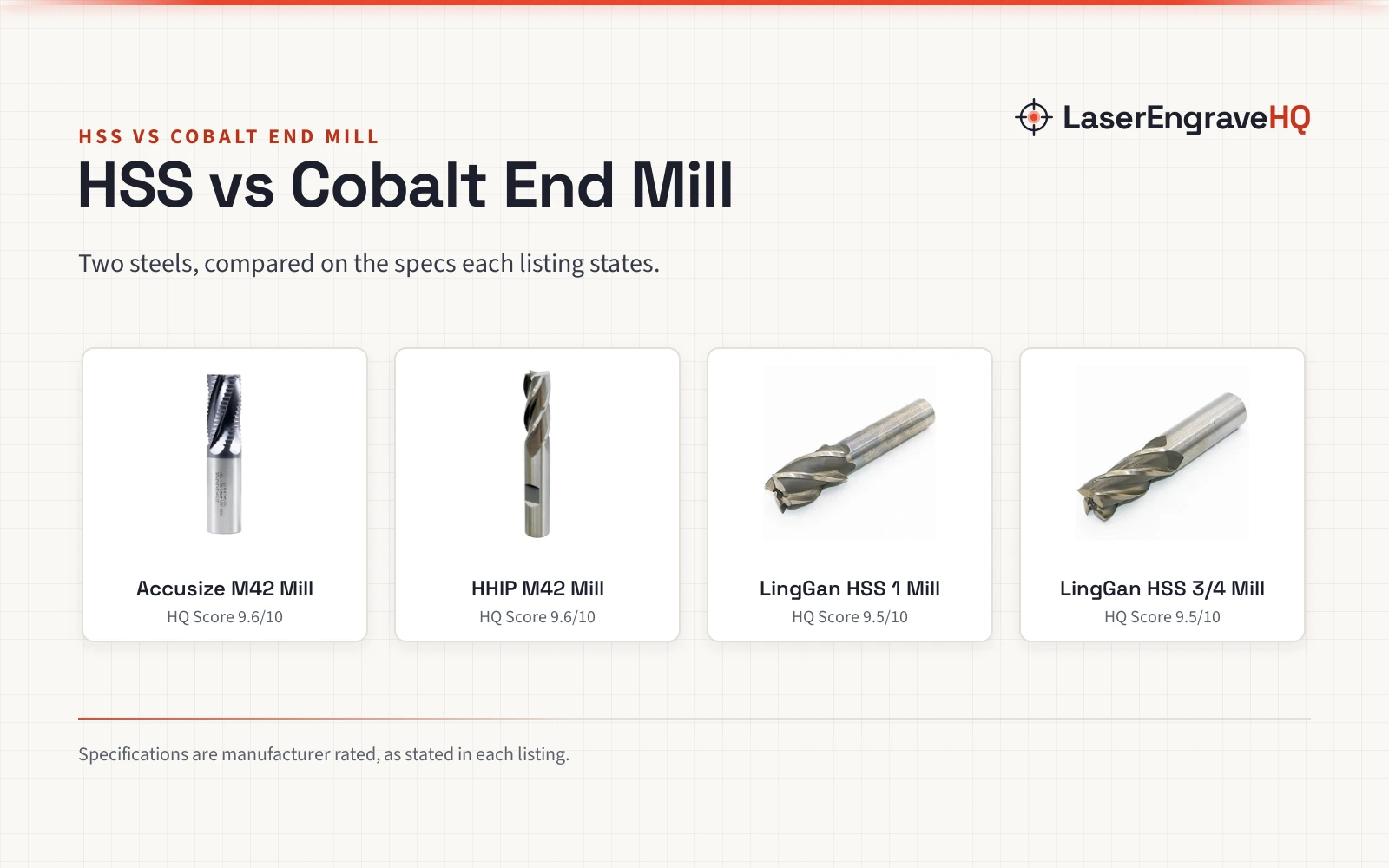
HHIP 8000-0002 4 Flute High Speed Steel End Mill
A 6-piece 4-flute high-speed steel end mill set with 3/8-inch Weldon shanks and an organized storage stand.
Pros
- 6-piece set includes 1/8, 3/16, 1/4, 5/16, 3/8, and 1/2-inch cutters
- High-speed steel toughness resists chipping on manual and lightweight CNC mills
- Center cutting design allows direct plunge cutting into workpieces
- Unified 3/8-inch Weldon shanks with flats seat firmly in standard set-screw holders
Cons
- HSS lacks the heat resistance and cutting speed capabilities of coated carbide
- Spec table lists material type as Blend rather than high-speed steel
- Spec table lists cutting diameter as 0.38 inches instead of the 6 distinct sizes
- No warranty term is stated

1" 4 Flute End Mill, High Speed Steel, 1/2" Shank
A large 1-inch diameter 4-flute high-speed steel end mill with a 1/2-inch shank for manual and home machine shop milling.
Pros
- Large 1-inch cutting diameter provides wide passes and facing coverage
- Center cutting 4-flute design enables direct plunging into workpieces
- High-speed steel toughness handles chatter and intermittent cuts without fracturing
- Direct US-based customer support from LittleMachineShop.com
Cons
- Unfinished high-speed steel lacks protective coating against high-temperature friction
- 1-inch cutter requires substantial spindle torque and rigid workholding
- Spec table lists dimensions as 3.63"L x 3.63"W, contradicting the 1-inch tool diameter
- No warranty term is stated
Other machines to compare
 SPEED TIGER INTA Carbide Roughing End MillCheck price on Amazon
 SPEED TIGER EISE 3/8" Carbide Square End MillCheck price on Amazon
 SPEED TIGER EISE 1/16" Carbide Square End MillCheck price on Amazon
 SPEED TIGER EISE 1/2" Carbide Square End MillCheck price on Amazon
 SPEED TIGER EISE 3/16" Carbide Square End MillCheck price on Amazon
 SPEED TIGER EISE 1/4" Carbide Square End MillCheck price on Amazon
Side by side
| Product | Side | Tool Material | Flutes | Stated Dimensions |
|---|---|---|---|---|
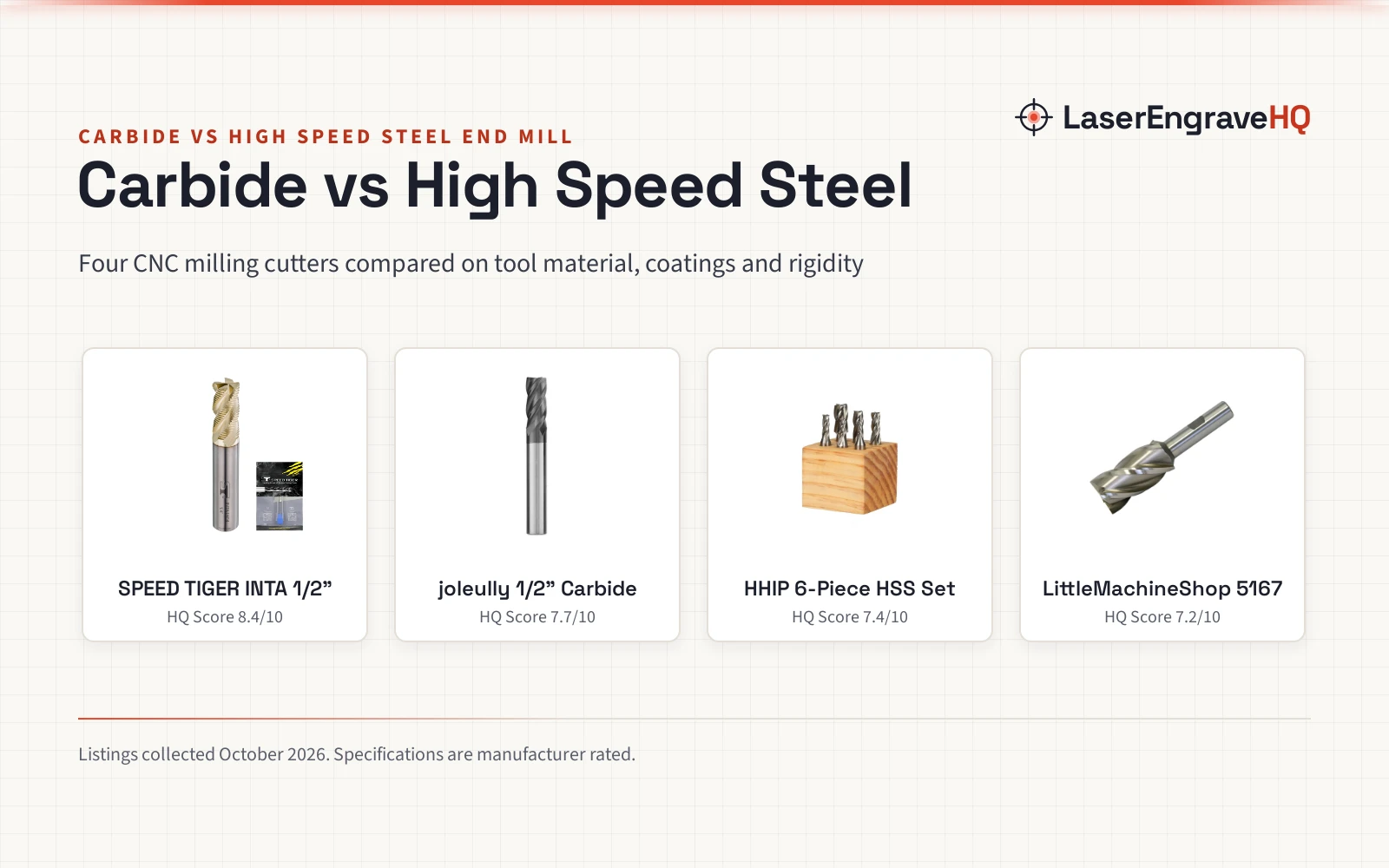
| SPEED TIGER INTA 1/2″ | Carbide | Micrograin tungsten carbide, ZrN + AlTiBN | 4 | 1/2″ diameter, 1″ cut length |
| joleully 1/2″ Carbide | Carbide | Micro grain carbide, AlTiN | 4 | 1/2″ diameter, 2.95″L x 0.5″W |
| HHIP 6-Piece HSS Set | High Speed Steel | High speed steel, brushed finish | 4 | 1/8″ to 1/2″ sizes, 3/8″ shank |
| LittleMachineShop 5167 | High Speed Steel | High speed steel, unfinished | 4 | 1″ diameter, 1/2″ shank |
Specifications are manufacturer rated, as published on each listing and collected 14 October 2026.
Carbide vs high speed steel end mill: key differences
The core division between carbide and high speed steel comes down to material science. Carbide end mills are crafted from sintered tungsten carbide particles held in a metallic binder, producing a tool material of exceptional hardness and compressive strength. High speed steel (HSS) is an alloy steel engineered to retain hardness at higher cutting speeds than plain carbon steel.
In workshop practice, this material difference defines how each cutter behaves under load. Carbide provides high wear resistance and maintains a sharp edge under continuous friction, but its rigidity makes it brittle. High speed steel possesses greater elasticity and fracture toughness, allowing it to withstand vibration, interrupted cuts, and machine deflection without edge chipping.
Hardness and heat resistance
Heat resistance separates carbide from high speed steel. As an end mill cuts metal, friction generates high temperatures at the shear zone. Carbide retains its cutting hardness at elevated temperatures, whereas high speed steel softens and loses its temper when subjected to excessive thermal buildup.
Coating selection further influences thermal limits. The SPEED TIGER carbide roughing cutter employs a dual Zirconium Nitride (ZrN) and Titanium aluminum boron nitride (AlTiBN) coating system designed to maintain stability at high temperatures, which the maker notes provides superior heat resistance compared to TiAlN, TiN, or TiCN coatings. The joleully carbide bit uses an Aluminum Titanium Nitride (AlTiN) coating with high aluminum content to resist oxidation and retain hot hardness. In contrast, the HHIP set features a brushed finish and the LittleMachineShop cutter has an unfinished surface, both lacking thermal barrier coatings and requiring conservative cutting speeds to avoid overheating.
Tool rigidity and fracture toughness
Rigidity determines whether a tool cuts clean profiles or flexes under radial force. Solid carbide has substantially higher rigidity than high speed steel, minimizing tool deflection during deep slotting or wall finishing. This stiffness helps maintain tight dimensional tolerances, as reflected in the SPEED TIGER listing specifying a 33-degree helix angle and a precision tolerance with an error of -0.02mm.
However, extreme stiffness also means lower impact resistance. If a machine flexes or vibrates, a carbide end mill cannot absorb the chatter and risks chipping along its cutting edges. High speed steel flexes slightly under shock loads before breaking, making it more forgiving on benchtop mills or manual machines with slight play in the ways. For machinists taking interrupted cuts or hand-feeding manual mills, HSS provides a forgiving margin of safety against tool breakage.
Cutting speeds and material compatibility
Because carbide withstands friction and heat, it runs at higher surface speeds than high speed steel, enabling higher spindle speeds and faster feed rates. Both carbide listings (SPEED TIGER and joleully) specify explicit workpiece compatibility: carbon steels (~HB225), alloy steels (HB225~325), pre-hardened steels (up to HRC45), hardened steels (HRC40~45), and cast iron.
In contrast, neither the HHIP set nor the LittleMachineShop HSS listing states specific workpiece material ratings or hardness limits. The HHIP listing describes its bits for general milling and plunge cutting, while the LittleMachineShop cutter is listed for general home shop machine work. When running high speed steel, conservative surface speeds are necessary to manage tool temperature. If you machine steel blocks regularly, see our guide on the best end mill for steel. For non-ferrous milling, explore our recommendations for the best end mill for aluminum.
Shank types and workholding
Proper workholding and tool clamping ensure concentric rotation without slippage. The SPEED TIGER roughing bit and joleully square bit both feature smooth round shanks (the joleully listing states a 0.5-inch width) designed for collets or chucks that deliver even radial clamping pressure.
The HHIP 6-piece HSS set features 3/8-inch Weldon shanks with flat surfaces across all six cutting sizes (1/8, 3/16, 1/4, 5/16, 3/8, and 1/2-inch). Weldon flats allow set screws in rigid holders to lock against the shank, preventing tool pullout under heavy axial cutting forces. The LittleMachineShop cutter pairs a 1-inch cutting diameter with a 1/2-inch shank, allowing machinists with 1/2-inch collets to run a wide tool without investing in larger tool holders.
Choose carbide end mills if
- You machine abrasive materials, cast iron, alloy steels, or pre-hardened steels up to HRC45.
- You run a rigid CNC machine with minimal backlash and vibration.
- You need high spindle speeds and feed rates to minimize cycle times in batch production.
- You want long edge life and maximum resistance to flank wear during extended cuts.
Choose high speed steel end mills if
- You operate a benchtop mill, manual mill, or lightweight CNC router with slight flex.
- You prioritize shatter resistance and toughness during interrupted cuts or rough manual feeds.
- You want a wide variety of cutter sizes in a single pack, like the HHIP 6-piece set.
- You perform general milling where high cutting temperatures are not generated and extreme hardness is not required.
For more tooling comparisons, see our guide on single flute vs two flute end mill selection, or explore upcut vs downcut end mill geometry.
Always secure workpieces firmly, wear eye protection when milling, verify spindle runout before engaging cuts, and avoid breathing airborne metal fines or coolant mists. See our CNC tooling guide for proper machine setup.
Project Match
- Pre-hardened and hardened steels up to HRC45: SPEED TIGER INTA 1/2″ (carbon steels, alloy steels, hardened steels up to HRC45, cast iron; work area not stated)
- Shallow slotting and profiling in carbon and alloy steels: joleully 1/2″ Carbide (carbon steels, alloy steels, hardened steels up to HRC45, cast iron; work area not stated)
- General milling across multiple diameters: HHIP 6-Piece HSS Set (plunge cutting and general milling; workpiece materials not stated; work area not stated)
- Manual and home shop machine milling: LittleMachineShop 5167 (general machine shop milling; workpiece materials not stated; work area not stated)
FAQ: lasers and CNC
What is the main difference between carbide and high speed steel end mills?
The primary difference lies in hardness and toughness. Carbide is significantly harder and retains its cutting edge at high temperatures, allowing higher surface speeds in hard metals. High speed steel is tougher and more shock resistant, making it less prone to chipping on machines with vibration or play.
Can high speed steel end mills cut hardened steel?
High speed steel is generally not suitable for hardened steels. The carbide listings in our comparison explicitly rate their tools for pre-hardened and hardened steels up to HRC45, whereas high speed steel loses its cutting edge rapidly when machining materials of that hardness.
Why do carbide end mills chip on lightweight CNC routers?
Carbide is brittle and sensitive to vibration, spindle runout, and frame flex. Lightweight hobby CNC routers often lack the structural rigidity required for carbide, causing the cutting flutes to chatter against the workpiece and chip.
Do high speed steel end mills require coatings?
High speed steel end mills do not require coatings for general milling, provided cutting speeds are kept moderate. While coatings like AlTiN or ZrN improve thermal resistance on carbide, uncoated HSS tools perform reliably when heat is controlled.
Which end mill material lasts longer?
In a rigid machine setup with appropriate feeds and speeds, carbide end mills last longer than high speed steel due to superior wear resistance. However, if machine chatter or severe deflection is present, carbide can chip prematurely, whereas high speed steel can survive the vibration.
Related: CNC bits explained for beginners, ball nose vs flat end mill, best end mill for aluminum, and CNC tooling.