CNC Mill vs CNC Router: Which One Should You Buy?
A clear comparison between a CNC mill and a CNC router: compare spindle speed, torque, work area, frame rigidity and material suitability to pick the right machine for your workshop.

On this page
Top picks at a glance
As an Amazon Associate I earn from qualifying purchases.
- 1
 SpeTool Carbide Single Flute CNC Router Bits 1/8" Cutting9.7/10View on Amazon
- 2
 SainSmart Genmitsu 3020-PRO Ultra CNC Router Machine9.7/10View on Amazon
- 3
 HQMaster 10 Pack O Flute CNC Router Bit 1/8” Shank Spiral9.6/10View on Amazon
- 4
 8PCS HSS 4-Flute End Mill Set CNC Milling Bits 1/16''-1/2''View on Amazon
- 5
 Genmitsu 40pcs End Mills CNC Router BitsView on Amazon
- 6
 SPEED TIGER ISE Carbide End Mill 1/8”View on Amazon
- 7
 SainSmart Genmitsu 10Pcs Nano Blue Coat End Mill CNC RouterView on Amazon
- 8
 SpeTool 5PCS O FluteView on Amazon
- 9
 SpeTool 5PCS O Flute Single Flute End Mill Set with 1/8 InchView on Amazon
When cutting parts, carving signs or machining brackets, choosing between a CNC mill vs CNC router comes down to cutting torque versus working envelope. A CNC router handles large sheet goods, wood, plastics and light aluminum plates using high spindle speeds and a wide bed. A CNC mill prioritizes frame rigidity, low-speed torque and tight tolerances to machine metals like steel and brass, as well as thick aluminum blocks, with minimal deflection. Below, we break down each difference step by step.
Other machines to compare
 8PCS HSS 4-Flute End Mill Set CNC Milling Bits 1/16''-1/2''Check price on Amazon
 Genmitsu 40pcs End Mills CNC Router BitsCheck price on Amazon
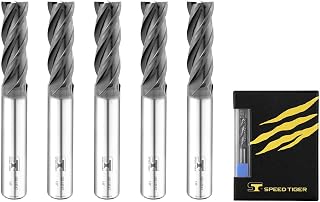 SPEED TIGER ISE Carbide End Mill 1/8”Check price on Amazon
 SainSmart Genmitsu 10Pcs Nano Blue Coat End Mill CNC RouterCheck price on Amazon
 SpeTool 5PCS O FluteCheck price on Amazon
 SpeTool 5PCS O Flute Single Flute End Mill Set with 1/8 InchCheck price on Amazon
LaserEngraveHQ earns a commission from purchases made through these links, at no extra cost to you. Read our affiliate disclosure.
Machining performance depends on mechanical stiffness, feed rates, chip evacuation and tooling geometry rather than motor wattage alone. We cite only published manufacturer specifications and explain mechanics without inventing numbers.
Step 1: Compare spindle speeds and cutting torque
CNC routers run at high rotational speeds to shear soft stock cleanly with small-diameter bits. The AnoleX listing states a speed range of 8000 to 24000 RPM across 6-speed settings on its 800W trim router with a 1/8″ collet. The Genmitsu 3020-PRO Ultra listing specifies 6500 to 30000 RPM on its 710W spindle, and the Genmitsu PROVerXL 6050 Plus listing states 12000 rpm on its 300W motor. Desktop models follow this pattern: the CNCTOPBAOS listing reports 10000rpm at 120W, while the Genmitsu Cubiko listing states 9000 rpm on a 96 watts motor.
A dedicated CNC mill uses geared or belt-reduction drives to deliver high torque at lower RPM. Ferrous metals like steel require heavy cutting force at lower speeds to prevent burning tool edges. Read our guide on spindle vs router for CNC mechanics for more details.
Step 2: Evaluate work area and travel clearance
CNC routers provide expansive horizontal beds with modest vertical travel to process wide sheet stock. The FoxAlien XE-Ultra 8080 listing specifies a workspace of 33″x33″x4.72″ (33x33x4.72in) alongside a 5.3″ pass height. The Genmitsu PROVerXL 6050 Plus listing states 600 x 500 x 115mm (23.62″ x 19.69″ x 4.53″), while the Genmitsu PROVerXL 4030 V2 listing provides 400 x 300 x 110mm. On desktop units, the Genmitsu PROVerXL 4030S listing features a 130mm pass height, while the CNCTOPBAOS listing specifies 300x180x45mm (11.8 x 7.1 x 1.8 inches).
A CNC mill offers a compact, cubic envelope with generous Z-axis clearance for machine vises, rotary indexers and thick metal billets. See our comparison of desktop CNC vs benchtop mill options for size trade-offs.
Step 3: Assess frame rigidity and structural mass
Frame rigidity dictates what materials a machine can cut without chatter. Desktop CNC routers use aluminum extrusions or molded resin to keep gantries lightweight for rapid positioning: the CNCTOPBAOS listing reports a resin and aluminum build at 15.31 pounds, the Genmitsu 3018-PROVer V2 listing states 9.24 kg, the Genmitsu 3030-PROVer Ultra listing states 23 kg, the AnoleX 4030-Evo Ultra 2 lists 38 kg, and the FoxAlien XE-Ultra 8080 lists 40 kg with a 46×80mm aluminum frame.
A dedicated CNC mill uses solid cast iron columns and heavy bases to absorb cutting forces completely. For carving wood and plastic, an aluminum gantry delivers swift motion, as explained in how to choose a desktop CNC router. For rigid metal blocks, heavy frame mass is essential.
Step 4: Match drive mechanisms and linear motion guides
Motion hardware controls cutting precision and rigidity across the X, Y, and Z axes. The AnoleX 4030-Evo Ultra 2 listing specifies HGH-15 dual linear rails and 1204 ball screws on each axis, citing ±0.005mm repeatability and ±0.02mm cutting accuracy in 6061 aluminum. The Genmitsu 3030-PROVer Ultra listing incorporates HG15 dual linear rails with 1204 ball screws for ±0.03mm precision, while the Genmitsu PROVerXL 4030S listing states ±0.05 mm accuracy. Larger machines use heavier parts: the FoxAlien XE-Ultra 8080 listing features 16mm ball screws on XY axes, 12mm ball screws on Z, and HG-15 linear rails, capable of travel speeds up to 5000 mm/min. In comparison, the Genmitsu PROVerXL 6050 Plus listing pairs dual linear rails with a T10 lead screw on its single Y-axis.
Stepper motor torque on axis drives also varies: the CNCTOPBAOS listing specifies Nema17 motors with 0.3N.m torque, the FoxAlien XE-Ultra 8080 listing features closed-loop motors delivering 2.6Nm torque, and the Genmitsu 3020-PRO Ultra listing states stepper motors delivering 7.3 Nm of torque on its XYZ axes. Dedicated mills use heavy ground ball screws and hardened box ways. Compare these systems in our guides on ball screw vs lead screw CNC drives and linear rails vs V wheels CNC carriages.
Step 5: Check material suitability from wood to steel
A CNC router cuts hardwoods, plywood, MDF, acrylic and carbon fiber with speed. Capable desktop routers also machine soft metals like aluminum and brass: the Genmitsu 3020-PRO Ultra listing states single-pass cutting in aluminum up to 1.5mm, while the AnoleX listing documents cutting accuracy within ±0.02mm on 6061 aluminum. For clean results, browse our recommendations for the best CNC router bits for hardwood and the best end mill for aluminum.
When cutting ferrous metals like carbon steel, stainless steel or cast iron, a CNC mill is the appropriate machine. Mills use rigid toolholders, flood coolant and low-RPM torque to clear chips without chatter. Our guide on the best end mill for steel details suitable cutters. Learn how to calculate feed rates in CNC feeds and speeds for beginners.
Step 6: Plan workholding and chip management
CNC routers feature open beds with T-slots or spoilboards: the Genmitsu PROVerXL 4030 V2 listing includes a T-slot hybrid table, and the Genmitsu PROVerXL 6050 Plus listing utilizes aluminum T-track extrusions supporting MDF spoilboards. Enclosed models like the Genmitsu Cubiko listing feature an integrated enclosure to contain airborne dust, while open frames rely on options in our guide on the best dust collector for desktop CNC units. Review hold-down techniques in clamping ideas on a CNC router.
On a CNC mill, workholding relies on precision machine vises bolted to a ground table. Mills use flood coolant or mist lubrication to clear heavy metal chips and cool the cutter. Router controllers can also automate coolant; the AnoleX listing highlights firmware compatibility with M07/M08 coolant control.
Step 7: Calculate workshop space and power requirements
Desktop CNC routers suit residential workshops. The CNCTOPBAOS listing operates on a 120W spindle motor drawing 1.33A on its stepper motors, while the Genmitsu Cubiko listing specifies 96 watts drawing 5 A. The Genmitsu PROVerXL 4030S listing draws 7 A on 110 volts, and the Genmitsu PROVerXL 6050 Plus listing specifies 230 volts.
Industrial CNC mills require reinforced concrete flooring and multi-phase electrical service for heavy spindles and hydraulic pumps. If space is limited, desktop routers offer an accessible entry point. Compare popular models in our guides to the best desktop CNC for beginners, the best CNC router for sign making, and the best CNC router for small business.
Common mistakes to avoid
- Expecting a lightweight CNC router to machine steel parts with the speed and depth of a rigid mill.
- Choosing a heavy benchtop mill for carving wooden signs, only to be limited by restricted travel.
- Running small engraving bits on a slow milling spindle that lacks surface speed.
- Neglecting dust extraction on a CNC router, allowing debris to foul linear bearings.
- Overlooking workholding, causing stock slippage and broken tools.
- Failing to check workshop electrical capacities before purchasing equipment.
CNC mill vs CNC router: the short version
- Identify materials: routers suit timber, plastics and aluminum plate; mills handle steel, iron and dense metal blocks.
- Measure workpiece size: large sheets need a router bed; thick billets need a mill.
- Match spindle speeds: routers provide high RPM for soft stock; mills provide low-speed torque for heavy chip loads.
- Evaluate rigidity: ensure the frame prevents chatter under your target cutting forces.
- Select workholding: spoilboards suit flat sheet routing; machine vises suit metal milling.
- Confirm workshop space: match floor footprint and electrical service to machine requirements.
Matching your primary materials and project dimensions to the mechanical strengths of each machine ensures a productive workshop workflow.
FAQ: lasers and CNC
Can a CNC router cut aluminum as well as a CNC mill?
A CNC router cuts aluminum plate and brackets effectively using single-flute carbide end mills and shallow passes. The Genmitsu 3020-PRO Ultra listing states single-pass cutting in aluminum up to 1.5mm, and the AnoleX listing states cutting accuracy within ±0.02mm on 6061 aluminum. However, a CNC mill machines aluminum faster with deeper axial cuts and higher rigidity.
Why do CNC routers run at higher RPM than CNC mills?
CNC routers cut softer materials like hardwood and acrylic with small-diameter bits that need high surface speed for clean cutting. CNC mills cut dense ferrous metals that produce extreme friction, requiring lower RPM to prevent destroying cutter edges.
Can a CNC mill cut wood and plastic?
Yes, but milling beds are typically too small for sheet goods, and milling spindles often lack the high RPM needed for clean finishes on timber and acrylic. Wood dust can also contaminate a mill’s fluid coolant lines.
Which machine is more accurate: a CNC mill or a CNC router?
A CNC mill is generally more accurate due to its structural mass, cast iron frame and ground guideways. Desktop routers achieve tight tolerances for hobby parts: the AnoleX listing states ±0.005mm repeatability and the Genmitsu 3030-PRO Ultra listing states ±0.03mm precision.
What type of software is used for CNC mills and CNC routers?
Both machines use CAD to model parts and CAM to generate standard G-code toolpaths. Desktop routers run on GRBL control boards, while industrial mills utilize dedicated control consoles.
Can a beginner start with a desktop CNC router?
Yes. Desktop CNC routers assemble quickly, connect to household power and allow makers to learn CAD and CAM workflows safely before advancing to complex metal machining.
Related: the CNC router hub, best desktop CNC for beginners and best CNC router for small business. Also see our how to choose a desktop CNC router. Also see our CNC feeds and speeds for beginners.